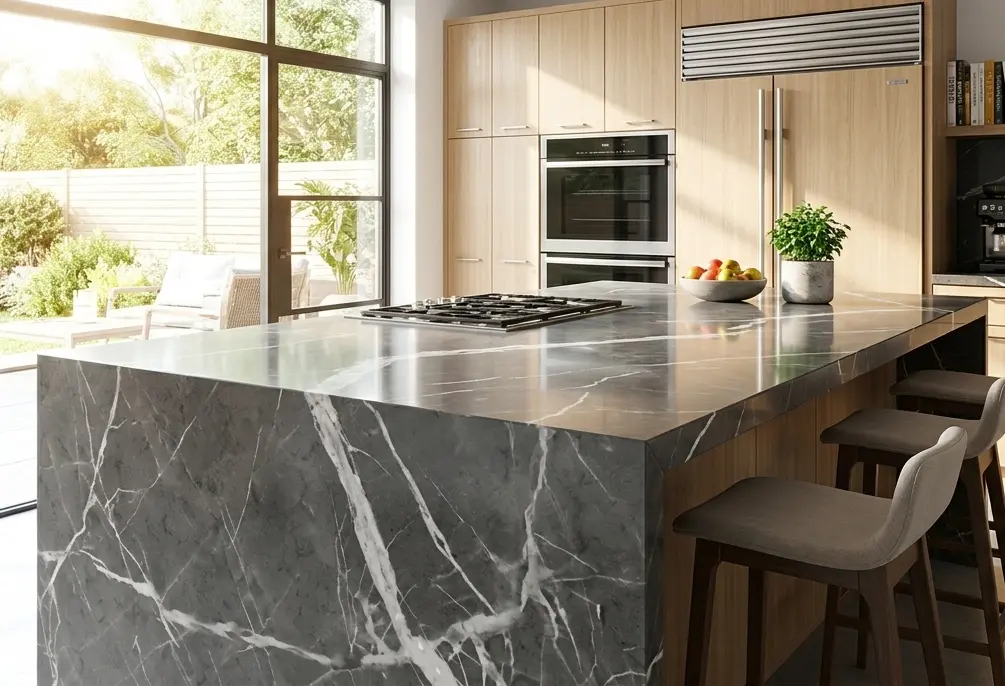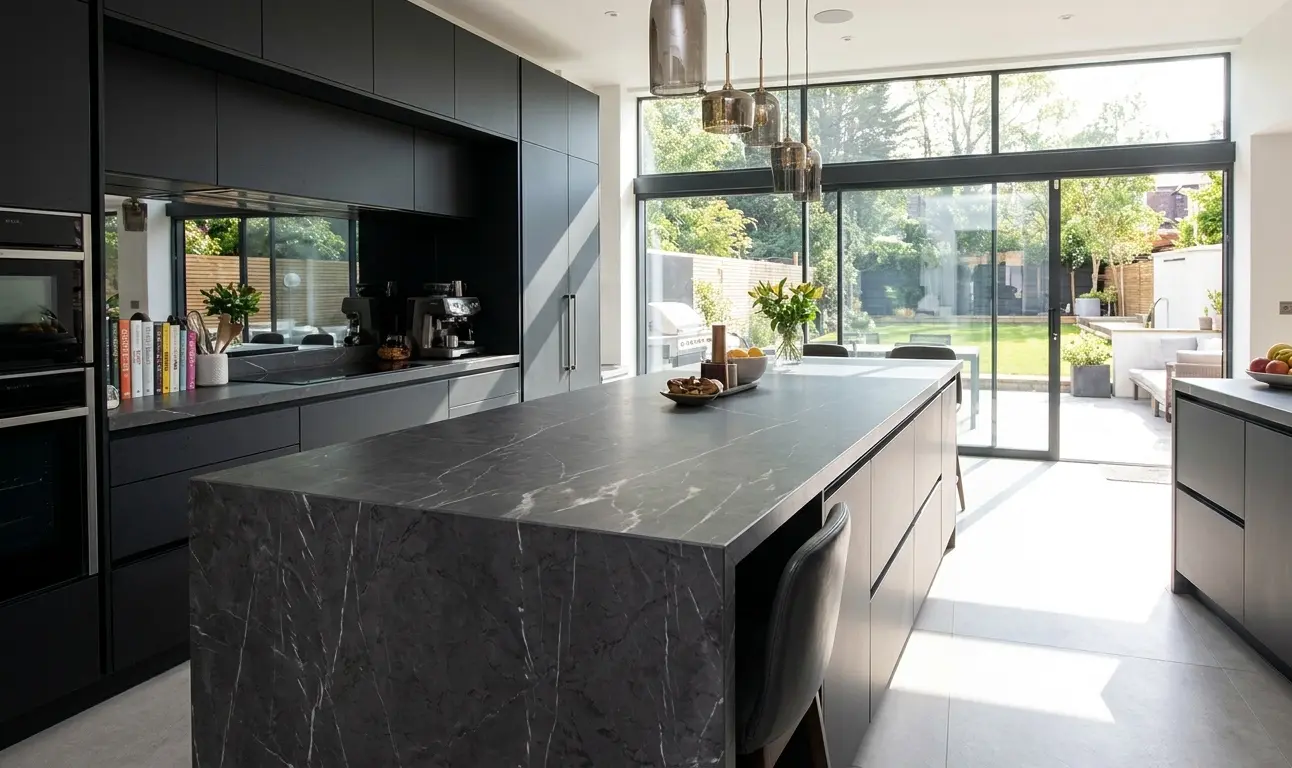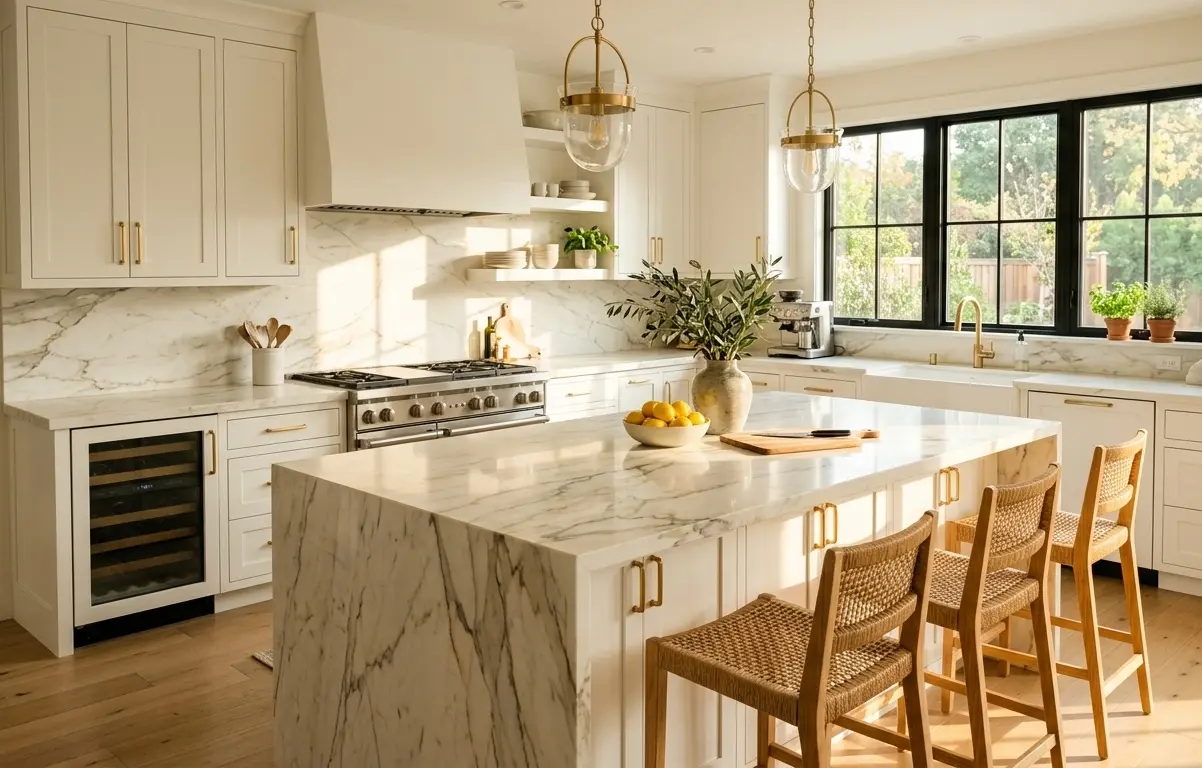
Why Marble Defines the Waterfall Kitchen Island Look
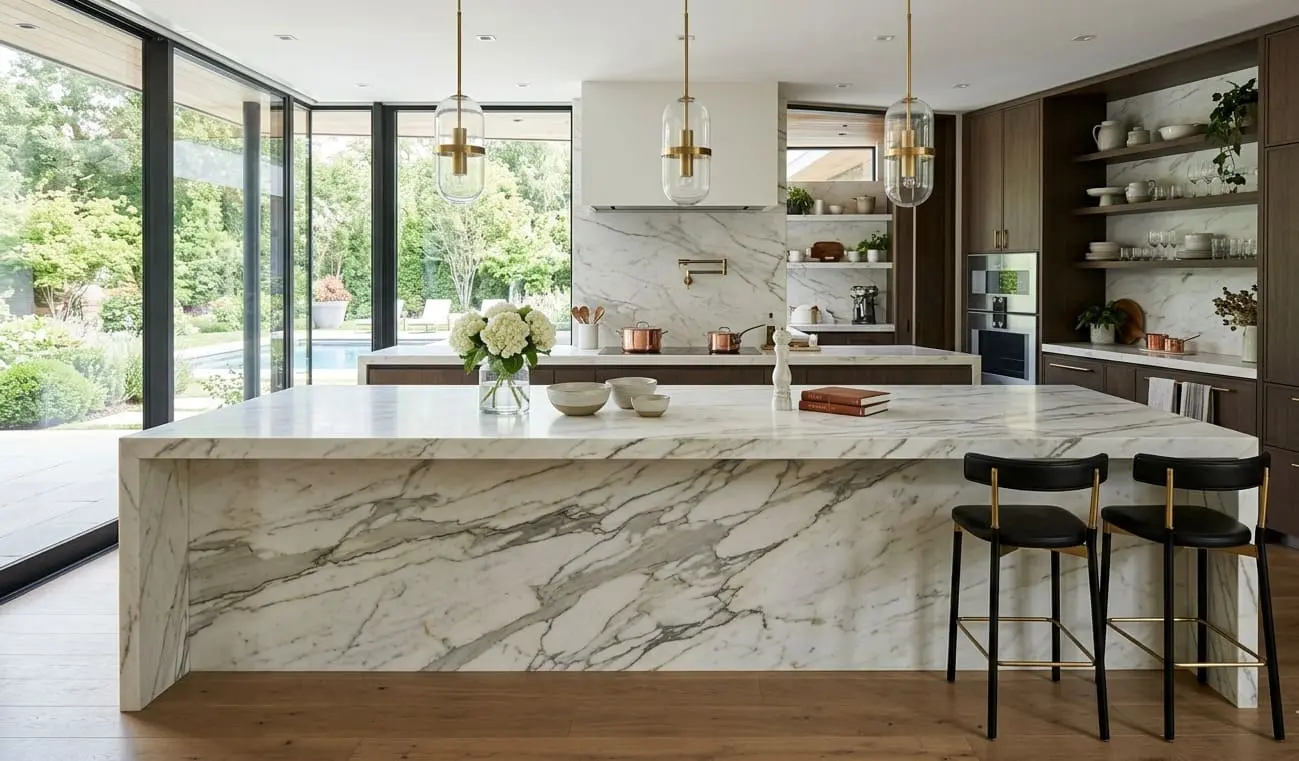
A waterfall marble kitchen island carries the stone surface from the countertop plane continuously over the island edge, cascading vertically along both sides in an unbroken flow of material. Calacatta marble, sourced from the Apuan Alps near Carrara in Tuscany, Italy, is the most recognized choice for this format: its bright white ground and bold diagonal veining in gold and warm grey perform beautifully across both the horizontal top and the vertical panels. Nova Tiles and Stone maintains full-slab inventory across four showroom locations, supporting the grain-matching demands of true waterfall applications.
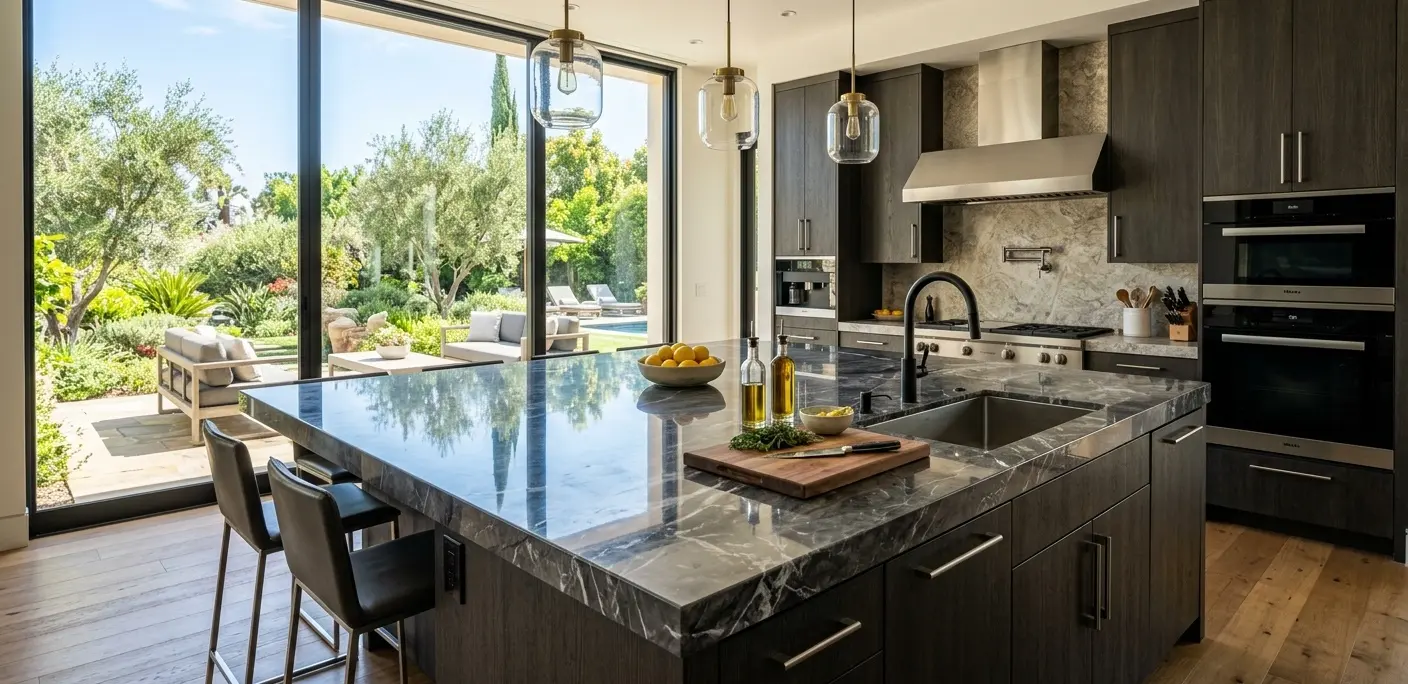 Conceptual rendering
Classic Elegance and Real Performance in a Waterfall Marble Kitchen Island
Calacatta marble originates in the Apuan Alps near Carrara, Tuscany, a region that has supplied premium marble to architectural projects since Roman antiquity. The stone's characteristic bright white matrix develops alongside bold diagonal veining in shades of warm gold and deep grey, formed through millions of years of heat and pressure on dense limestone deposits. That combination of contrast and natural drama is precisely what makes Calacatta the preferred material for a waterfall marble kitchen island, where the vein pattern must hold visual coherence from the countertop face to the vertical drop panels.
Polished Calacatta offers the highest surface reflectivity, intensifying veining depth and making the waterfall transition more visually striking. Honed marble delivers a softer, non-reflective surface and better conceals minor surface wear during daily kitchen use. Leathered finishes add light texture and are available on select marble varieties.
Browse marble slab inventory to compare veining intensity and finish options before committing to a slab selection.
Design Options for Every Waterfall Marble Kitchen Island Layout
The waterfall format offers two primary configurations. A double-side waterfall wraps the island on both ends, creating a fully enclosed stone base that reads as a unified sculptural element. A single-side waterfall is common in peninsula layouts or open-plan kitchens where only one end remains visible as the primary design focal point.
Achieving a seamless waterfall transition depends on veining direction and slab batch consistency. Selecting slabs from the same quarry bundle ensures color and vein density remain consistent between the horizontal top and the vertical panels. Bookmatched slabs, cut from the same block and opened to mirror each other, deliver the most geometrically precise transition and are particularly effective with Calacatta's bold diagonal veining. Nova's commission-free design team provides honest guidance on slab pairing for waterfall specifications without any sales pressure.
For a complementary natural stone accent in the same kitchen space, a marble kitchen island slab in a coordinating finish reinforces visual continuity throughout the room.
Functional Advantages Worth Considering Before You Choose
 Conceptual rendering
Marble's strengths and limitations both matter when selecting a stone surface for a kitchen island.
- Heat tolerance. Marble withstands ambient kitchen temperatures without degrading; trivets are still recommended for direct cookware contact to prevent localized thermal stress.
- Finish choices. Polished marble displays the deepest veining and highest reflectivity; honed marble resists surface abrasion more evenly and better conceals minor etch marks over time.
- Cutting boards required. Marble scores 3–4 on the Mohs scale, making it susceptible to scratches from hard utensils in daily kitchen use.
- Acid sensitivity. Lemon juice, vinegar, wine, and carbonated beverages can etch a polished or honed surface if left unwiped promptly.
- Periodic sealing. Resealing every one to two years maintains stain resistance and keeps the surface performing well on an active island.
- Indoor specification. Marble performs best in interior applications; prolonged UV exposure affects both finish quality and color stability.
The countertop edge profiles guide provides a comprehensive overview of slab sizing standards, edge treatments, and configuration requirements, offering in‑depth direction for achieving precise waterfall applications. It explains how thickness, alignment, and grain continuity influence both structural stability and visual impact, ensuring designers and homeowners can select and install slabs that meet performance benchmarks while delivering a seamless aesthetic.
Investment-Grade Stone Built for Lasting Visual Impact
Marble's standing in high-end residential design has remained stable for centuries because its visual quality is rooted in natural variation that cannot be replicated by specification alone. Every Calacatta slab carries a unique vein structure, which means the waterfall marble kitchen island produced from one slab batch has no exact duplicate. Engineered surfaces increasingly reference marble aesthetics, but they cannot fully reproduce the depth, movement, and character of natural stone viewed across a large-format slab.
ASTM C503 establishes the classification and physical requirements for marble dimension stone used in architectural and decorative applications, including countertops and island surfaces. ASTM C97 defines the test methods for measuring absorption rate and bulk specific gravity, both of which inform how a marble slab performs under regular kitchen conditions. Slabs meeting these benchmarks, when sealed and maintained properly, hold their function and character through the life of the kitchen. Professional specification standards maintained by Tile Contractors Association of America (TCAA) guidelines complement these testing criteria as a recognized reference for natural stone specification quality.
To align slab inventory with a planned waterfall design, request a slab quote for current sizing and availability.
How Calacatta Marble Compares to Other Kitchen Island Materials
The table below compares Calacatta marble against granite, quartzite, quartz, and porcelain across the performance and maintenance criteria most relevant to a waterfall kitchen island.
Property |
Calacatta Marble
| Quartzite |
Granite
| Quartz | Porcelain |
Material Type | Natural Stone | Natural Stone | Natural Stone | Engineered | Engineered |
Mohs Hardness | 3–4 | 6–7 | 6–7 | 7 | 6–7 |
Water Absorption | 0.1–0.2% (ASTM C97) | 0.1–0.4% (ASTM C97) | <0.4% (ASTM C615) | Non-porous | Non-porous (ISO 10545-3) |
| Sealing Required | Yes - every 1-2 years | Yes - every 1-3 years | Yes - every 2-3 years | No | No |
Available Finishes | Polished, Honed, Leathered | Polished, Honed, Leathered | Polished, Honed, Leathered, Flamed | Polished, Honed | Polished, Honed |
Acid Sensitivity | High | Moderate | Low | Low | None |
Heat Tolerance | Good (trivets advised) | Excellent | Excellent | Poor - resin damage risk | Excellent |
UV Stability / Outdoor Use |
Indoor only | Indoor / Outdoor | Indoor / Outdoor | Indoor | Indoor / Outdoor |
Waterfall Slab Format | Yes - grain-matched pairs | Yes - grain-matched pairs | Yes | Yes - limited vein continuity | Yes -large-format slabs |
Visual Character | Bold diagonal veining - unique per slab | Linear movement - unique per slab | Speckled crystalline -unique per slab | Consistent -replicated pattern | Consistent -replicated pattern |
Water absorption per ASTM C97 (marble, quartzite) · ASTM C615 (granite) · ISO 10545-3 (porcelain). Mohs hardness per standard mineralogical scale. Marble classified to ASTM C503; quartzite to ASTM C616; granite to ASTM C615. Acid sensitivity reflects response to common kitchen acids (lemon juice, vinegar, wine) at pH < 4. Quartz engineered stone carries no ASTM dimension stone classification.
Frequently Asked Questions
Polished marble maximizes veining visibility and creates a reflective surface that emphasizes the waterfall's sculptural effect. Honed marble offers a lower-sheen alternative with slightly better resistance to showing minor etch marks in daily use.
Marble rates 3–4 on the Mohs scale, which makes it softer than quartzite or granite. With routine sealing, daily use of cutting boards, and prompt spill cleanup, marble performs well as an island surface for decades.
Bold, diagonal veining characteristic of Calacatta marble creates the most visually coherent waterfall transition. The pattern should flow consistently from the island top across the vertical panel, which is achieved through careful slab selection at the time of purchase.
Yes. Marble is a porous natural stone that benefits from periodic sealing to reduce stain absorption, particularly on a kitchen island surface exposed to food preparation, oils, and acidic liquids.
A 3 cm (1-1/4-inch) slab is the standard specification for marble kitchen islands, including waterfall applications. The additional thickness contributes structural stability to the waterfall panel and delivers a more substantial edge profile visually.