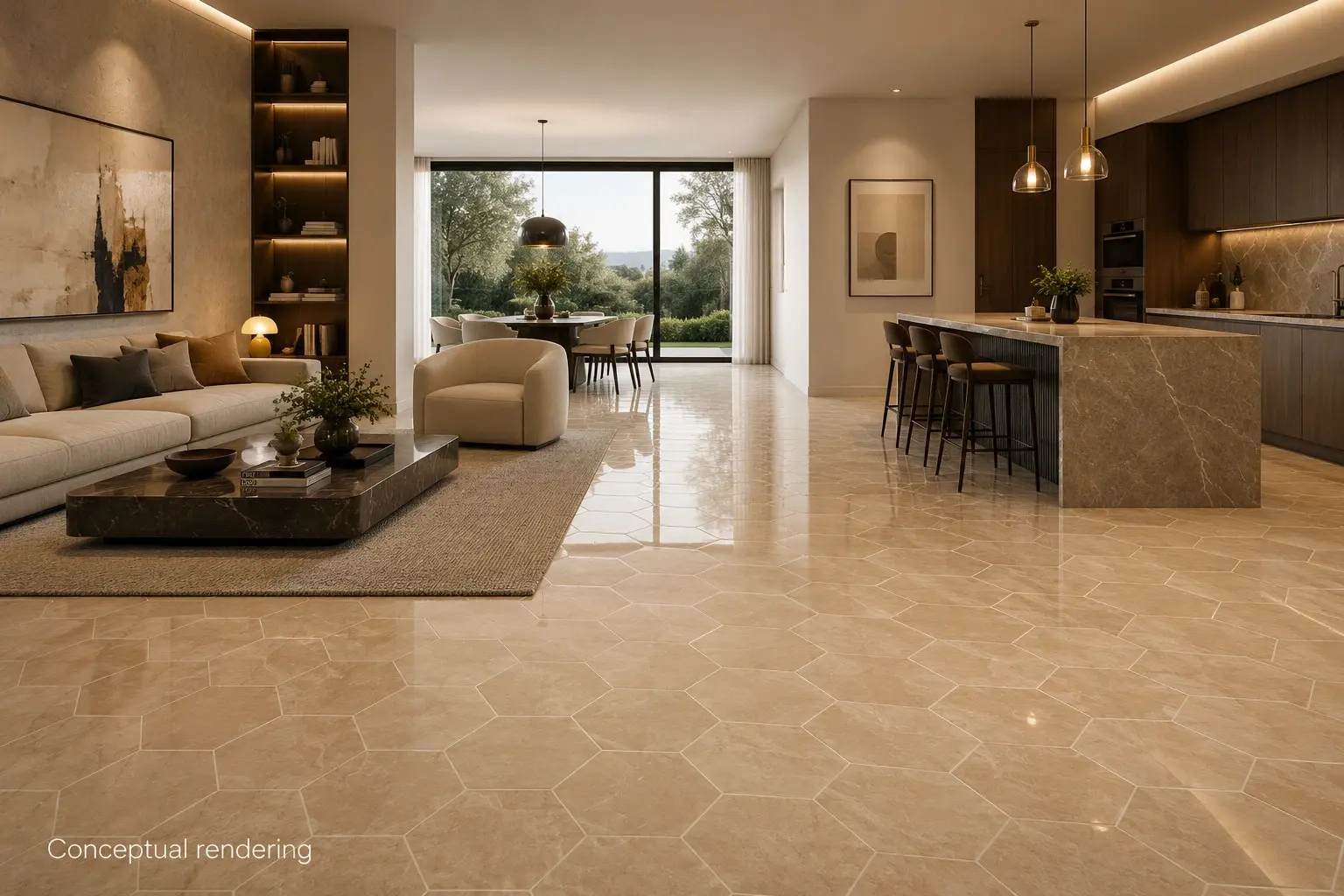
Porcelain tile is a high-density ceramic surface fired between 1,200 and 1,400 degrees Celsius to reach a water absorption of 0.5% or less per ANSI A137.1, making it suitable for floors, walls, shower surrounds, fireplace faces, and exterior surfaces without sealing when glazed. Honey is one of the warm-neutral color options available across porcelain's floor, wall, and slab formats, ranging from golden-beige to amber. Beyond its tone, honey performs exactly like any other porcelain colorway: the same durability, water resistance, and installation versatility apply, with the only real difference being that its golden neutral pairs with white cabinetry, wood tones, sage green, powder blue, and warm gray without dominating a room's palette.
Where to Use Honey Porcelain Tile
Honey porcelain tile works across a wide range of spaces. The warm golden tone can adapt to different room functions without drawing undue attention. See our complete guide to porcelain tile for a broader look at how porcelain performs across rooms and applications.
Kitchen floors and backsplashes
Honey tones work well beneath white or off-white cabinetry, where the contrast reads as clean without feeling cold. As a backsplash, honey porcelain pairs naturally with stone or quartz countertops in warm white, cream, or veined gray, adding depth without pulling focus from the rest of the space.
Living rooms, entryways, and fireplaces
Honey porcelain coordinates naturally with wood furniture, linen upholstery, and warm-toned accessories, and holds up well in entryways under varying light and daily foot traffic. The same warm amber range also suits a fireplace surround, where porcelain's non-combustible, dimensionally stable composition allows installation on the face and hearth.
Bathroom floors and walls
Honey porcelain brings warmth to bathrooms, where cooler palettes can feel clinical. Bathroom floors walked on while wet must meet ANSI A137.1's minimum wet DCOF of 0.42, measured per ANSI A326.3; confirm the specific product's rating before installation. On shower walls, the fired glaze surface is impermeable, making it a practical choice for steam exposure.
Commercial spaces
Honey tones read as welcoming rather than institutional, suiting lobbies, reception areas, and retail floors in hospitality and professional settings. For commercial floor use, look for a PEI rating of 4 or higher, the grade most commonly specified for moderate to heavy foot traffic. Confirm the rating on the product's technical data sheet before specifying it.
Why Choose Honey Porcelain Tile
Beyond where it fits in a room, honey porcelain holds up well on a few practical measures worth knowing.
Color versatility. Honey porcelain sits in a tonal range that bridges warm neutrals and richer earth tones. It pairs with soft sage, powder blue, charcoal, and warm white without reading as too dominant or too recessive. For homeowners and designers working on a coordinated palette, honey porcelain is easier to build around than a tile with stronger chromatic contrast.
Durability. Porcelain tile's density comes from the dust-press method and high-temperature kiln-firing process, producing a material harder and less porous than standard ceramic. Per ANSI A137.1, porcelain tile must achieve an average breaking strength of 275 lbf with no individual specimen below 250 lbf, as tested per ASTM C648.
Frost resistance. Low water absorption is a prerequisite for frost suitability, but not a guarantee. Per TCNA, porcelain tiles are usually frost resistant, although not always. Before specifying honey porcelain for any exterior or freeze-thaw installation, confirm the product carries a frost-resistant rating from the manufacturer, verified through ASTM C1026 testing.
Design consistency. Unlike natural stone, porcelain tile is manufactured with controlled variation. The baseline color and finish tend to remain consistent from tile to tile, which can simplify installation and reduce visual irregularities across a large floor or wall surface.
No sealing required. Glazed honey porcelain does not need a topical sealer at installation or on any recurring schedule. The glaze is a glass coating that becomes impermeable once fired, resisting moisture and staining on its own. Grout lines, however, are more porous and should be sealed separately.
Note: Some images on this page may be conceptual renderings created to illustrate design possibilities and may not depict actual installations.
Care and Maintenance
Honey porcelain tile requires minimal upkeep. The routine below keeps honey porcelain looking its best.
Daily cleaning. Sweep or dry-mop to remove loose dirt before it gets ground in. For regular washing, use a pH-neutral cleaner diluted in warm water with a soft mop or cloth. Avoid acidic cleaners and abrasive scrubbing pads, which can dull a glazed surface over time.
Grout care. Porcelain resists staining, but grout lines are more porous and can discolor. Seal grout at installation and reapply as needed. A grout brush with a mild cleaner addresses surface staining without harsh chemicals.
Spill response. Blot liquid spills promptly rather than wiping, which spreads them. For dried-on residue, a damp cloth with dish soap is sufficient. Avoid leaving standing water on grout lines for extended periods.
Deep cleaning. Occasional deep cleaning with a dedicated tile and grout cleaner handles buildup that routine mopping leaves behind. Apply per product instructions, allow dwell time, and rinse thoroughly. This is typically needed a few times per year in kitchens and entryways.
Find Your Perfect Tile
Frequently Asked Questions
Honey porcelain tile falls in the warm golden-beige to amber range. The tone varies by product line, but the defining quality is warmth without saturation. It reads lighter and more golden than taupe or walnut, and richer than ivory or cream. This makes it a warm neutral that stops short of orange or brown.
Yes. The glaze is a glass coating fired onto the surface, making it impermeable to moisture without sealing. It resists soap residue and cleans easily. For shower floors, confirm the specific tile's wet DCOF meets the 0.42 minimum required by ANSI A137.1. A quality epoxy or stain-resistant grout simplifies long-term maintenance on joints.
Glazed honey porcelain tile does not require sealing. The fired glaze is impermeable to moisture and staining without a topical sealer. Unglazed or through-body porcelain may benefit from sealing in certain applications, but most residential honey porcelain tile is glazed. If unsure of the finish type, check the product's technical data sheet or ask at the showroom.
Honey porcelain coordinates naturally with warm whites, sage green, powder blue, and warm gray. Wood tones, natural linen, and brushed brass or gold hardware complement it well. For a bolder accent in the same warm family, coral porcelain tile pairs well as an entryway or feature wall without clashing with honey's golden base. For higher contrast, charcoal or deep navy on adjacent walls or cabinet finishes adds definition without clashing. Cooler tones with strong blue or green undertones pair less predictably and should be sampled first.
Porcelain tile's water absorption of 0.5% or less makes it a candidate for freeze-thaw climates, but low absorption alone does not confirm frost suitability. Per TCNA, porcelain is usually frost resistant, but not always. Verify that the specific product carries a frost-resistant rating from the manufacturer, confirmed through ASTM C1026 testing. Outdoors, a wet DCOF above the 0.42 interior minimum is also advisable. Review the technical data sheet or ask at the showroom before specifying honey porcelain for any exterior installation.
Visit a Nova Tile and Stone Showroom
Nova Tile and Stone carries a selection of porcelain tile in honey and related warm-toned colorways across all four showroom locations in Reno, Sacramento, Minden, and Fernley. Tile samples are available for $1 each, so you can see how honey porcelain reads in your actual space before committing to a full order. Walk-in design consultations are available during showroom hours.