Graphite Marble
What Is Graphite Marble and Why Designers Choose It
Graphite marble is a natural metamorphic stone characterized by a deep charcoal-to-near-black base and bold white or grey veining. It forms when limestone is subjected to intense heat and pressure deep within the Earth, recrystallizing calcite crystals into a dense, interlocking structure. The dark coloration is produced by fine graphite particles (metamorphic carbon) distributed through the calcite matrix during that transformation. No two slabs carry the same vein pattern, making each piece visually distinct.
As a calcite-based natural stone, graphite marble registers between 3 and 5 on the Mohs hardness scale. Designers choose it for its high-contrast palette, its ability to anchor both contemporary and transitional interiors, and its compatibility with polished, honed, leathered, and specialty finishes across countertops, flooring, walls, and fireplace surrounds. That visual identity begins at the geological level, long before any finish is applied.
The Geology Behind This Stone's Color and Character
The deep grey-to-black palette of graphite marble is not a surface treatment or applied pigment but the direct result of mineralogy. When the original limestone formed in low-oxygen, organic-rich marine environments, carbon compounds became trapped within the sediment layers. During metamorphism, that organic material converted into graphite: dark scales woven through the recrystallized calcite. The higher the graphite concentration, the deeper the dark base color appears across the slab.
The bright veining contrasts with this dark base through the same metamorphic process. Mineral impurities such as clay, silica, and iron oxides present in the original limestone were mobilized and recrystallized during metamorphism, producing the distinct vein patterns visible across the slab face. Because this contrast is geological in origin, it holds regardless of which surface finish is selected, and understanding those finish options is the key to specifying graphite marble correctly.
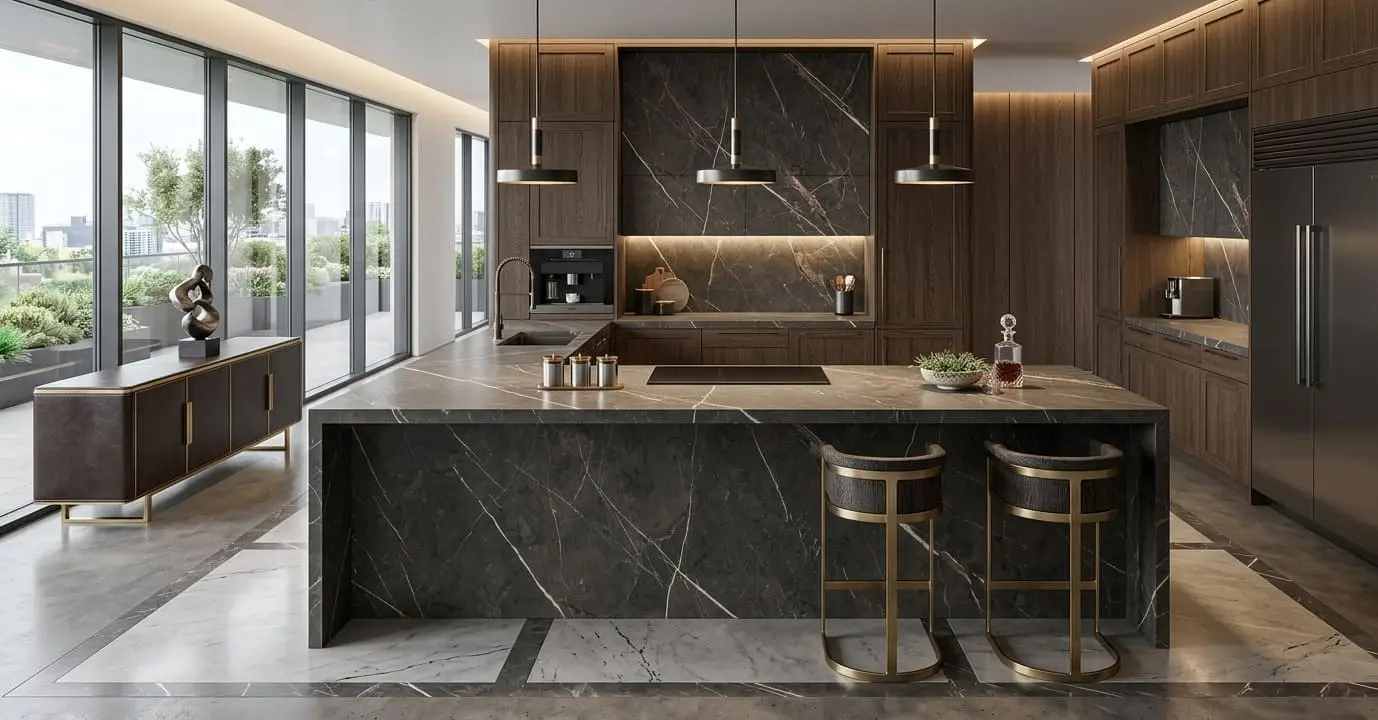
Surface Finishes: Polished, Honed, Leathered, and Specialty Options
Each finish changes how graphite marble looks, how it performs, and how frequently it requires sealing.
Polished Finish
Polished finish produces a high-gloss, mirror-like surface through progressive grinding and buffing. On graphite marble, polishing deepens the base color and intensifies the contrast between the dark ground and light veining.
Because polishing partially closes the stone's surface pores, a polished slab offers better stain resistance and suits feature walls, backsplashes, and countertops where a high-impact aesthetic is the goal.
Honed Finish
Honed finish produces a smooth, flat, matte surface by stopping the grinding process before a reflective sheen develops. Honing softens the base color and produces a restrained aesthetic.
Minor etching and surface wear are less visible on a honed surface, making it a practical choice for flooring, shower walls, and horizontal surfaces in high-use areas.
Leathered Finish
Leathered finish begins as a honed slab processed with diamond-tipped brushes, creating a subtly dimpled texture with a low sheen. On graphite marble, leathering retains more depth of color than honing does, while the textured surface conceals fingerprints, water spots, and minor wear.
Consistent sealing remains important because the open texture still allows moisture penetration. This finish suits kitchen countertops, bathroom vanity tops, and fireplace hearths where an organic surface character is part of the design intent.
Specialty Finishes
Specialty finishes such as brushed and satin expand the available range. A brushed finish produces a lightly textured surface well suited to transitional or rustic interiors, while a satin finish falls between polished and honed, offering a soft, low-level sheen.
Knowing how each finish behaves makes it possible to match graphite marble to the specific demands of any surface.
Countertops, Flooring, and Walls: Matching the Finish to the Surface
Graphite marble slabs are available in large-format sizes, allowing them to cover continuous surfaces without grout lines interrupting the veining. The finish chosen for each application directly affects the visual result and long-term performance of the slab.
In bathroom environments, the stone is particularly effective. Full-slab shower walls in a polished or honed finish allow the veining to run continuously across large vertical planes, while vanity tops in a leathered or honed finish provide practical resistance to water contact and minor impact. The dark palette contrasts effectively with white plumbing fixtures and pale grout, producing a high-contrast aesthetic common in contemporary luxury bathroom design.
For fireplace surrounds and accent walls, polished graphite marble delivers maximum visual presence in luxury interiors. The reflective surface amplifies nearby light sources, and the large-scale veining creates a natural focal point that requires minimal maintenance over many years.
Graphite marble flooring benefits most from a honed or leathered finish, both of which provide better traction than a polished surface and work well in open-plan spaces. Once the right finish for each surface is clear, the next step is selecting the specific slabs that will bring the design to life.
Everything You Need to Know About Slabs
Frequently Asked Questions
The grey-to-black base results from fine graphite particles distributed through the stone's calcite matrix. Graphite is metamorphic carbon formed when organic material in the original limestone was transformed under heat and pressure. The density of that graphite distribution determines how deep and uniform the dark base appears from slab to slab.
Graphite marble falls between 3 and 5 on the Mohs hardness scale, placing it below harder stones like granite and quartzite. This makes it more susceptible to surface scratching and chemical etching from acidic substances, so proper sealing and pH-neutral cleaning products are essential.
Kitchen countertops may benefit from sealing every six to twelve months, bathroom surfaces every one to two years, and lower-traffic applications such as fireplace surrounds every two to three years. A water bead test, where water soaking into the surface rather than beading signals it is time to reseal, is a reliable monitoring method between resealing intervals.
Honed and leathered finishes are better suited to high-traffic countertops and flooring than a polished finish. Both conceal minor scratches and etching more effectively because the matte or low-sheen surface does not amplify imperfections the way a polished surface does. The leathered finish also resists fingerprints and water spots due to its textured surface.
Yes. Graphite marble slabs work well on both horizontal and vertical surfaces. For flooring, a honed or leathered finish provides better traction and conceals wear more effectively. For walls and fireplace surrounds, a polished finish is appropriate because those surfaces face minimal abrasion and benefit most from the stone's full reflective depth and visual contrast.