Skip to Content

Graphite Marble Slabs

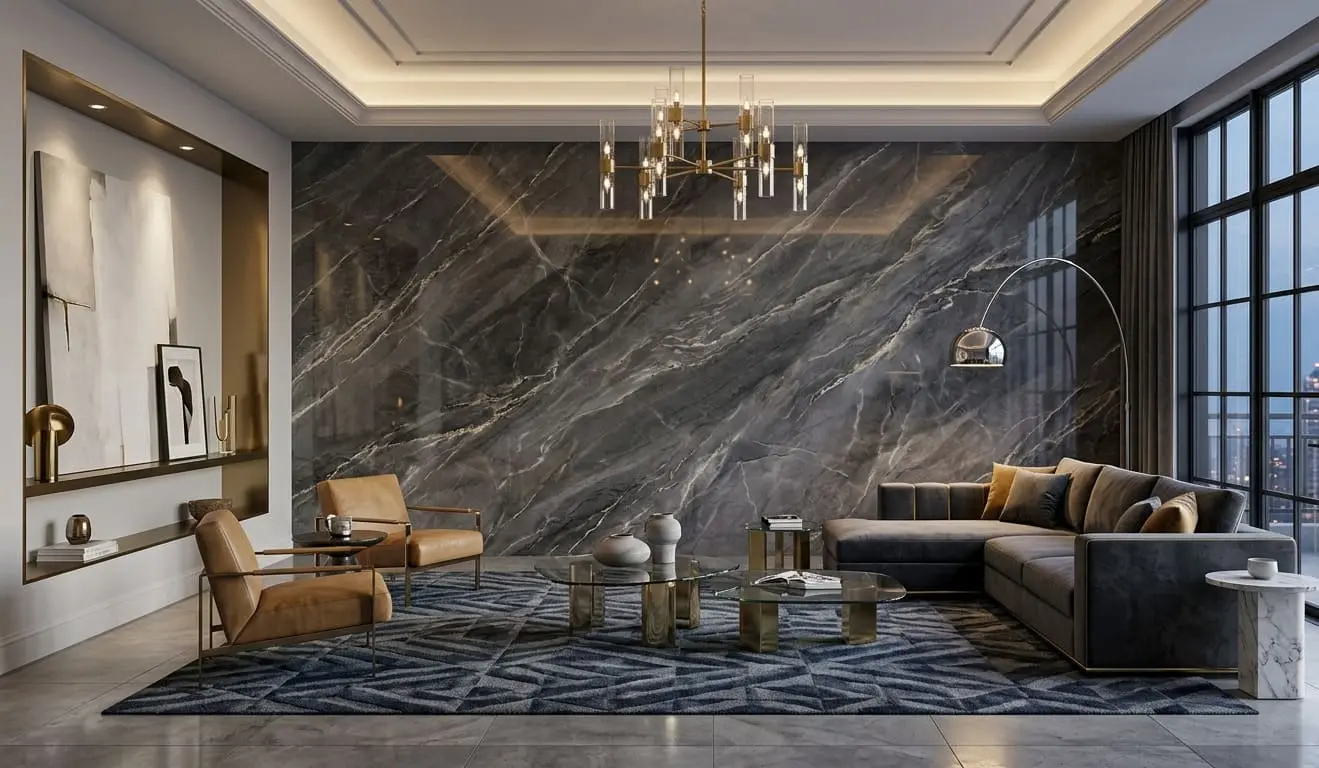
Sophisticated living room with graphite marble feature wall

Graphite marble slabs are full-format natural stone panels whose dark grey to near-black coloration comes from graphite mineral inclusions distributed through a recrystallized calcite matrix. They are used primarily for countertops, wall cladding, fireplace surrounds, and residential flooring, selected when a design requires high visual contrast, organic depth, and pattern variation that only a natural material can produce. 

Graphite marble rates between 3 and 4 on the Mohs hardness scale, with some varieties containing harder mineral inclusions reaching up to 5, and understanding both its visual character and physical properties is what allows it to be placed and maintained correctly.

Slabs Available In-Store At Nova Tile and Stone

The Visual Character of Graphite Marble

The defining characteristic of graphite marble is the interplay between its dark base and the veining that moves across each slab. Those veins range from fine, hair-thin lines to bold, branching patterns, the product of mineral-rich fluid infiltrating stone over geological time, which means no two slabs are identical.

The dark palette makes graphite marble effective in high-contrast design schemes. Paired against warm wood tones, brushed brass fixtures, or white cabinetry, the stone creates tension that elevates an otherwise straightforward interior. In monochromatic settings, it introduces subtle movement and organic texture that breaks up visual monotony.

Larger format slabs allow veining to read as a continuous composition, while bookmatched pairs produce a symmetrical pattern that has become a signature approach in high-end graphite marble interiors. A polished surface intensifies contrast between dark ground and light veining, while honed or leathered surfaces bring forward texture and depth. These visual considerations directly inform where the stone performs best.

Where Graphite Marble Slabs Perform Best

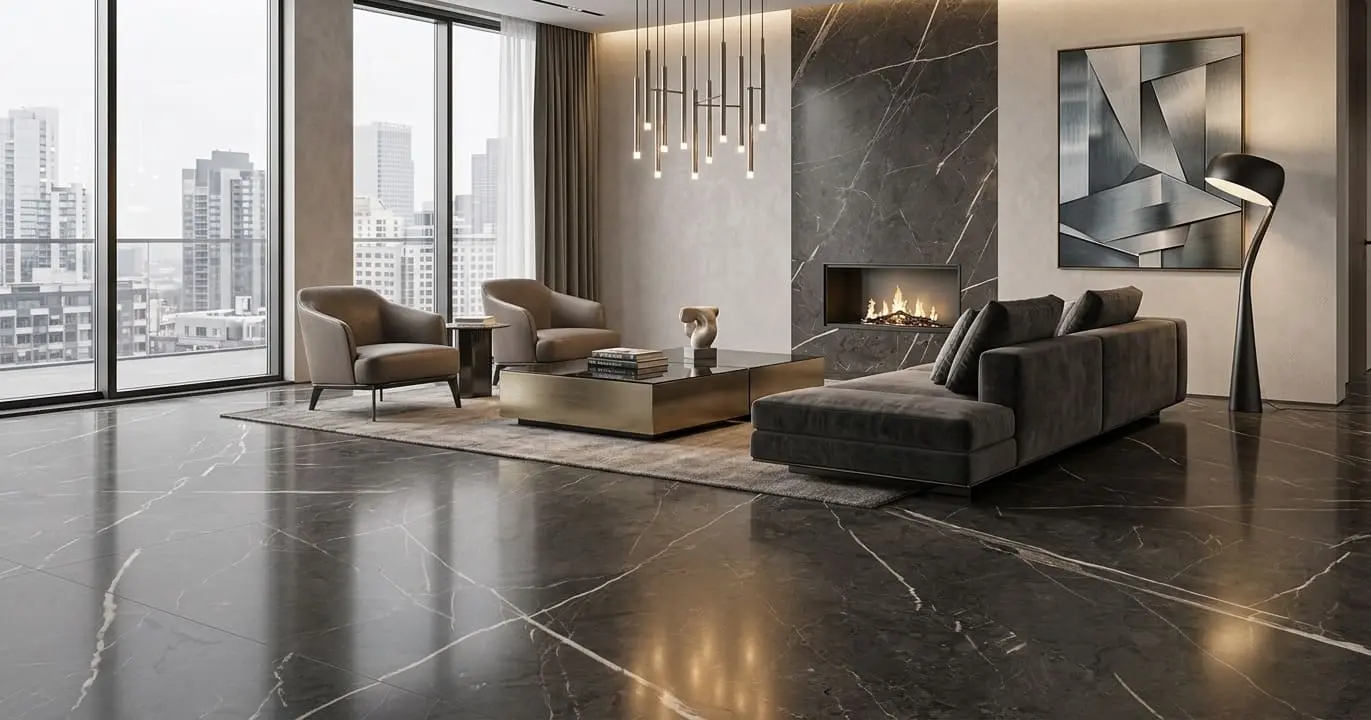
Luxury living room with polished graphite marble floors

The same qualities that define graphite marble's appearance also determine which applications suit it most. As a natural stone countertop material, graphite marble slabs bring a dramatic quality rarely achieved by other stones, performing well on vanity tops, kitchen perimeter surfaces, and islands when properly maintained.

Wall cladding and feature walls are among the strongest applications for this stone. Vertical surfaces are not subject to the mechanical wear countertops encounter, allowing the stone's beauty to come through without the same maintenance demands. Fireplace surrounds follow the same logic, dark tones complement the warmth of a fire and the stone's properties make it suitable for surround cladding.

Flooring in lower-traffic areas such as primary bathrooms and formal entry spaces is also well suited to graphite marble. High-traffic commercial floors are better served by harder stone options, but in residential settings with appropriate care and finish selection, graphite marble floors are a strong choice. Getting both placement and finish right requires a clear understanding of the stone's physical properties. 

Graphite Marble Hardness, Porosity, and Durability


Marble is a calcite-based metamorphic rock that typically measures between 3 and 4 on the Mohs hardness scale, with some varieties, those containing harder mineral inclusions such as quartz, reaching up to 5. This places it softer than granite (6–7) and well below quartzite (7–8). Graphite marble is susceptible to surface scratches and to etching from acidic substances such as citrus juice, vinegar, or certain cleaning products. Etching is a chemical reaction between acid and calcite that produces dull surface spots, it is distinct from staining, and standard penetrating sealers do not prevent it.

Sealing is essential for stain protection. Without a penetrating sealer, liquids absorb into the stone's pores and cause permanent discoloration. The water bead test is the most reliable indicator of when resealing is due, and daily cleaning with a pH-neutral stone cleaner protects both the surface and the sealer. Finish choice has the most direct impact on how the stone looks and holds up over time.

Surface Finish Options for Graphite Marble


Polished finish deepens base color, intensifies vein contrast, and produces a high-gloss result best suited to lower-traffic countertops and wall cladding. Etching and scratches are more visible on polished surfaces. Sealing is required.

Honed finish offers a smooth, matte surface that conceals minor marks more effectively, making it practical for active kitchen countertops and residential floors. Consistent sealing is especially important as honing leaves the surface more open than polishing.

Leathered finish uses high-pressure brushes to create subtle surface undulations resulting in low-sheen texture. The process compresses the stone's surface, masks fingerprints and everyday marks, and most amplifies graphite marble's natural dimensional character. Sealing is required.

Specialty finishes, sandblasted, brushed, antiqued, and waterjet, are available for architectural and commercial applications. Availability varies by fabricator, so confirming options before specifying is essential. Once the finish is chosen, seeing slabs in person makes all the difference.


Explore Our Slab Guides and Inspiration

Your Dynamic Snippet will be displayed here... This message is displayed because you did not provided both a filter and a template to use.

Frequently Asked Questions

Graphite marble slabs are natural stone panels whose dark grey to near-black color comes from graphite mineral inclusions in the stone's calcite matrix. They are used for countertops, wall cladding, fireplace surrounds, and flooring, and valued for their high visual contrast and distinctive veining formed during metamorphism.

Marble rates between 3 and 4 on the Mohs hardness scale, softer than granite (6–7) and quartzite (7–8), making it more susceptible to scratching and acid etching. Etching is a chemical surface reaction distinct from staining and cannot be prevented by sealing.

Polished maximizes reflectivity but shows surface marks more readily. Honed is matte and practical for active kitchens and floors. Leathered adds low-sheen texture and masks fingerprints effectively. All three require sealing.

Yes, sealing protects against staining by preventing liquid absorption into the stone's pores. Use the water bead test to determine when resealing is needed. Sealing does not prevent etching, which is a surface chemical reaction unrelated to absorption.

Yes. Countertop use requires proper sealing and a finish that conceals minor marks, honed or leathered are the practical choices. Wall applications face no mechanical wear, making them one of the strongest uses for the stone.

Transform Your Space

Nova Tile and Stone carries a curated selection of graphite marble slabs at showroom locations in Reno, Sacramento, Minden, and Fernley. Natural stone is inherently variable, so viewing the actual slab is the only way to know exactly what you are bringing into your project. Our team is available to help identify slabs suited to your application, whether a marble countertop, bathroom feature wall, fireplace surround, or large-format floor.