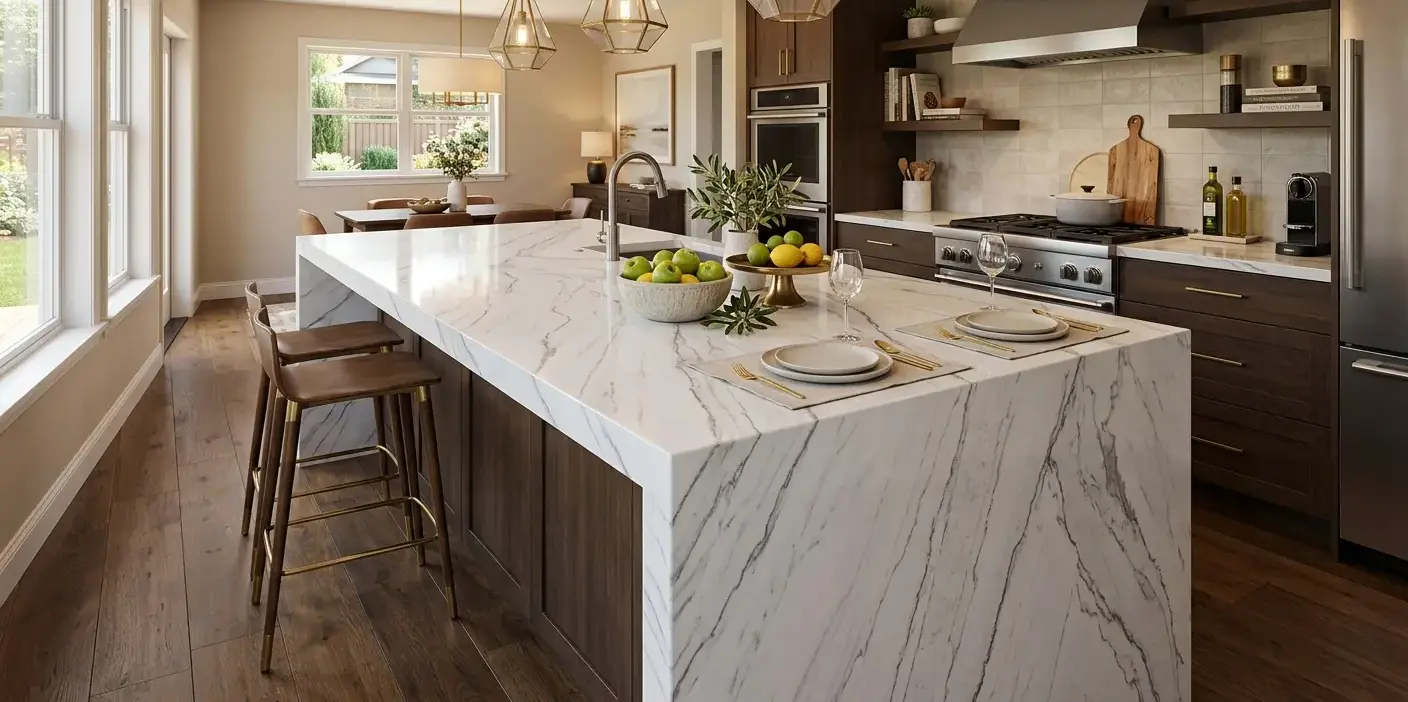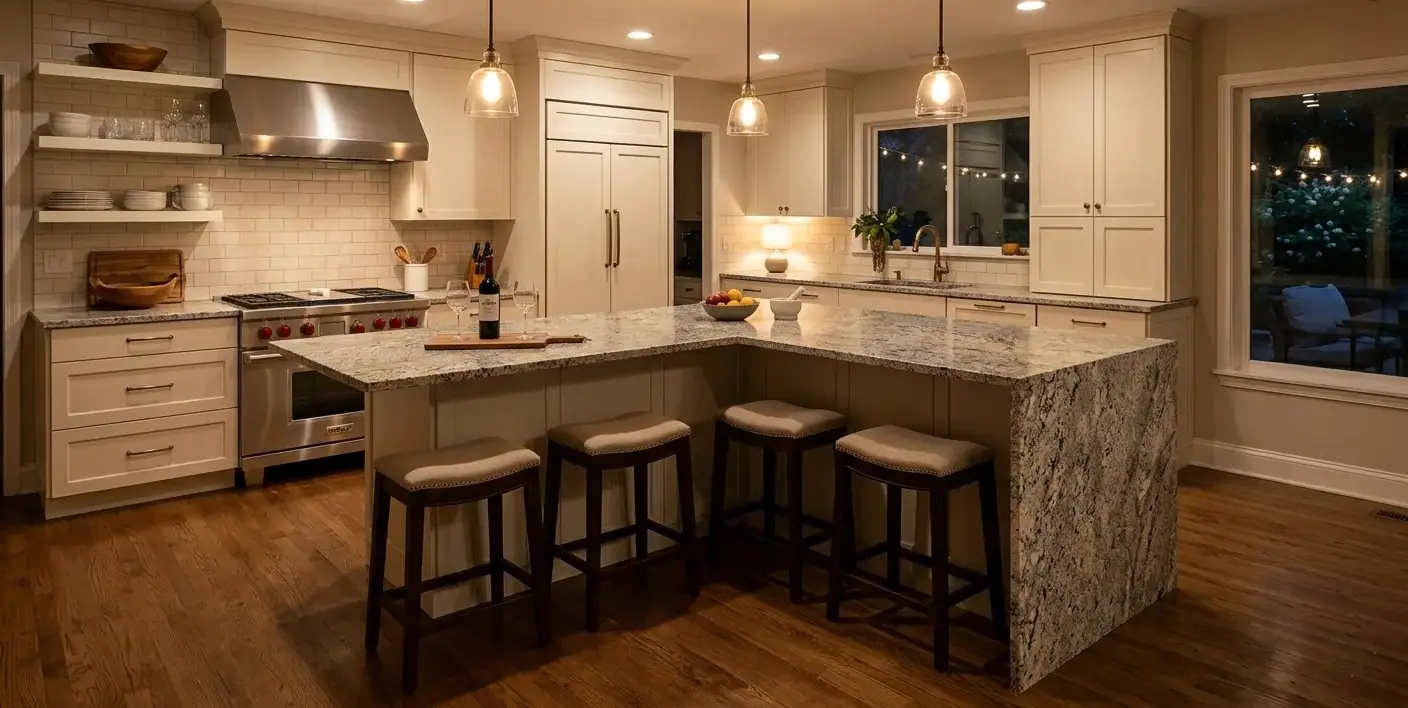
A stone slab used for a waterfall edge countertop extends the surface vertically down the sides of a kitchen island or cabinet end, creating a seamless cascade of stone from countertop to floor. This variation is available in natural stone slabs such as quartzite, marble, granite, and dolomite, as well as engineered options including quartz and porcelain. Each material supports multiple finish choices, including polished, honed, leathered, and specialty, giving the profile exceptional range across kitchen design styles.
Nova Tile and Stone, a direct stone importer, offers premium slabs from a live inventory purpose-built for slab-intensive applications like this one.
Slabs for Waterfall Edge Countertops: Materials and Finish Options
The most popular slab choice for a waterfall edge countertop is quartzite, typically in white or soft cream tones with bold, linear gray veining. Quartzite rates between 7 and 8 on the Mohs hardness scale, among the highest of any countertop surface.
Standard slab thickness for waterfall applications is 3 cm (approximately 1.25 inches), which provides the structural mass the profile demands. Quartzite is quarried primarily in Brazil and India, where metamorphic pressure produces a dense, tightly crystallized stone well-suited to high-traffic kitchen surfaces.
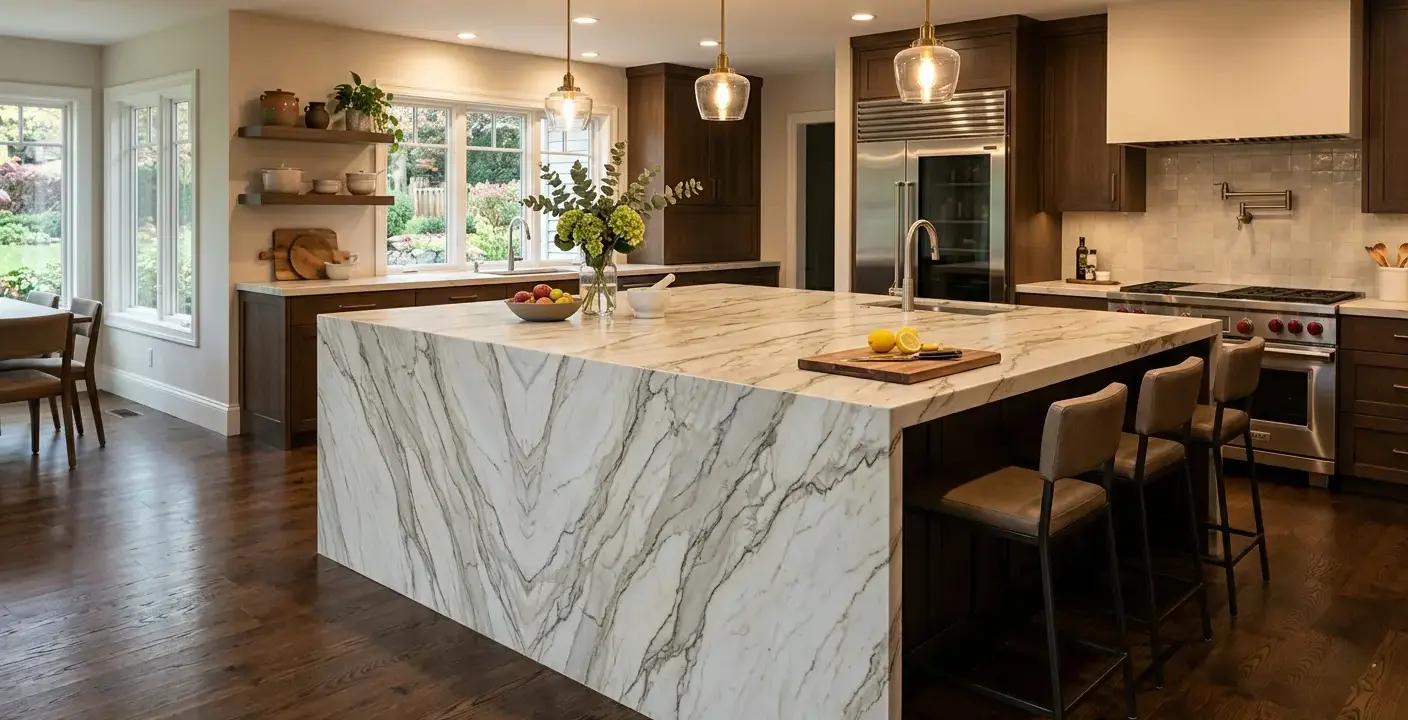 Conceptual rendering
Granite, with a Mohs rating of 6 to 7, delivers a speckled patterning distinct from quartzite's linear veining and holds up to scratching when used with cutting boards. Quartz, an engineered slab, provides uniform veining across large panel formats, which is an advantage for bookmatched waterfall configurations. Porcelain slabs, verified under the PTCA program to meet a water absorption threshold of 0.5% or less as defined by the Tile Council of North America, present a durable low-maintenance option for contemporary kitchen islands.
Absorption rates for properly sealed quartzite fall below 0.4%, which limits staining risk during daily kitchen use. Annual resealing is still required to maintain that barrier. Marble, the second most common material for this variation, brings a softer look with white and gold undertones and flowing organic veining.
It is more porous than quartzite and more susceptible to etching from acidic kitchen substances, making routine maintenance more demanding.
Slab Continuity and Finish Choices
Slab continuity across veining is the defining challenge of a waterfall edge layout. Bookmatching, which involves opening two adjacent slab cuts like a book and aligning them at the seam, creates the most dramatic result, with veining flowing uninterrupted from the horizontal surface down both vertical panels. This technique works especially well on quartzite and marble with pronounced linear patterning. A single continuous slab wrapped around one island end is a practical alternative when bookmatching is not available.
Polished finishes amplify veining contrast and complement modern or transitional kitchens. Honed finishes reduce reflectivity for a warmer, more lived-in aesthetic. Leathered finishes, available on quartzite, granite, marble, and dolomite, add a tactile matte texture that reads particularly well on vertical panels. Specialty finishes offer additional surface variation for projects that call for a more distinctive or custom look. Homeowners can visit the Nova Tile and Stone showroom to evaluate slab pairs in person before committing to a selection.
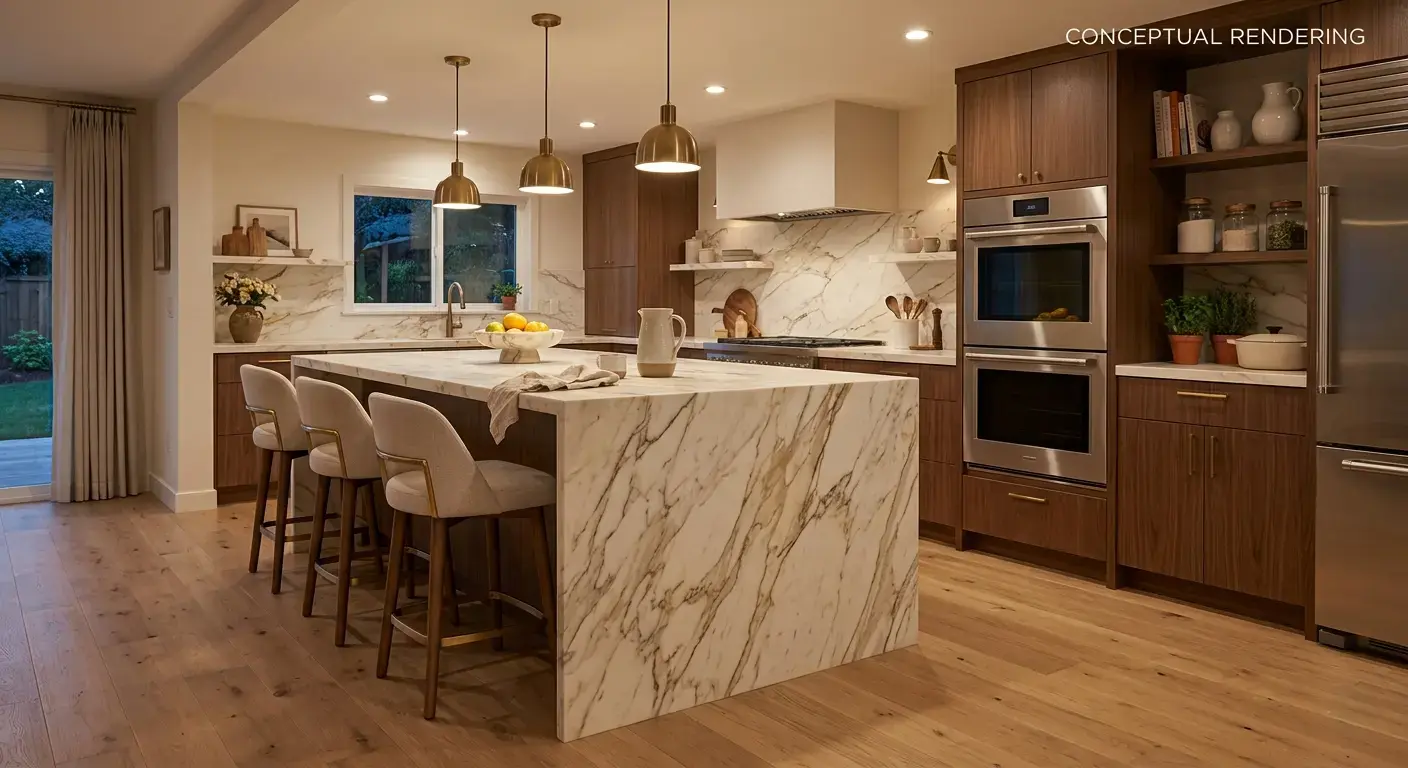 Conceptual rendering
Practical Benefits
- Substrate protection. Continuous stone wraps cabinet edges from moisture and impact, though prompt spill cleanup is still recommended along seams.
- Scratch resistance varies by material. Quartzite and granite lead natural stone options; cutting boards remain recommended regardless of material to preserve finish appearance.
- Heat tolerance with caution. Natural stone and porcelain handle brief heat exposure, but thermal shock from direct pan contact can cause cracking in any material. Trivets protect long-term condition.
- Finish and wet-area safety. Polished surfaces are slipperier when wet. Honed, leathered, and specialty finishes provide more grip where water contact is likely.
- Food contact guidance. Suitability for direct food contact depends on material type, seal condition, and finish; a stone professional can advise based on the specific slab.
- Commission-free design support. Nova Tile and Stone's design team assists with slab pairing and material selection without a sales agenda.
Why a Waterfall Edge Countertop Slab Holds Its Value Over Time
The waterfall edge profile suits both contemporary and transitional kitchen aesthetics, which helps it remain visually relevant beyond short-term design trends. Natural stone slabs develop character with age when given consistent care, rather than appearing worn. Quartzite and granite show fewer signs of daily wear than softer stone options, making both a practical long-term choice for a prominent, high-contact surface. Quartz maintains consistent color and patterning for years, though its lack of UV stability limits it to indoor kitchen applications only.
Selecting a slab through a direct importer with live inventory means choosing the actual stone slab rather than a catalog photo, a meaningful difference for a design feature as visible as a waterfall panel. Nova Tile and Stone's team can help match slab dimensions and veining patterns to your specific island configuration. Ready to move forward? Request a slab quote and get material options matched to your kitchen project.
Frequently Asked Questions
Quartzite and marble are the most popular natural stone choices for waterfall edge countertops because their bold linear veining creates a strong visual flow across horizontal and vertical surfaces. Granite, quartz, and porcelain are also well-suited to this profile, with each offering different trade-offs between durability, maintenance, and design flexibility. The right material depends on the kitchen's usage level, finish preference, and desired visual result.
The vertical panels of a waterfall edge countertop require the same routine care as the horizontal surface, regular cleaning with a pH-neutral cleaner and periodic resealing for natural stone. The seams where horizontal and vertical panels meet should be inspected periodically to confirm the adhesive remains stable. No material eliminates the need for basic maintenance; consistent upkeep preserves both the finish and the structural integrity of the profile.
Polished, honed, leathered, and specialty finishes are all compatible with the waterfall edge profile, depending on the material. Polished finishes maximize vein contrast and light reflection. Honed and leathered finishes reduce glare and provide a more textured surface feel on the vertical panel. The finish choice also affects slip resistance and maintenance requirements, so it is worth evaluating the kitchen's traffic patterns before selecting a finish.
Bookmatching, which mirrors two adjacent slab cuts to align veining across a seam, produces the most dramatic and intentional result for a waterfall edge, but it is not required. Some designs use a single continuous slab wrapped around an island end, while others prioritize a complementary match over a strict mirror image. The decision depends on the slab’s veining pattern, the available slab dimensions, and the visual result the design calls for.
Quartzite is harder, more scratch-resistant, and less porous than marble, making it the stronger performer for a busy kitchen island. Marble offers a warmer, more luminous surface with organic veining that many designers prefer for its aesthetic character, but it requires more consistent sealing and is more susceptible to etching from acidic substances. Both are strong candidates for the waterfall profile; the choice comes down to kitchen usage patterns and how much maintenance the homeowner is prepared to provide.
Discover More Answers Here