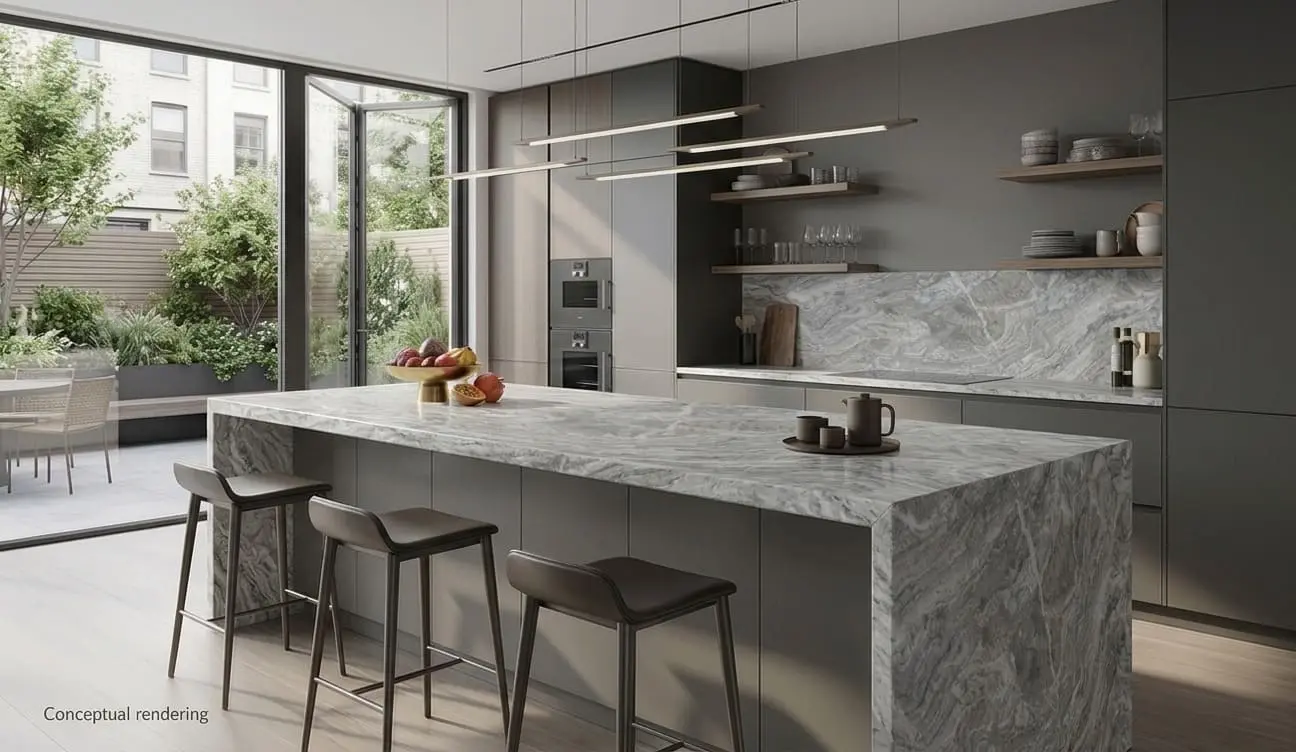
A kitchen island demands a countertop that is durable, visually striking, and practical to install. A prefab slab, factory-cut, edge-finished, and polished to standard dimensions before delivery, is one of the most efficient solutions for a kitchen renovation. When used as a prefab slab for kitchen island surfaces, it removes the extended lead times and higher fabrication costs of custom stone work while delivering the same material quality.
Nova Tile and Stone offers prefab slabs in both natural stone and engineered stone, spanning dolomite, quartzite, marble, and engineered quartz. Each material brings different hardness ratings, porosity levels, and aesthetic profiles, giving homeowners and designers the ability to match the surface to how the kitchen is actually used.
Engineered Stone
We Offer Prefab Slabs in:
Natural Stone
To learn more about sustainability and transparency in natural stone materials, review the Natural Stone Institute’s guide to environmental and health product labels for natural stone and explore the Natural Stone Institute’s calendar of stone industry events and educational programs.
Why a Prefab Slab Works for a Kitchen Island
The kitchen island handles more concentrated daily use than most other surfaces in the home, where food preparation, casual dining, and countertop tasks all occur in the same footprint. A prefab slab for kitchen island use addresses this directly because it arrives factory-cut with edges already profiled and surfaces already polished, reducing countertop installation time significantly compared to custom fabrication on location.
Because prefab slabs are produced under controlled factory conditions, countertop thickness is generally uniform and edge profiles are consistent across every piece. For kitchen islands visible from multiple angles, that consistency matters, as the fit against cabinetry tends to be tight and every exposed edge is finished to the same standard. Once the format is confirmed, the next decision is which material best suits the island and how the kitchen will be used.
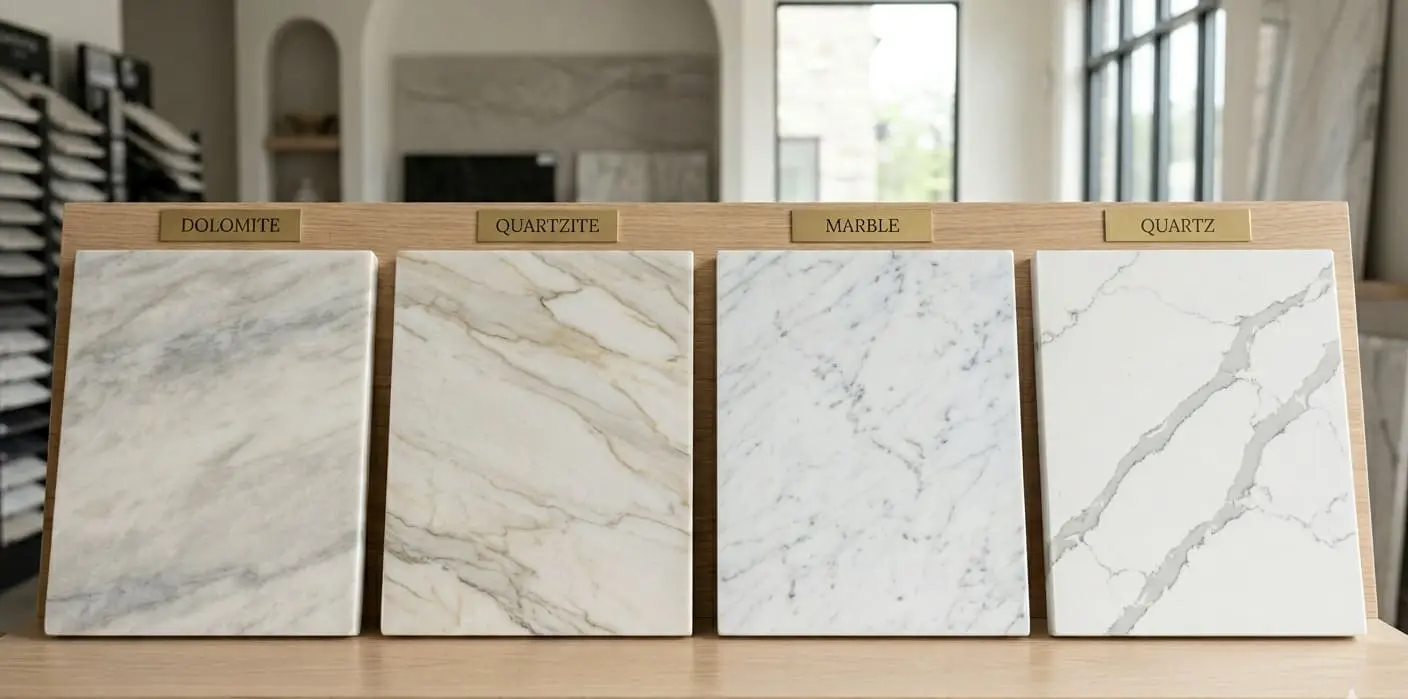
Natural Stone Countertop Options for Kitchen Island
Material Options for a Kitchen Island Prefab Slab
Dolomite is a natural stone countertop option well suited to kitchen island surfaces. Rated between 3.5 and 4 on the Mohs hardness scale and available in four finishes (polished, honed, leathered, and specialty), it offers meaningful variation in how the island surface looks and feels. Its magnesium-calcium bond tends to resist acid attack more than the pure calcium carbonate in marble, though it still benefits from prompt spill cleanup and regular stone sealer application.
Quartzite rates 7 on the Mohs hardness scale and is generally resistant to etching from food-related acids, making it well suited to heavy prep work on a kitchen island. Marble, rated between 3 and 4, is softer and prone to etching from acidic substances, though its naturally cool surface temperature, a result of high thermal conductivity, makes it a practical choice for baking-oriented island use.
For those who prefer engineered stone, quartz countertop prefab slabs are composed of approximately 90 to 95 percent crushed quartz bound with polymer resin, producing a non-porous surface that does not typically require sealing and rates 7 on the Mohs scale, comparable to quartzite in scratch resistance.
Performance Specs of a Prefab Slab for Kitchen Island Applications
Standard prefab slabs typically measure approximately 108 to 110 inches long by 25.5 inches deep, with a countertop thickness of 3 centimeters (approximately 1.25 inches). The 3-centimeter thickness provides the structural rigidity to span cabinet bases without a plywood substrate, a requirement that thinner 2-centimeter slabs are generally not able to meet. When planning a prefab slab for kitchen island seating, a 3-centimeter slab can typically extend 10 to 12 inches beyond the cabinet edge without additional support; anything beyond that range is likely to require corbels, steel brackets, or embedded rod reinforcement.
The hardness differences covered in the materials section translate directly into real-world performance. Quartzite and engineered quartz tend to resist surface scratching from cookware and daily handling more reliably than dolomite or marble. Dolomite is likely to scratch from knife blades used without a cutting board, as kitchen knife steel rates approximately 5.5 on the Mohs scale. Marble carries a similar scratch risk and is prone to acid etching, which is generally not reversible without professional refinishing. Engineered quartz resists both but is sensitive to direct heat; the polymer resin can begin to soften and discolor above approximately 150°F (65°C), making trivets strongly advisable on any quartz kitchen island surface.

Island Ready. Instantly Stunning.
Care and Maintenance of a Prefab Slab
Maintaining a prefab slab for a kitchen island requires a routine matched to the specific material. The following practices apply across all stone types unless noted:
• Clean with a soft cloth and a pH-neutral stone cleaner or mild dish soap diluted in warm water. Bleach, vinegar, and ammonia-based cleaners are not recommended, as these can degrade a stone sealer on natural stone and may dull engineered surfaces over time.
• Wipe up spills promptly, particularly acidic liquids such as citrus juice, wine, and tomato-based sauces. On dolomite and marble, brief acid contact can cause etching, a chemical dullness in the finish that is generally not removable through cleaning alone.
• Seal dolomite and quartzite at installation and reseal based on a water-bead test: if water absorbs rather than beading after 30 minutes, a fresh stone sealer application is likely due. Dolomite and quartzite typically benefit from resealing every one to two years; marble every 6 to 12 months. Engineered quartz does not typically require sealing.
• Use cutting boards on all surfaces. Dolomite and marble can scratch from direct knife contact. Quartzite and engineered quartz tend to resist scratching under normal use but benefit from consistent cutting board use to protect the finish.
• Place trivets or heat pads under hot cookware, particularly on engineered quartz. The polymer resin can begin to soften and may discolor above approximately 150°F (65°C). Natural stone generally tolerates higher sustained heat but can develop stress fractures from sudden thermal exposure.
• For dolomite in leathered or specialty finishes, use a soft-bristle brush periodically to clean the textured grain. Abrasive pads can wear down the finish and are not recommended on any stone surface.
Note: Some images on this page may be conceptual renderings created to illustrate design possibilities and may not depict actual installations.
Frequently Asked Questions
A prefab slab for kitchen island use is typically 108 to 110 inches long by 25.5 inches deep at a thickness of 3 centimeters. This suits most residential island cabinet configurations and provides a natural front overhang. Islands with custom widths or L-shaped layouts may need careful seaming or custom slab fabrication.
In most cases, yes. A prefab slab is cut from the same quarried or engineered stone as any custom piece, with generally identical material composition and hardness. The difference lies in pre-set dimensions and factory-finished edges, not in material quality.
Engineered quartz is generally the most practical choice for high-traffic use, given its non-porous surface and low maintenance requirements. Among natural stone options, quartzite is the stronger performer, offering comparable hardness and acid resistance. Marble tends to suit lower-traffic or specialty applications such as a baking island.
Generally, yes. Dolomite, quartzite, and marble are porous and benefit from sealing at installation. Use the water-bead test to know when resealing is due: if water absorbs rather than beading after 30 minutes, it is time to reseal. Engineered quartz does not typically require sealing.
A 3-centimeter prefab slab for kitchen island seating can typically extend 10 to 12 inches beyond the cabinet edge without additional support, which generally provides adequate knee clearance. Overhangs beyond 12 inches are likely to require corbels, steel brackets, or rod reinforcement to help prevent stress fractures under load.