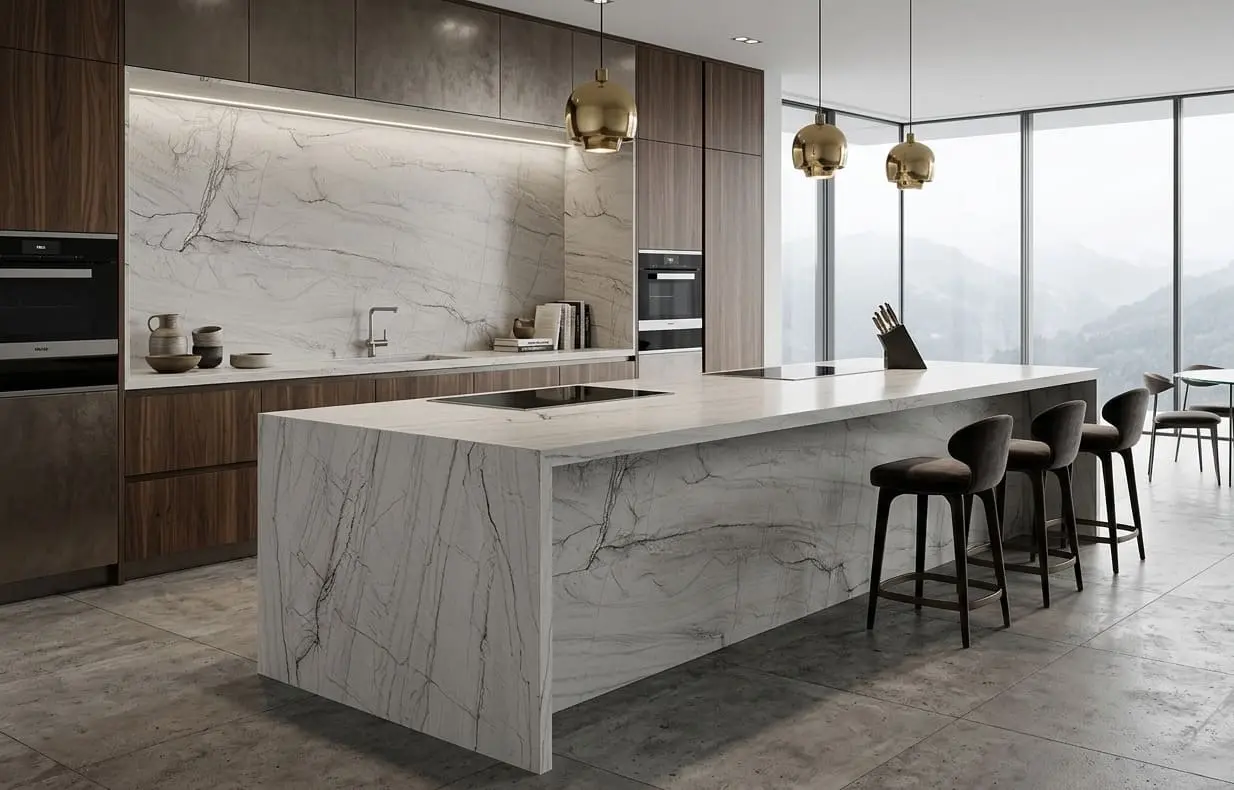
Slab for a kitchen countertop is a large-format cut of natural or engineered stone installed as a continuous work surface, typically at a standard thickness of 3 cm (1¼ inch). The four most common materials are dolomite, quartzite, marble, and engineered quartz. Each differs in hardness, porosity, finish availability, and maintenance requirements, all of which directly shape how the surface performs over time.
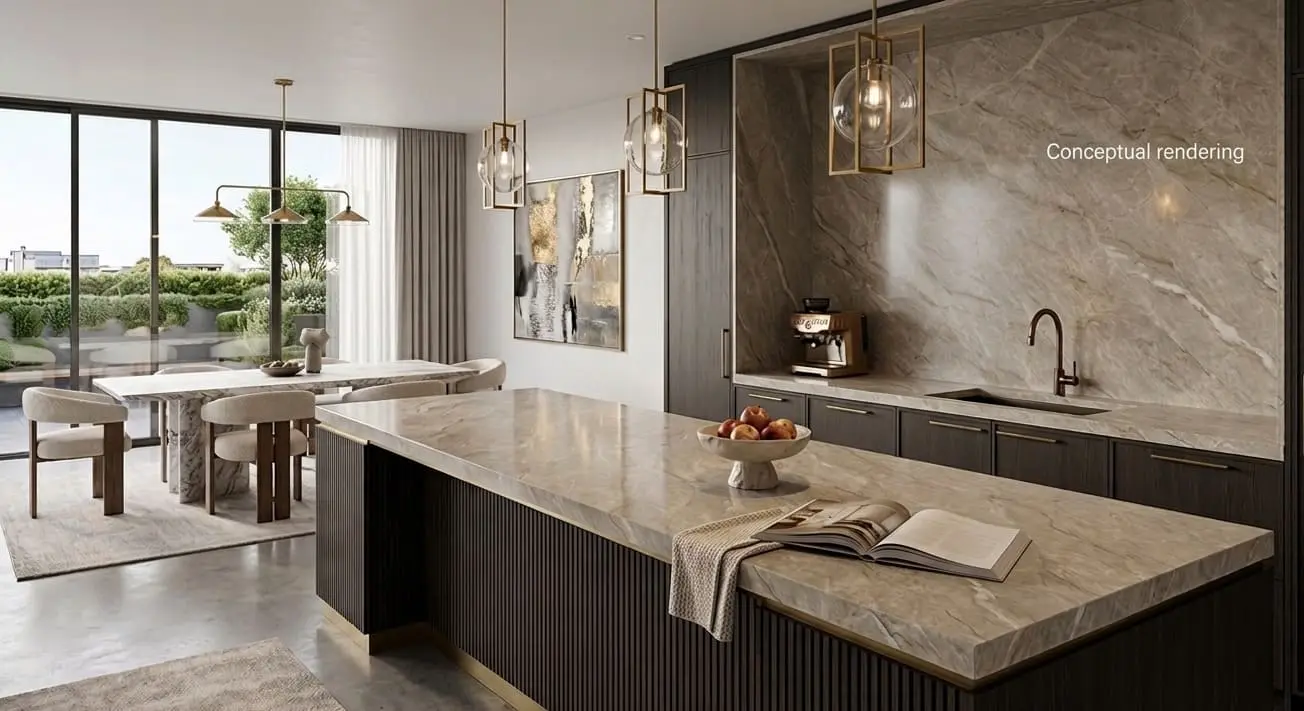
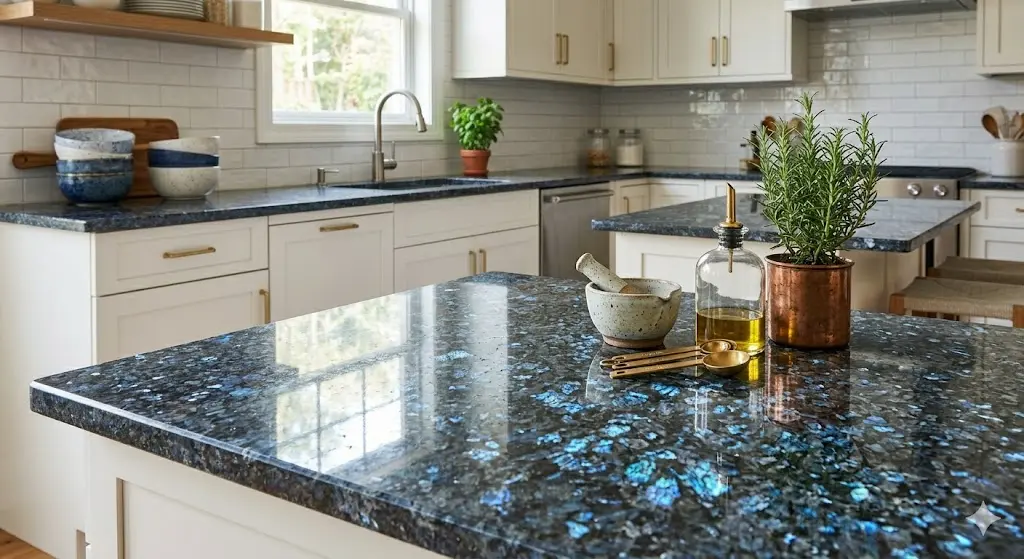
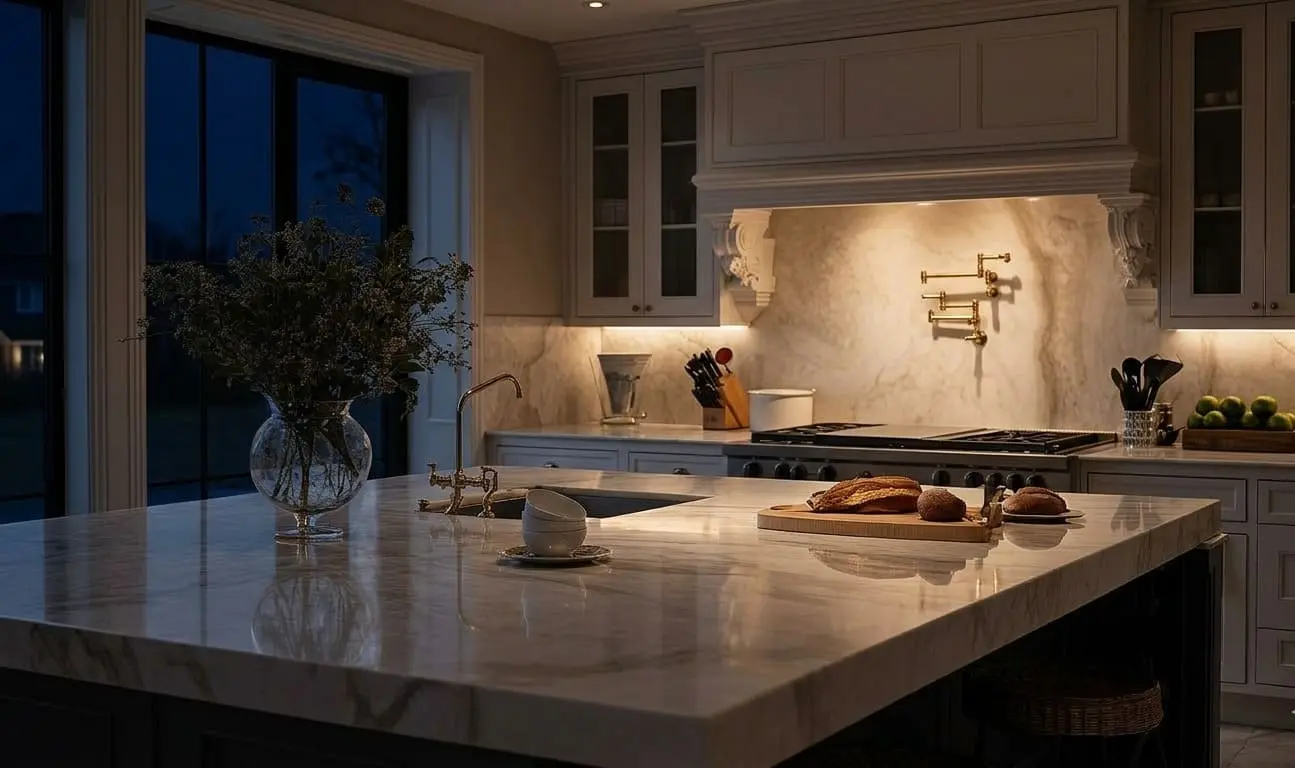
Note: Some images on this page may be conceptual renderings created to illustrate design possibilities and may not depict actual installations.
Applications: Where Each Countertop Slab Works Best
Not every kitchen zone places the same demands on a surface. Matching the right material to each area helps the stone perform well.
Kitchen Islands: Full slabs for countertop help minimize visible seams across wide spans. Quartzite suits islands that see heavy daily use. Dolomite works well where a softer, marble-like look is preferred. Marble is an option for homeowners who are prepared to manage acidic spills carefully.
Perimeter Countertops: Engineered quartz is a reliable choice for continuous wall runs because its uniform patterning makes seam alignment predictable. Honed dolomite or quartzite slab material suits homeowners who prefer natural stone with a matte finish.
Cooking and Prep Zones: Quartzite performs well beside cooktops and sinks given its hardness and heat-tolerant composition. Engineered quartz offers strong stain resistance but requires protection from direct heat above approximately 150°C (300°F). Marble and dolomite can be used in prep zones but are better suited to kitchens where cooking is moderate rather than intensive.
Breakfast Bars and Eat-In Counters: These surfaces see lighter daily use, which makes softer stones more practical. Polished marble and polished dolomite offer a refined look in areas where heavy cutting and heat exposure are less of a concern.
Slab for Kitchen Countertop: Performance Specifications by Material
The four materials below are listed from softest to hardest on the Mohs scale to illustrate durability trade-offs.
Dolomite: Dolomite is a sedimentary carbonate rock rating 3.5 to 4 on the Mohs hardness scale, placing it between marble and quartzite in scratch resistance. As a kitchen countertop slab, it offers reasonable everyday durability but can etch from prolonged acidic contact or sharp objects. Nova Tile and Stone, trusted stone supplier carries dolomite in polished, honed, leathered, and specialty finishes, and it is suitable for indoor countertops, walls, floors, and fireplaces.
Marble: Marble is a metamorphic rock composed primarily of calcite (CaCO₃), rating 3 on the Mohs scale. Because calcite reacts chemically with acids, substances such as lemon juice, wine, and coffee can produce visible etch marks within minutes. Etching is a property of the mineral itself, so it can occur even on sealed surfaces. Marble is best suited to lower-traffic kitchen areas where acidic exposure is limited.
Quartzite: Quartzite is a metamorphic rock composed of 90 to 99 percent quartz crystals, rating 7 to 8 on the Mohs scale. This hardness provides strong scratch resistance in daily kitchen use. As a fully natural stone, quartzite tends to be heat-tolerant but is porous and requires periodic sealing. Prolonged contact with strongly acidic liquids can cause etching on some slab varieties, though quartzite tends to be less reactive than marble or dolomite.
Engineered Quartz: Engineered quartz is a manufactured countertop material composed of 90 to 95 percent crushed quartz crystals bound with 5 to 10 percent polymer resins, rating approximately 7 on the Mohs scale. Its non-porous surface generally does not require sealing and resists stains, scratches, and bacteria well. However, sustained heat above approximately 150°C (300°F) can cause discoloration or warping, and prolonged UV exposure can cause the resin to yellow over time.
How to Care for Your Kitchen Countertop Slab
Daily Cleaning: Use a soft cloth and a pH-neutral cleaner on all stone countertop surfaces. Avoid vinegar, citrus sprays, bleach, and ammonia, as these degrade stone finishes and sealants. For engineered quartz, mild dish soap and warm water is sufficient.
Sealing Natural Stone: Dolomite and marble require resealing every 6 to 12 months. Quartzite can typically go 1 to 2 years between applications. To check when a reseal is due, place a few drops of water on the surface: if the stone darkens and absorbs the water rather than beading it off, apply a fresh coat. Engineered quartz generally does not require sealing.
Heat Protection: Use trivets or heat pads under hot cookware on all countertop surfaces. Sudden temperature changes can cause thermal cracking in any natural stone. Engineered quartz is generally more heat-sensitive because contact with cookware above its resin threshold can cause surface damage that is difficult to repair.
Spill Response: Blot spills immediately rather than wiping, which spreads liquid and extends contact time. Marble is the most sensitive to acids; dolomite carries a similar but slightly lower risk. On quartzite, prompt cleanup helps prevent staining and reduces etching risk on more reactive slab varieties.
Frequently Asked Questions
Quartzite and engineered quartz are among the stronger countertop slab choices for heavy daily use. Quartzite offers scratch-resistant hardness and natural heat tolerance. Engineered quartz is non-porous and generally does not require sealing. The choice typically comes down to preference: natural variation with quartzite, or consistent low-maintenance performance with engineered quartz.
Yes, for homeowners willing to seal it every 6 to 12 months and manage spills promptly. Dolomite handles everyday use better than marble and offers polished, honed, leathered, and specialty finishes. With consistent care it tends to hold up well.
Polished finishes highlight veining but show fingerprints readily. Honed finishes offer a matte look more forgiving in active kitchens, though they may need more frequent sealing on porous stones. Leathered finishes add texture that helps conceal smudges. Specialty finishes are best assessed in person at our showroom.
No. Quartzite contains very little calcium carbonate and tends to resist acid attack more effectively than marble, whose calcite mineral dissolves on contact with household acids. Some quartzite varieties with higher calcite content can show etching from prolonged acid exposure, so prompt spill cleanup is good practice on any natural stone countertop.
Quartzite is a natural stone with unique veining per slab, requires periodic sealing, and tolerates direct heat well. Engineered quartz is a manufactured countertop material with consistent patterning that generally does not require sealing, though it is sensitive to high heat and UV exposure. Choose based on whether natural character or low-maintenance consistency matters most.