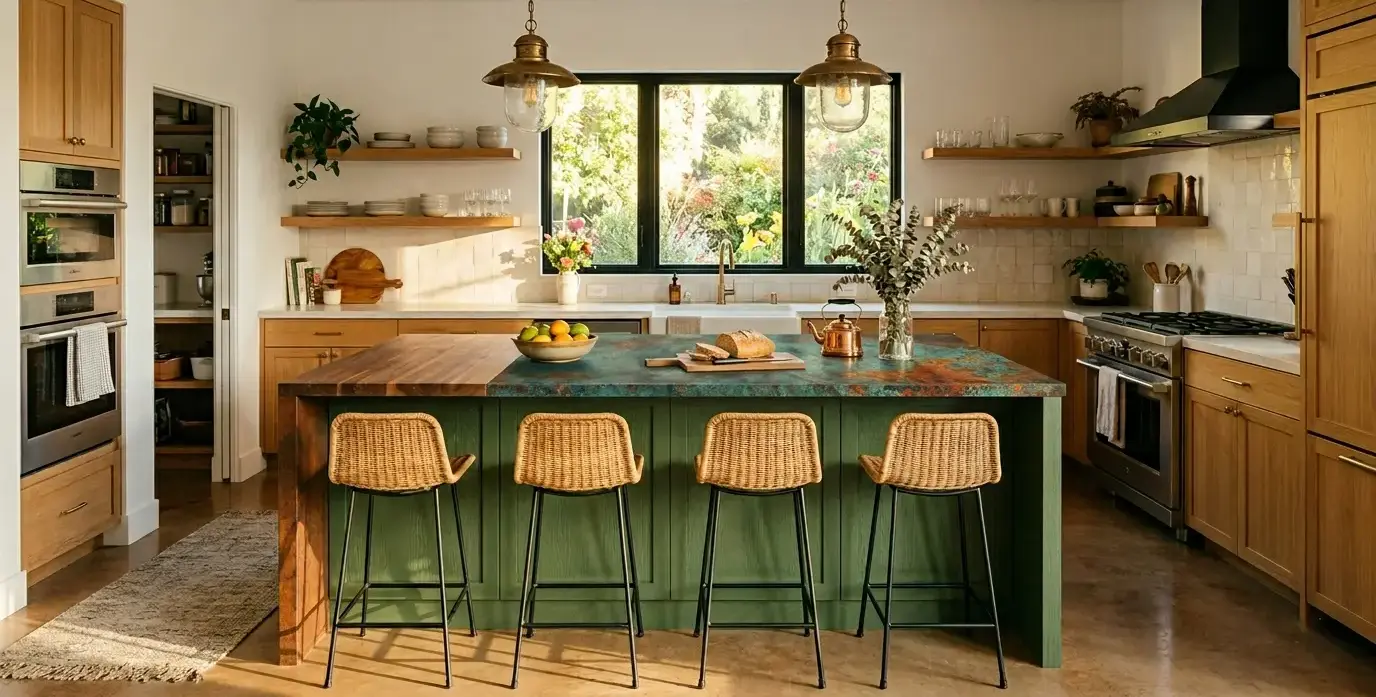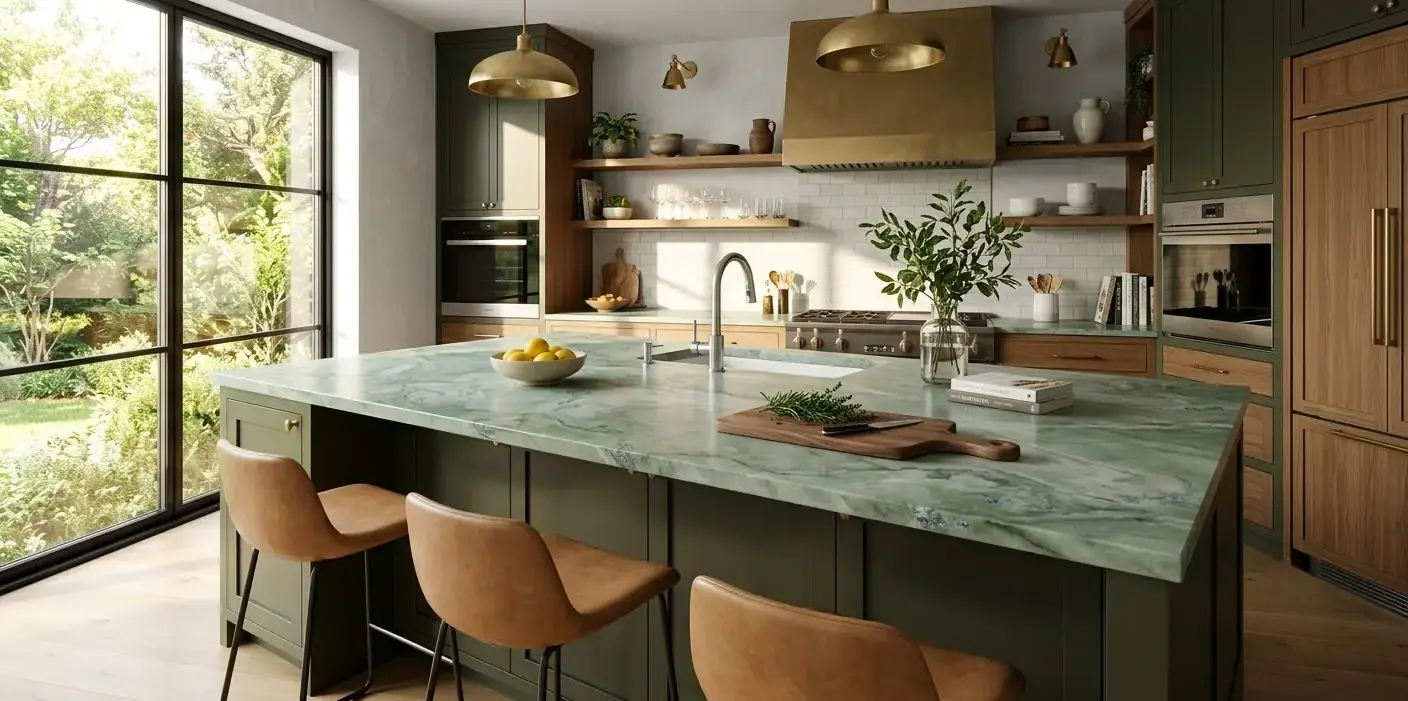
Green slab for kitchen island delivers one of the most sought-after combinations in luxury interiors: rare earthy tones, natural movement, and a surface that commands attention. The right stone ties together warm wood accents, neutral cabinetry, and metallic fixtures in a way no painted finish can replicate. Whether crafted from quartzite, marble, granite, or high-density porcelain, green-toned slabs often reveal secondary hues of beige and cream, taupe and brown, gold and honey, rust and orange, and soft blue-gray accents, making each piece truly unique.
Veining patterns range from tight linear flows and cross-cut designs to sweeping marble-like arcs and soft, cloudy washes of color. For anyone planning a kitchen renovation or statement remodel green stone island slabs offer a compelling starting point.
Slab Specifications: Green Slab for Kitchen Island
Green-toned slabs for kitchen island use span multiple material categories. Natural quartzite in green registers between 6 and 7 on the Mohs hardness scale, making it harder than most marbles and resistant to everyday scratching. Green marble typically scores between 3 and 4, offering softer surface character but exceptional visual depth. Granite with greenish undertones sits around 6 to 6.5 and absorbs very little moisture, with a water absorption rate commonly below 0.4%. Dense porcelain slabs engineered to mimic green stone carry near-zero absorption rates, often under 0.05%, and are nearly impervious to staining.
Standard slab thickness runs at 2 cm and 3 cm, with 3 cm preferred for kitchen island tops due to added weight and edge-profile flexibility. Slab dimensions typically measure 55 x 110 inches or larger, depending on the block and material type. Green quartzite and green marble are quarried primarily in Brazil, India, and select regions of Europe, each source contributing distinct mineral character to the color and veining pattern.
Compared to engineered quartz, natural green stone offers unrepeatable patterning and better heat tolerance at the surface. Compared to granite, marble-type green stones provide softer, more romantic veining but require sealing to maintain low absorption. The Calacatta Marble Kitchen Island page offers a useful comparison for shoppers weighing green versus classic white marble tones.
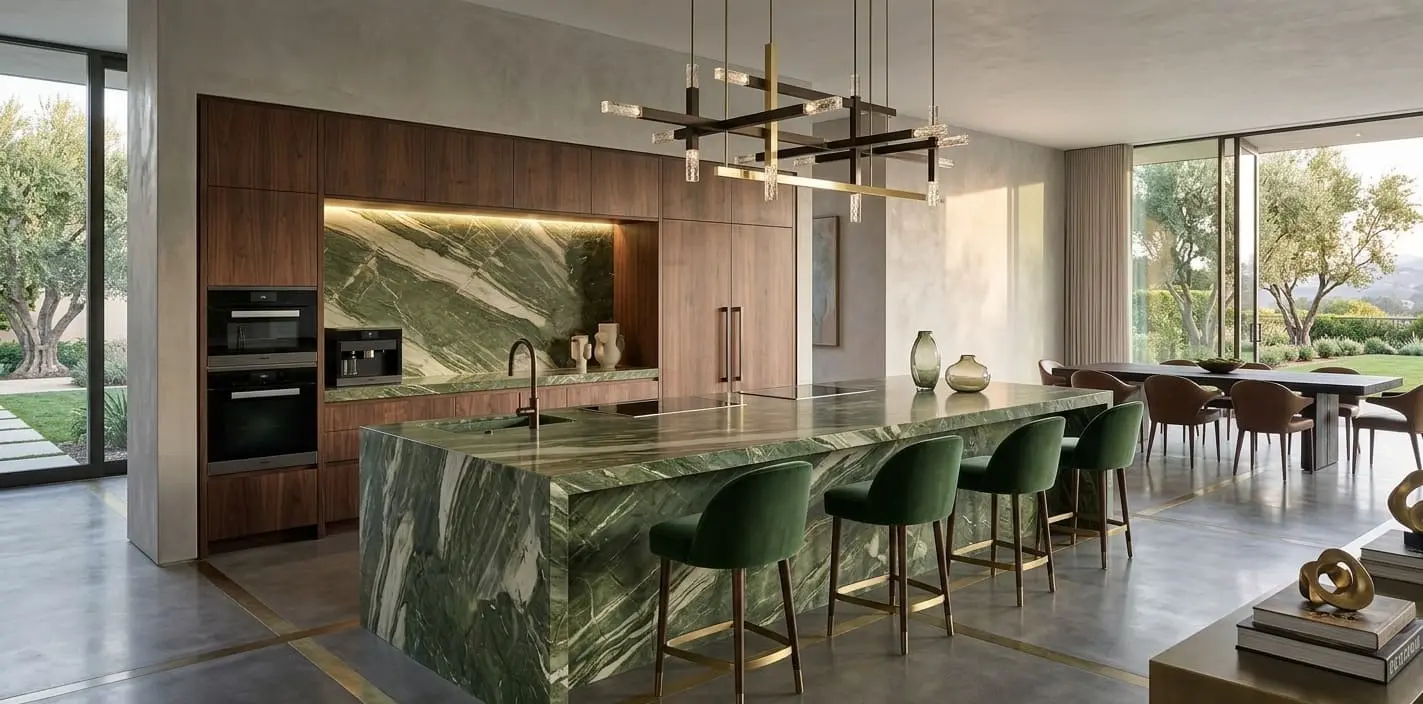 Conceptual rendering
How Green Island Slabs Work Across Layout and Room Types
Special patterning found in green slabs performs best when the full stone face is showcased in a continuous horizontal run across a green kitchen island top. Horizontal layouts let the linear and cross-cut veining travel across the eye, expanding the visual width of the space. Vertical installation on accent walls or waterfall island sides creates height and drama, particularly when marble-like veining runs floor to ceiling.
In kitchens, green slabs anchor modern, transitional, and even rustic designs. Paired with white or off-white cabinetry, the green draws out the gold and honey tones within the stone. Against dark walnut or charcoal cabinetry, the blue-gray accents and rust undertones take prominence, delivering a richer, moodier aesthetic.
In bathrooms, a green slab vanity top or feature wall works especially well alongside warm brass or matte black hardware. For living rooms and function halls, large green slabs used as accent walls or fireplace surrounds introduce organic texture without overwhelming the space.
Practical Advantages That Make Green Slabs a Functional Choice
- Surface hardness: Quartzite and granite green slabs handle cutting board use and cookware placement without visible damage under normal conditions.
- Heat resistance: Natural stone surfaces tolerate brief contact with warm pots better than most synthetic alternatives.
- Low porosity options: Dense granite and porcelain variants resist liquid penetration, keeping the surface hygienic in food-prep environments.
- Unique pattern per slab: No two green slabs are identical. The special cross-cut and marble-like veining means the green kitchen island top is a permanent original.
- Color depth under light: Green-toned stone responds dynamically to natural and artificial lighting, shifting from muted sage in shadow to vivid emerald in direct sunlight.
- Sealing extends life: Marble and lower-density quartzite benefit from annual sealing, which maintains absorption rates and prevents long-term staining from oils and acidic liquids.
For a detailed breakdown of care and maintenance across stone types, the stone slab care guide covers sealing schedules, cleaning products to avoid, and long-term upkeep for marble and quartzite surfaces.
A Long-Term Investment That Holds Its Value
Stone surfaces consistently outperform synthetic materials in resale contexts. A green slab for kitchen island is not a trend-driven finish. The earthy palette and special patterning place it in the same timeless category as classic marbles, meaning the investment holds relevance across design cycles rather than dating to a particular year. Buyers and designers consistently return to green slabs for kitchen island surfaces precisely because the color connects to nature without feeling temporary.
Green stone's durability also means the surface typically outlasts the cabinetry and fixtures around it. Properly sealed and maintained, a natural stone island top can serve two or three generations of use without replacement. From a cost-per-decade perspective, that longevity positions natural green slabs favorably against laminate or quartz alternatives that may require replacement within ten to fifteen years. The team at Nova Tile and Stone can help you evaluate specific slab options in person, where lighting and physical texture make the selection process far more accurate than online browsing alone.
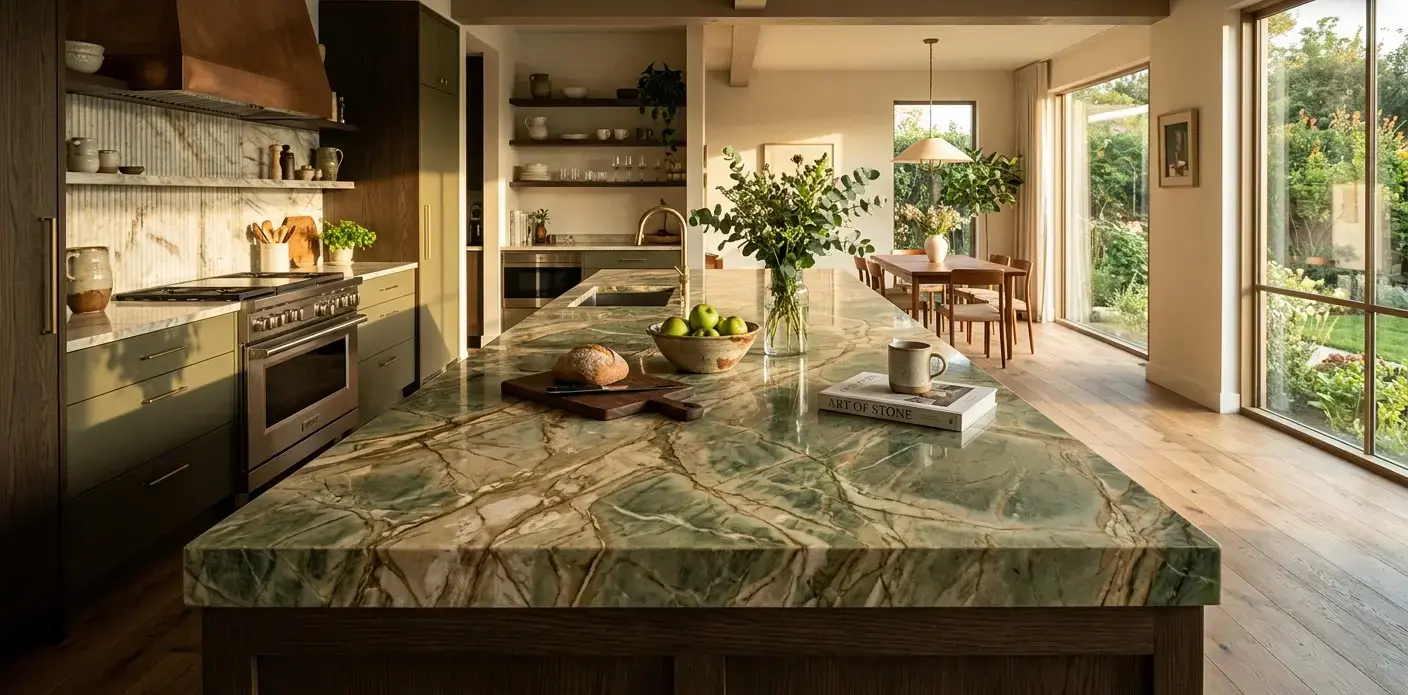 Conceptual rendering
Frequently Asked Questions
Quartzite, marble, granite, and engineered porcelain all come in green variations. Quartzite offers the best combination of hardness and natural beauty. Marble provides softer, more fluid veining. Granite delivers exceptional durability and low absorption. Porcelain mimics the look with near-zero porosity.
Green quartzite ranks between 6 and 7 on the Mohs hardness scale, which places it above most marbles and comparable to granite. It resists scratching and chipping under typical kitchen use, though sharp impact at edges can cause fractures in any natural stone.
Marble is more porous than quartzite or granite and will absorb liquids like red wine, citrus juice, or oil if left unsealed. Annual sealing significantly reduces absorption and keeps the surface protected. Polished finishes seal more tightly than honed surfaces.
Green slabs for island commonly carry secondary tones of beige, cream, taupe, warm brown, gold, honey, rust, and soft orange, with some pieces showing blue-gray mineral accents. These secondary hues make green slabs highly versatile across a range of cabinet and flooring combinations.
Polished, honed, leathered, and brushed finishes are the most common. Polished maximizes color depth and reflectivity. Honed creates a matte, softer look with a slightly more natural feel. Leathered adds tactile texture and is particularly popular for kitchen islands due to its fingerprint resistance.
See Green Slabs in Person Before You Decide
Green slabs are best selected in person, where natural light reveals the full depth of color, veining movement, and finish character. Browse the live slab inventory or book a free design consultation to view current availability across showroom locations in Reno, Minden, Sacramento, and Fernley.