Gray Travertine Stone
Gray travertine stone slabs are natural stone surface panels formed from sedimentary limestone, created over thousands of years through the deposit of calcium carbonate in mineral-rich spring environments. Composed primarily of calcite, this stone is also known as silver travertine or Travertino Grey, quarried primarily in Italy, Turkey, Iran, and Peru, and recognized for its soft gray tones, warm taupe undertones, and characteristic linear veining ranging from silver-gray to deeper charcoal.
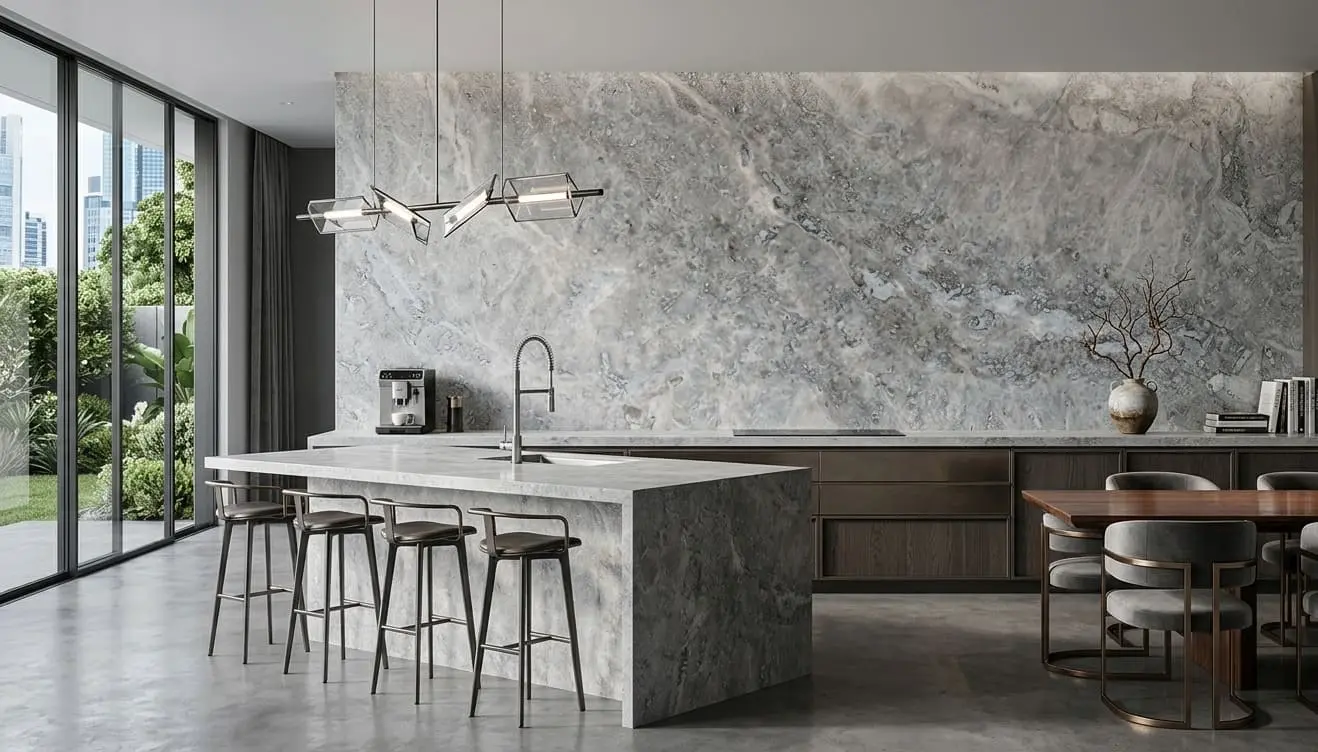
As a natural stone countertop and surface material, gray travertine stone is used across kitchen countertops, bathroom vanities, backsplashes, feature walls, fireplace surrounds, and commercial surface applications. It is available in polished, honed, leathered, and specialty finishes, typically supplied in 2cm and 3cm slab thicknesses. Rated 3 to 4 on the Mohs hardness scale, travertine is softer than granite and benefits from proper sealing and careful handling in high-traffic environments.
At Nova Tile and Stone, each slab is sourced from verified premium quarries and inspected to meet quality standards in color, veining, and structural integrity.
Material Characteristics of Gray Travertine Stone
Unlike warmer varieties such as ivory travertine, gray travertine stone carries a cooler, more contemporary tone that complements a wide range of design schemes, from minimalist modern interiors to rustic, earthy aesthetics. Its coloring, shaped by iron hydroxides and manganese carbonates during formation, is typically accented by creamy white or beige veining that can give each slab a layered visual character under varied lighting conditions.
A defining physical property of travertine is its natural porosity. Carbon dioxide bubbles escaping during geological formation leave behind voids and channels that give the stone its characteristic open texture. In finished slabs, these voids are typically filled with grout or resin to create a smoother working surface. Porosity levels typically range from 2 to 12 percent, depending on the variety, and cut direction influences the final appearance: a cross cut produces a mottled pattern, while a vein cut exposes the linear veining gray travertine is most recognized for.
Gray travertine occupies a tonal range that is neither stark nor cold. It tends to carry enough inherent warmth to bridge contemporary and traditional design languages, pairing well with wood, matte metal, and other organic materials.
Durability, Care, and Maintenance
Gray travertine is generally dense enough for regular residential and commercial use. With a well-documented history in monumental architecture, including its use as a primary building material for the Colosseum in ancient Rome, it has a long record of structural durability. Surface damage such as light etching or staining may be repairable without full slab replacement, depending on the extent of the damage.
As a calcite-based material, it benefits from consistent care to preserve its surface finish. Sealing is strongly recommended for countertop and backsplash applications, as a penetrating stone sealer can help reduce staining and moisture absorption. At Nova Tile and Stone, we advise resealing twice per year for kitchen countertops, and every one to two years for lower-traffic applications.
For routine upkeep, surfaces are best cleaned with a pH-neutral stone cleaner and a soft cloth. Acidic substances such as vinegar, citrus juice, wine, and coffee are best avoided, as they can etch the calcite surface. Wiping up spills promptly and using trivets and cutting boards are recommended, as travertine is more vulnerable to scratching and surface damage than harder stones like granite.
Frequently Asked Questions
Gray travertine stone is a sedimentary limestone composed primarily of calcite, formed when calcium carbonate-rich groundwater emerges near hot springs or limestone cave systems and deposits mineral layers over thousands of years. The gray coloring generally results from iron hydroxides, manganese carbonates, and other mineral impurities absorbed during formation. Italy, Turkey, Iran, and Peru are the primary sourcing regions, each producing stone with distinct tonal and structural qualities.
Yes, with proper preparation and maintenance. Filled travertine slabs in a honed or polished finish are the recommended choice, as the closed surface provides a more even, easier-to-clean working area. The stone should be sealed before installation and resealed twice per year. Trivets and cutting boards are recommended, as travertine is softer than granite and sensitive to etching from acids.
Filled travertine has its natural pores closed with grout or resin, resulting in a smoother surface suited to countertops, vanity tops, and other high-use applications. Unfilled travertine preserves its natural open voids, producing a raw, textured appearance suited to decorative feature walls and rustic applications. At Nova Tile and Stone, filled travertine is our standard recommendation for countertop use.
Four finishes are available: polished, honed, leathered, and specialty. Polished produces a high-gloss surface that intensifies the stone's veining and color depth. Honed offers a smooth, matte result widely used in kitchen and bathroom applications. Leathered enhances the stone's natural texture for a more tactile surface, while specialty gives a weathered, antiqued quality suited to traditional or rustic schemes. Contact the Nova Tile and Stone team to discuss the right finish for your project.
Gray travertine and marble share a similar Mohs hardness range of 3 to 4, as both are calcite-based stones with comparable scratch and etch sensitivity. Granite rates harder at 6 to 7 on the Mohs scale and is generally more resistant to scratching and heat. A practical advantage travertine may hold over marble is repairability, as surface damage can often be refinished without full slab replacement. It tends to have a more textured, organic appearance than marble's typically veined surface, and a warmer tone than most granites.
Transform Your Space with Natural Stone
With its natural variation, understated tone, and documented use across centuries of architecture, gray travertine stone brings a material depth to any space that is difficult to achieve with manufactured surfaces. Whether you are renovating a kitchen, designing a bathroom, or planning a commercial fitout, this natural stone offers the versatility to support a wide range of design visions.
At Nova Tile and Stone, our team is ready to help you find the right slab for your project. Visit our showroom to view our current gray travertine inventory, or contact our stone specialists to discuss your requirements.