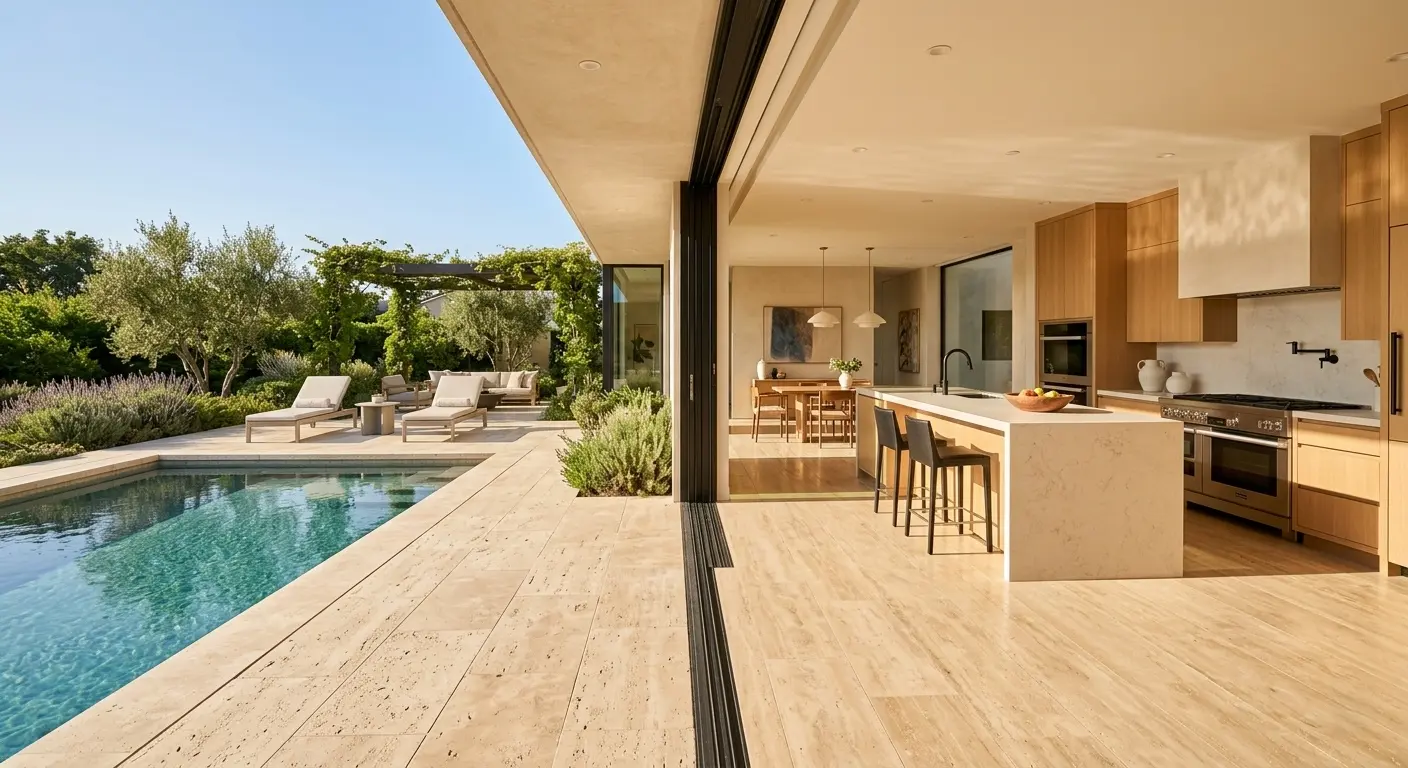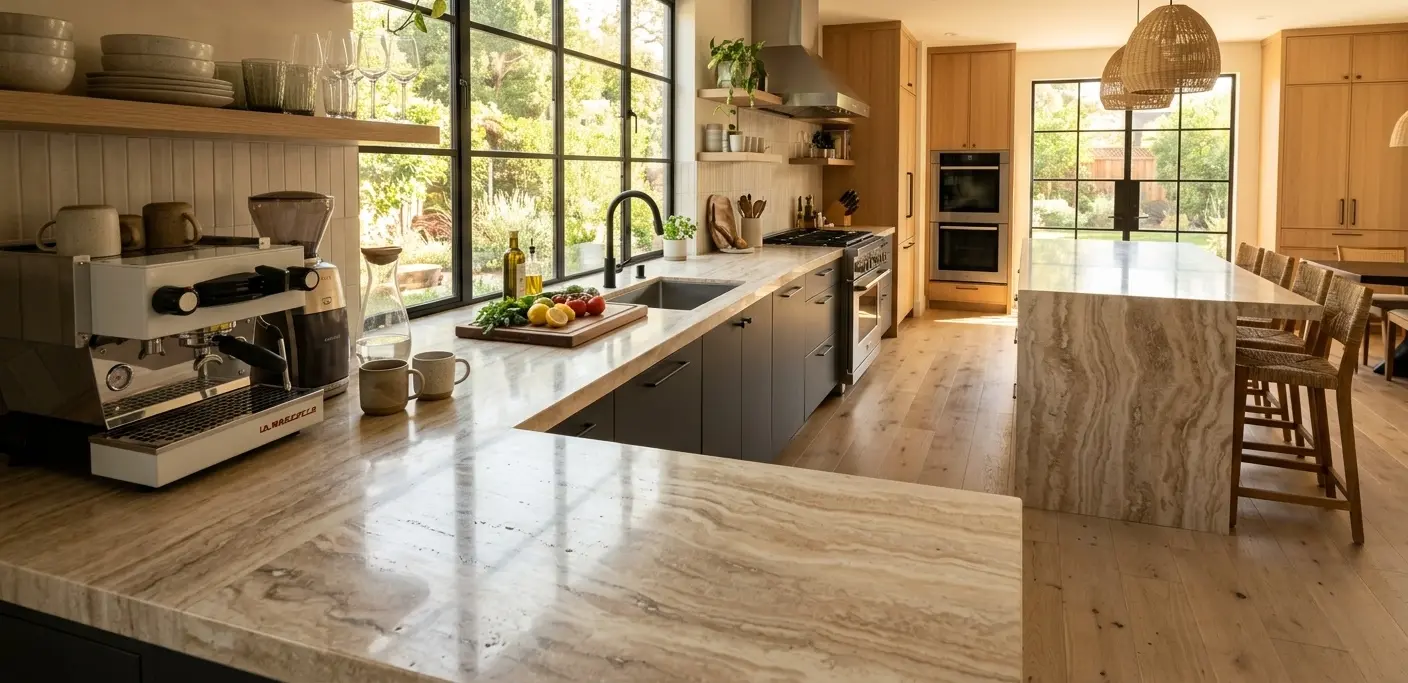
Beige Travertine is a rare natural stone slab available in polished, honed, and leathered finishes, prized for its warm cream-to-ivory palette and distinctive cross-cut or vein-cut patterning. Because it carries a rare-pattern designation, no two slabs share identical movement or color distribution, which makes every kitchen countertop, bathroom vanity, and flooring installation genuinely one of a kind. It suits a broad range of applications, from indoor kitchen countertops and bathroom vanities to outdoor patios, pool decks, and wall cladding. Nova Tile and Stone's natural stone slab specialists offer live slab viewing, complimentary design consultations, and home delivery, so you can select and confirm your exact piece before committing.
Beige Travertine Stone Specs, Durability, and What Sets It Apart
Beige Travertine is a sedimentary calcium carbonate stone formed over millennia by mineral-laden hot spring deposits. It scores 3 to 4 on the Mohs hardness scale, which places it softer than granite (6 to 7) but fully workable for custom edge profiles and precision cuts. Standard slab thickness runs 3/4 inch (20mm) for countertops and 1-1/4 inch (30mm) for flooring and exterior cladding applications. Water absorption rates fall between 0.5% and 4% depending on slab density, which is higher than granite or quartzite. Periodic sealing every one to two years protects the surface in kitchen and bathroom environments where moisture exposure is frequent.
Primary quarry sources include Iran, Italy, and Turkey, with additional production in Mexico and Peru. Iranian beige travertine typically features tighter pitting and a cleaner background tone, while Italian varieties show richer golden undertones. Compared to marble, beige travertine is warmer in color and more tactile in texture, while generally offering a more accessible price point. Against engineered quartz, it delivers material depth and natural variation that manufactured surfaces cannot reproduce, though it does require more consistent maintenance.
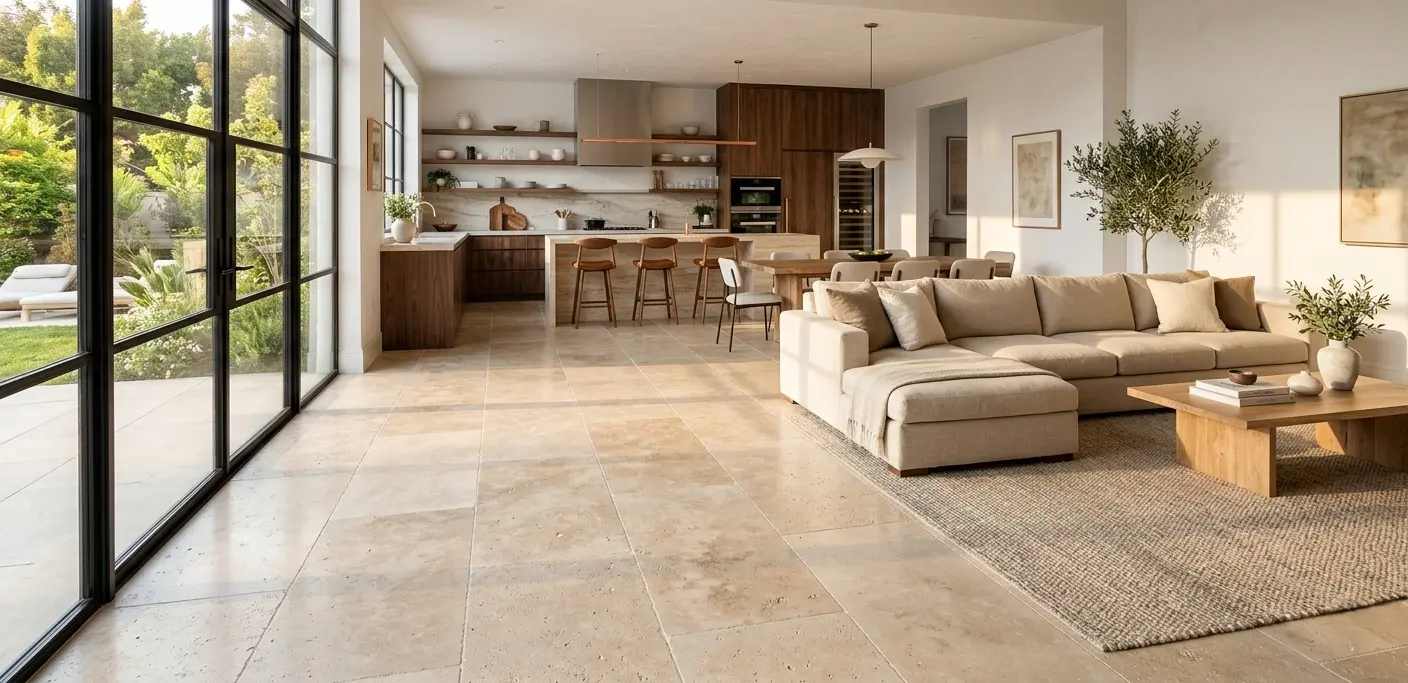
Layout Options and Where Beige Travertine Performs Best
Beige travertine adapts cleanly to a wide range of design directions. On kitchen countertops and bathroom vanities, bookmatching two consecutive slabs creates a mirrored veining effect that turns a working surface into a focal point. For flooring, large-format slabs installed in a straight stack, brick offset, or diagonal pattern read as a seamless plane that visually expands any room.
A herringbone layout in honed finish suits transitional or Mediterranean interior styles particularly well. On exterior patio surfaces and pool decks, the leathered finish adds natural traction while maintaining the stone's warm, resort-style character. As wall cladding, vertical-stacked panels in a polished finish bring a refined, architectural quality to accent walls and fireplace surrounds. Browse our live slab inventory to see which beige travertine slabs are currently in stock.
Practical Advantages of Choosing Beige Travertine
- Naturally cool surface temperature makes it comfortable underfoot in warm climates, ideal for pool decks and outdoor patios
- Three distinct finish options allow the same stone to serve modern, transitional, or classic interior styles without visual conflict
- Performs reliably on fireplace surrounds and wall cladding because it does not absorb or transfer excess heat
- Each slab carries a unique pattern, so no two kitchen countertops or bathroom vanities will look identical
- Compatible with radiant in-floor heating systems when properly sealed and installed over a structurally sound substrate
- Rare-pattern classification limits total supply, giving each slab added collectible value as a design material
If you are also weighing travertine against marble, quartzite, or granite for full-room flooring, the Natural Stone Slab Flooring guide covers finish selection, stone comparisons, and long-term care in practical detail.
Frequently Asked Questions
Beige travertine is a natural sedimentary limestone formed by calcium carbonate deposits from hot spring mineral water. Over thousands of years, those deposits build into dense stone layers with characteristic pitting and flowing veining. It is quarried primarily in Iran, Italy, and Turkey.
Yes. With a proper sealer applied before use and refreshed every one to two years, beige travertine performs well on kitchen countertops. Wiping spills quickly, especially acidic liquids, and using pH-neutral cleaners will protect the finish long term.
Three finishes are available: polished, which produces a reflective, formal surface; honed, which delivers a soft matte look popular in contemporary and transitional kitchens and bathrooms; and leathered, which adds a subtle texture ideal for flooring, patios, and pool decks.
Both are calcium carbonate stones, but travertine forms sedimentarily while marble is metamorphic. Beige travertine is warmer in tone, more textured on the surface, and often more affordable than comparable marble slabs. Marble tends to show more dramatic, flowing veins, while travertine features a more organic, earthy movement.
Yes. Honed and leathered finishes provide adequate traction for outdoor use, and the stone's natural composition handles outdoor temperature cycles well. Sealing is essential in outdoor settings to prevent moisture absorption, and using a product rated for exterior stone will keep the surface protected season to season.