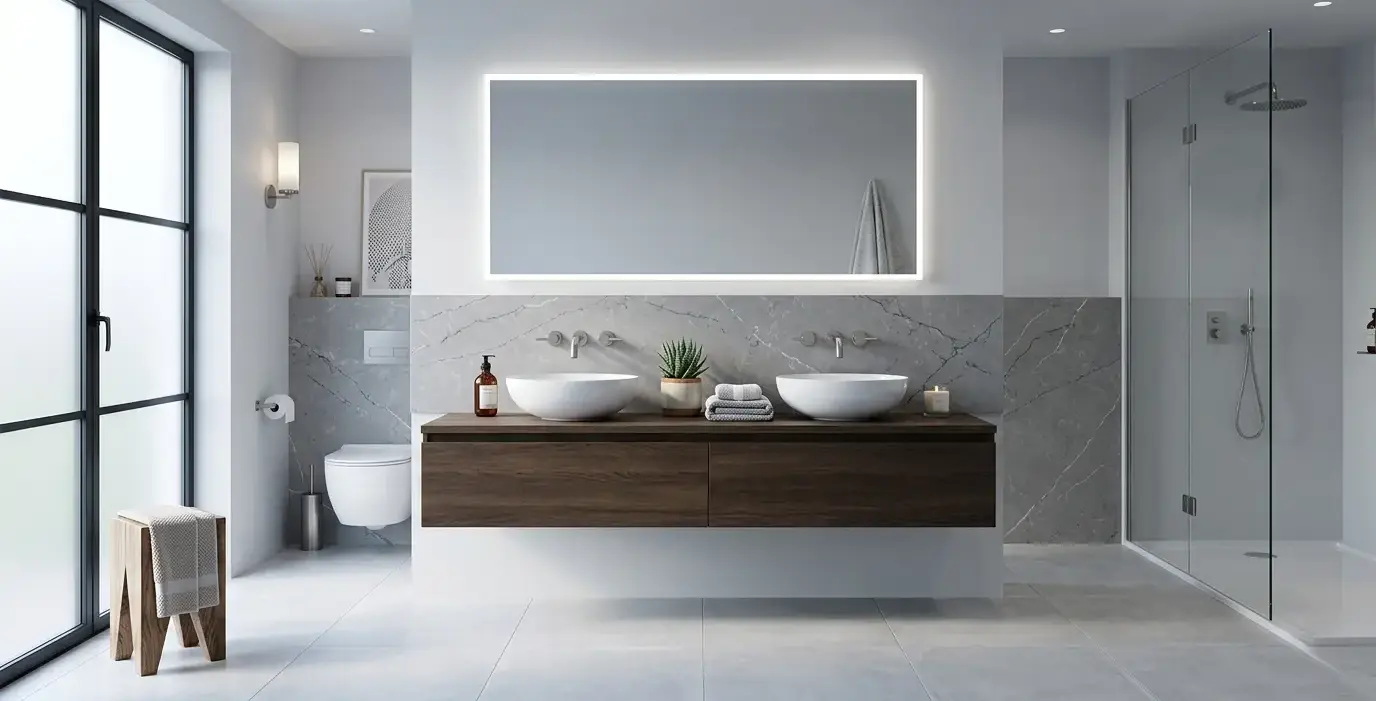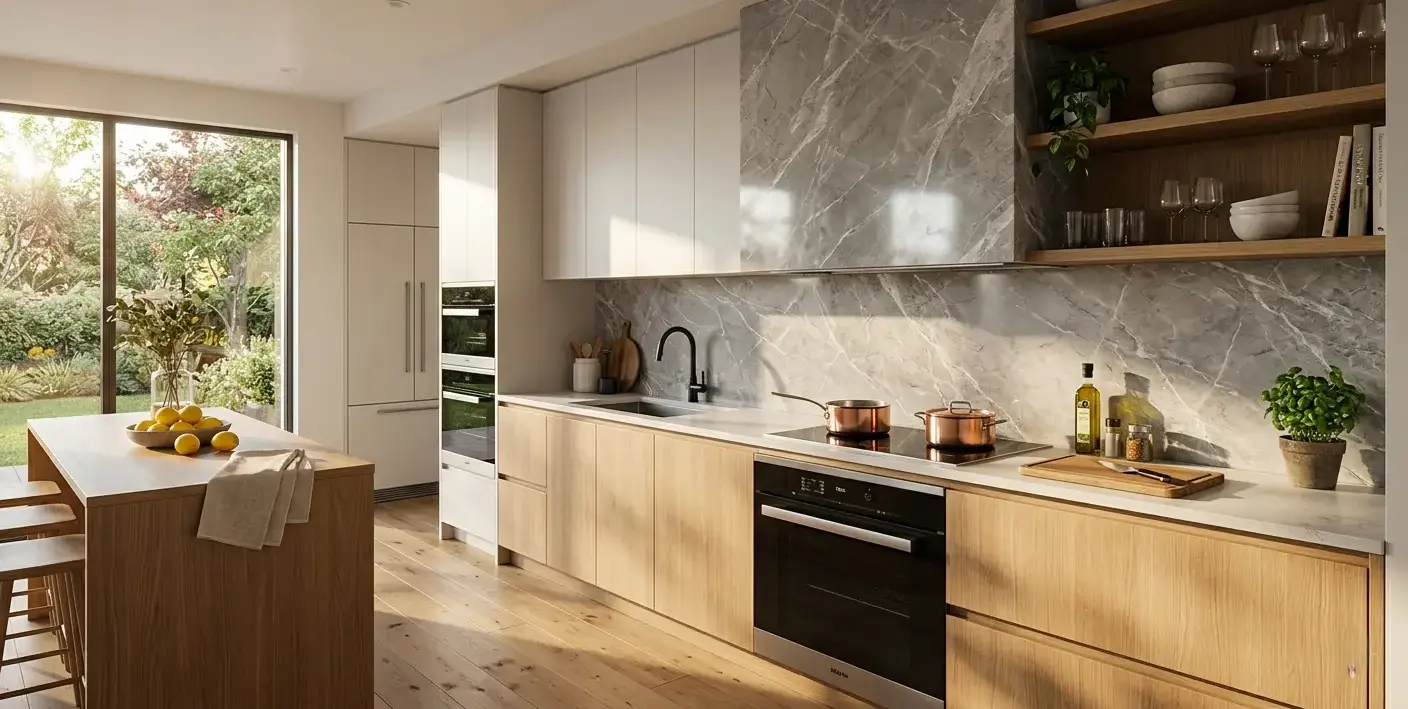
A gray slab used as a backsplash in natural or engineered stone transforms kitchens and bathrooms with layered depth, neutral versatility, and enduring surface character. Gray stone slabs are available in marble, quartzite, granite, dolomite, travertine, quartz, and porcelain, each offering distinct veining, texture, and finish options suited to a range of backsplash designs.
Nova Tile and Stone slab collections present gray slabs in polished, honed, and leathered finishes depending on material.
Gray Stone Slab Specifications: Material, Finish, and Performance Data
Gray marble is predominantly quarried in Italy, Turkey, and Greece, while gray quartzite and granite originate from quarries across Brazil, India, and the United States. These geographic sources produce the tonal range and veining character most associated with premium gray backsplash designs.
Property | Marble | Quartzite | Granite | Quartz (Engineered) |
Mohs Hardness | 3–4 | 7–8 | 6–7 | 7 (engineered) |
Standard Thickness | 3/4 in (2 cm) | 3/4–1.25 in | 3/4–1.25 in | 3/4 in (2 cm) |
Water Absorption (ASTM C97) | 0.1–0.2% | < 0.1% | <0.5% | < 0.02% |
Available Finishes | Polished / Honed / Leathered / Specialty | Polished / Honed / Leathered / Specialty | Polished / Honed / Leathered / Specialty | Polished / Honed |
Indoor Wall (Backsplash) | Yes | Yes | Yes | Yes |
Gray marble commonly presents silver-white and charcoal secondary tones. Gray quartzite often carries white, taupe, or subtle gold undertones. Gray granite pairs well with black, cream, or rust secondary colorways. Engineered quartz in gray delivers a more consistent background color with controlled veining depth. Compared to softer sedimentary options, quartzite and granite offer greater scratch resistance for kitchen applications, though cutting boards remain recommended regardless of material.
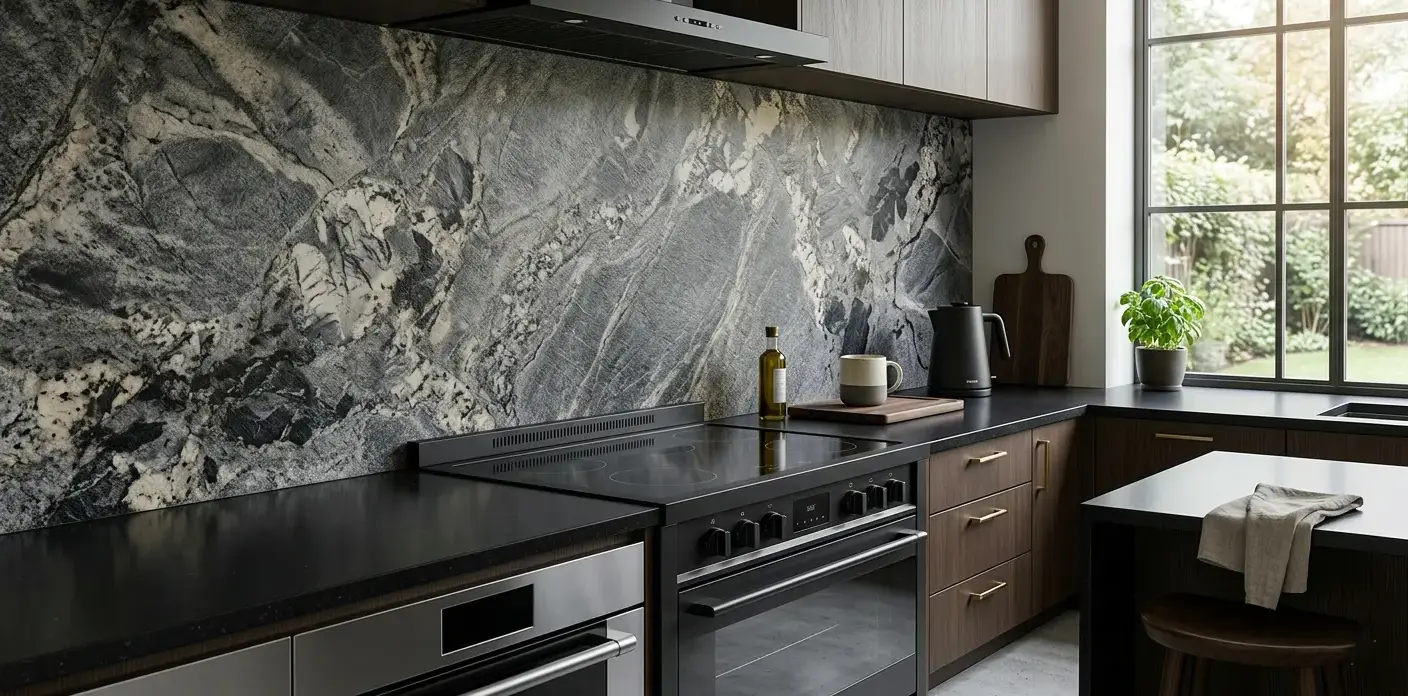 Conceptual rendering
Layout and Spatial Pairing for Gray Stone
Vertical slab installation emphasizes height in kitchen and bathroom spaces, drawing the eye upward along natural veining lines. Horizontal layouts allow dramatic book-matched panels to run as a continuous visual field across countertops. For more intricate backsplash designs, herringbone or chevron cuts from a single gray slab maintain tonal cohesion while adding geometric movement. A full-height gray marble or quartzite slab behind a range or vanity functions as a focal surface while anchoring the surrounding cabinetry and hardware palette.
Gray stone pairs naturally with white, charcoal, warm wood, and matte black finishes. In bathrooms, honed or leathered surfaces reduce glare under artificial lighting and provide a tactile contrast to polished fixtures. For kitchen backsplash use, polished finishes reflect light effectively, though matte and honed options perform better in high-moisture zones where slip and water spotting are concerns.
Practical Advantages of a Gray Stone Slab Backsplash
- Finish variety: Polished, honed, leathered, and specialty options are available across most natural stone types; engineered quartz supports polished, honed, and specialty finishes.
- Color neutrality: Gray tones coordinate with a wide range of cabinetry, hardware, and countertop materials without requiring a complete design overhaul.
- Surface options: Large-format slab cuts reduce visible seam lines compared to smaller formats, producing a cleaner visual field on backsplash surfaces.
- Maintenance clarity: Natural stone slabs require periodic sealing to minimize staining; proper guidance on sealing your stone slab helps preserve surface performance over time.
- Heat resistance: Stone slabs tolerate incidental heat near ranges, but direct pan placement without trivets can risk thermal shock regardless of material.
- Abrasive cleaners: Avoid abrasive products on all polished and honed surfaces; pH-neutral cleaners are appropriate for routine maintenance.
Gray Slabs: Enduring Interior Value
Gray stone slabs have maintained consistent demand across residential and commercial design because the color family accommodates shifting decor preferences without becoming dated. Marble slabs that comply with ASTM C503 requirements for dimension stone are suitable for interior vertical wall applications. Materials exhibiting low water absorption values when tested in accordance with ASTM C97, including quartzite, granite, and engineered quartz, generally demonstrate strong resistance to moisture penetration and moisture-related deterioration over time.
Trade professionals sourcing gray slabs for backsplash projects can review TCNA industry standards for installation and performance benchmarks applicable to stone wall surfaces. Design professionals and contractors are also encouraged to explore trade account access for streamlined procurement and project pricing.
Purchasing gray stone slabs requires careful consideration. Sealing requirements, finish selection for the intended application, and material hardness should all be evaluated before making a final decision. The aesthetic appeal and durability of gray stone backsplash slabs make them a worthwhile long-term investment for both kitchens and bathrooms.
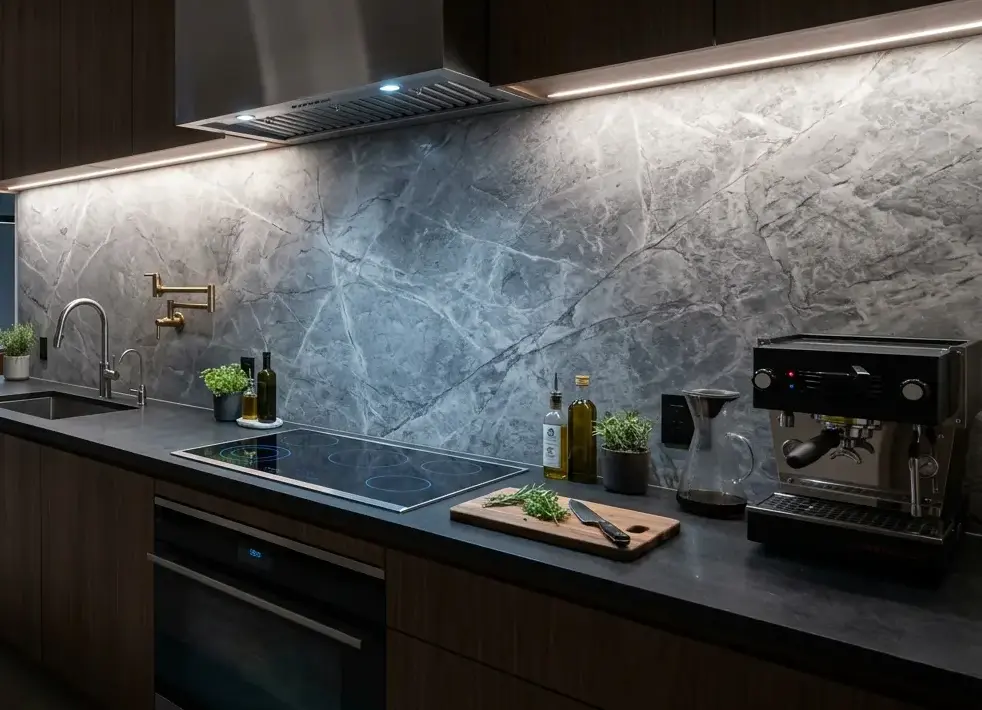 Conceptual rendering
Note: Some images on this page may be conceptual renderings created to illustrate design possibilities and may not depict actual installations.
Stay Updated With Our New Posts
Catch Up on Our Latest Highlights!
Frequently Asked Questions
Gray backsplash slabs are available in marble, quartzite, granite, dolomite, travertine, quartz, and porcelain. Each material differs in hardness, absorption rate, available finishes, and maintenance requirements, so selection should be based on the specific application and traffic level.
Polished finishes are common for gray marble and quartzite backsplash designs because they reflect light and enhance veining contrast. Honed and leathered finishes reduce glare and fingerprint visibility, making them practical for high-use kitchen zones. Finish selection should account for cleaning habits and moisture exposure.
Most natural gray stone slabs, including marble, quartzite, granite, dolomite, and travertine, require periodic sealing to reduce surface porosity and minimize staining risk. Engineered quartz has very low absorption and generally does not require sealing, though manufacturer guidance should be confirmed for each product.
Gray quartzite rates 7 to 8 on the Mohs hardness scale, making it more scratch-resistant than gray marble, which rates 3 to 4. Both are suitable for backsplash applications, but quartzite holds up better to incidental contact from cookware and kitchen tools without additional protective measures.
Yes. Marble, quartzite, granite, dolomite, and travertine are appropriate for bathroom backsplash and wall applications. Honed or leathered finishes are often preferred in wet bathroom zones as they reduce surface slipperiness compared to polished stone. Quartz is limited to indoor wall applications and performs well in bathroom environments with consistent moisture exposure.
See Gray Slabs in Person
Viewing stone slabs in person reveals tonal variation, veining movement, and finish character that digital images cannot fully capture. Request a slab quote to begin the selection process with direct access to current inventory and expert guidance on material performance for your specific kitchen or bathroom project.