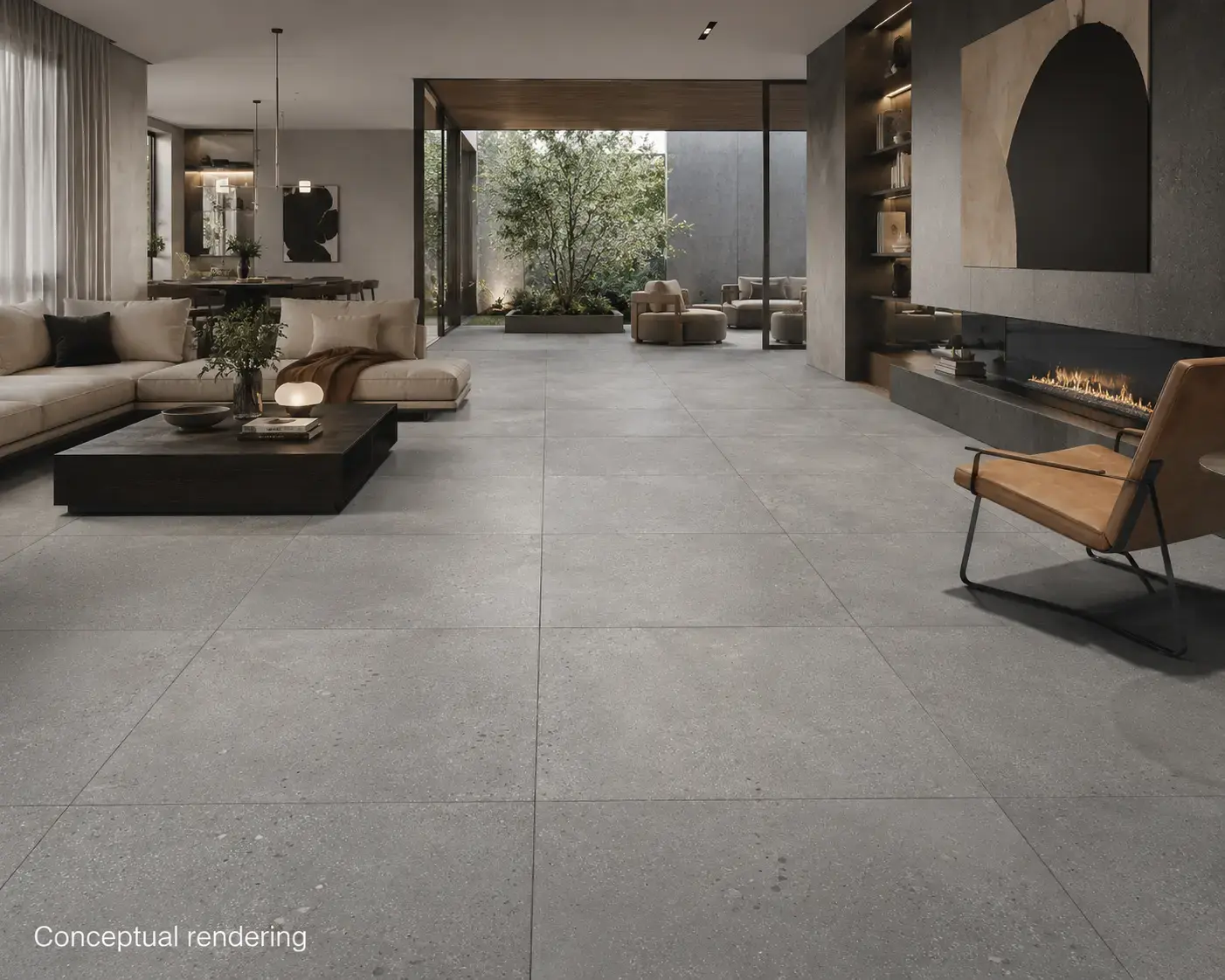
Porcelain tile is an engineered flooring material that is fired at high temperatures to create a dense, low-porosity surface. Concrete look porcelain tile flooring is a type of porcelain tile designed to reproduce the tonal variation, texture, and trowel-mark movement of poured concrete through a printed or textured finish, rather than being poured and cured on site. It has a water absorption rate below 0.5%, which meets the ANSI A137.1 standard for impervious tile. Unlike real concrete, it typically does not require sealing and is more resistant to cracking, staining, and moisture damage over time. This makes it a common choice for homeowners and designers who want an industrial, minimalist floor without the ongoing maintenance that real concrete requires.
The appeal of concrete style tile comes from a broader shift toward pared-back, architectural interiors, where warehouse conversions, loft apartments, and contemporary new builds favor neutral, textural surfaces over high-gloss or heavily patterned ones. Digital printing technology now allows manufacturers to reproduce the subtle color drift and micro-texture of real concrete across large tile formats, so the finished floor reads as a continuous surface rather than a repeating pattern. That visual continuity is a major reason concrete effect porcelain has become a frequent specification in kitchen, living area, and commercial flooring projects.
APPLICATIONS
Where Concrete Look Porcelain Tile Flooring Works Well
This material performs well across a wide range of settings. Its low water absorption, high abrasion resistance, and dependable slip resistance hold up whether the space sees light foot traffic or constant daily use.
COMPARISON
Why Choose Concrete-effect Porcelain Over Real Concrete
Knowing where this material holds up naturally raises the next question: what it offers over the real thing.
Poured concrete floors require periodic sealing to resist staining and moisture penetration, and without that maintenance they can develop cracks, efflorescence, or surface pitting over time. Porcelain tile in a concrete finish typically does not need sealing to remain water and stain resistant, since its low absorption rate is a property of the fired material itself rather than a surface coating. It also offers more consistent color and texture from tile to tile than a hand-troweled concrete slab, which can vary with pour conditions, curing time, and finishing technique.
Breaking strength is another consideration for flooring longevity. Tile that meets ANSI A137.1 and ASTM C648 requirements carries a minimum breaking strength of 250 pounds-force, which supports typical residential and light commercial loads. Buyers comparing products should also confirm the PEI rating printed on the specification sheet, since it indicates how well the surface is likely to hold up to the abrasion of foot traffic and grit over years of use rather than just its initial appearance.
Water absorption | < 0.5% (ANSI A137.1) |
Breaking strength | 250 lbf min (ASTM C648) |
Frost resistance | ASTM C1026 rated |
| DCOF, interior wet | 0.42 min (ANSI A326.3) |
| DCOF, interior wet plus | 0.50 min (ANSI A326.3) |
| Sealing required | No |
MATERIAL SPEC SHEET
UPKEEP
Care and Maintenance
Those same properties are also what keep day-to-day care simple.
Routine care for concrete look porcelain tile flooring is straightforward. Since concrete look tile generally doesn't rely on a surface sealant to stay water and stain resistant, maintenance mainly comes down to keeping grout lines clean, as grout is more porous than the tile and can absorb spills if left unaddressed.
DAILY Sweep or vacuum to remove grit that would otherwise scratch the surface finish.
WEEKLY Damp mop with a pH-neutral tile cleaner to handle everyday soiling.
GROUT Use a sealed, stain-resistant grout and clean it periodically with a soft brush and a neutral cleaner.
AVOID Abrasive scouring pads and highly acidic or alkaline cleaners, which can dull a matte finish.
Shop Porcelain Tile for Every Space
Frequently Asked Questions
Yes. Porcelain tile conducts and retains heat efficiently, which makes it a common pairing with radiant floor heating systems. Installers typically recommend allowing the tile and heating system to be commissioned together so the substrate cures properly before the heat is activated.
It still requires grout joints, though rectified large-format tile is often installed with a narrower joint, commonly around 1/8 inch, to reinforce the look of a continuous poured surface. TCNA guidance generally recommends this as the minimum for rectified tile, since narrower joints require a flatter substrate to avoid visible lippage.
Polished concrete generally needs to be periodically reground and resealed as the surface wears, while concrete look tile generally does not require that kind of renewal. It also has an advantage if damage occurs: a single porcelain tile can usually be replaced without disturbing the rest of the floor, while repairing a section of poured concrete is more involved and can leave a visible patch.
In many cases, yes, as long as the existing surface is flat, structurally sound, and prepared according to TCNA installation guidelines. Large-format tile in particular requires a flat substrate to prevent lippage, so an installer will typically assess subfloor condition before recommending direct installation versus removal.
Matte and textured finishes are more common for concrete look tile because they better replicate the appearance of unsealed poured concrete and typically offer higher slip resistance underfoot. A polished version is available in some product lines but is generally reserved for lower-traffic areas where slip resistance is less of a concern.
Note: Some images on this page may be conceptual renderings created to illustrate design possibilities and may not depict actual installations.
See and Compare this Finish in Person
Photographs and screens can only approximate how a concrete-effect finish looks in real lighting, as the subtle tonal variation and texture that make this tile so convincing are easiest to appreciate in person. Visit the showroom to view full-size samples and discuss format and layout options with our design specialist based on your room and expected traffic conditions, or browse the collection online.
Nova Tile and Stone Product Range
Our Showroom Locations:
RENO | MINDEN | FERNLEY | SACRAMENTO