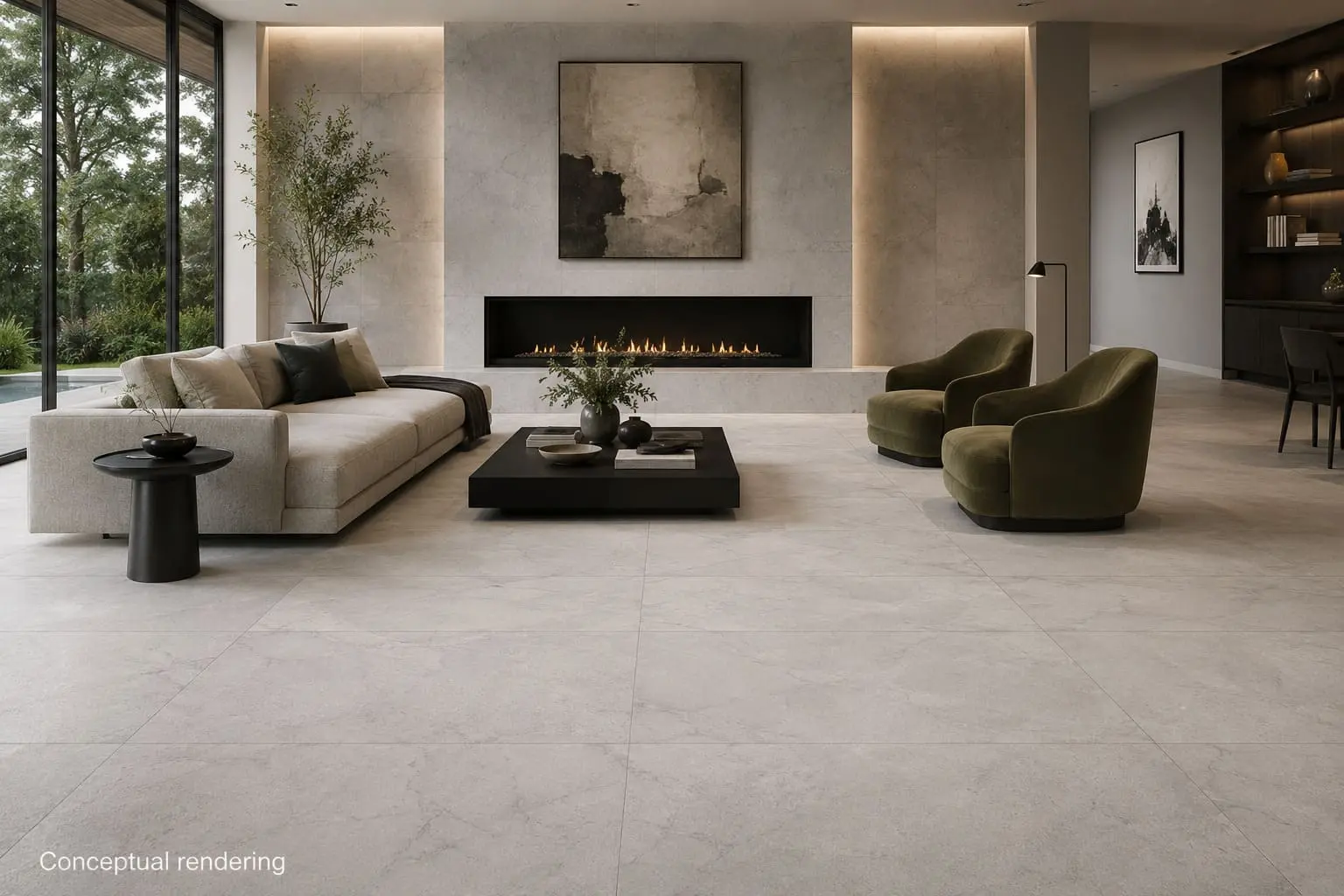
Large format porcelain tile is a ceramic surface where at least one facial dimension exceeds 23 inches (584 mm), as defined by ANSI A108.T:2024. It is made from refined clay, kaolin, feldspar, and silica, pressed under high pressure and fired at approximately 1,200°C (2,200°F). This vitrification process produces a tile body with a water absorption rate of 0.5% or less, which is the threshold that defines porcelain tile under ANSI A137.1 and ISO 13006, and is independently verified by the Porcelain Tile Certification Agency. Large format porcelain tile is typically produced as rectified porcelain tile, with edges mechanically finished to precise dimensions. For a broader overview of finish types, wear grades, and size formats, see Nova Tile and Stone's complete guide to porcelain tile.
Because each tile covers a larger surface area, large format porcelain tile reduces the number of grout joints across a floor or wall, which limits where dirt and moisture can accumulate. Tiles with any side 15 inches or longer also fall under stricter substrate flatness and installation requirements per the ANSI standards published by the TCNA, which is why professional installation is generally recommended for this format.
Where Large Format Porcelain Tile Works Best
Large format porcelain tile performs differently in each setting depending on what the space demands: visual continuity, moisture resistance, or traffic durability.
OPEN-PLAN LIVING AREAS
Wide floor planes can read as a single unbroken surface, reinforcing the scale of the room rather than fragmenting it with a tile grid.
KITCHENS
The dense, vitrified surface resists staining from food, cooking oil, and common household spills, generally without requiring sealers or specialized cleaning products.
BATHROOMS
Porcelain tile's water absorption rate of 0.5% or less makes it well suited to resist moisture penetration in showers and wet floor areas where prolonged contact with water is routine.
ENTRYWAYS
Entry areas take concentrated wear from foot traffic, grit, and tracked-in moisture. Porcelain tile's surface hardness and low porosity make it well suited for all three with minimal degradation over time.
FEATURE WALLS
Installed vertically, large format porcelain tile creates a continuous surface across an accent wall, a surface choice increasingly specified by architects and designers seeking the look of natural stone without its structural weight or sealing requirements.
COMMERCIAL SPACES
Porcelain tile's hardness and abrasion resistance can hold up well under the sustained foot traffic found in lobbies, retail floors, and office common areas.
Large Format Porcelain Tile for Open Living Spaces
In an open floor plan, the flooring connects kitchen, dining, and lounge into a single visual field. A 24x48-inch large format porcelain tile covers exactly eight square feet per piece, substantially more than most standard formats. The same format is also available as wood-look porcelain tile, which offers similar visual continuity with the natural warmth of a wood grain finish. Across an open-plan floor, that translates to far fewer total joints, which can give the surface a more continuous, uninterrupted appearance.
The visual effect tends to be strongest in rooms with high ceilings or floor-to-ceiling glass, where the horizontal line of the floor reinforces the sense of scale.
Fewer joints also mean less porous surface area between tiles where staining can develop, which simplifies routine cleaning over time.
The 24x48-inch format reduces total joint count by roughly 75% compared to a standard 12x24-inch tile across the same floor area, directly reducing how much surface area requires grout maintenance over time.
Care and Maintenance
Porcelain tile's vitrified body, which has a water absorption rate of 0.5% or less, means liquids are unlikely to penetrate the tile surface under normal conditions, making routine cleaning straightforward.
Clean with warm water and a mild soap or neutral pH cleaner. Products containing acids, ammonia, or bleach can damage glazed and polished porcelain tile finishes over time.
Dry sweep or vacuum porcelain tile floors before mopping to remove grit and debris that could scratch the surface during wet cleaning.
After damp mopping, dry polished surfaces with a clean microfiber cloth to prevent water spots as the floor dries.
Wipe spills as they happen, particularly acidic liquids such as wine, coffee, or citrus juice, to prevent residue from drying on the surface.
Cementitious grout joints benefit from a penetrating sealer applied 72 hours after installation to reduce staining and moisture absorption. Epoxy grout is chemically cured and does not require sealing. The tile itself requires no sealer.
Matte and textured finishes should be cleaned periodically with a neutral pH concentrated cleaner to lift grease and residue that warm water alone may not remove.
See Large Format Porcelain Tile in Person
Understanding how a tile performs on paper is a useful starting point, but scale, finish, and texture are best assessed in person. Visiting a showroom lets you compare large format porcelain tile directly on the floor and see how different formats and finishes read in real lighting conditions.
RENO SACRAMENTO MINDEN FERNLEY
Nova Tile and Stone carries a curated selection of large format porcelain tile across all four showroom locations. Our team can help you work through substrate requirements, layout patterns, and what the installation process involves for your specific project. You can also browse the full tile collection online before your visit.
Find Your Perfect Tile
Frequently Asked Questions
Per ANSI A108.T:2024, large format porcelain tile is defined as any tile with a facial dimension greater than 23 inches (584 mm). ANSI A108.02 also applies stricter substrate flatness tolerances of no more than 1/8 inch variation in 10 feet to any tile with at least one edge of 15 inches or longer, compared to the standard 1/4 inch. Common sizes include 24x24, 24x48, and 12x24 inches.
Yes. Large format porcelain tile is suitable for both floors and walls. Wall applications include feature walls, shower surrounds, and backsplashes. Because large format porcelain tile is heavier per piece than standard sizes, wall installation requires appropriate substrate preparation and adhesive rated for the load.
It requires more substrate preparation. Per ANSI A108.02, any tile with a side measuring 15 inches or longer requires a substrate flatness of no more than 1/8 inch variation in 10 feet. For floor installations on wood framing, the structure must also meet an L/480 deflection limit, compared to the L/360 limit that applies to standard tile. Professional porcelain tile installation is advisable to ensure these requirements are met correctly.
No. Per ANSI A137.1, porcelain tile has a water absorption rate of 0.5% or less, meaning liquids are unlikely to penetrate the tile surface under normal conditions. Cementitious grout joints are porous and benefit from a penetrating sealer applied 72 hours after installation. Epoxy grout is chemically cured and does not require sealing.
In most cases, yes. Fewer grout lines reduce the visual grid that divides a floor into small segments, which can make the surface appear more continuous. The effect tends to be strongest in rooms with even lighting. Choosing the right porcelain tile size relative to the room matters, as an oversized format can look out of scale even when large format porcelain tile is the right material for the space.