The best stone cladding for exterior walls is granite or quartzite for full facades and exposed elevations, and travertine for sheltered accents like entry surrounds and column wraps. All three are natural stones in our slab selection at Nova Tile and Stone that suit both outdoor use and wall applications, while marble, a softer calcareous stone, is better kept indoors.
Exterior stone cladding is natural stone applied as a facing on a home's outside walls, from a full elevation to a lower-wall band or a single feature. How much of the wall the stone covers is the first decision, because it sets how much sun, water, and wind the stone has to handle and narrows the material choice before finish and climate come into play.
Granite and quartzite are naturally low-absorption stones, and sealing adds protection on exposed walls. Travertine's natural pores need regular sealing, so it fits best where a roofline or porch keeps it out of the heaviest weather. The sections below match each stone to full-wall, partial, and accent cladding.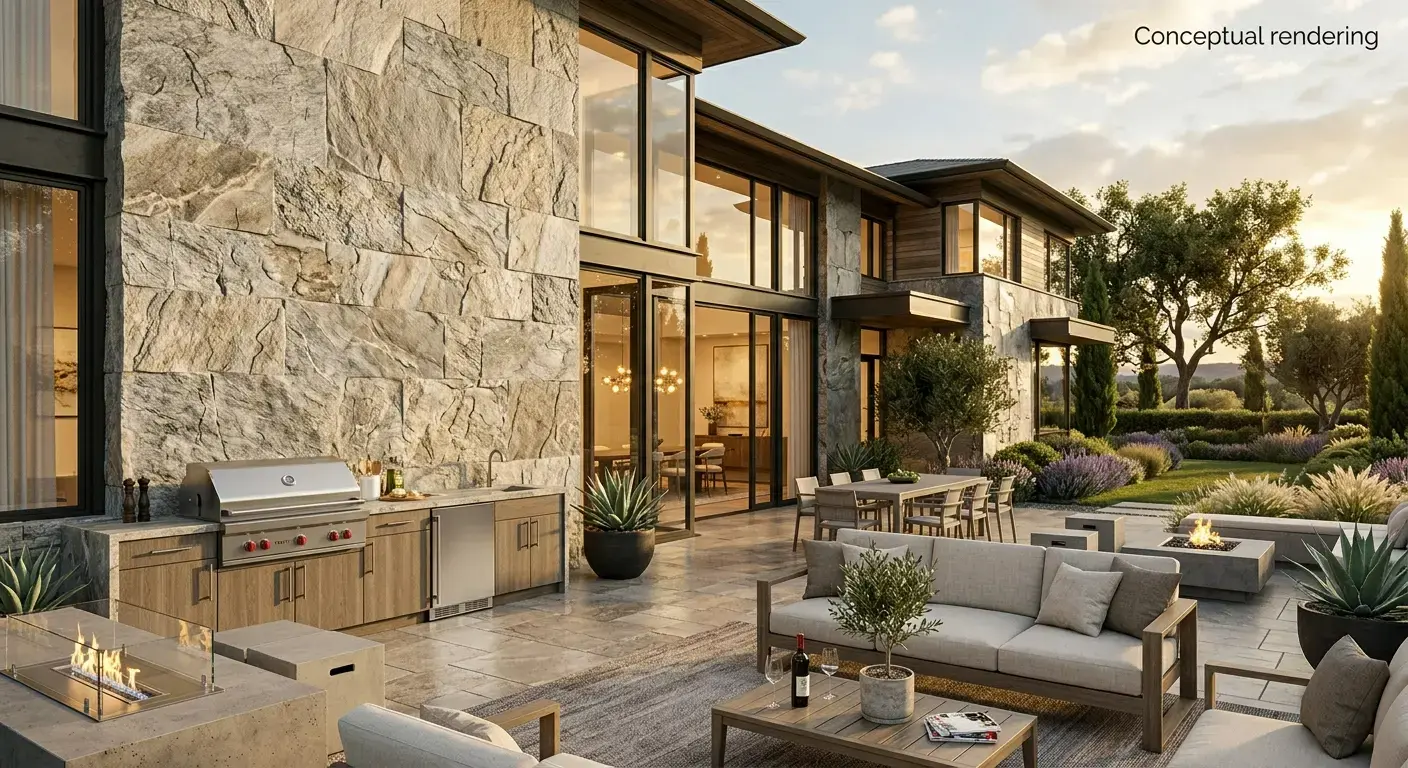
Which Stone Fits Each Coverage Level?
Granite and quartzite handle every coverage level, from a full facade down to a single column, while travertine belongs on smaller, sheltered surfaces. The table sums up where each stone fits, and the sections after it explain why.
Stone | Look | Standout use | Also works for | Sealing | Finish direction |
Granite | Speckled, crystalline pattern | Full facades on exposed elevations | Lower-wall bands, accents | Naturally low absorption; sealing adds protection | Honed or leathered on facades, polished on close-up accents |
Quartzite | Marble-like veining | Veined facades and bold entry or chimney accents | Full walls, lower-wall bands | Naturally low absorption; sealing adds protection | Honed or leathered on facades, polished on close-up accents |
Travertine | Banded texture in warm ivory, walnut, and gold tones | Sheltered entry surrounds and column wraps | Courtyard feature walls | Needs sealing and periodic resealing | Honed or leathered to show its texture |
Granite is the workhorse of the three, with a dense, crystalline structure, and it is UV resistant, but performance may vary by color and finish. Quartzite brings marble-like veining to the outside of a house and shows up often in exterior wall cladding for good reason.
Travertine is the warm, textured option, with banded patterns in ivory, walnut, and gold tones. The open pores that give it character are also the reason its upkeep grows with the size of the wall. Our page on natural stone for exterior facades profiles each of these stones in more detail, and you can browse our full selection of tile, stone, and slabs to compare them.
How Much of the Wall Should Stone Cover?
Residential cladding falls into three levels. Full-wall coverage wraps an entire elevation, partial cladding covers a defined band such as the lower third of a wall, and accents highlight a single feature like an entry surround, a column, or a chimney.
Each level changes the job the stone has to do. A full front elevation takes every bit of sun, wind, and weather the site delivers, while a column tucked under a porch roof sees a fraction of it. That exposure gap is the reason coverage should drive the stone choice, not the other way around.
The general selection and care basics that apply at every level are covered in our guide to stone for exterior walls. The rest of this article focuses on how each coverage level changes the right pick.
Which Stone Holds Up Across a Full Facade?
Granite and quartzite are the right stones for a full facade. A whole elevation takes more sun, rain, and wind than any other coverage level, and the Natural Stone Institute's guide to natural stone cladding notes that corners and areas where the wall steps in or out typically take the most wind.
Granite and quartzite hold up to sun, rain, and winter weather better than softer stones, which matters most when stone covers an entire wall and every slab is on display. Both are durable, but proper care will help preserve their appearance.
Color matters at this scale too. A slab headed for a sun-facing south or west elevation should be chosen with that exposure in mind, since granite's UV resistance can vary from one color and finish to the next. Designers and contractors matching color across several full facades can apply for a trade account for job-site delivery and a dedicated rep.
Travertine stays off our list for full exposed elevations. Multiplying its sealing routine across every square foot of a facade is a commitment most homeowners underestimate.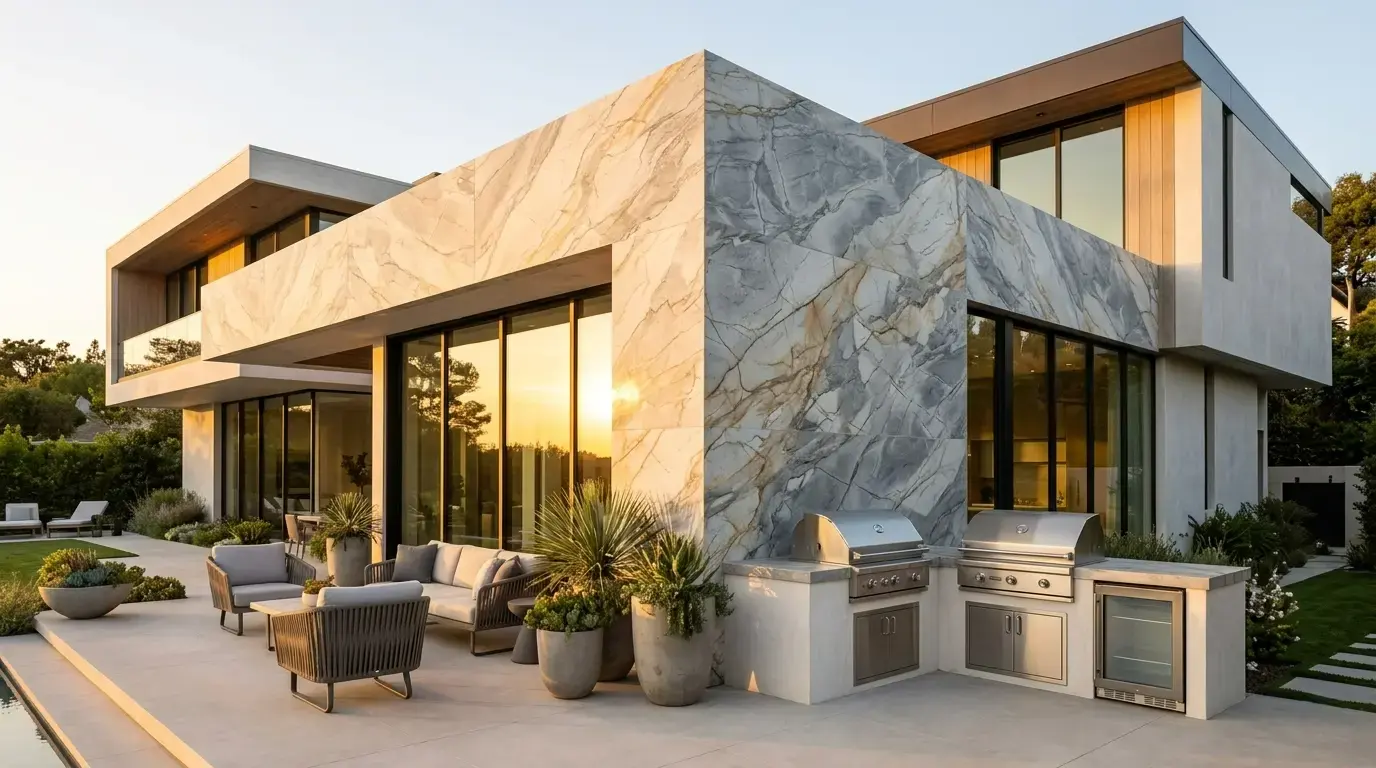
What Stone Works for Lower-Wall Cladding?
The lower third of a wall is the most popular partial treatment, and it is also the wettest spot on the house. Sprinkler overspray, rain splashback, and snow piled against the foundation all land right where the stone sits.
That moisture drives the material choice. Water moving through stone can carry mineral salts to the surface and leave a white residue called efflorescence. In colder areas like Reno and Minden, water that freezes inside stone or mortar joints can contribute to damage over repeated winters.
A dense granite or quartzite is the safer pick for a low band, and on a north-facing wall that stays damp through winter, we steer away from travertine entirely. If you're near our Reno or Minden showroom, comparing granite, quartzite, and travertine slabs side by side shows the difference in surface texture and pores right away.
Partial cladding also works well on two-story homes. Stone across the ground floor with siding above keeps the upper walls visually light and ties the house to its patio and planting beds, and the stone never has to handle the full height of the elevation.
Where the stone stops matters as much as which stone you choose. A band that ends at a window sill line, or wraps an outside corner and stops at an inside one, looks intentional. Stopping flat on an exposed outside corner shows the edge and makes solid stone look like a thin applied layer.
Which Stone Suits Entry and Column Accents?
Travertine is the standout for accents, with granite and quartzite close behind. A stone surround at the front door, a pair of column wraps, or a courtyard feature wall is seen up close and often sits under a roofline, and that lower exposure opens the door to warmer, more textured stone.
On a small, sheltered surface, travertine's sealing routine stays manageable, and its texture softens an entry in a way polished granite rarely does. Seeing a full travertine slab at our Sacramento or Fernley showroom shows how its banding will read on a column wrap before you commit.
Accents are also the right place for a bolder slab. A dramatically veined quartzite that would overwhelm a full facade reads as a deliberate focal point when it is limited to one entry wall or a chimney face. Keep one accent material per elevation, since two competing feature stones on the same wall cancel each other out.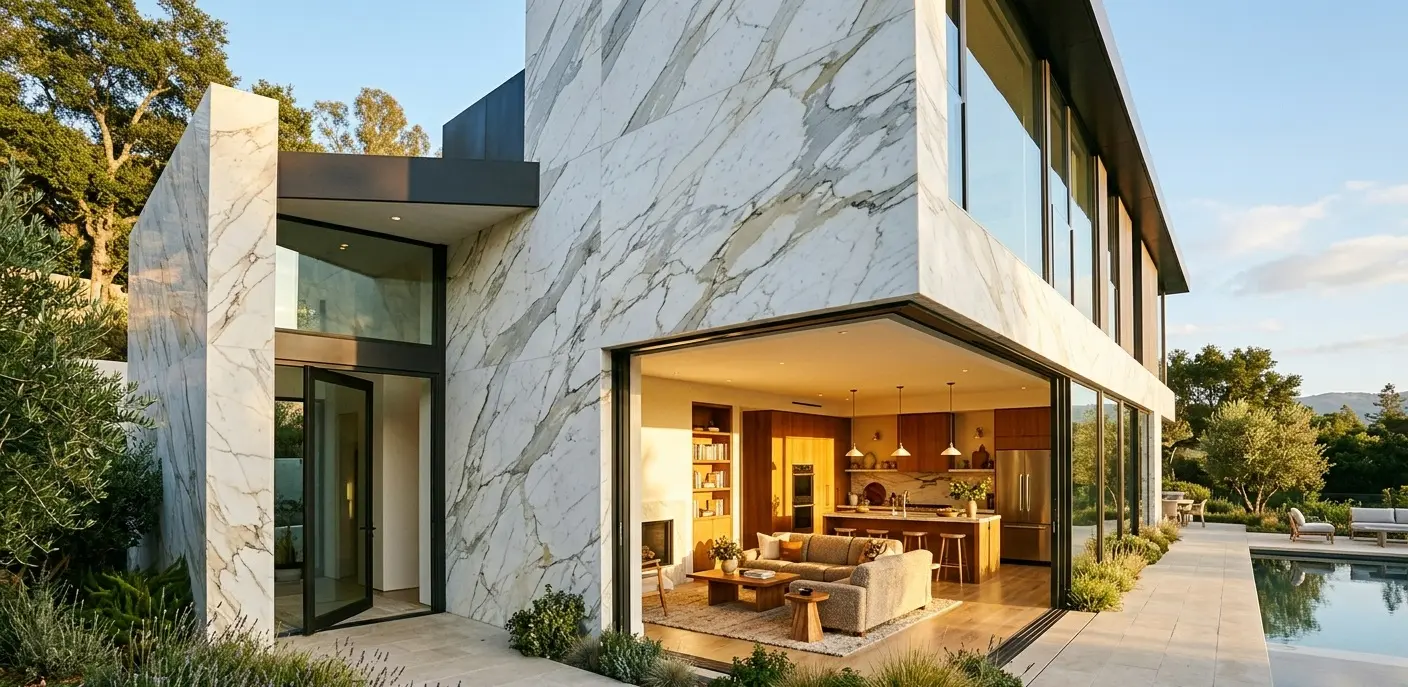
What Finish Works Best on Exterior Stone Cladding?
Honed and leathered finishes work best on large exterior walls, and polished finishes suit small accents seen up close. Depending on the slab, finishes range from polished to honed to leathered, and each one reads differently at a distance.
On a full facade viewed from the street, a honed or leathered surface reads as natural stone texture, while a polished face throws back glare in afternoon sun. At an entry seen from three feet away, polished granite looks crisp and finished rather than flashy.
Care follows the same logic. Travertine is a calcareous stone, so acidic cleaners like vinegar can etch it, and while granite and quartzite resist most acids, the Natural Stone Institute's care guidelines still point owners toward neutral cleaners for every stone type.
Choose the Actual Slabs, Not a Photo
Natural stone varies from slab to slab in tone, veining, and movement, and that variation multiplies across a full wall. A facade needs several slabs that sit together well, which is why choosing from a single bundle matters more on cladding than on one countertop.
Our live slab inventory photographs every bundle on our floors, more than 500 across four showrooms, and is updated weekly, so you can shortlist real slabs before you visit. From there, find a showroom near you to see your shortlisted bundles at full size before choosing.
Sourcing is part of the same decision. If sustainability matters to your project, this guide to environmental and health product labels for natural stone explains how those declarations document a stone's life cycle impacts and ingredients.
Conclusion
Sketch each elevation before you visit and mark it full, partial, or accent. That one page turns a showroom visit from browsing into choosing, because exposed walls point to granite or quartzite and sheltered features open up travertine.
Bring that plan when you book a free design consultation, and our team will help match slabs, finishes, and bundles to each wall. Once you settle on a bundle, you can request a slab quote and note the bundle number on the form so the exact slabs you saw are the ones quoted.
Note: Some images on this page may be conceptual renderings created to illustrate design possibilities and may not depict actual installations.
Frequently Asked Questions
Granite and quartzite are the best choices for full walls and exposed elevations because of their density. Travertine is the best fit for sheltered accents like entry surrounds and column wraps, as long as it is sealed on a regular schedule.
Full coverage suits simpler facades where stone is the main material. Partial cladding on the lower wall or ground floor adds texture and weight without asking the stone to handle every exposure on the house, which makes it the easier choice for most two-story homes.
Marble does appear on some building exteriors, but it is not one of the stones we suggest for outdoor walls. It is a calcareous stone, so acid rain and acidic cleaners dull and etch its surface, and thin marble panels are known to bow over years of heating and cooling, as happened on Chicago's Aon Center before its facade was replaced. Granite and quartzite are the safer choices for exterior cladding.
Travertine needs sealing and periodic resealing because of its natural pores. Granite and quartzite are naturally low-absorption stones, and sealing adds protection on exposed walls, with the sealer manufacturer's instructions guiding the product and schedule.
Honed and leathered finishes read as natural texture on large walls and keep glare down. Polished finishes suit smaller accents seen up close, where a crisp surface looks intentional.