AT A GLANCE
- Hardscape includes patios, paths, gravel, steps, and walls.
- Turf-heavy yards used 54% more water than mixed-plant yards.
- Permeable pavers have stone-filled joints that let rain soak in.
- Permeable concrete pavers are typically made to ASTM C936.
- Retaining walls hold back soil on sloped yards.
- Patios and paths 5 to 30 feet from a home can act as fuel breaks.
- Lower-turf yards needed about 26 fewer hours of upkeep per year.
IN THIS POST
- Does Hardscape Save Water?
- Does Hardscape Affect Drainage?
- Do Retaining Walls Stop Erosion?
- Can Hardscape Be a Fuel Break?
- Gravel or Pavers Instead of Grass?
- Does Hardscape Add Usable Space?
- Is Hardscape Low Maintenance?
- What Are the Cons of Hardscape?
- Which Hardscape Should I Choose?
- Conclusion
- Frequently Asked Questions
- Sources
Hardscape refers to the built surfaces and structures in a yard, such as stone paths, paver patios, gravel areas, steps, and retaining walls, that keep their shape through every season. Beyond curb appeal, the main benefits of hardscape are using less irrigation water, managing rain and runoff, steadying sloped ground, creating wildfire fuel breaks, covering spots where grass struggles, making a yard easier to move through, and cutting down on routine yard work.
Each benefit depends on design. A permeable patio handles rain differently from solid concrete, and a retaining wall only helps if it is built with proper drainage. Below, we look at what research, public agencies, and industry organizations say about each benefit, plus the trade-offs worth planning around.
Does Hardscape Save Water?
Yes. Replacing part of a lawn with hardscape saves water, because a patio or gravel path needs no irrigation and grass is usually the thirstiest part of a traditional yard. Research compiled for a federal water-efficiency program found that turfgrass receives the highest share of residential irrigation water in traditional landscaping.
The same research summarized several field studies. In Marin, California, turf-dominated yards used 54 percent more water than yards planted mostly with trees, shrubs, and water-conserving plants. In Southern Nevada, water-efficient landscaping used 76 percent less water per square foot than the turf it replaced.
Hardscape works best as part of that kind of mix rather than as a full replacement for planting. Grass still has real benefits, such as controlling erosion and filtering stormwater, which is why many water-wise designs keep a practical patch of lawn for play and pair the rest with paths, patios, and low-water plants.
Does Hardscape Affect Drainage?
Yes. Solid hardscape can cause drainage problems, while permeable hardscape can help prevent them. Solid surfaces such as concrete driveways and sidewalks contribute to stormwater runoff, which can carry pollutants and sediment to nearby waterways and lead to erosion downstream.
Permeable pavers work differently. Their joints or openings are filled with small, angular stone, so rain can pass through the surface into a stone base below, where it is stored and gradually soaks into the soil. The pavers themselves are typically made to meet ASTM C936, the standard for interlocking concrete pavers, and these systems are commonly used for residential patios, walks, and driveways.
Permeable surfaces are not right for every site, though. They work best where the water table sits well below the base and the surface has a gentle slope, and like any hardscape, they need upkeep. Our post on hardscaping trends covers how to keep permeable pavers draining.
Do Retaining Walls Stop Erosion?
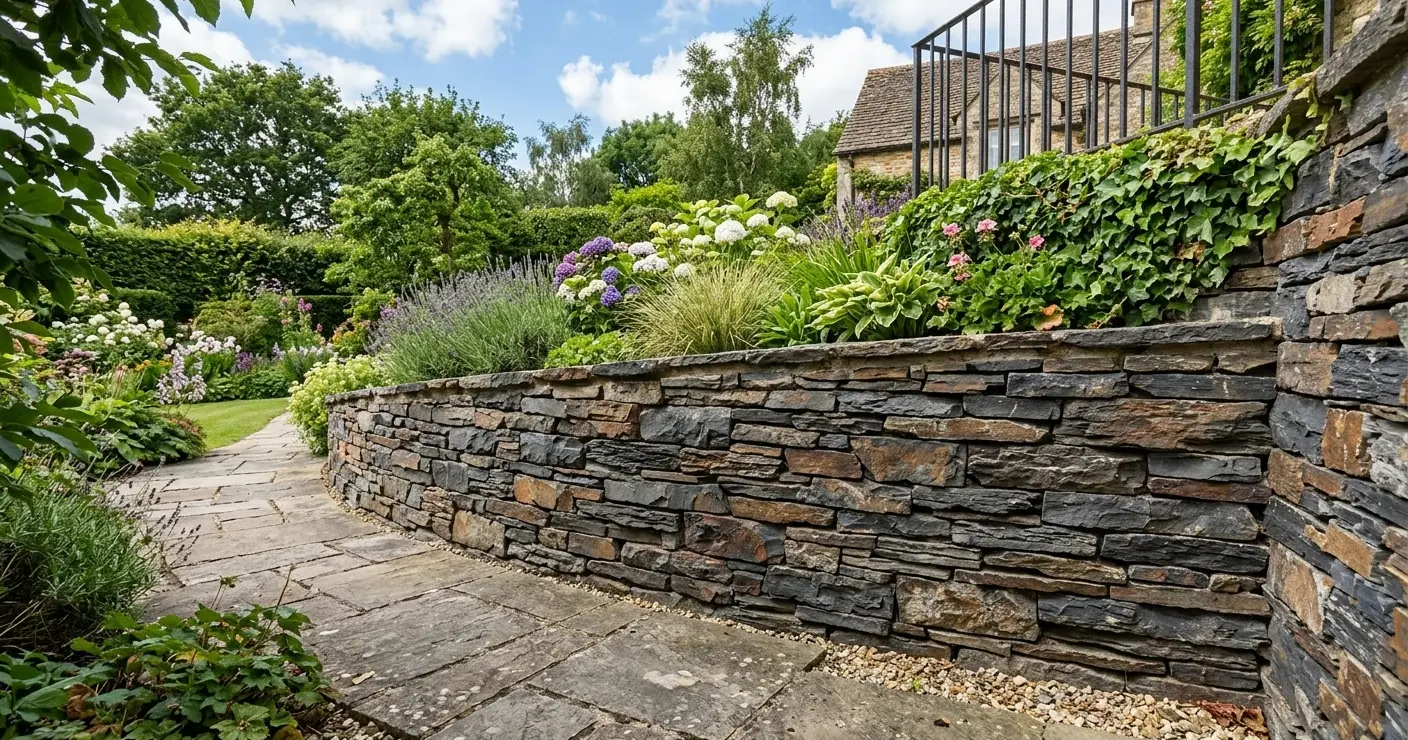
Retaining walls can help control erosion on a sloped yard. A retaining wall holds back soil to stabilize a slope and reduce erosion. A series of walls across a hillside creates terraces, which turn a steep grade into flatter areas that are easier to plant, walk on, and enjoy. Those flatter areas also slow rainwater so more of it can soak into the soil instead of running downhill.
Retaining walls must be carefully designed. Water building up behind a wall can cause it to fail, so drainage is an essential part of the design. Before building any retaining wall, it is wise to consult a qualified landscape architect or engineer, who can also tell you whether a permit is needed where you live.
Can Hardscape Be a Fuel Break?
Yes. Driveways, walkways, patios, and decks can serve as fuel breaks that interrupt the vegetation a wildfire could follow toward a house. National wildfire safety guidance divides a property into zones, and for the area 5 to 30 feet from the furthest exterior point of the home, it recommends using landscaping and hardscape to create fuel breaks with driveways, walkways, patios, and decks. These hard surfaces break up what would otherwise be a continuous run of grass, shrubs, and other vegetation.
The same guidance pairs those breaks with other steps in that zone, such as keeping grass mowed to about four inches and limiting trees and shrubs to small, spaced-out clusters. Closer in, the first 5 feet around the home is treated as a noncombustible area, where mulch, flammable plants, and anything else that can burn are moved away from the walls. Zone distances can vary with slope and local conditions, so it is worth checking with your local fire department for guidance where you live.
Gravel or Pavers Instead of Grass?
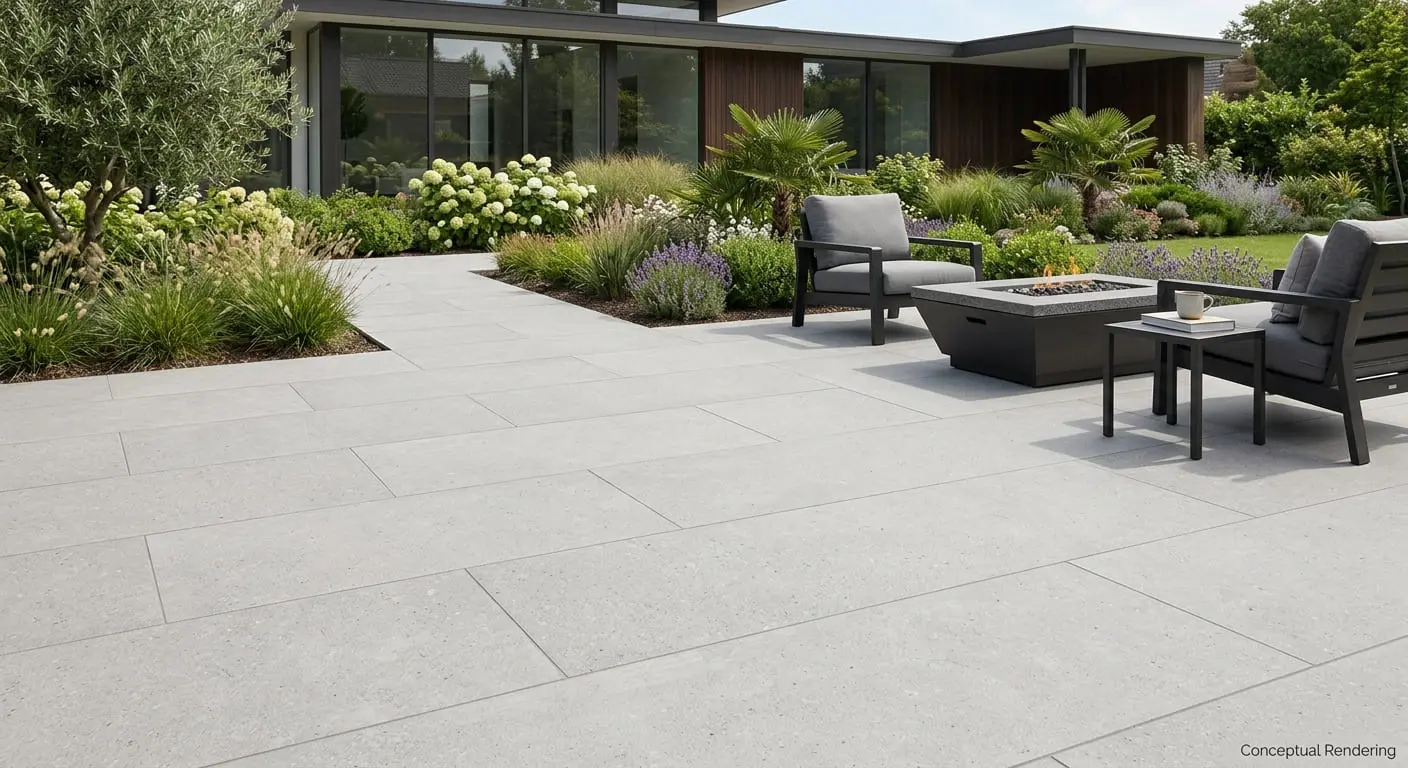
In spots where grass struggles, such as deep shade, narrow side yards, strips along driveways, and paths worn bare by foot traffic, gravel or pavers are often the more practical choice. A gravel path, stepping stones, or a small paver landing can turn those spots into something clean and usable instead of patchy lawn or mud.
Climate matters too. Kentucky bluegrass, a common lawn grass, is native to regions that receive more than 40 inches of rain a year, yet it is widely planted in much drier places, where it depends on irrigation to stay green. In dry climates, replacing hard-to-water areas with hardscape and drought-tolerant plants is often more practical than working to keep them green.
Does Hardscape Add Usable Space?
Yes. Firm, level hardscape adds usable space by giving a yard defined places to sit, cook, and gather, plus steady paths between them. A path gives secure footing in wet weather, steps make slopes easier to navigate, and a patio creates a flat surface for tables, chairs, and grills. Layout matters as much as material. Wide, even paths with gentle transitions are easier for strollers, wheelbarrows, and anyone with limited mobility, and low path lighting helps people see edges and steps after dark.
Hardscape also divides a yard into zones, such as a dining area, a play area, and a garden path, so each part of the space has a clear purpose. At Nova Tile and Stone, our natural stone, porcelain, and paver options make it easy to set those zones apart, for example by using one color or finish for the dining area and another for the paths leading to it.
Is Hardscape Low Maintenance?
Yes. Hardscape is generally lower maintenance than grass, though it is not maintenance-free. Studies of water-efficient yards, which pair hardscape and low-water plants with smaller lawns, point the same way. In one study cited in the same federal turfgrass report, homeowners with mostly water-efficient landscapes spent about 26 fewer hours per year on maintenance than those with turf-dominated yards. Another study found 25 percent lower labor needs, along with 61 percent less fertilizer use.
The care hardscape does need includes sweeping, clearing joints, and occasional cleaning. For natural stone around patios and pools, industry care guidance recommends flushing the surface with clear water and using a mild bleach solution to remove algae or moss. Acidic cleaners such as vinegar or lemon can dull or etch calcium-based stones like travertine and limestone, so those are best avoided.
What Are the Cons of Hardscape?
The main cons of hardscape are surface heat in summer, a higher upfront cost than grass, and the need for careful planning.
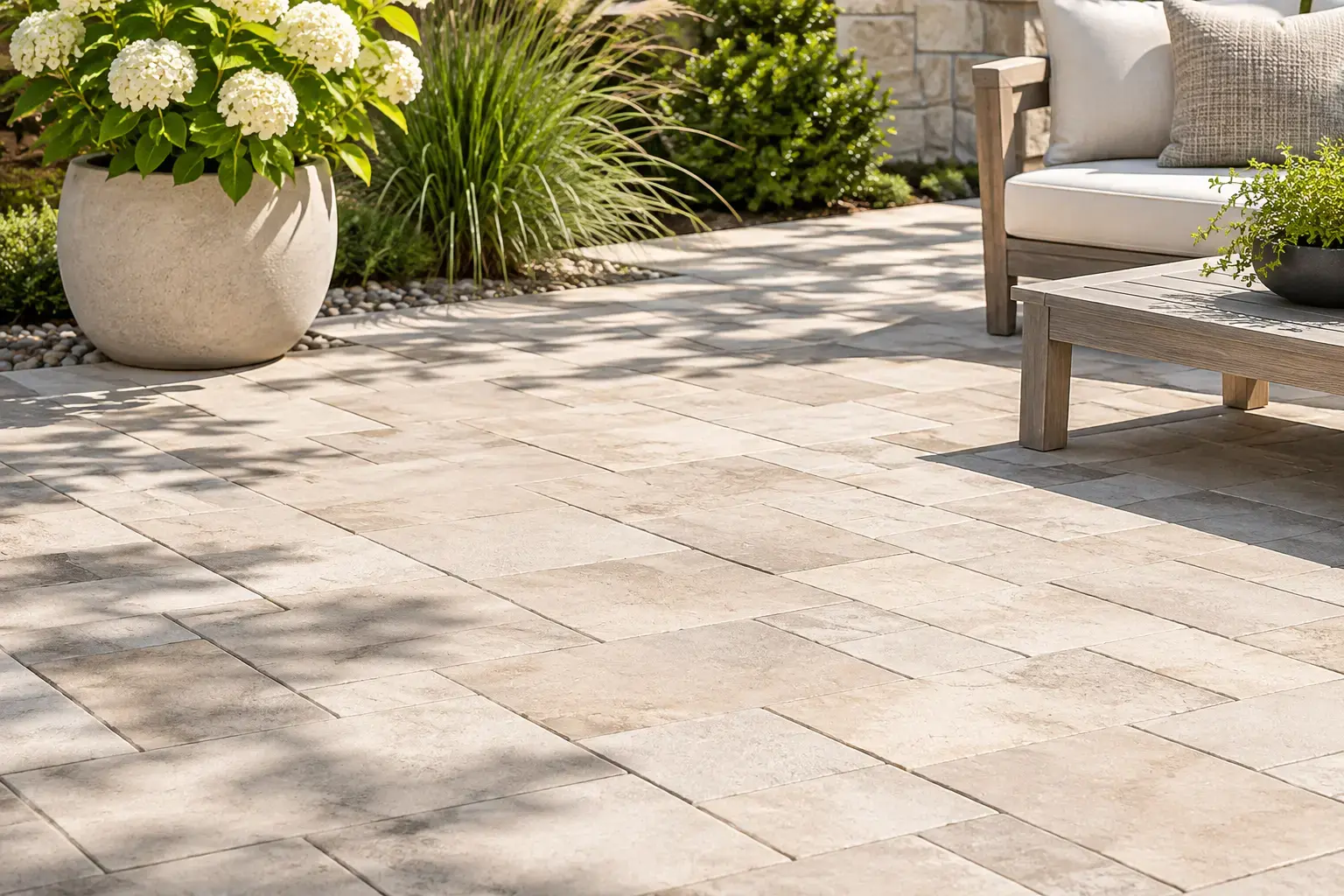
Surface heat. Paved surfaces absorb sunlight and can get very hot. In one Arizona pilot study, conventional asphalt reached surface temperatures up to 152°F at midday, while cooler pavements stayed 10 to 16°F lower. Placing patios where trees or structures provide afternoon shade helps, and lighter-colored materials generally stay cooler than dark ones.
Upfront cost and planning. Hardscape usually costs more to install than seed or sod, and how well it performs depends on the work beneath the surface. A good base, correct slope, and a material suited to your climate all affect how a patio, path, or wall holds up over time, so choosing an experienced installer is one of the most important decisions in any project.
Which Hardscape Should I Choose?
Choose hardscape based on the problem you want to solve, such as high water use, runoff, a slope, or bare spots. Here is how common yard problems match up with hardscape options:
Yard Problem | Hardscape Option | Keep in Mind |
Large lawn with high water use | Patio or gravel path paired with low-water plants | Keep a practical patch of grass if you need play space |
Puddling or runoff | Permeable pavers or gravel | Needs a deep enough water table, a gentle slope, and regular joint upkeep |
Steep or eroding slope | Retaining walls or terraces | Requires drainage and, for larger walls, professional design |
Wildfire-prone property | Walkways, patios, and driveways as fuel breaks | Works alongside vegetation spacing and upkeep |
Shade, foot traffic, or narrow strips | Stepping stones, gravel, or a small paver landing | Choose a product rated for damp outdoor areas |
Uneven or hard-to-cross ground | Steps and level paths | Plan lighting and gentle transitions |
For paths that stay damp or shaded, surface texture affects how secure they feel underfoot, which we cover in our guide to slip resistance for outdoor hardscape.
Conclusion
Hardscape does much more than shape how a yard looks. Planned well, it can lower irrigation needs, guide rain into the ground, hold slopes in place, break up wildfire fuel, and cut down on weekend yard work. The key is matching the hardscape to the problem you want to solve and building it with the right base, drainage, and materials for your site.
If you are planning a patio, path, or wall, visit one of our Nova Tile and Stone showrooms to see natural stone, porcelain, and pavers side by side, or book a free design consultation to talk through the options for your project.
Frequently Asked Questions
Yes. Gravel is a permanent, non-living ground cover, so it counts as hardscape. It is often used for paths, borders, and seating areas, and its loose surface allows water to pass through to the soil below.
There is no set ratio. The right amount depends on how you use the space, your climate, and how much shade and planting you want. Many designs place hardscape where people walk, sit, and gather, then use plants around the edges to add shade and soften the look.
Hardscape is often installed first, since grading, excavation, and base work can disturb nearby soil and plants. Planting afterward also makes it easier to fit beds around the finished edges of a patio or path.
Yes. A compact patio, a stepping-stone path, or a small gravel seating area can create usable space without taking over the whole yard. A simple layout with fewer material changes can also help a small space feel less busy.
Yes. Stepping stones set into groundcover, planting pockets within a patio, and stone borders around garden beds all combine the two. Mixing them softens the look of hard surfaces and leaves more open soil to absorb rain.
Sources
- U.S. EPA WaterSense: Research Report on Turfgrass Allowance | https://www.epa.gov/sites/default/files/2017-01/documents/ws-outdoor-home-turfgrass-report.pdf
- Pacific Northwest National Laboratory, Building America Solution Center: Water-Efficient Landscape Design | https://basc.pnnl.gov/resource-guides/water-efficient-landscape-design
- Concrete Masonry & Hardscapes Association: Construction of Permeable Interlocking Concrete Pavement Systems (Tech Note PAV-TEC-018) | https://www.cmha.org/resource/pav-tec-018/
- Snohomish County Surface Water Management: Retaining Walls & Terracing | https://snohomishcountywa.gov/6968/Retaining-Walls-Terracing
- National Fire Protection Association: Preparing Homes for Wildfire | https://www.nfpa.org/en/education-and-research/wildfire/preparing-homes-for-wildfire
- U.S. Department of Energy, Federal Energy Management Program: Water-Efficient Landscaping | https://www.energy.gov/cmei/femp/best-management-practice-4-water-efficient-landscaping
- Natural Stone Institute: Care & Cleaning of Natural Stone | https://www.naturalstoneinstitute.org/consumers/care/
- U.S. EPA: Using Cool Pavements to Reduce Heat Islands | https://www.epa.gov/heatislands/using-cool-pavements-reduce-heat-islands
Note: Some images on this page may be conceptual renderings created to illustrate design possibilities and may not depict actual installations.