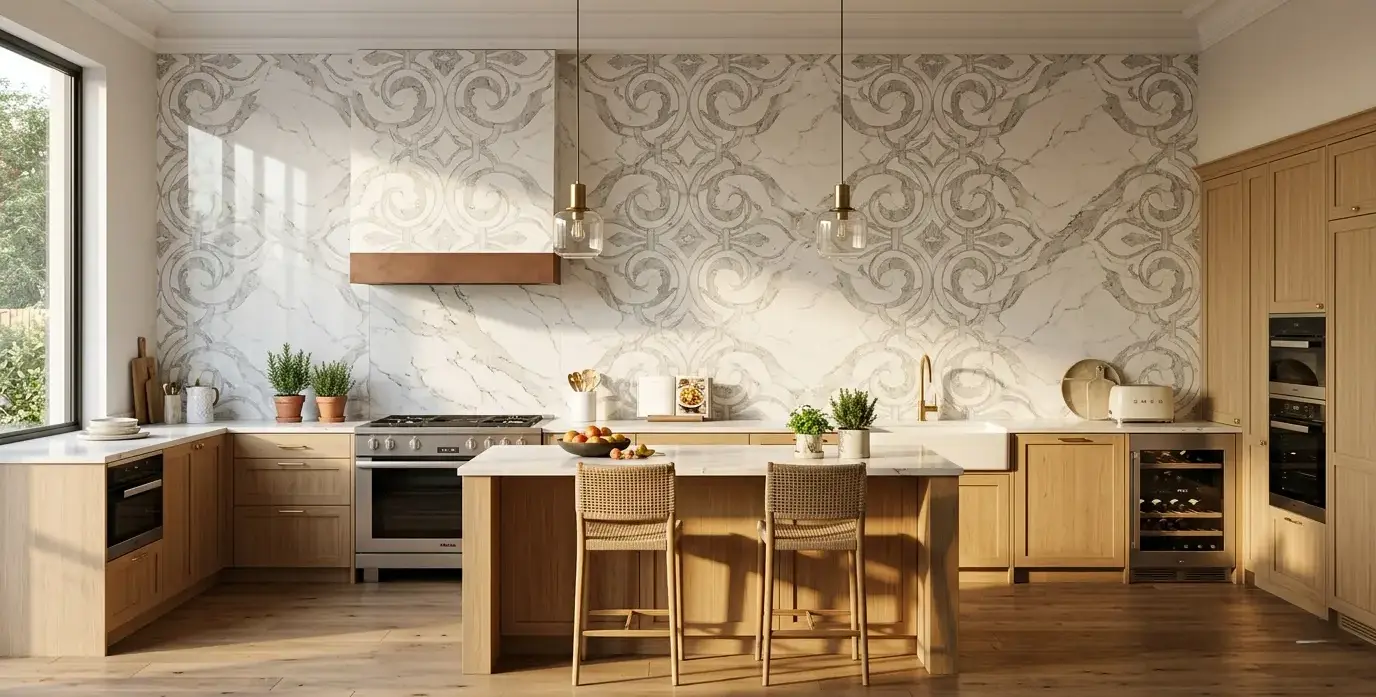
Arabesque slabs for backsplash application bring sculptural geometry to kitchens, bathrooms, living rooms, and wall cladding applications. Few stone surface patterns carry the same immediate visual weight as a well-chosen arabesque backsplash material. Available in Calacatta Gold marble or Calacatta quartz, this curved ogee-shaped slab surface delivers a timeless pattern that elevates stone surfaces from functional to focal. Polished finishes are most common for this variation, amplifying the material's natural veining through the contoured silhouette.
Calacatta Gold Marble and Quartz: What Sets Each Apart as an Arabesque Slab for Backsplash
Calacatta Gold marble originates primarily from the Carrara quarrying region of Tuscany, Italy, where high-altitude extraction yields the dense, bright white stone prized for its bold gold and gray veining. Each slab is geologically unique, which means no two arabesque slab surfaces are identical. The veining pattern most associated with this material runs in broad, sweeping diagonal strokes across a bright white field, creating the dramatic contrast that makes arabesque geometry especially impactful.
Calacatta Gold quartz, by contrast, is an engineered composite of approximately 90–93% natural quartz aggregate bound with polymer resin. It replicates the warm-white base and gold veining of its natural counterpart with intentional consistency across slabs.
Property | Calacatta Gold Marble
| Calacatta Quartz |
| Mohs Hardness | 3–4 | 7 |
| Standard Thickness | 3/4 in (2 cm) / 1-1/4 in (3 cm) | 3/4 in (2 cm) / 1-1/4 in (3 cm) |
| Water Absorption (ASTM C97)
| 0.1–0.3% | ~0.02% |
| Finish Available | Polished, Honed, Leathered, Specialty | Polished, Honed |
Veining | Natural, bold gold-gray strokes | Engineered, uniform pattern |
Both materials suit kitchens, bathrooms, and living room wall cladding, though each carries distinct trade-offs. Marble offers unmatched natural authenticity and depth; quartz delivers superior stain and moisture resistance with less maintenance. Designers exploring natural stone backsplash options can compare both surface types in full before committing to a direction.
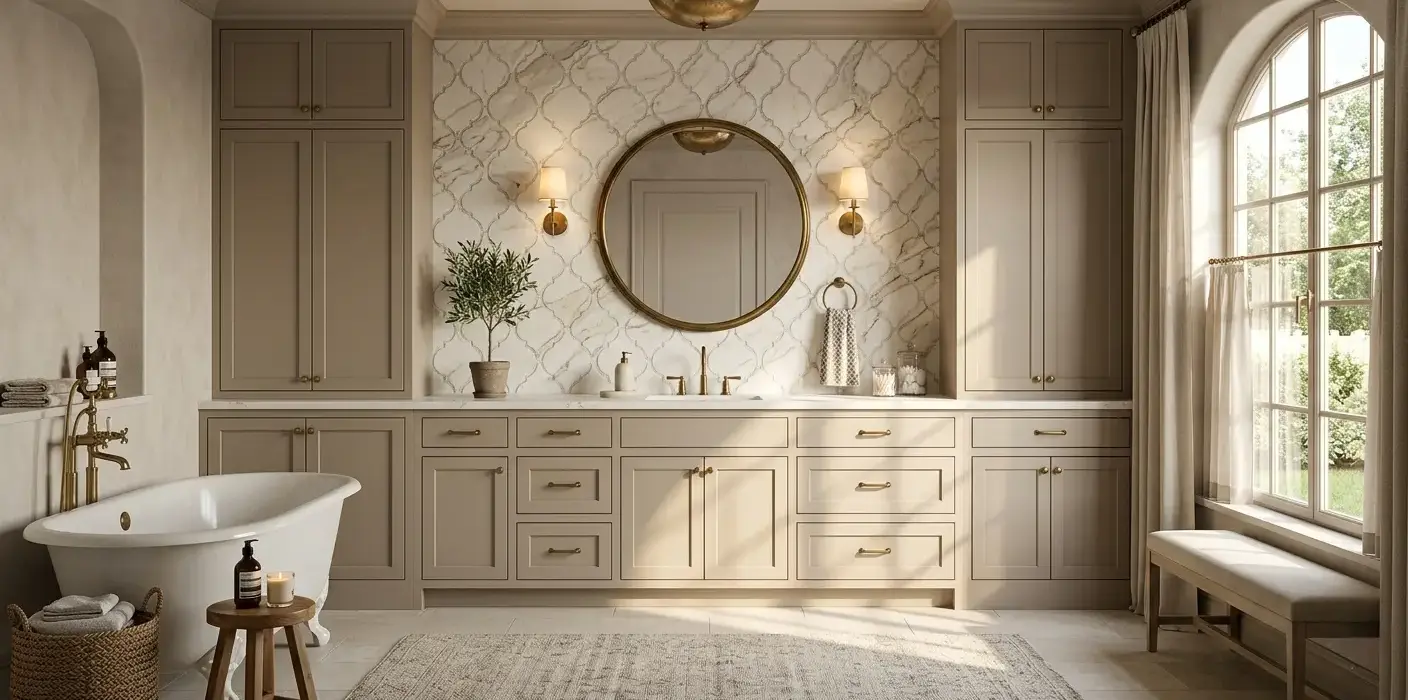 Conceptual rendering
Arabesque Slab's Pattern Flexibility
The arabesque slab shape is defined by its pointed-arch silhouette, a form derived from Moorish geometric tradition. That curvilinear profile interacts with grout lines differently than rectangular slab cuts, producing a mosaic-like rhythm even when the source material is a continuous stone surface. An arabesque slab pattern introduces architectural detail and visual cadence to surfaces where flat rectangular cuts would read as passive. In kitchens, the pattern reads best as a full-height backsplash behind a range, where the arabesque silhouette frames cookware and cabinetry with symmetrical elegance. In bathrooms, vertical stacking accentuates ceiling height, while horizontal runs visually widen narrow wet-wall spaces. In a living room, an arabesque slab pattern used as wall cladding brings inherent movement to the surface plane, preventing large flat walls from appearing monotonous.
The Nova Tile and Stone's slab collection includes both natural and engineered slab options suited to these applications, with showroom staff available to help assess scale and layout for each room type.
Arabesque Slab Practical Advantages Worth Knowing
- Polished marble: Amplifies veining depth and light reflection; requires prompt spill cleanup and periodic sealing to maintain appearance
- Polished quartz: Achieves similar visual brightness with no sealing requirement and greater resistance to staining agents
- Marble: Food contact is acceptable when properly sealed; avoid prolonged acidic exposure (citrus, vinegar) to prevent surface etching
- Quartz: Non-porous by manufacture; suitable for food-contact surfaces without sealing
- Both: Avoid abrasive cleaners; use cutting boards to protect the polished surface. Both surfaces perform best with pH-neutral cleaning products
- Marble: Not rated for direct UV exposure; suitable for shaded outdoor applications only
- Quartz: Indoor and wall applications only; not recommended for outdoor environments
The TCNA standards resource maintains technical standards relevant to surface performance and material classification for engineered stone products.
A Stone Investment That Retains Its Value Across Decades
Calacatta Gold marble has appeared in high-end residential and commercial interiors for centuries, and its association with luxury construction remains intact across shifting design trends. Slabs meeting ASTM C503/C503M specifications for marble are evaluated for properties such as absorption, density, and strength, providing objective benchmarks for quality assessment. ASTM C97 measures absorption and bulk specific gravity in dimension stone and is commonly referenced when evaluating marble's moisture-related performance. Quartz surfaces, for their part, offer long-term color consistency, as the engineered pigmentation process resists the fading that can affect unsealed natural stone over time. Understanding natural stone care guidance prevents the most common maintenance errors before they affect a finished surface. For buyers weighing both, our sourcing standards define the quality benchmarks behind every slab we bring into the portfolio.
Both marble and quartz arabesque slab surfaces tend to support resale positioning in kitchen and bathroom renovation contexts, though ultimate return depends on project quality, home market, and buyer preferences rather than the material alone.
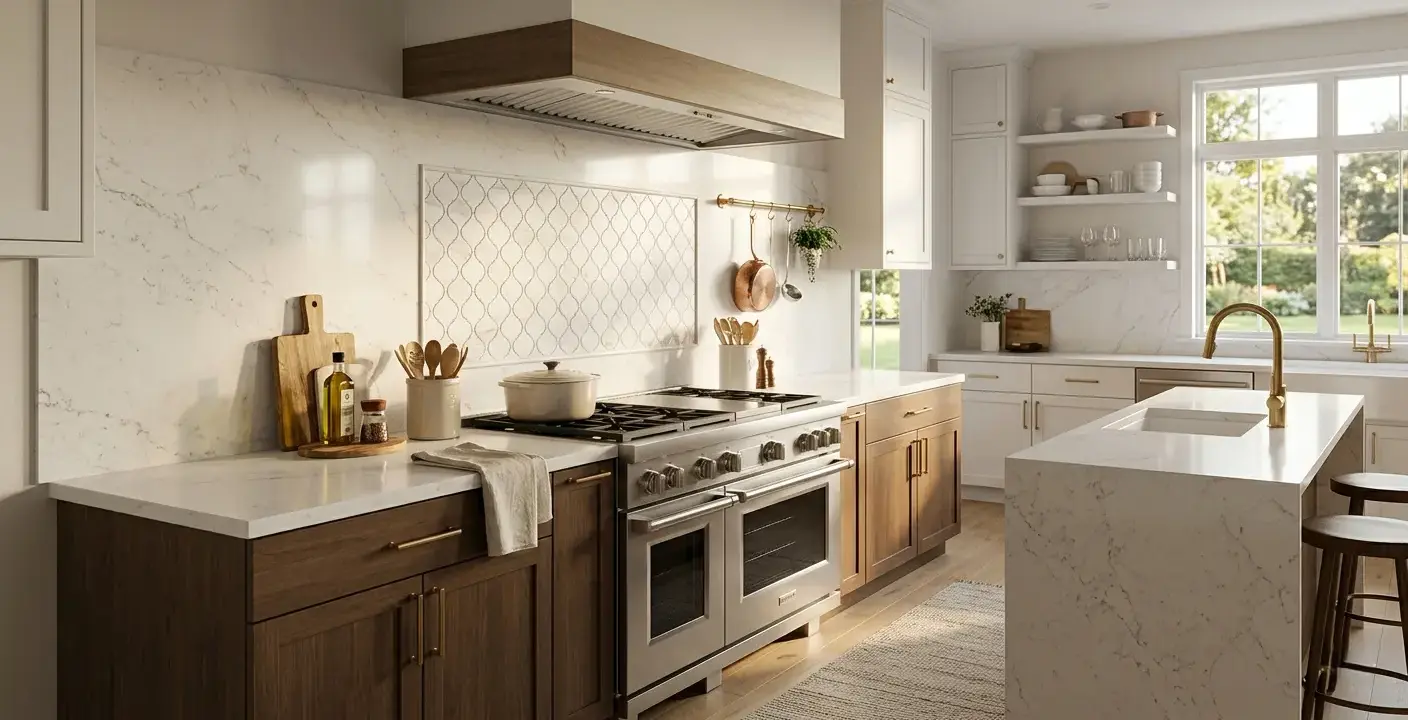
 Conceptual rendering
Frequently Asked Questions
Both are viable. Marble offers natural veining variation and a warmer aesthetic; quartz provides greater stain resistance and consistency. Kitchen environments with heavy cooking activity may benefit from quartz's non-porous surface, while marble suits spaces where natural character and periodic maintenance are acceptable.
Polished Calacatta Gold marble is less porous than honed versions but still benefits from sealing, particularly in kitchens and bathrooms where moisture, cooking oils, and acidic substances are present. A quality penetrating sealer applied on a schedule appropriate to usage levels preserves the polished surface appearance.
Calacatta Gold marble typically displays bold, irregular gold and gray veining on a bright white background. The veins tend to run diagonally across the slab face in sweeping strokes rather than fine hairline patterns, which makes the arabesque shape an ideal format for showcasing the material's natural drama.
Yes. Both marble and quartz are suitable for interior wall cladding in living spaces. The arabesque pattern creates visual movement across large wall surfaces, particularly effective as an accent behind fireplaces, media walls, or entry focal points. Slab thickness and substrate preparation are factors to address with a qualified fabricator.
A polished finish produces a glossy, reflective surface that enhances color depth and veining contrast, ideal for kitchens and bathrooms where light reflection is desirable. A honed finish is matte and smoother to the touch, which can soften the visual intensity of bold veining. Polished is the more popular choice for arabesque backsplash applications where the pattern is meant to serve as a design statement.
Explore the full range of available slab materials and finishes. Contact the team to discuss your project and review current inventory for your kitchen, bathroom, or living room wall cladding application.