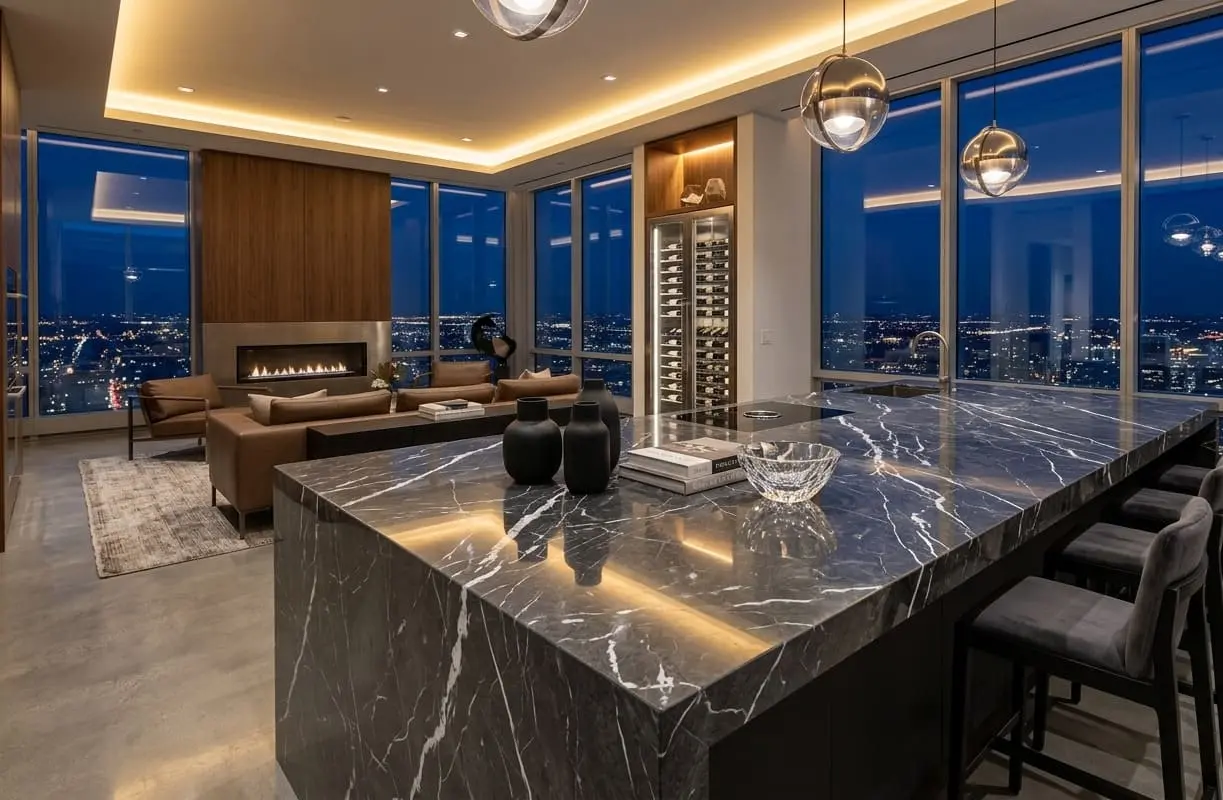
Applications for White Veined Graphite Marble Slabs
White veined graphite marble slabs perform well across most interior environments. In kitchens, the stone pairs with both light and dark cabinetry, and its pattern variation ensures each installation reads differently. Graphite marble countertops are valued for the bold contrast they introduce, functioning as a focal point rather than a background element. In bathrooms, it serves as both wall cladding and marble flooring, making it a natural fit for spa-inspired schemes.
Feature walls and fireplace surrounds are among the most impactful uses for this natural stone surface, where bookmatching adjacent slabs produces a mirrored vein pattern that elevates the result. For countertop and island applications, graphite marble slabs are available in 2 cm and 3 cm thicknesses, with 3 cm preferred for its greater structural stability.
White-Veined Graphite Marble vs. Quartzite, Quartz, and Lighter Marbles
Quartzite registers between 7 and 8 on the Mohs scale and is significantly harder and more resistant to scratching and etching than marble, making it a strong alternative for high-use surfaces. Engineered quartz offers a non-porous surface that requires no sealing and resists staining effectively, but as a manufactured product it lacks the natural variation that characterizes genuine marble slabs.
Within the marble category, white veined graphite marble occupies a different position from lighter options like Calacatta or Carrara. Where light marbles create an airy effect, this dark marble introduces visual gravity and contrast. The choice should be driven by the overall tonal palette of the project. For those who have identified white veined graphite marble as the right fit, the next step is viewing slabs in person to find the veining and finish combination that best serves the design.