
White quartzite slabs for backsplash bring the raw beauty of natural stone to your kitchen, bathroom, or accent wall with a character that no engineered surface can replicate. Quartzite is a metamorphic rock formed when quartz-rich sandstone is subjected to intense heat and pressure deep within the earth. The result is a dense, hard-wearing stone with luminous white and light gray tones, intricate veining in patterns from linear to brecciated, and a surface presence that instantly becomes the focal point of any room. Available in honed, polished, leathered, and specialty finishes, this is a material that earns its place in the most demanding spaces of your home.
What Makes White Quartzite Slabs a Premium Natural Stone
White quartzite registers between 7 and 8 on the Mohs hardness scale, making it significantly harder than marble (3 to 4) and comparable to granite. Slabs are available in standard thicknesses of 2 cm and 3 cm, with 2 cm being the preferred choice for backsplash and wall applications. Most white quartzite originates from quarries in Brazil, with additional sources in India and Norway, each region contributing distinct mineral compositions. Brazilian quartzite tends to carry bolder veining and higher silica density, while Indian varieties often deliver softer, cloudy formations.
Primary colors in this category include white, light gray, and off-white cream tones. Secondary color presence varies by slab and can include pink, taupe, beige, yellow-brown, green, blue, and silver shimmer, all naturally occurring within the stone's mineral matrix. Veining types range from tight linear formations to expressive feather veins, cross-veins, brecciated patterns, and soft cloudy diffusions.
The absorption rate of quartzite is lower than marble but still requires periodic sealing to maintain stain and moisture resistance. Compared to engineered quartz, white quartzite offers one-of-a-kind patterning that cannot be reproduced in a factory. Compared to granite, it delivers a lighter, more refined aesthetic while matching its durability.
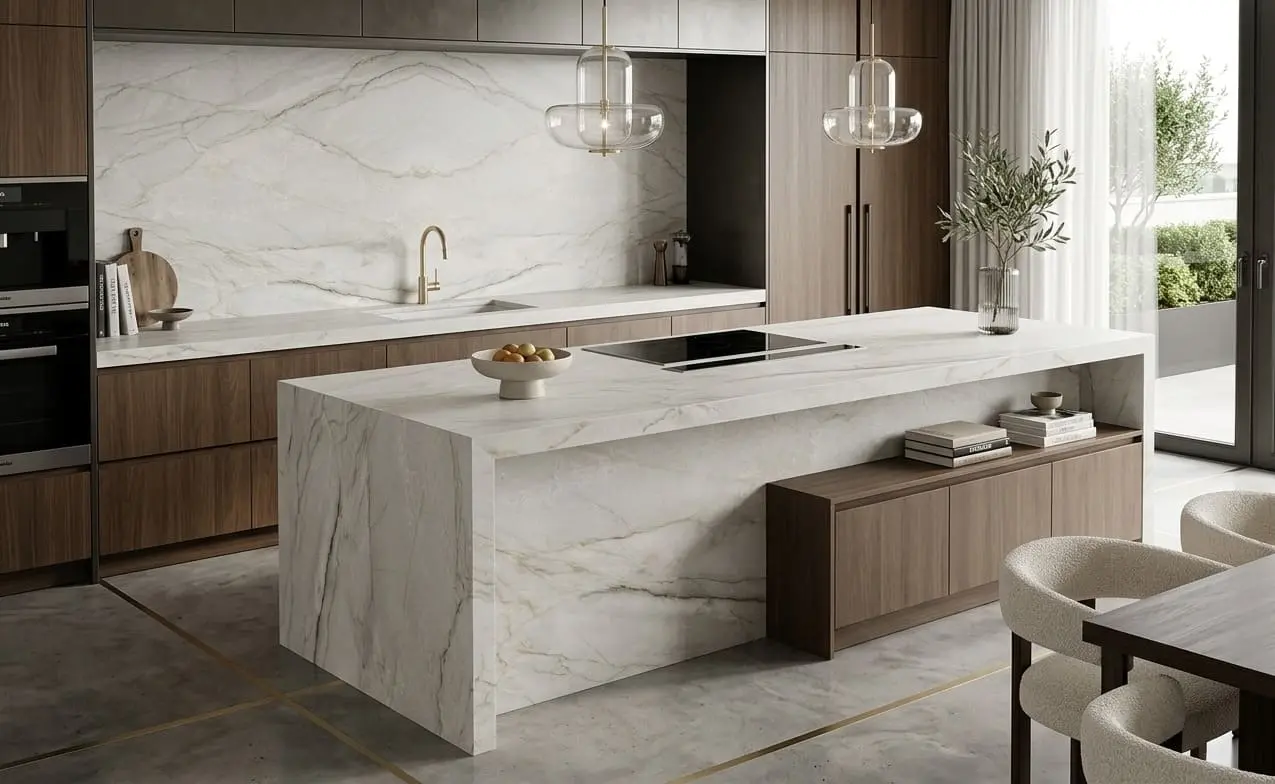 Conceptual rendering
 Conceptual rendering
Layout and Finish Options for White Quartzite Slabs for Backsplash Application
The design range of white quartzite for backsplash is one of its defining strengths. Vertically stacked slabs create height and a gallery-like formality in narrow kitchens. Horizontal layouts elongate the space and emphasize countertop lines. For bathrooms, a book-matched quartzite panel behind a freestanding tub or floating vanity serves as a seamless stone mural. Herringbone and offset cuts work well with fabricated pieces, adding visual movement without competing with the stone's natural patterning.
Finish selection changes the room's tone entirely. Polished quartzite reflects light and adds a refined glamour suited to contemporary and transitional kitchens. Honed delivers a soft, matte appearance preferred in farmhouse and Scandinavian-inspired interiors. Leathered surfaces introduce a subtle hand-crafted texture with improved fingerprint resistance, ideal for high-traffic walls. Specialty finishes provide an artisan quality that pairs naturally with custom cabinetry, open shelving, and statement lighting.
For living rooms and function halls, large-format quartzite slabs can be used as fireplace surrounds and full feature walls where the stone's scale creates maximum visual impact.
Built to Perform in Kitchens, Bathrooms, and Beyond
- Mohs hardness of 7 to 8 resists surface scratches from cookware and daily prep activity
- Denser than marble, reducing the risk of chipping along exposed backsplash edges
- Heat tolerant near stovetops and range hoods without surface damage under normal use
- Lower porosity than marble means routine sealing provides strong protection against grease and moisture
- Each slab is geologically unique, guaranteeing no two backsplash installations look identical
- Works across kitchens, bathrooms, living rooms, and function hall accent walls
- Pairs with a wide spectrum of countertop materials, cabinetry finishes, and grout tones
Nova Tile and Stone's natural stone slab specialists offer free design consultations at showroom locations in Reno, Minden, Sacramento, and Fernley, where you can view actual slabs before purchasing. Their 100% U.S.-based client services team is available Monday through Friday to guide material selection.
A Natural Stone Investment That Holds Its Value
White quartzite carries a higher price point than ceramic tile or porcelain, but the comparison ends there. Its hardness means the surface can withstand decades of daily contact without the wear marks, fading, or cracking that affect softer materials. Its color profile of whites, creams, silver shimmer, and subtle secondary tones remains timeless across design cycles, so the surface never reads as dated. Real estate professionals and buyers consistently recognize natural stone as a value-adding finish, making it a practical choice for long-term investment and resale appeal.
For guidance on maintaining this material over time, the White Quartzite Countertops: Benefits, Varieties and Care Tips guide from Nova Tile and Stone covers sealing schedules, cleaning methods, and what to expect from each finish type.
Browse Our Latest Guides
Discover Our Latest Updates!
Frequently Asked Questions
Yes. Its hardness rating of 7 to 8 on the Mohs scale, heat tolerance, and relatively low absorption rate make white quartzite one of the most practical natural stone options for kitchen backsplash applications. Periodic sealing keeps it performing well over years of use.
Quartzite is considerably harder (7 to 8 Mohs versus 3 to 4 for marble) and resists scratching and etching from acidic substances like lemon juice and vinegar far better than marble. Marble has a more uniform veining look, while quartzite patterns are denser and more varied.
White quartzite slabs are available in honed, polished, leathered, and specialty finishes. Each finish changes the surface texture and light reflection, giving you control over the aesthetic from matte and soft to high-gloss and dramatic.
Standard quartzite slab thicknesses are 2 cm and 3 cm. For backsplash and wall applications, 2 cm is typically the preferred choice. It is lighter, easier to work with during fabrication, and still delivers the full visual impact of the stone.
Yes. While quartzite has a lower absorption rate than marble, sealing is still recommended, generally once per year depending on use. Sealing prevents moisture, oils, and cleaning products from penetrating the surface and altering the stone's appearance over time.
