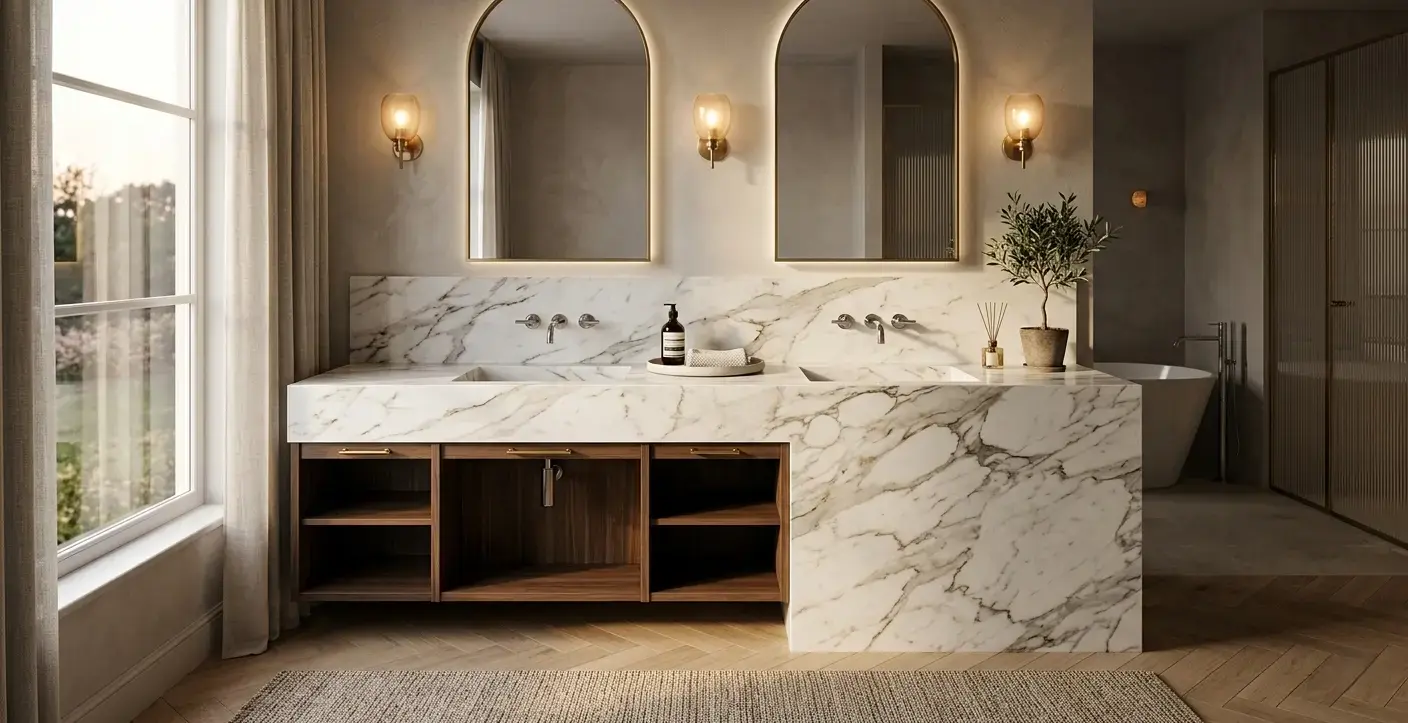
A slab used as a vanity countertop defines the visual and functional center of any bathroom or kitchen. Natural marble, quartzite, and engineered quartz slabs offer distinct stone surfaces suited to countertop design projects at every scale, from single-sink powder rooms to expansive kitchen islands and bar countertops. Selecting the right slab material means balancing aesthetics, finish, and long-term performance before the first cut is made.
Material Specs, Origins, and Stone Surface Details
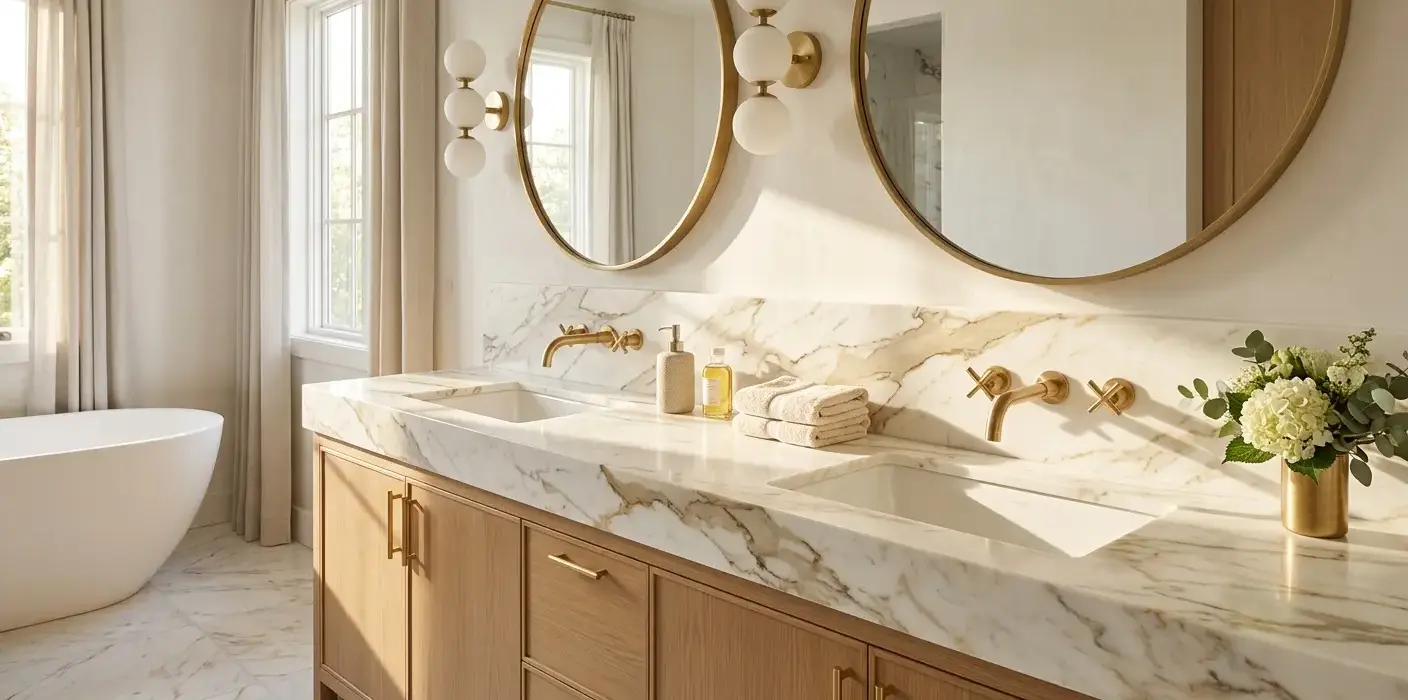
Calacatta Gold Marble originates from the Apuan Alps quarries of Carrara, Italy, a region supplying fine white marble for centuries. Its creamy white field carries bold gold and warm taupe veining in a dramatic, flowing pattern that remains the most sought-after look in vanity countertop design.
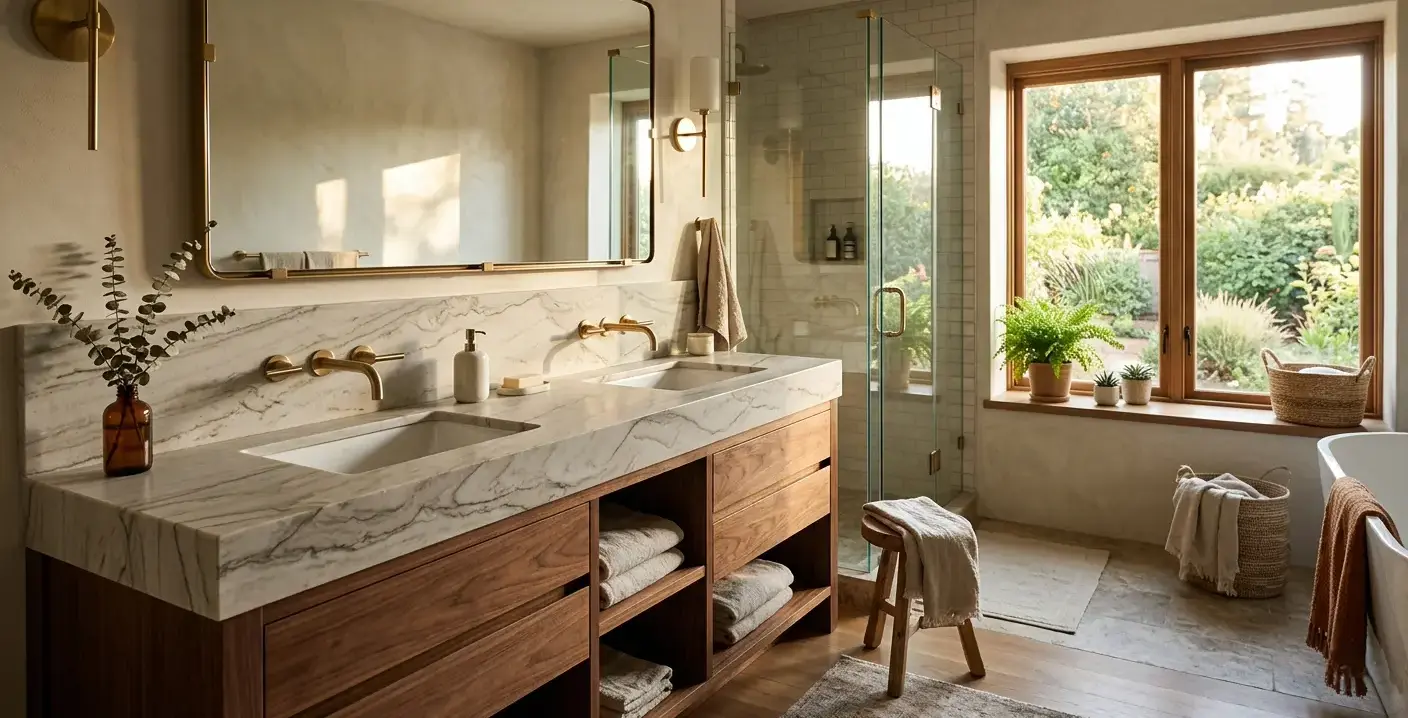
Brazilian Quartzite (specifically Fantasy Brown and Mont Blanc varieties) emerges from quarries in Minas Gerais, Brazil. Its silica-rich composition produces a hard, dense slab with soft gray-and-beige movement that suits both contemporary and transitional countertop design equally well.
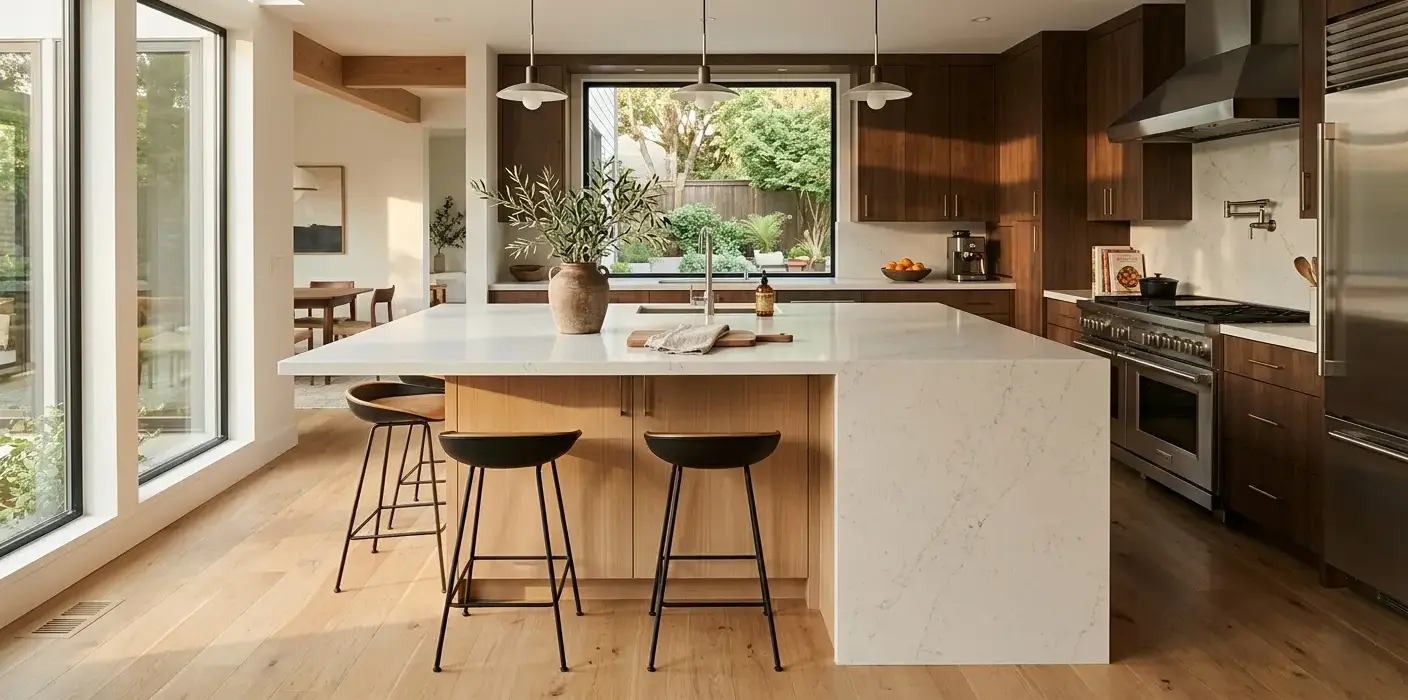
White Quartz (engineered, Calacatta-style compositions) replicates marble veining with consistent color distribution, making it a reliable option for large kitchen or bar slab runs where slab matching is a priority.
Note: Some images on this page may be conceptual renderings created to illustrate design possibilities and may not depict actual installations.
Property | Calacatta Gold Marble |
Brazilian Quartzite
|
White Quartz
|
| Hardness (Mohs)
| 3 | 7 | 6-7 |
Standard Thickness | 3/4 in / 1.25 in | 2 cm / 3 cm | 12 mm / 20 mm |
Water Absorption Rate | ~0.10–0.40% | ~0.05–0.20% | <0.05% |
Finish Options | Polished, Honed, Leathered, Specialty | Polished, Honed, Leathered, Specialty | Polished, Honed |
Indoor / Outdoor | Indoor preferred | Indoor / Outdoor | Indoor only |
Marble and quartzite are available in polished, honed, leathered, and specialty finishes. Polished amplifies veining contrast with a high-gloss surface, honed offers a matte appearance that minimizes visible etching, leathered adds subtle texture while retaining natural movement, and specialty finishes provide unique surface treatments for distinctive applications. Quartz comes in polished and honed. Polished delivers uniformity that simplifies long-term cleaning on kitchen and bar surfaces, while honed offers a softer, low-reflectivity alternative.
Layout Versatility of Slabs for Vanity and Kitchen Countertops
A full-slab for vanity countertop with a bookmatched pair creates a symmetrical veining mirror effect that reads as a deliberate design choice. Waterfall edges carry the slab face vertically over the cabinet side, showcasing the veining pattern as a continuous stone surface. This is particularly effective on Calacatta Gold and Fantasy Brown quartzite. For kitchen islands, a horizontal orientation aligns veining with the counter's long axis, reinforcing visual flow across the space.
Bar countertops benefit from narrower slab sections with a honed or leathered finish to reduce surface reflectivity and improve tactile comfort under high traffic. Designers benchmarking material sourcing trends can reference the International Surface Event architects resource for current industry specification guidance.
Trade professionals sourcing slabs for multi-unit or high-volume countertop design projects can access volume pricing and priority inventory through the Nova Tile and Stone trade account program, designed for architects, designers, and contractors.
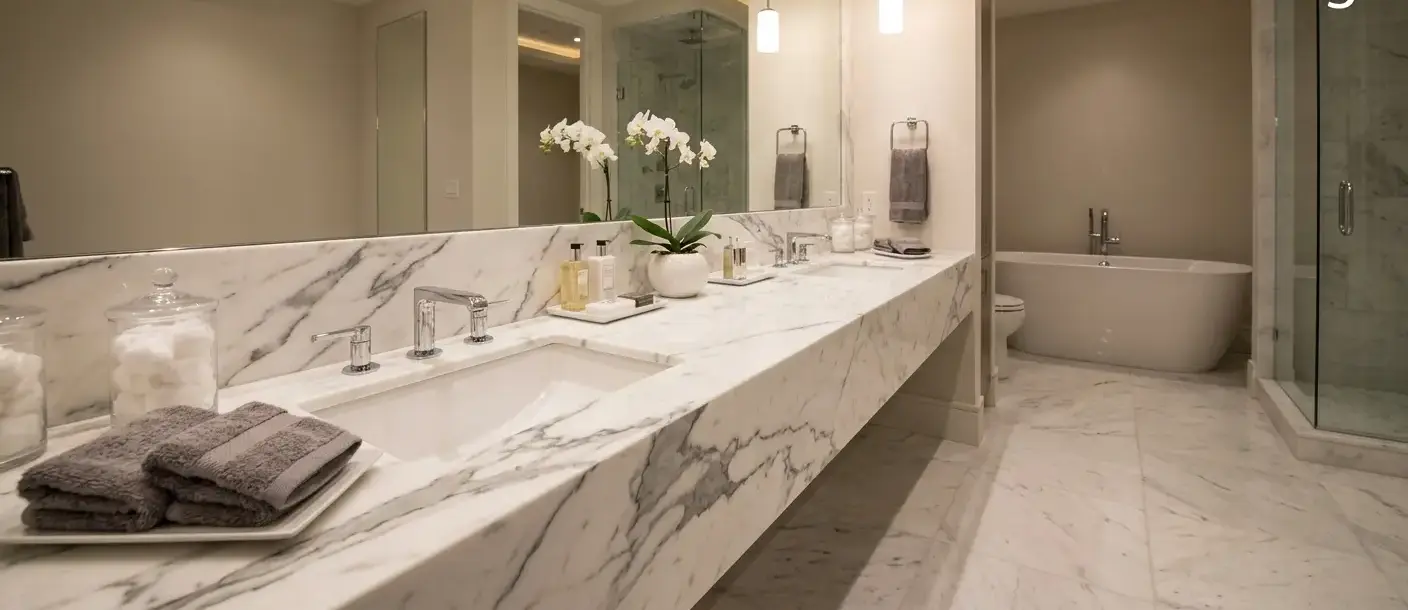 Conceptual rendering
Practical Advantages of Stone Slab Countertops
- Heat tolerance with care: All three materials handle ambient kitchen heat well, but trivets remain necessary to prevent thermal shock at concentrated points.
- Scratch resistance: Quartzite and quartz rate significantly higher on the Mohs scale than marble, making them preferable for kitchens where cutting boards may be overlooked.
- Nonporous quartz: Engineered quartz absorbs minimal moisture, reducing staining risk on bar countertop applications without routine sealing.
- Marble character: Etching and patina on honed marble develop over time, contributing to an aged, lived-in appearance many homeowners value.
- Consistent sizing: Standard 3/4 in and 1.25 in slab thicknesses accommodate undermount sinks and integrated drains without custom fabrication adjustments.
- Cleaning: All three materials respond well to pH-neutral cleaners. Abrasive products should be avoided on polished and honed finishes.
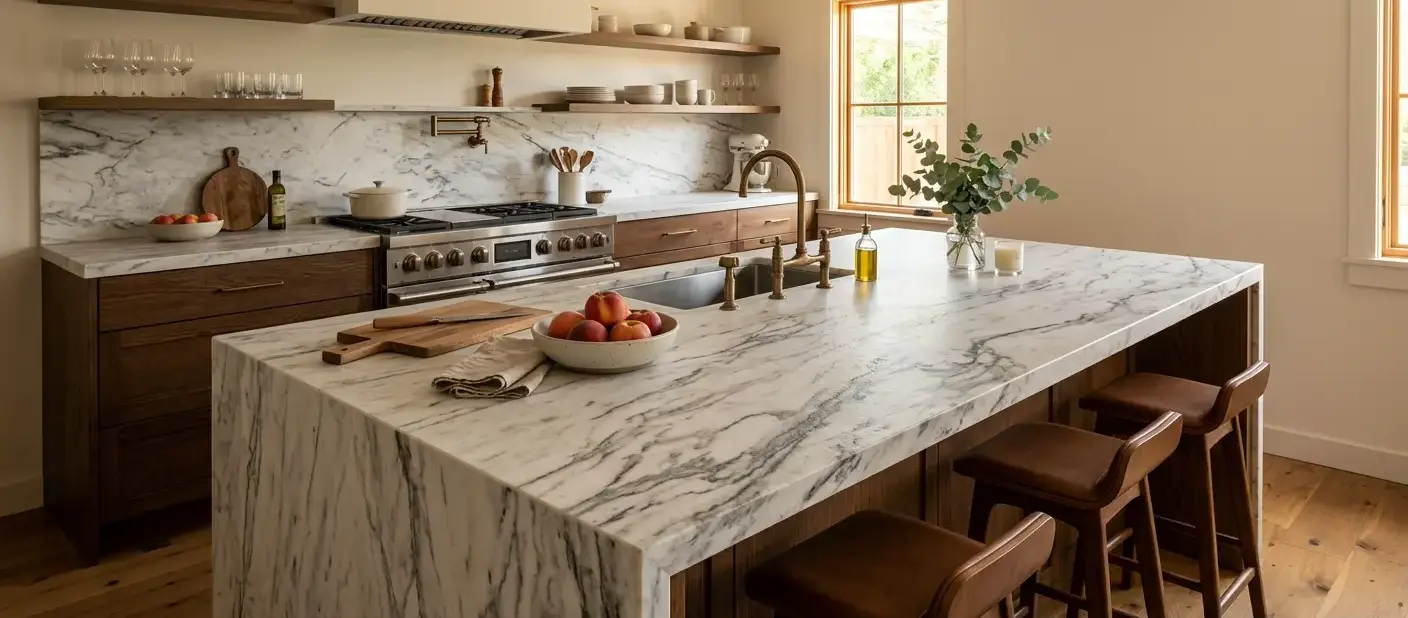 Conceptual rendering
Why a Stone Vanity Countertop Retains Long-Term Value
Stone slab countertops consistently appear in home appraisal discussions because they signal quality material selection to buyers. Calacatta Gold marble carries design recognition that aligns with aspirational interior standards. Brazilian quartzite is commonly evaluated under ASTM C616 (Standard Specification for Quartz-Based Dimension Stone) and tested using ASTM C97 to measure water absorption and bulk specific gravity. These standardized measurements provide specifiers with documented performance data when assessing quartzite for architectural and surface applications.
Quartz surfaces carry manufacturer warranties that natural stone cannot match, providing a form of long-term assurance that appeals to buyers in high-humidity bathrooms. Browsing live slab inventory at Nova Tile and Stone allows homeowners and trade professionals to evaluate actual veining patterns and available grades before committing to a design direction.
Nova Tile and Stone premium slab selection maintains direct import relationships, making a broad range of slab grades, finishes, and materials accessible at the showroom level. This is a practical advantage for projects requiring specific visual matches or volume supply.
Frequently Asked Questions
The best stone depends on use and aesthetic preference. Marble offers unmatched visual elegance but requires sealing and careful maintenance to resist etching. Quartzite provides comparable aesthetics with greater hardness. Quartz suits high-moisture bathrooms with minimal upkeep requirements.
Honed marble is more forgiving visually because etching blends into the matte surface rather than appearing as a bright contrast mark. Acidic liquids still cause chemical etching on marble surfaces, so prompt cleanup remains important for maintaining long-term appearance.
Yes. Quartzite rates around 7 on the Mohs hardness scale, making it one of the more durable natural stone options for kitchen surfaces and bar tops. A penetrating sealer applied periodically helps maintain stain resistance across high-use areas.
Quartz is an engineered product combining natural quartz crystals with resin binders, producing a non-porous, consistent surface. Quartzite is a natural metamorphic stone with variation in pattern and slight porosity. Both suit bathroom and kitchen slab applications, but quartz requires no sealing.
Standard thickness options are 3/4 in (20 mm) and 1.25 in (30 mm). The 1.25 in slab produces a more substantial visual edge profile and is common for kitchen and bar countertops where the edge detail is a design statement. Both thicknesses accommodate standard undermount sink cutouts.