A vanity backsplash in natural or engineered stone transforms the area above a sink or countertop into a defining design moment. Whether the goal is a spa-calm bathroom or a bold kitchen statement, stone slab options such as marble, quartzite, granite, travertine, dolomite, and quartz deliver surfaces that are as functional as they are visually striking. Each material brings distinct veining, color range, and finish compatibility that directly shapes the mood of the space. Nova Tile and Stone's premium slab inventory carries in-stock options across all four showrooms, with selections suited to both residential renovations and trade-level projects.
Stone Slab Materials for Vanity Backsplash Applications
The quarry origin of each material shapes its visual character and physical behavior. Marble is sourced predominantly from Italy, Turkey, and Greece, where metamorphic pressure transforms limestone into stone defined by crystalline structure and flowing veins. Quartzite originates from sandstone formations across Brazil and the American Southwest, its silica-rich composition creating exceptional hardness. Granite quarries across India, Brazil, and Norway supply coarse-grained igneous stone renowned for pattern diversity. Travertine emerges from freshwater limestone deposits around the Mediterranean basin, and dolomite forms through the gradual magnesium replacement of ancient limestone beds.
Property | Marble | Quartzite | Granite | Travertine | Dolomite | Quartz (Engineered) |
Mohs Hardness | 3–4 | 7–8 | 6-7 | 3-4 | 3.5-4 | 7 |
Standard Thickness | 2 cm / 3 cm | 2 cm / 3 cm | 2 cm / 3 cm | 2 cm / 3 cm | 2 cm / 3 cm | 2 cm / 3 cm |
Absorption Rate (ASTM C97) | 0.1–0.5% | 0.1–0.3% | 0.1-0.4% | 0.5-3.0% | 0.1-0.4% | Non-porous |
Available Finishes | Polished, Honed, Leathered, Specialty | Polished, Honed, Leathered, Specialty | Polished, Honed, Leathered, Specialty | Polished, Honed, Leathered, Specialty | Polished, Honed, Leathered, Specialty | Polished, Honed |
Indoor Use | ✓ |
✓ | ✓ | ✓ | ✓ | ✓ |
Outdoor (UV-Stable) | ✗ | ✓ | ✓ | ✓ | ✗ | ✗ |
Primary colors by material:
- Marble: White, cream, and gray tones (Calacatta white base with gold or gray veining; Carrara soft white with blue-gray movement).
- Quartzite: Ivory to warm white (Taj Mahal) or blue-gray to silver (Mont Blanc).
- Granite: Beige, white-gray, and black.
- Travertine: Ivory and warm caramel.
- Dolomite: Soft white with subtle gray movement.
- Quartz (engineered): Consistent white, gray, and concrete tones with uniform veining replicas.
Marble leads as the dominant choice for bathroom vanity backsplash applications due to its luminosity and natural veining that reads as art at close range. For kitchens, granite and quartzite are preferred as lead materials given their superior hardness and wider finish compatibility.
Backsplash Layout Options for Bathroom Vanities
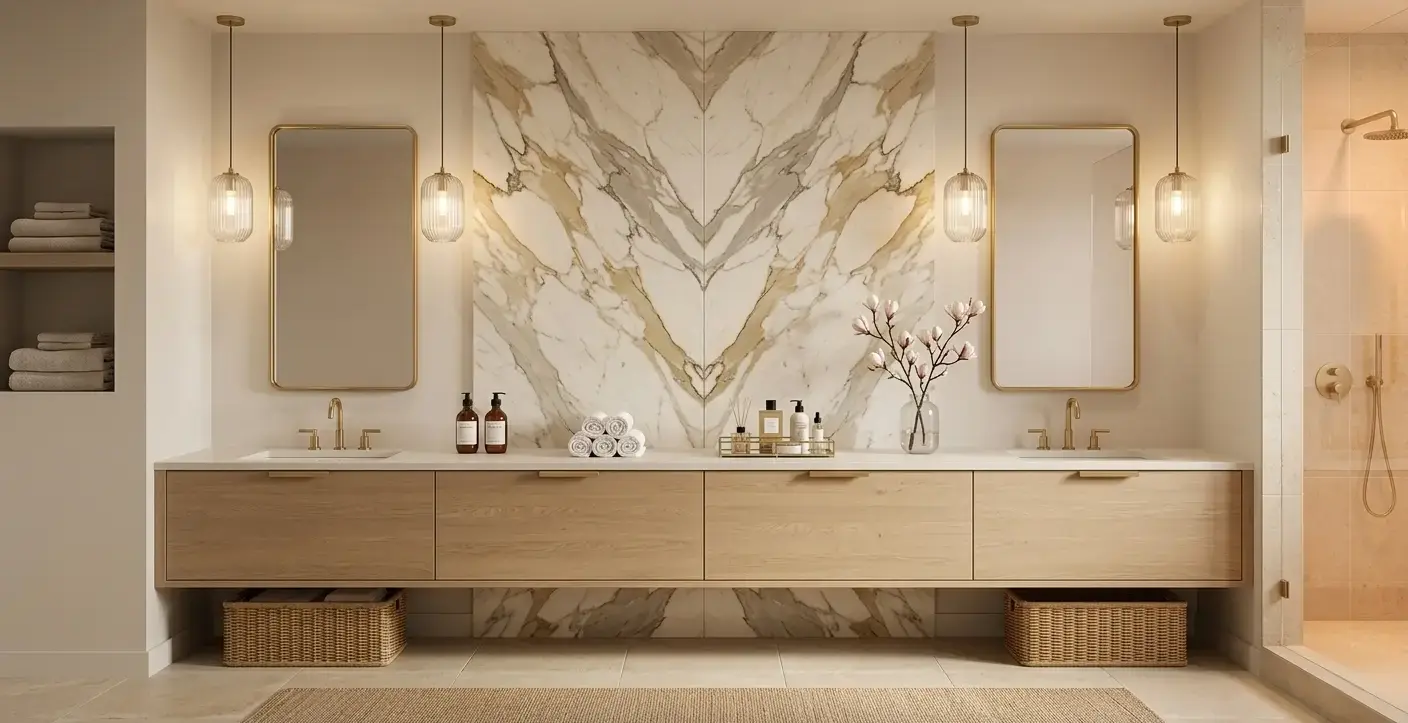
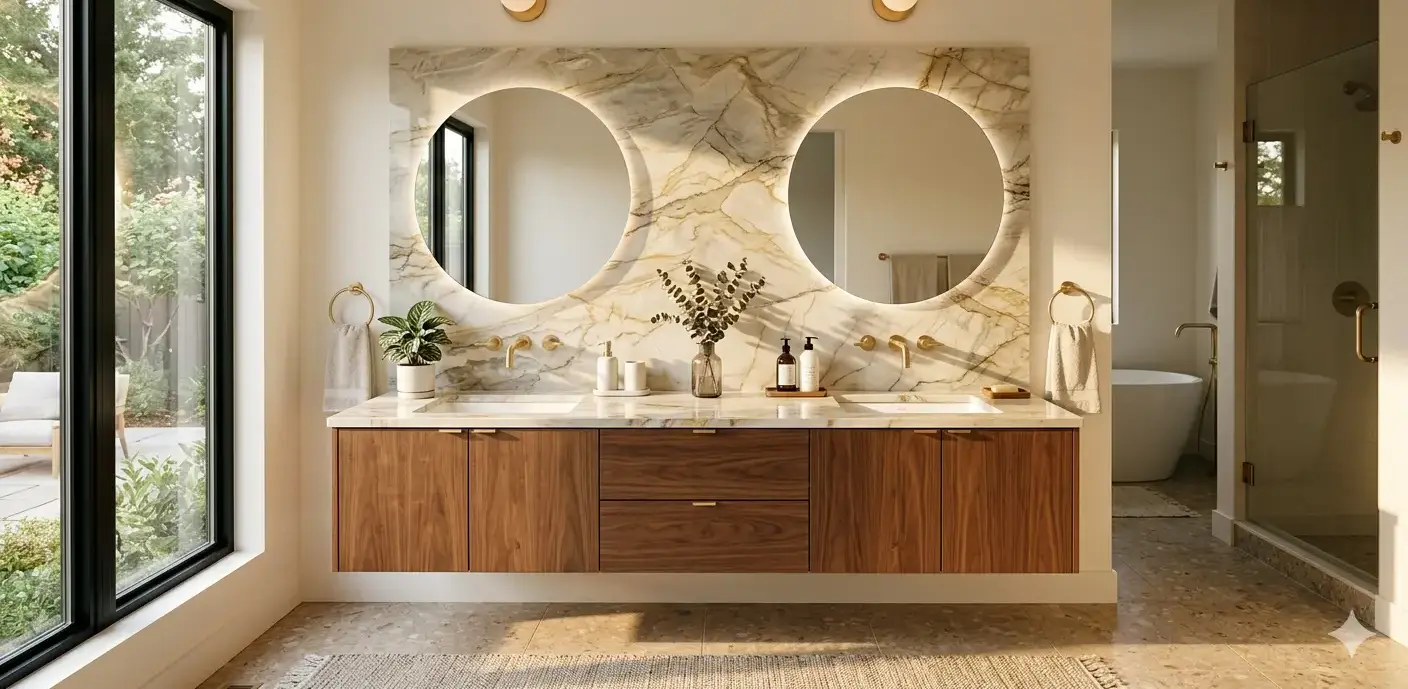
Stone slab backsplashes behind a vanity can be cut to full wall height for a seamless, grout-free look, or sized as a traditional backsplash band between countertop and upper cabinets or mirror. Vertical slab orientation elongates visual height in compact bathrooms, while horizontal alignment emphasizes width across a double-sink vanity. Bookmatched pairs consist of two adjacent slab cuts mirrored along a centerline, producing dramatic symmetrical veining that works particularly well for primary bathroom vanity walls. For kitchen designs, a slab backsplash carried up behind a range hood creates a focal wall that anchors the entire kitchen layout.
The Nova Tile and Stone team offers design consultations for residential and trade clients, helping match materials to project goals before a purchase decision is made.
Herringbone and offset patterns are possible with stone slab cuts but require fabrication decisions made at the material stage. Full-slab runs remain the most space-efficient approach for a vanity backsplash and eliminate the grout lines that require ongoing maintenance in standard tile formats. For smaller powder rooms or secondary bathrooms, a single slab panel behind the mirror delivers the visual weight of full-height stone with minimal material.
 Conceptual rendering
Practical Benefits of Using Stone Slabs for Vanity Backsplash Surfaces
- Polished marble and quartzite reflect ambient light, enlarging the perceived footprint of a bathroom or kitchen.
- Honed finishes on marble, travertine, and dolomite reduce sheen for a softer, spa-appropriate surface; note that honed surfaces are slightly more porous and require more consistent sealing.
- Leathered granite and quartzite conceal water spots and grooming residue better than polished surfaces, making them practical for busy vanity environments.
- Engineered quartz is non-porous and requires no periodic sealing, reducing maintenance obligations compared to natural stone; quartz is limited to indoor use only.
- Granite slab backsplashes resist scratching from grooming tools and cleaning implements due to their hardness rating of 6–7 on the Mohs scale.
- Travertine introduces natural texture with its characteristic pitting, though filled-and-honed travertine provides a smoother, more moisture-resistant surface suited to wet bathroom environments.
- All polished finishes become slipperier when wet; for wet wall areas adjacent to shower zones, matte or textured finish options provide better safety performance.
- Heat from styling tools placed near the vanity will not damage stone surfaces under normal contact, but direct prolonged heat exposure can cause thermal shock in some materials; a protective pad is recommended.
- Cutting boards are advised on stone surfaces where food preparation occurs, regardless of material hardness, to preserve both the stone and any bladed tools.
- Stone slab backsplashes behind vanities require no abrasive cleaners; a pH-neutral cleaner and prompt spill cleanup preserve appearance across all materials.
For guidance on current installation standards and wet-area material performance testing, the TCNA Handbook and industry standards resource is the relevant industry reference.
 Conceptual rendering
Long-Term Value of a Stone Slab for Vanity Backsplash
A stone slab used as vanity backsplash is not a consumable surface. Natural stone demonstrates physical properties that support decades of residential service when maintained correctly. Marble and travertine require periodic resealing, typically every six to twelve months in high-use vanity environments, but with proper care, they retain their surface integrity and visual appeal for many years. Granite and quartzite rank higher on hardness scales and demand less frequent sealing, generally every one to three years.
Engineered quartz, while non-porous by composition, has a rated service life of twenty-five to thirty years in indoor residential settings and maintains its surface without sealing. Its consistency eliminates slab to slab matching concerns across large backsplash runs, which is an advantage for phased renovation projects. Across all materials, a stone slab surface adds measurable value to a property at resale, particularly in primary bathrooms where buyers evaluate material quality at close inspection distance. Trade professionals managing multi-unit projects can access volume support and custom pricing through the Nova Tile and Stone trade account program.
Design longevity matters as much as physical durability. Calacatta white marble, warm travertine, and crisp engineered quartz in white or gray tones have demonstrated sustained commercial demand across multiple design cycles, which reduces the risk of a vanity backsplash surface appearing dated within a few years of completion.
Frequently Asked Questions
Marble is the most popular choice for bathroom vanity backsplash applications, particularly Calacatta and Carrara varieties with white bases and gray or gold veining. Quartzite is a strong alternative for those wanting the look of marble with greater hardness and lower maintenance requirements. Engineered quartz suits environments where a maintenance-free, non-porous surface is preferred.
Sealing requirements depend on the material. Natural stone options including marble, granite, quartzite, travertine, and dolomite are porous to varying degrees and benefit from a penetrating sealer at the time of completion, with periodic resealing based on use and porosity. Engineered quartz is non-porous and does not require sealing.
Yes. Matching the countertop and vanity backsplash from the same slab lot creates a continuous, coordinated surface with consistent veining and color throughout. This approach is common with marble and quartzite and requires coordinated cutting to ensure visual alignment across both surfaces.
Polished finishes are popular for their reflectivity and ease of cleaning, but they show water spots more readily in wet zones. Honed or leathered finishes hide daily splash marks and are practical alternatives for the area directly above a kitchen sink. All finishes perform adequately with regular pH-neutral cleaning.
Travertine can perform well in bathroom backsplash applications when properly sealed and maintained, as long as it is not subjected to standing water or persistent moisture contact without protection. Filled-and-honed travertine reduces the open pitting that can collect moisture. Adequate ventilation in the bathroom extends the effective life of any natural stone backsplash surface.