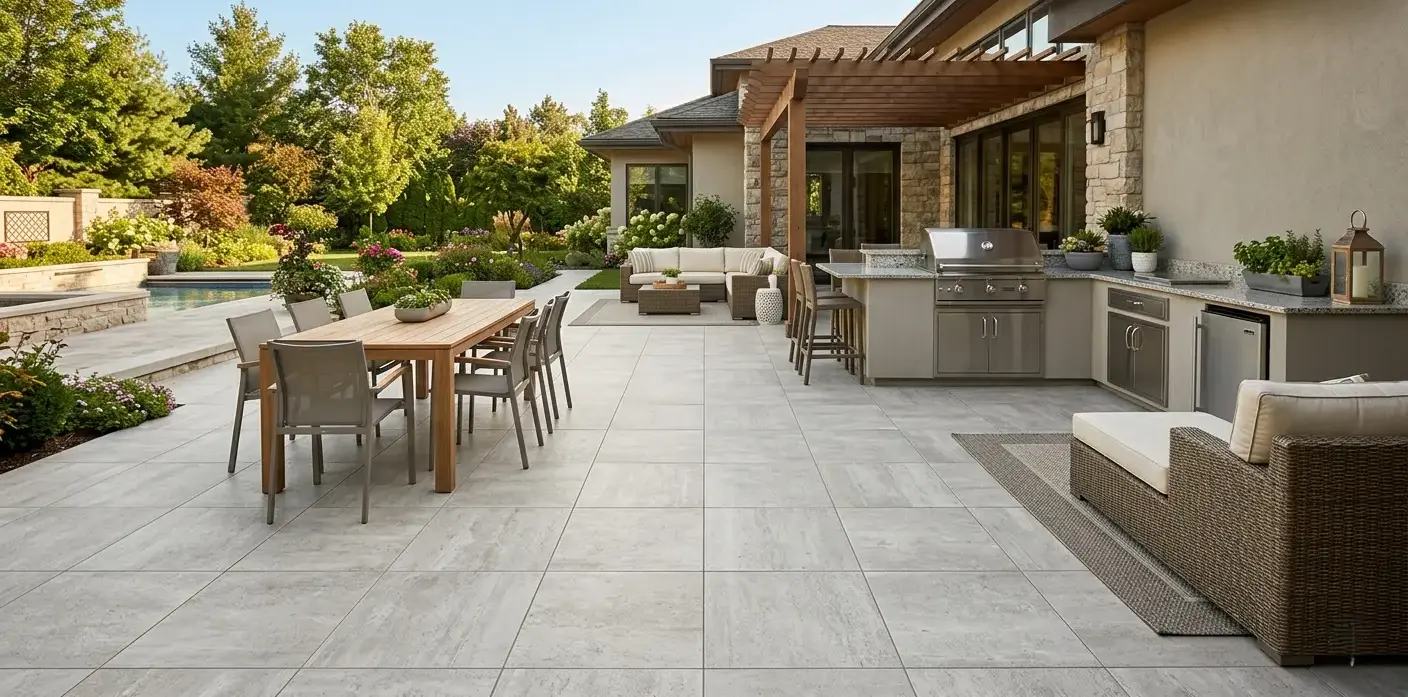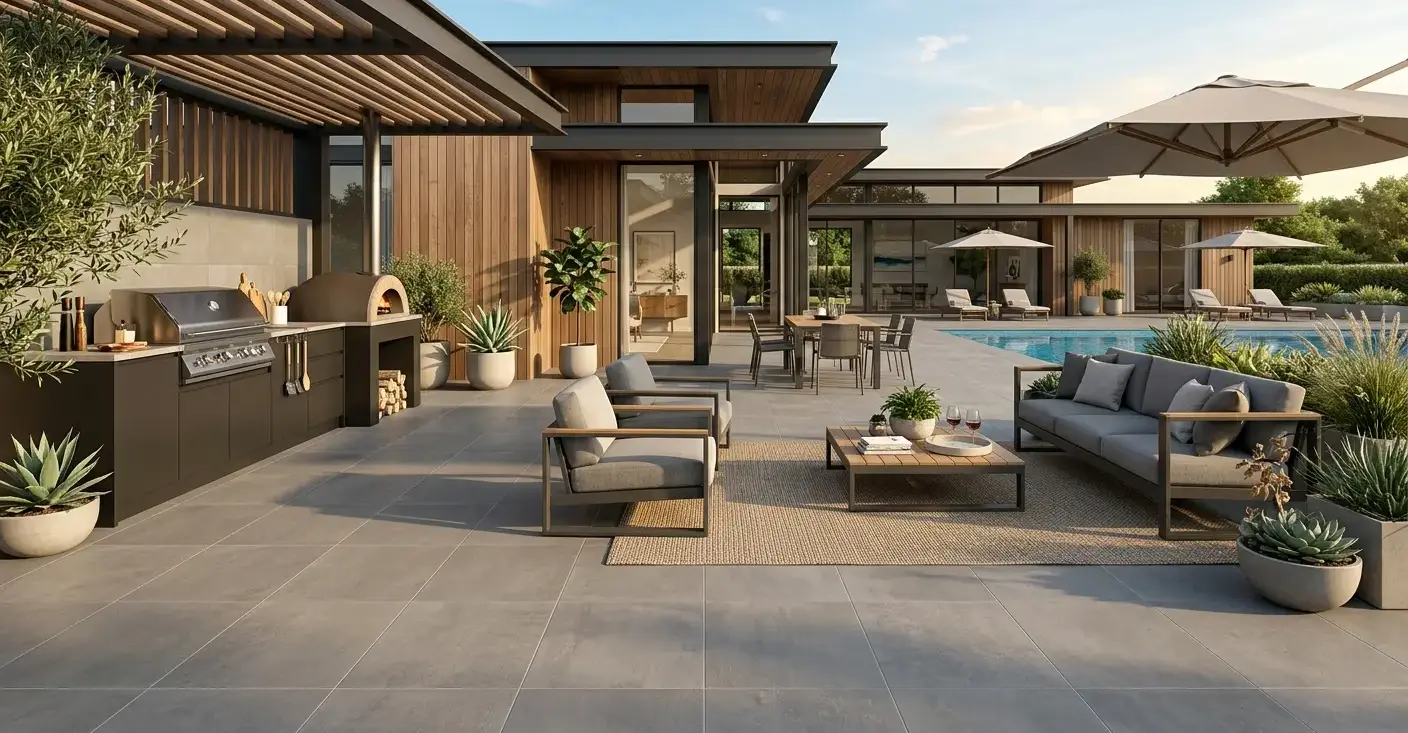
Porcelain patio tiles offer a frost-resistant, UV-stable solution for outdoor living spaces that natural stone alternatives often cannot match without added maintenance. Manufactured to a dense, vitrified body with a water absorption rate below 0.5%, these tiles handle freeze-thaw cycles, prolonged sun exposure, and daily foot traffic with consistent performance. For format and finish options across Nevada and California, Nova Tile and Stone operates showrooms in Reno, Minden, Sacramento, and Fernley.
Gray Matte Porcelain Patio Tile: Specifications and Performance
Porcelain tile is an engineered ceramic product fired at temperatures above 2,000°F. That firing process vitrifies the clay body and reduces internal porosity to near zero, yielding a surface denser and more dimensionally consistent than most quarried stone products. For outdoor settings where moisture and temperature fluctuations test material limits, this consistency is a measurable technical advantage.
Warm concrete gray is the most commercially dominant primary color for outdoor porcelain. This mid-tone holds neutrally against exterior cladding, stone features, and planted areas without competing for attention. A warm sand or beige secondary tone pairs well as a border or accent field. The matte finish is the appropriate choice for all outdoor-facing surfaces, providing a textured grip that reduces slip risk on wet areas.
The 20 mm paver format provides greater structural depth for ground-level patio settings, while the 10 mm format remains standard for elevated decks and covered terraces. A detailed breakdown of grades, finishes, and format options is available in the porcelain tile guide published by Nova Tile and Stone.
Property |
Specification
|
Mohs Hardness | 6–7 |
Standard Thickness | 3/8 in (10 mm) / 3/4 in (20 mm) paver format |
Water Absorption | Less than 0.5% (vitrified body) |
PEI Wear Rating | Grade 4–5 (outdoor-rated) |
Slip Resistance | R10 minimum (wet exterior surfaces) |
Updated Stone‑Look Collection
Fresh Finds in Our Inventory!
Patio Tile Designs That Work From Indoors to Outdoors
Concrete-gray porcelain adapts to multiple layout configurations because the manufacturing process produces consistent tile dimensions across every production batch. Tight, even grout lines are easier to maintain at scale with porcelain than with quarried materials, which can vary subtly in thickness and edge profile from one piece to the next.
Common patio tile design layouts include:
- Large-format straight lay: 24×24 in or 24×48 in tiles aligned parallel to the longest exterior wall. The most widely specified layout for open patio surfaces, minimizing visual breaks across the floor plane.
- Running bond (offset): A staggered joint pattern that introduces directional movement without requiring irregular tile shapes or additional cuts.
- Grid pattern: Square tiles in a uniform grid, effective for symmetrical outdoor courtyards and formal garden settings.
- Herringbone: More practical on covered terraces or transition zones near an exterior wall than on open, ground-level patio surfaces.
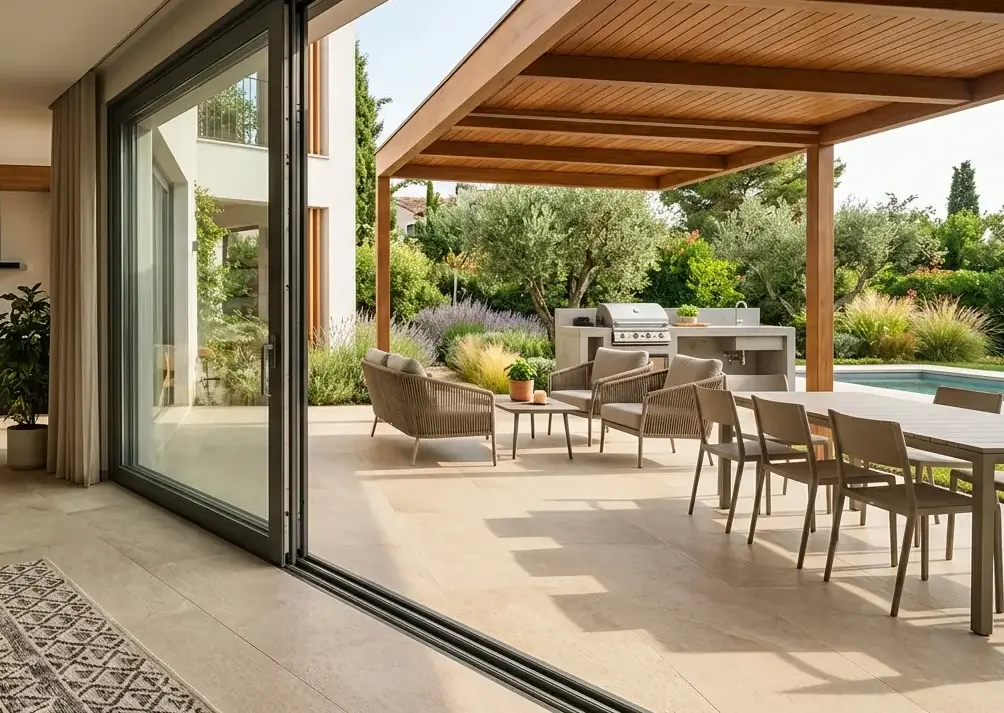 Conceptual rendering
Extending the same tile through a sliding or bifold door to the interior floor creates a continuous surface that visually expands both areas. The Nova design team can help with format selection for each project's threshold height and layout.
Discover Our Recent Publications
Catch Up on Our Recent Innovations !
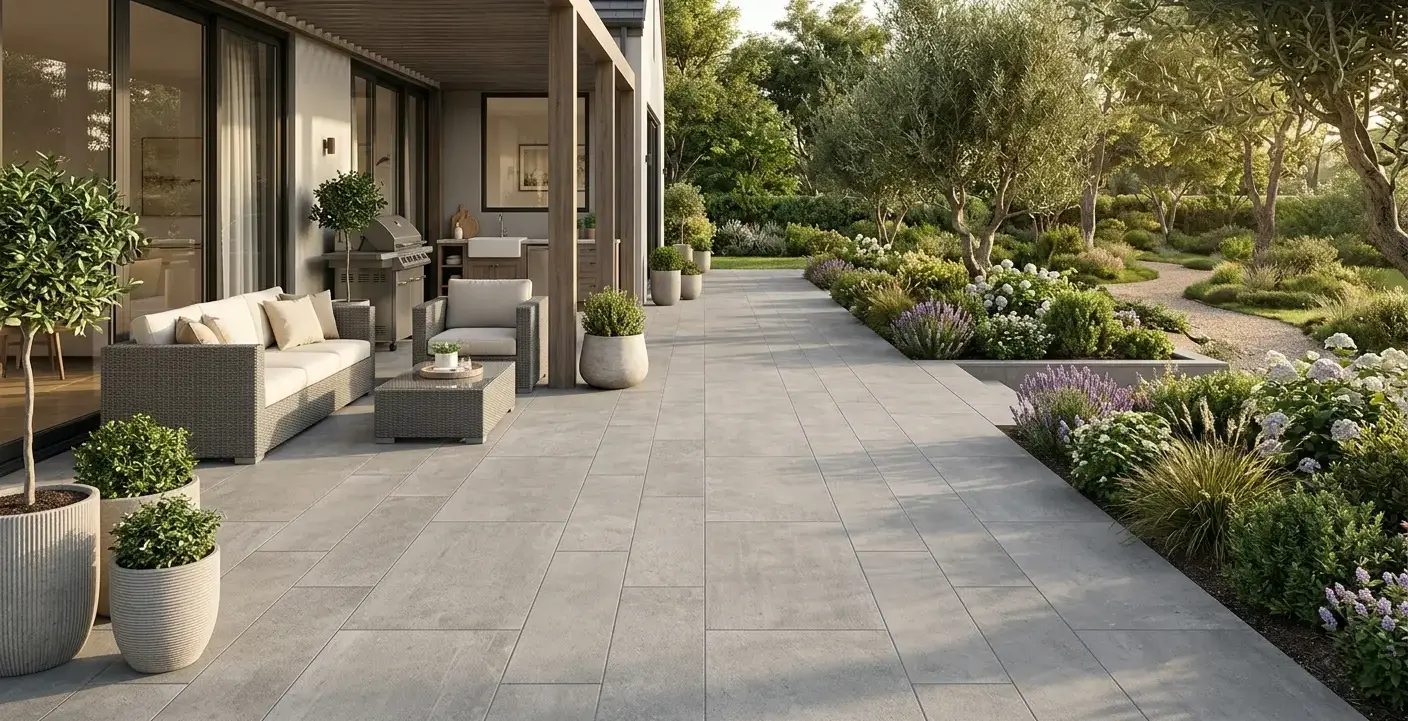 Conceptual rendering
Why Porcelain Patio Tiles Outperform Other Outdoor Materials
Engineered porcelain delivers several practical advantages for patio applications that are difficult to replicate with natural stone, standard ceramic tile, or concrete:
- Frost resistance: The vitrified body absorbs less than 0.5% water, leaving minimal moisture to expand during freeze-thaw cycles in cold-climate outdoor settings.
- UV stability: Kiln-fired color and surface texture retain consistency under prolonged sun exposure, unlike some natural stone finishes that can fade over repeated seasons.
- Slip resistance: Matte and textured finishes achieve an R10 or higher slip rating, meeting safety thresholds for wet exterior surfaces under most standard outdoor conditions.
- No sealing required: Porcelain's non-porous surface does not absorb staining agents, eliminating the periodic resealing cycles that marble, travertine, and other natural stone surfaces demand.
- Low-maintenance upkeep: Routine sweeping and a mild detergent rinse are sufficient for most patio cleaning tasks, regardless of season.
- Scratch resistance: The hard vitrified surface resists light abrasion from outdoor furniture and foot traffic, though protective pads on heavy furniture are still advisable.
For homeowners pairing a patio with a covered cooking area, the durability that suits porcelain patio tiles extends to outdoor kitchen countertops, supporting a cohesive stone surfaces aesthetic across the exterior.
A Stone Surface Investment Built for Decades of Outdoor Use
Porcelain patio tiles, when selected at the correct grade and format for the application, can serve an outdoor space for 50 years or longer with appropriate care. That potential lifespan compares favorably to composite decking, standard concrete pavers, and lower-grade ceramic tile, especially in climates that cycle through both summer heat and winter frost.
Warm concrete gray resists design fatigue better than highly saturated alternatives. It accommodates changing furniture, landscaping, and cladding over time without requiring tile replacement, making it a practical long-term choice for residential and light-commercial patio settings.
Porcelain tile performance is governed by ISO 10545, which defines testing protocols for water absorption, flexural strength, and thermal shock resistance. ASTM C373 provides the supplementary water absorption standard referenced across U.S. tile markets. The TCNA Handbook consolidates performance specifications aligned with these standards and serves as the primary reference for professional tile specifiers.
Frequently Asked Questions
Yes, porcelain patio tiles are frost-resistant when the tile's water absorption rate falls below 0.5%, which is standard for vitrified porcelain. The low absorption leaves minimal moisture inside the tile body, reducing the risk of cracking during freeze-thaw cycles. Confirm ISO 10545 compliance before specifying for cold climates.
A matte or textured finish is the recommended choice for outdoor patio applications. These finishes achieve an R10 or higher slip rating, meeting safety thresholds for wet exterior surfaces. Polished finishes are visually appealing but become slippery when wet and are not appropriate for uncovered outdoor areas.
Large-format tiles, typically 24×24 in or 24×48 in, are the most popular choice for open patio surfaces. Larger formats minimize grout lines, reduce visual complexity across the floor plane, and create a more seamless, contemporary appearance. The 20 mm paver format is recommended for ground-level patio settings.
No. Porcelain tiles are non-porous and do not require sealing, unlike natural stone surfaces such as marble or travertine. This is one of the primary maintenance advantages of porcelain for outdoor use. Grout lines, however, may benefit from a penetrating grout sealer to limit staining in high-exposure areas.
Warm concrete gray is the most commercially popular color for porcelain patio tiles. It reads as neutral against most exterior cladding and landscaping, holds up visually in shaded and sun-exposed conditions alike, and does not show fine debris as readily as very light or dark alternatives. Sand and beige tones are a close secondary choice for traditional outdoor settings.