Design Applications: Where This Stone Works Best
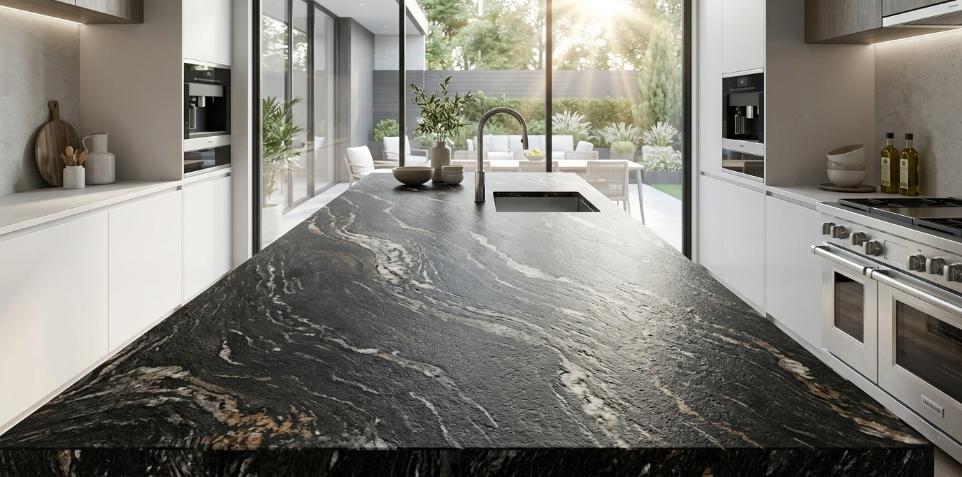
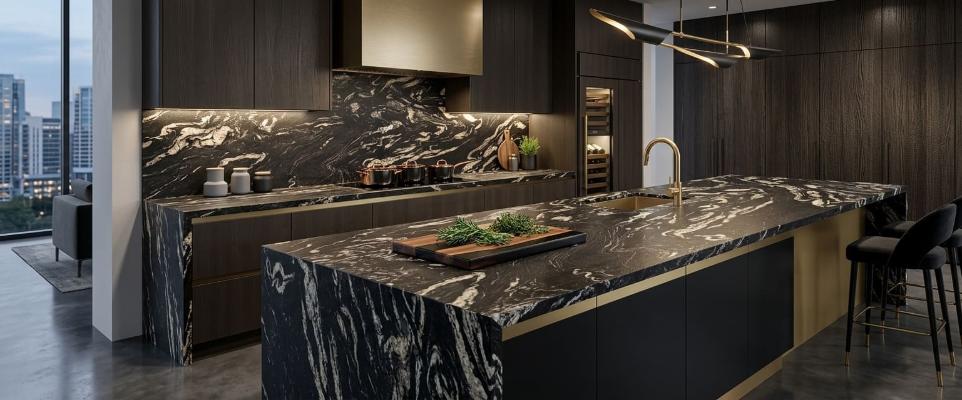
Leathered titanium granite's bold coloring and low-sheen character make it adaptable across residential and commercial installations. In the kitchen, leathered titanium granite countertops pair well with white or cream cabinetry and equally well alongside warm wood tones or darker flat-panel cabinetry. Its scratch resistance and heat tolerance suit daily cooking demands, though trivets are advisable to prevent thermal shock.
For bathrooms, the leathered finish adds a tactile dimension that a polished slab does not provide, and full slab panels on shower walls or floors create a cohesive aesthetic. As a fireplace surround, the stone's visual weight and heat-resistant properties make it a reliable anchor. It also performs well on patio surfaces, grill areas, and outdoor kitchen countertops, where its igneous composition holds up across varying climates.
Comparing Granite Finishes: Polished, Honed, Leathered, and Specialty
The four finish categories for granite are polished, honed, leathered, and specialty, each producing different results in appearance, maintenance, and performance.
Polished titanium granite suits formal and contemporary interiors, though its mirror-like surface shows fingerprints more readily. A honed finish leaves a flat matte surface that is smooth to the touch, though its open pores make it the most stain-susceptible residential option. Specialty finishes such as flamed and sandblasted create slip-resistant surfaces used primarily for outdoor paving and high-traffic commercial applications.
Leathered titanium granite retains more color depth than honed while eliminating the reflectivity of polished granite. Its compressed pores improve stain resistance, and unlike specialty finishes, it maintains the smoothness required for countertop use. Fabricators and designers consistently recommend it for titanium granite because it allows the stone's full crystalline complexity to come through without distraction.