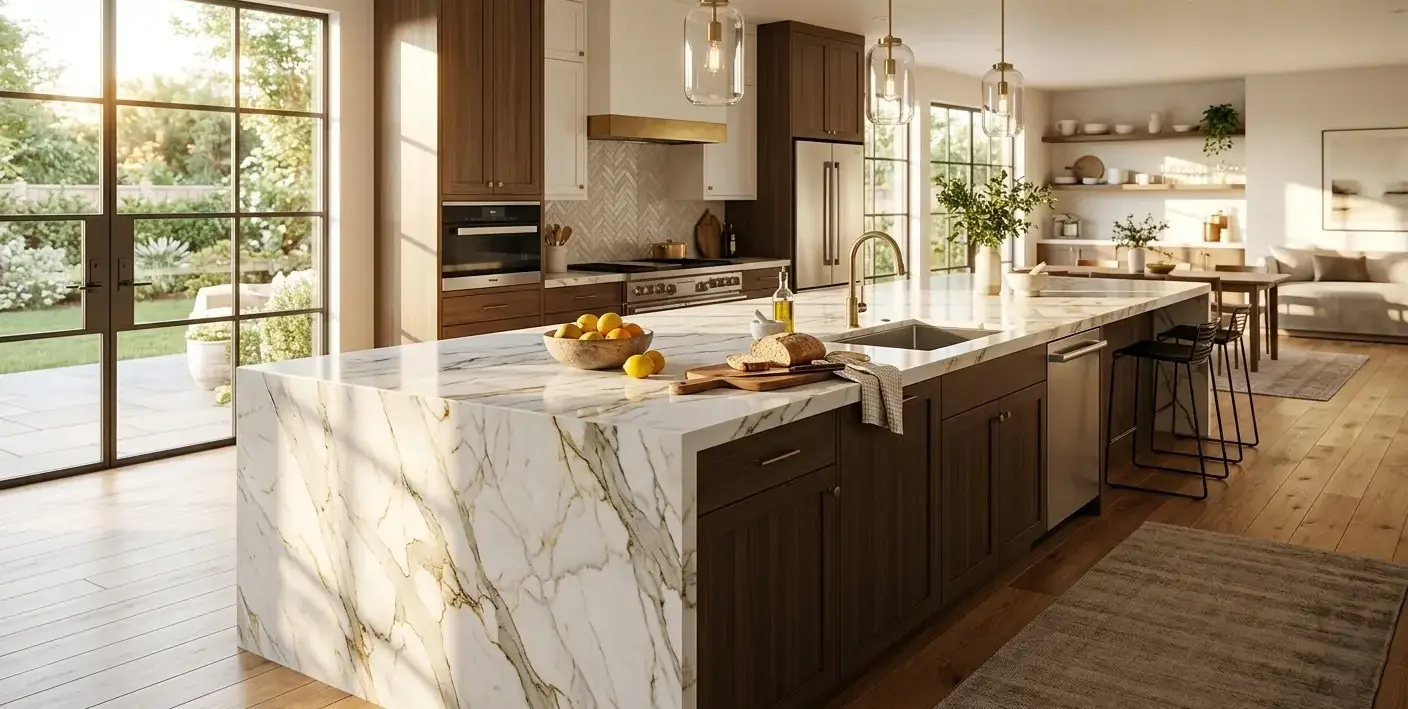
Kitchen island waterfall countertop slabs are designed to highlight the natural beauty and movement of stone across both the horizontal and vertical surfaces of the island. Available in quartzite, marble, granite, quartz, and porcelain, these slabs offer the size, durability, and visual continuity needed for waterfall-style kitchen island installations. Browse the Nova Tile and Stone slab inventory to find the right material for your project.
Stone Specifications for a Waterfall Island Countertop
The waterfall format demands a slab with strong visual depth, consistent veining, and enough surface area to cover both the horizontal top and vertical side panels from a single run of material. Quartzite is the leading natural stone choice for this application, prized for its dramatic movement and structural density. Quartz (engineered stone) is the most popular alternative when pattern-matching precision is the primary concern.
Quarry Origin Callout: Premium quartzite slabs used in waterfall applications, including Super White, Bianco Superiore, and Taj Mahal, originate primarily from quarries in Minas Gerais and Espírito Santo, Brazil. High pressure metamorphic conditions in these regions produce the fine crystalline matrix responsible for the material's characteristic translucency and pronounced veining.
| Property |
Quartzite
|
Quartz (Engineered)
|
Granite
|
Mohs Hardness | 7 | 6 - 7 | 7 - 8 (surface) |
Water Absorption | 0.1 - 0.4% (ASTM C97) | Non-porous | 0.1 - 0.4% (ASTM C97) |
Standard Thickness | 2 cm / 3 cm | 2 cm / 3 cm | 2 cm / 3 cm |
Finishes Available | Polished, Honed, Leathered, Specialty | Polished, Honed | Polished, Honed, Leathered, Specialty |
UV Stability
|
UV Resistant | UV Resistant | Not UV Resistant |
ASTM Standard | C503 | Manufacturer spec | C503 |
Quartzite in a polished finish amplifies the waterfall effect by reflecting ambient light across the vertical face. Honed and leathered finishes soften the sheen and reduce fingerprint visibility on the side panels, making them a practical choice for high traffic kitchens where the vertical surface is frequently touched. Specialty finishes, such as brushed or textured surfaces, provide additional visual depth and a distinctive tactile character while maintaining the natural beauty of the stone.
Design Options for Waterfall Kitchen Islands
The slabs used as a kitchen island waterfall countertop perform across a wide range of spatial contexts. In open-concept kitchens, the vertical slab panel reads as a sculptural room divider, anchoring the island visually without adding physical barriers. In galley-style kitchens with a single island run, a single-sided waterfall on the seating end creates a refined finish while conserving material.
For color, white-and-gold quartzite (Super White, Calacatta quartzite) remains the most requested palette, pairing naturally with both white and dark cabinetry. Warm gray veining on a cream ground suits transitional interiors, while bold black-and-white movement suits contemporary and industrial schemes.
The classic color schemes that endure in interior design, such as charcoal with creamy white and warm beige with soft gray, translate directly into quartzite selections, making stone color choice easier when you start with a proven palette.
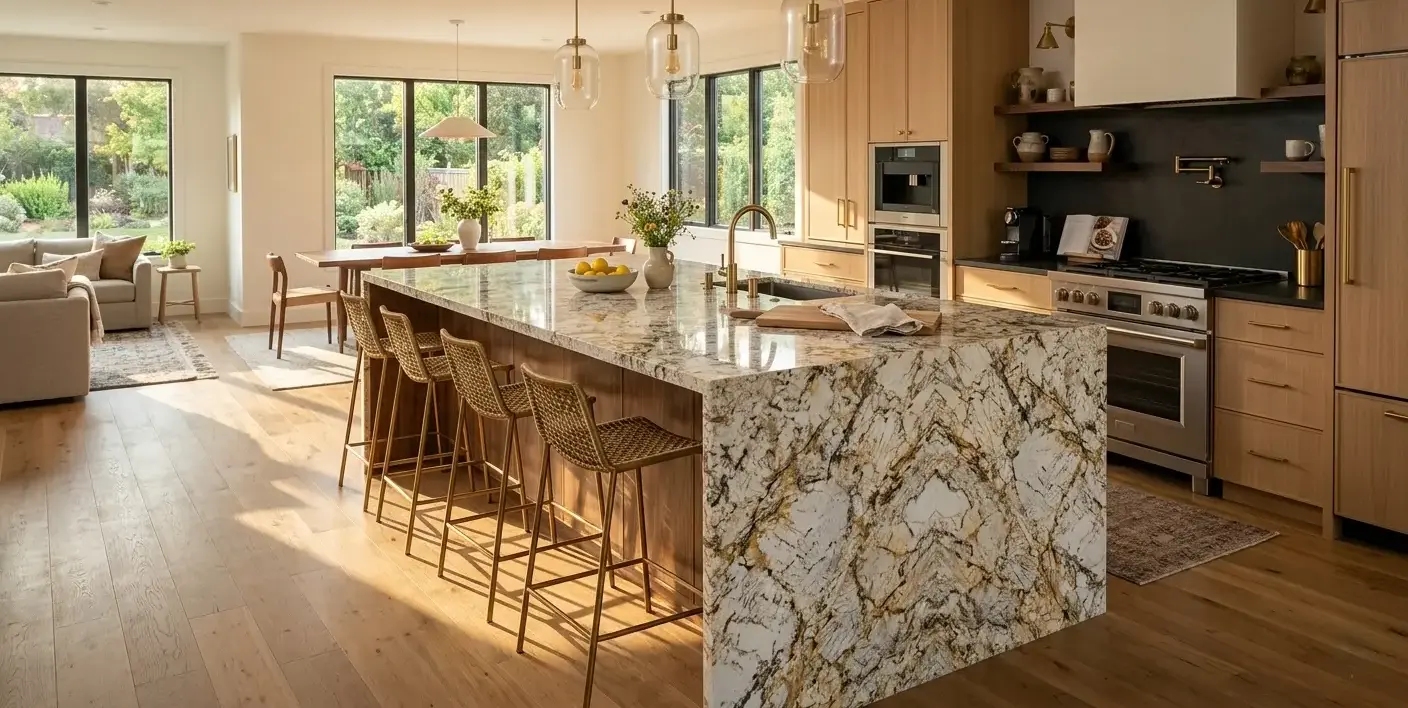 Conceptual rendering
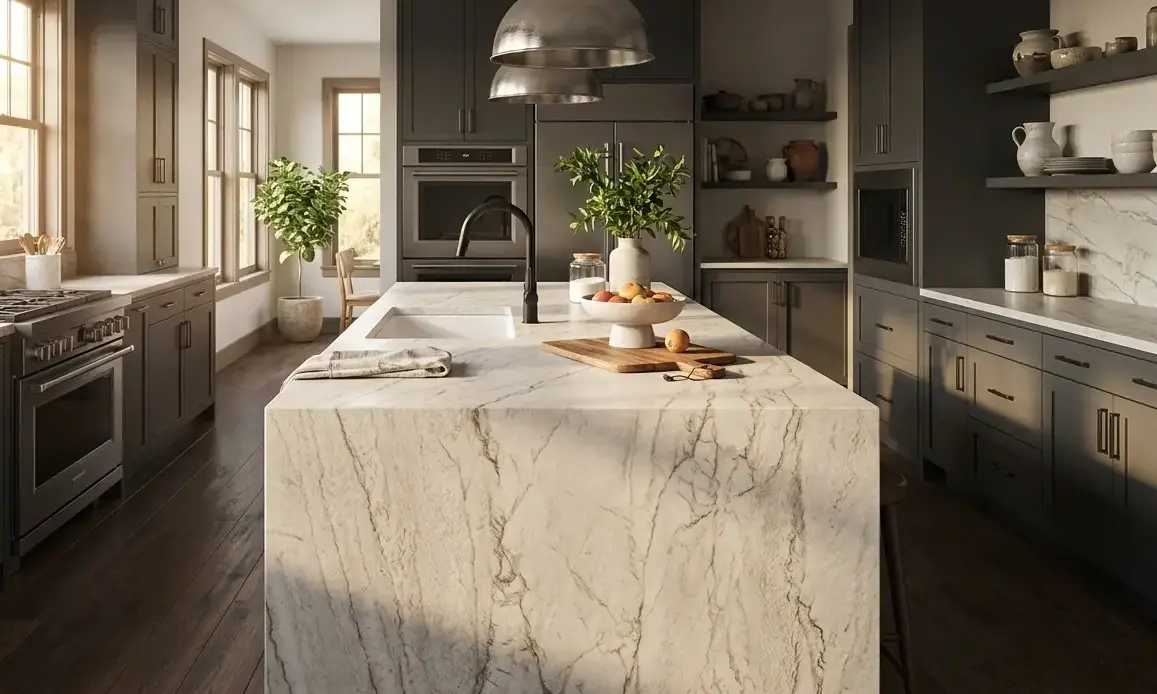 Conceptual rendering
For those drawn to the elegance of marble veining, the marble slab options for kitchen island in Nova Tile and Stone inventory include Calacatta and Statuario selections that complement the waterfall profile effectively in lower traffic kitchens and dry use bar areas.
Veining alignment is the defining quality factor in a waterfall countertop. Book-matching, in which a slab is cut and mirrored at the corner joint, produces the most dramatic and continuous veining flow from the top surface to the side panel. Standard mitered joints without book matching are a cost conscious alternative that still delivers visual continuity. A skilled stone advisor can explain both approaches and help select slabs whose natural movement supports the desired design effect.
Note: Some images on this page may be conceptual renderings created to illustrate design possibilities and may not depict actual installations.
Practical Advantages of Stone for a Kitchen Island Waterfall Countertop
- Cabinet edge protection: The vertical slab panel covers exposed cabinet sides, shielding plywood or MDF edges from moisture and impact with a material rated to ASTM C503 standards.
- Seam reduction: Fewer exposed horizontal seams mean fewer collection points for debris, making surface maintenance more manageable over time.
- Integrated seating zone: The vertical panel creates a natural visual boundary that defines the seating overhang without the need for additional paneling or millwork.
- Finish flexibility: Polished, honed, leathered, and specialty quartzite are all compatible with the waterfall profile; finish can be selected independently for the top and side panels to balance aesthetics with grip.
- Versatile application: The same stone format translates to bathroom vanity countertops, bar countertops, and living room stone surfaces, providing design continuity across multiple rooms.
Ready to see how the waterfall format fits your project? Book a design consultation with Nova's stone advisors to review full-size slabs in person.
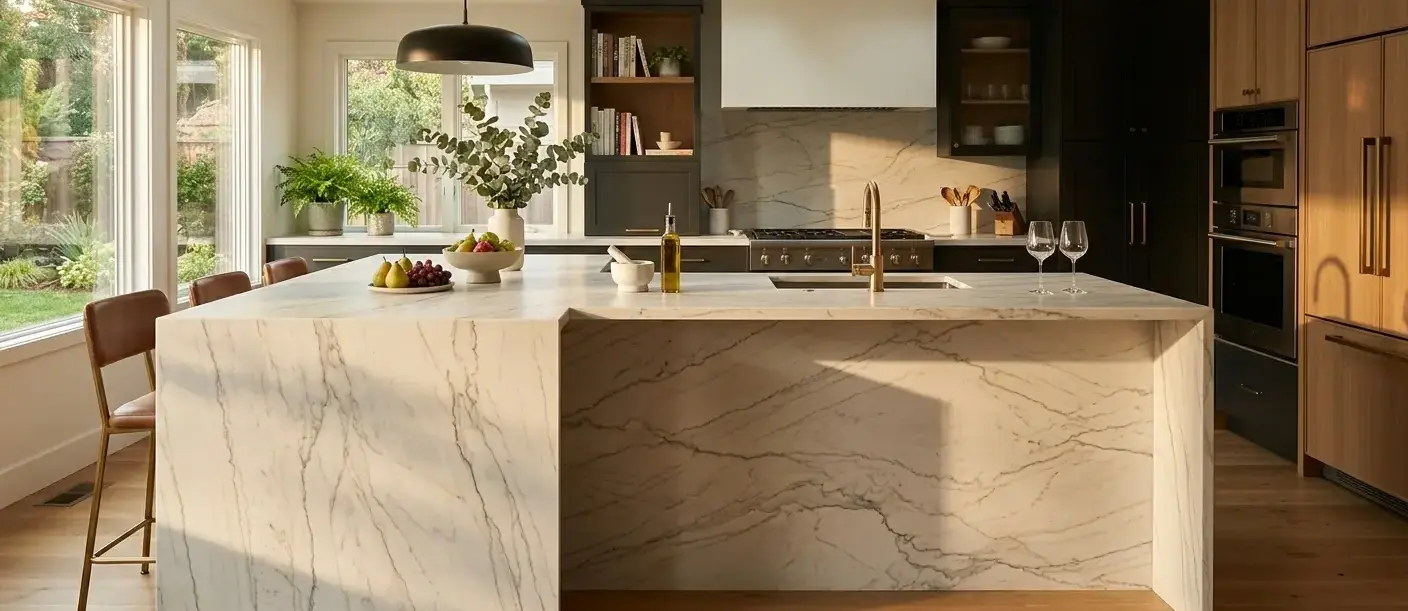 Conceptual rendering
Long-Term Value of Kitchen Island Waterfall Countertops
A kitchen island waterfall countertop is a structural and visual investment that holds relevance well beyond short-cycle design trends. Quartzite slabs tested in accordance with ASTM C97 for water absorption and bulk specific gravity generally exhibit low absorption rates, contributing to their resistance to staining when properly sealed and maintained. Many quartzites absorb significantly less water than marble, making them well suited for kitchen applications. Engineered quartz offers similarly low porosity and does not require sealing, providing strong resistance to staining and everyday wear. Granite, which is commonly evaluated under ASTM C615 and ASTM C97 standards, delivers comparable durability and low absorption for high use kitchen environments.
The waterfall format maximizes the surface area of a premium slab, making the material investment visible from multiple angles. Stone and engineered surfaces that would otherwise function as a single horizontal countertop gain additional architectural presence when the same quartzite, granite, or quartz slab wraps the island sides. This continuous application highlights the material's color, pattern, and texture while creating a more substantial visual focal point within the kitchen.
Natural and engineered stone surfaces used as countertops consistently rank among the property improvements that support long-term home resale value, particularly in kitchens where surface quality is a primary evaluation point for buyers. The waterfall profile amplifies that signal by demonstrating both material quality and design intent, which tend to read as premium upgrades regardless of when the renovation was completed.
Frequently Asked Questions
Quartzite, granite, and quartz are the most practical choices for a kitchen island waterfall countertop. Quartzite offers high hardness (Mohs 7), low absorption, and dramatic natural veining that reads beautifully on the vertical face. Granite provides comparable durability with a wider range of movement patterns. Quartz (engineered stone) is preferred when consistent pattern alignment across the mitered joint is the priority, since the manufactured pattern can be controlled more precisely than a natural slab.
Most waterfall countertops use either 2 cm or 3 cm slabs. A 3 cm thickness is generally preferred for the horizontal top because it provides a substantial edge profile and eliminates the need for a substrate buildup at the perimeter. For the vertical waterfall panel, 3 cm also reads as more proportional from a visual standpoint. A 2 cm slab can work with the appropriate support structure but may require laminated edges to achieve the same visual weight.
Book-matching is not required, but it produces the most seamless veining flow at the corner joint. In a standard mitered waterfall, the top and side panels are cut from the same slab but the pattern does not necessarily continue around the corner. Book-matching involves splitting and flipping a matching slab section so the veining mirrors across the joint, creating a continuous, uninterrupted stone pattern. The choice depends on the natural movement of the specific slab and the visual effect the homeowner or designer wants to achieve.
Yes. The waterfall countertop design can be used for bathroom vanities and fabricated from the same materials commonly used in kitchens. Quartzite and granite are particularly well suited for bathroom applications because of their durability and resistance to moisture when properly sealed and maintained. A honed finish is often preferred for vanity installations because it reduces the visibility of water spots compared to a polished surface. The waterfall format is especially effective on freestanding vanities, where the exposed side panel highlights the material's color, veining, and texture.
Natural stone waterfall countertops, particularly those made from quartzite and granite, benefit from periodic sealing to maintain low absorption rates and resist staining. Clean spills promptly, especially acidic substances such as citrus juice or wine, which can etch certain stone surfaces over time. Avoid abrasive cleaners on polished, honed, or leathered finishes. A pH neutral stone cleaner is the appropriate choice for routine maintenance. Use trivets for hot pots and pans, as heat resistance does not make stone immune to thermal shock. Quartz waterfall countertops do not require sealing but should still be protected from excessive heat and cleaned with pH neutral products.
Bring your kitchen island vision to life with a slab that performs as beautifully as it looks. Visit a Nova Tile and Stone showroom in Reno, Minden, Fernley, or Sacramento to view full size slabs suitable for waterfall countertops and discuss your design options with an experienced stone advisor.