Jet Black Granite
Jet black granite is a natural igneous stone typically characterized by a deep, uniform black color, exceptional hardness, and low porosity, making it one of the more durable and versatile slab materials available for countertops, flooring, fireplace surrounds, and outdoor installations.
Formed through the slow crystallization of magma beneath the earth's surface, it develops a dense, interlocking crystal structure driven by feldspar, quartz, biotite mica, and hornblende amphibole, with a Mohs hardness rating of 6 to 7. That positions it above marble in scratch resistance while its low porosity can help reduce staining risk. Available in polished, honed, leathered, and specialty finishes, the material adapts across a wide range of interior and exterior applications.

Why Jet Black Granite Is a High-Performance Natural Stone Slab
This stone's performance begins at its mineralogical composition, feldspar, quartz, biotite mica, and hornblende amphibole, forming a dense structure known to resist scratching and abrasion. Its water absorption rate of 0.05% to 0.40% by weight leaves very little pore volume available to harbor staining agents, making it a generally reliable material for surfaces subject to frequent liquid contact.
The stone is heat resistant up to approximately 250°C (480°F), though direct application of localized heat sources is discouraged, as strong thermal gradients can initiate cracking. Its low sensitivity to UV-related fading means it can help retain its color and surface quality even under sustained outdoor sun exposure, a quality that compares favorably to stones more prone to visual degradation in exterior settings.
Surface Finish Options for Black Granite Slabs
The character of a slab can vary considerably depending on the surface finish selected, with each option carrying distinct functional and aesthetic implications.
Polished finish tends to bring out the stone's deepest, most reflective black tone through a smooth, glossy surface. It is a common choice for interior countertops and accent walls where visual impact takes priority.
Honed finish stops short of the final polishing stage, yielding a flat, matte surface that tends to conceal fingerprints and minor marks more effectively than a polished finish. It suits flooring and outdoor horizontal surfaces where glare reduction is a practical advantage.
Leathered finish compresses the surface pores through a texturing process, creating a low-sheen, slightly tactile surface that can help hide smudges and water marks. It can be a good fit for kitchen islands, outdoor counters, and fireplace surrounds.
Specialty finish, brushed, flamed, or
sandblasted, tends to produce a coarser texture with notably higher slip
resistance, making it a practical consideration for pool surrounds, steps, and
walkways.
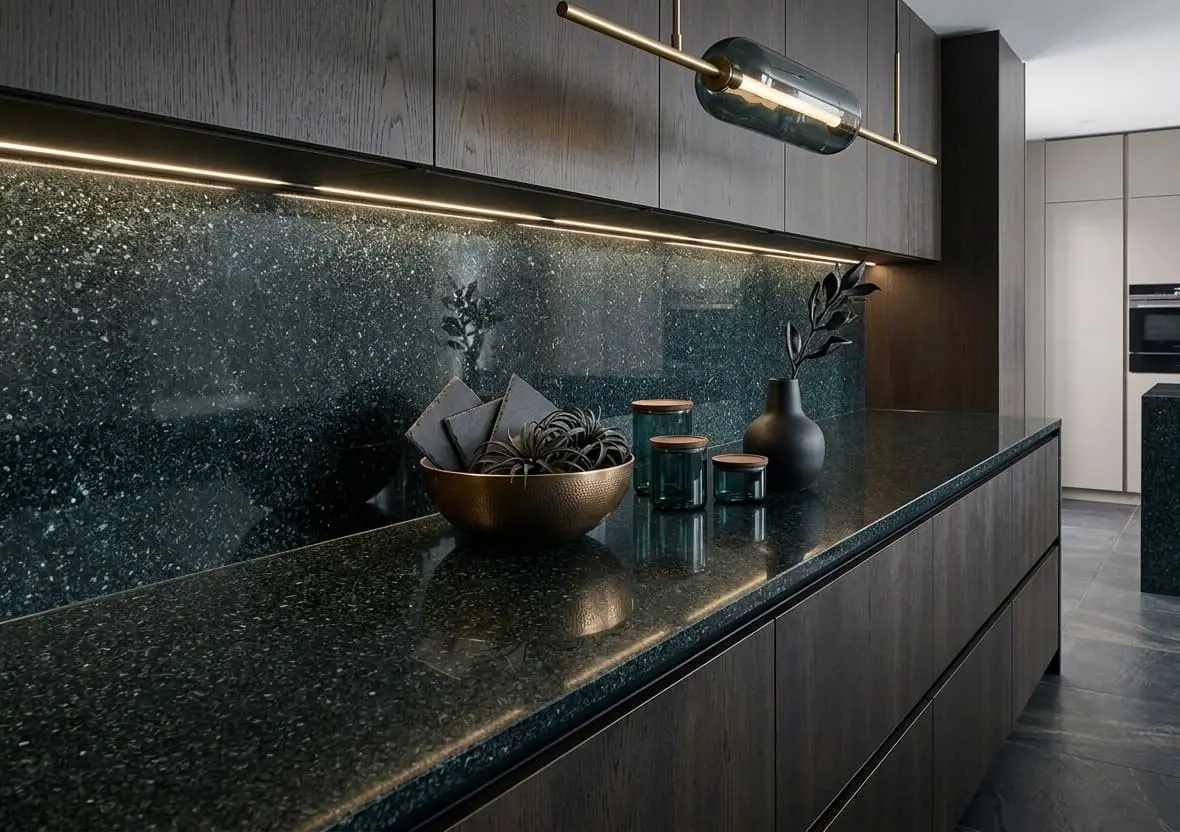
The rich, uniform tone of jet black granite brings a sharp, sophisticated edge to any surface, indoors or out.
Where Black Granite Slabs Perform Best: Indoor and Outdoor Applications
For kitchen countertops, the stone's heat tolerance and dense, low-porosity surface can make it a practical choice for daily food preparation and liquid contact. Its surface can resist staining effectively when properly sealed.
For flooring, hardness and density can contribute to wear resistance across high-traffic spaces. The stone's depth of color holds across honed and leathered finishes, giving floor installations a consistent visual result alongside functional traction.
For fireplace surrounds, its structural density and heat tolerance make it a generally appropriate choice. The uniform black tone can create strong visual contrast against lighter wall finishes. For projects calling for a bolder color pairing, Imperial red granite is worth considering, as its warm red tones can complement the cooler black in accent and surround applications.
For outdoor installations, counters, cladding, paving, and pool surrounds, UV stability and weather resistance can support long-term performance with minimal color loss. Finish selection for outdoor horizontal surfaces should take both traction and surface temperature into account, as the stone tends to absorb more heat in direct sunlight than lighter alternatives.
Caring for Black Granite Slabs: Maintenance and Sealing
Across all of these applications, this stone is considered relatively low-maintenance, though consistent care can help preserve its performance and appearance over time.
Daily cleaning with a pH-neutral soap and warm water is generally sufficient. Acidic or abrasive cleaners should be avoided, as they can degrade the sealer and increase vulnerability to staining. Spills from oils, wine, and citrus-based liquids should be wiped up promptly.
A penetrating sealer is recommended across most applications. It can help reduce staining by limiting liquid absorption, though it does not protect against etching from acidic contact. The sealer can also be damaged at temperatures lower than the stone can tolerate, so trivets are advisable on countertop surfaces. Resealing once every one to three years is a commonly cited interval, with outdoor and high-use surfaces typically warranting more frequent attention.
Of the four finish types, leathered tends to require less visible upkeep than the others, owing to its compressed pore structure and low-sheen surface.
Transform Your Space
Nova Tile and Stone carries jet black granite slabs across four showroom locations in Reno, Sacramento, Minden, and Fernley. Each slab is available for in-person viewing so you can assess color depth, grain consistency, and finish before committing to a selection. Nova Tile and Stone is a slab-only supplier, fabrication and installation are managed by your chosen professionals. Visit any location or browse the current inventory to source the right slab for your project.
Request a Slab Quote Schedule an Appointment
Looking for immediate assistance?
Give us a call!
775-374-6682
(Available Mon-Fri 7:30am - 4:00pm PST)
Unlike most customer service lines, ours connects you with real people.
When you call, just press 1 for online shopping support, or 2 for local shopping support!
Frequently Asked Questions
Yes, it can perform well outdoors given its low porosity, UV stability, and color stability. A honed, leathered, or specialty finish is often recommended over polished for outdoor flooring, and pool surrounds. Resealing once every one to three years can help sustain stain resistance under outdoor conditions.
It depends on use. A polished finish is a common choice for interior kitchen countertops where visual depth and reflectivity take priority. A leathered finish tends to suit counters with heavy handling, as its low-sheen surface hides smudges and water marks effectively.
Yes. A penetrating sealer is recommended to help guard against staining from common liquids. Sealers address staining only and do not prevent etching from acidic substances. Resealing every one to three years is a commonly cited interval for most residential surfaces.
It registers between 6 and 7 on the Mohs hardness scale, harder than marble and softer than quartzite. At that range, everyday objects are unlikely to scratch the surface.
Yes. With heat resistance up to approximately 250°C (480°F), it is considered appropriate for this application, though direct flame contact should be avoided, as thermal gradients can stress the stone. A polished finish can enhance reflective quality in this setting; a honed finish offers a matte alternative.