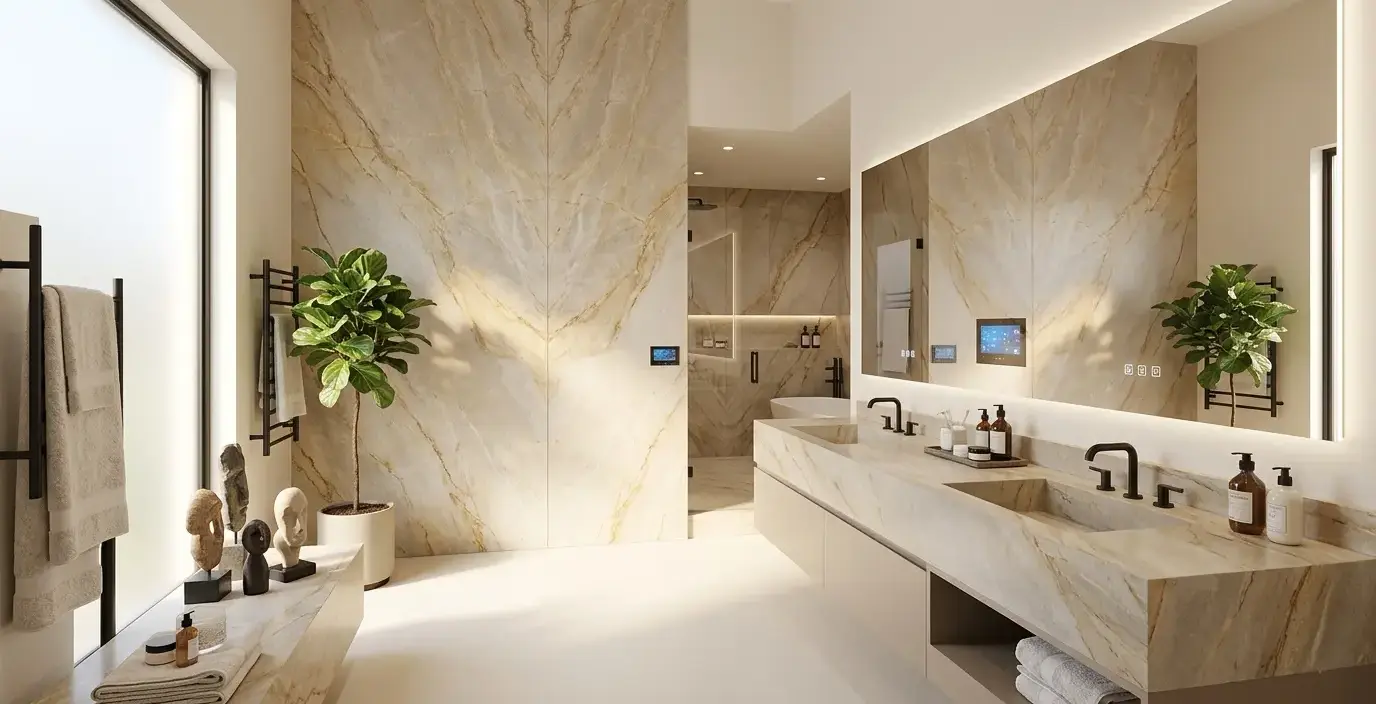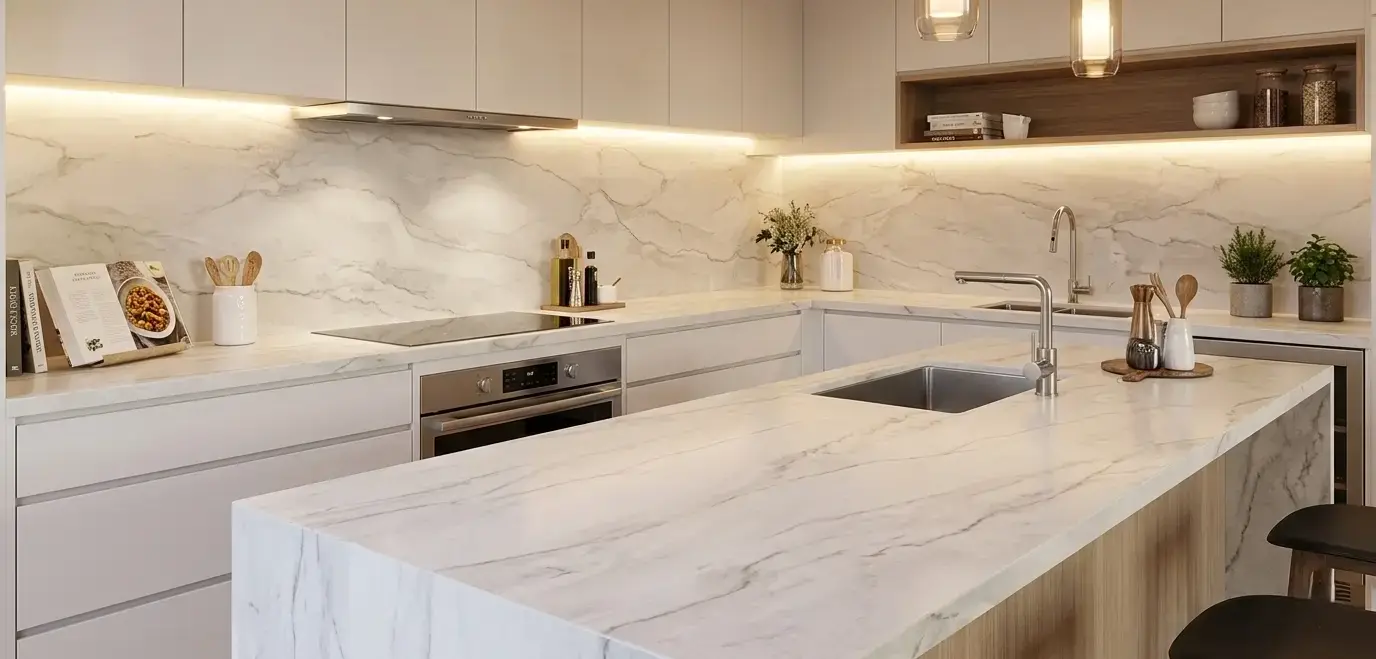
Honed quartzite is a natural stone surface that brings the hardness and density of quartzite to a smooth, matte finish with no high-gloss reflectivity. Colors span white and gray, pink and red, yellow and brown, and green and blue, with secondary shades including beige, cream, taupe, gold, rust, and blue-gray accents, while soft linear, cross-cut, marble-like, and cloudy veining patterns make each slab distinctly its own. Honed quartzite is a popular choice for kitchen and bathroom countertops, offering the durability quartzite is known for in a finish that suits both minimalist and layered design schemes.
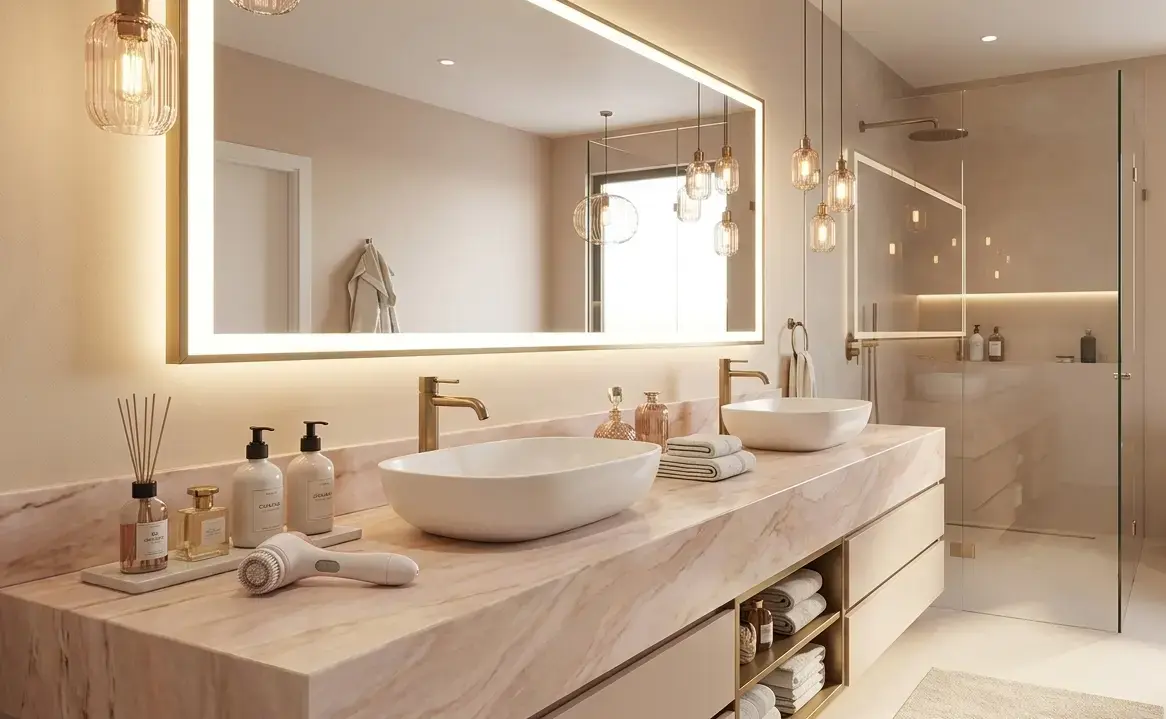 Conceptual rendering
Stone Origin, Specs, and Finish Details
Quartzite is a natural metamorphic rock formed when quartz-rich sandstone recrystallizes under intense geological heat and pressure. It rates 7 on the Mohs hardness scale, harder than granite (approximately 6.5) and substantially more durable than marble (3 to 4). Standard slabs typically range from 115 to 138 inches wide and 55 to 80 inches tall, available in 2cm (3/4 inch) or 3cm (1-1/4 inch) thickness. Most commercial quartzite varieties are sourced from quarries in Brazil, where geological conditions produce the tightly interlocked crystalline structure that gives the stone its strength.
Water absorption for quartzite typically falls between 0.1% and 0.4%, making it notably less porous than marble, though periodic sealing remains recommended. The honed finish is achieved through fine abrasive processing that strips surface reflectivity and produces a smooth, flat, satin-soft face. Compared to engineered quartz, natural quartzite delivers veining patterns that cannot be factory-replicated. Against granite, it offers a quieter, more refined visual character at equal or greater hardness. Against marble, it resists etching and daily surface damage far more effectively in kitchen and bathroom conditions.
Layout and Design Options for Every Space
Honed quartzite slabs integrate seamlessly into kitchen countertops, especially along perimeter layouts where their subtle matte finish enhances everyday functionality. They pair beautifully with waterfall island edges, showcasing the stone’s natural veining in full view. In bathrooms, honed quartzite countertops and vanity tops deliver a refined, gallery‑like surface that balances durability with understated elegance, making them ideal for both modern and classic designs.
For a deeper look at how quartzite performs across different applications, the quartzite countertop guide on the Nova Tile and Stone blog covers the pros, cons, and care requirements in full detail. The stone's broad color palette makes it compatible with both light and dark cabinetry across farmhouse, transitional, and contemporary styles.
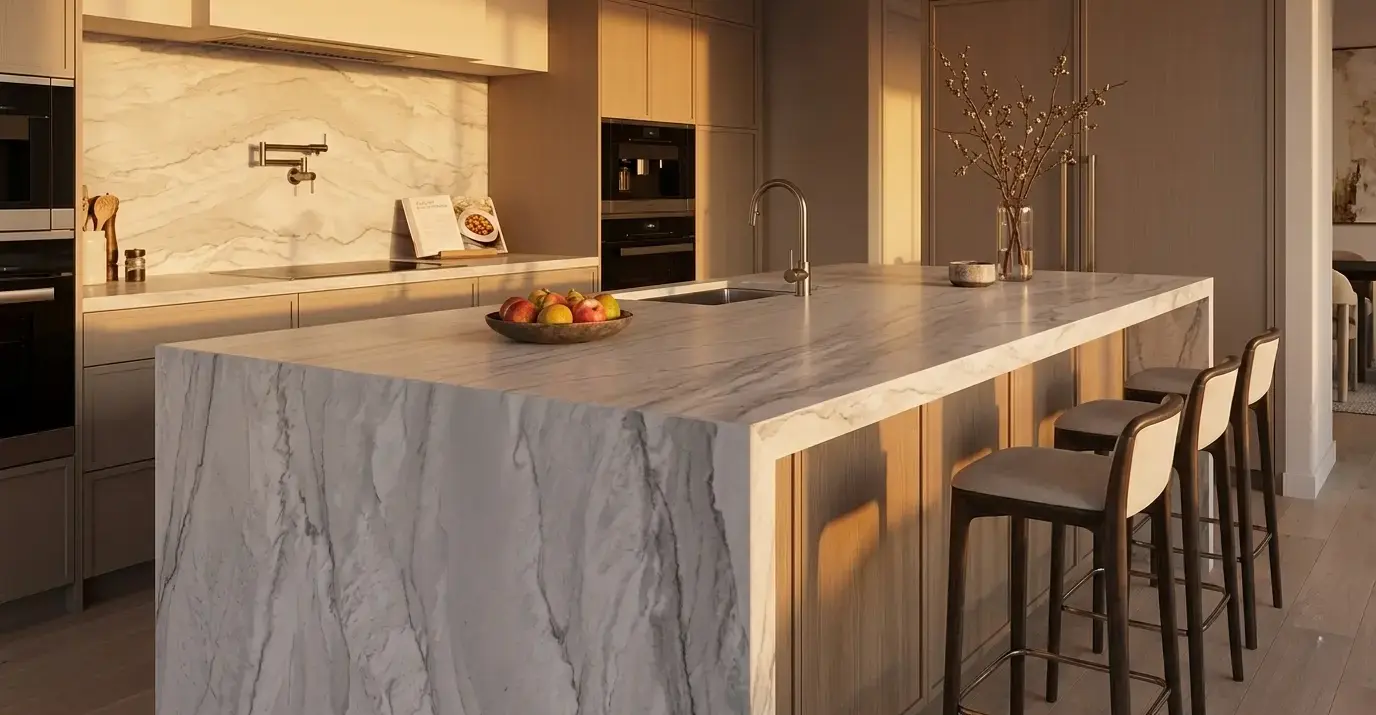 Conceptual rendering
Why Honed Quartzite Works for Countertops
Choosing honed quartzite slabs for your next countertop project means selecting a surface that handles daily demands without sacrificing design quality. Key performance advantages include:
- Scratch resistance: A Mohs rating of 7 means everyday utensils and cookware are unlikely to leave lasting surface marks.
- Heat tolerance: Quartzite forms under intense geological heat, giving it strong natural resistance to temperature exposure in cooking environments.
- UV stability: Unlike resin-based engineered stone, quartzite does not fade under prolonged sunlight, making it well suited for sun-exposed interiors and outdoor applications.
- Acid resistance: Quartzite resists etching from common kitchen acids far better than marble, which reacts to lemon juice and vinegar on contact.
- Fingerprint concealment: The matte honed finish hides smudges and minor marks more effectively than a polished surface.
- Natural uniqueness: Every slab delivers a character that manufactured materials cannot replicate.
Browse the live slab inventory to view current honed quartzite selections and confirm dimensions before finalizing your project.
A Long-Term Surface Worth Every Dollar
Honed quartzite slabs for countertops age gracefully without losing character. The matte surface develops natural depth over years of use, rather than showing wear the way softer stone or engineered materials often do. With regular sealing every one to two years and simple soap‑and‑water cleaning, these kitchen and bathroom countertops maintain their performance for decades. Quartzite’s proven hardness, broad natural color range, and finish that resists daily use make it a practical long‑term investment. Unlike laminate or surface‑printed materials, quartzite countertops do not chip, peel, or degrade from heat and moisture exposure over time.
Current Blog Features and Inspiration
See What’s Fresh in Our Collections
Frequently Asked Questions
Honed quartzite has been processed to a smooth, matte surface without the high-gloss reflectivity of a polished finish. The result is a soft, flat texture that presents the stone's natural color and veining in a calm, understated way.
Yes. The matte finish conceals fingerprints and minor surface marks better than polished stone. Quartzite's hardness provides strong resistance to scratching and heat, and periodic sealing keeps the surface protected against staining.
Both share the same material composition and durability. Honed delivers a matte aesthetic that is better at concealing everyday surface marks. Polished quartzite offers higher reflectivity and visually amplifies the stone's depth and veining for a bolder effect.
Honed quartzite is available in white and gray, pink and red, yellow and brown, and green and blue tones. Secondary shades include beige, cream, taupe, gold, rust, and blue-gray accents, covering a broad range of design palettes.
Most professionals recommend sealing every one to two years depending on how heavily the surface is used. Regular sealing prevents staining and protects against moisture penetration. A water bead test is a practical way to check whether a reseal is needed.