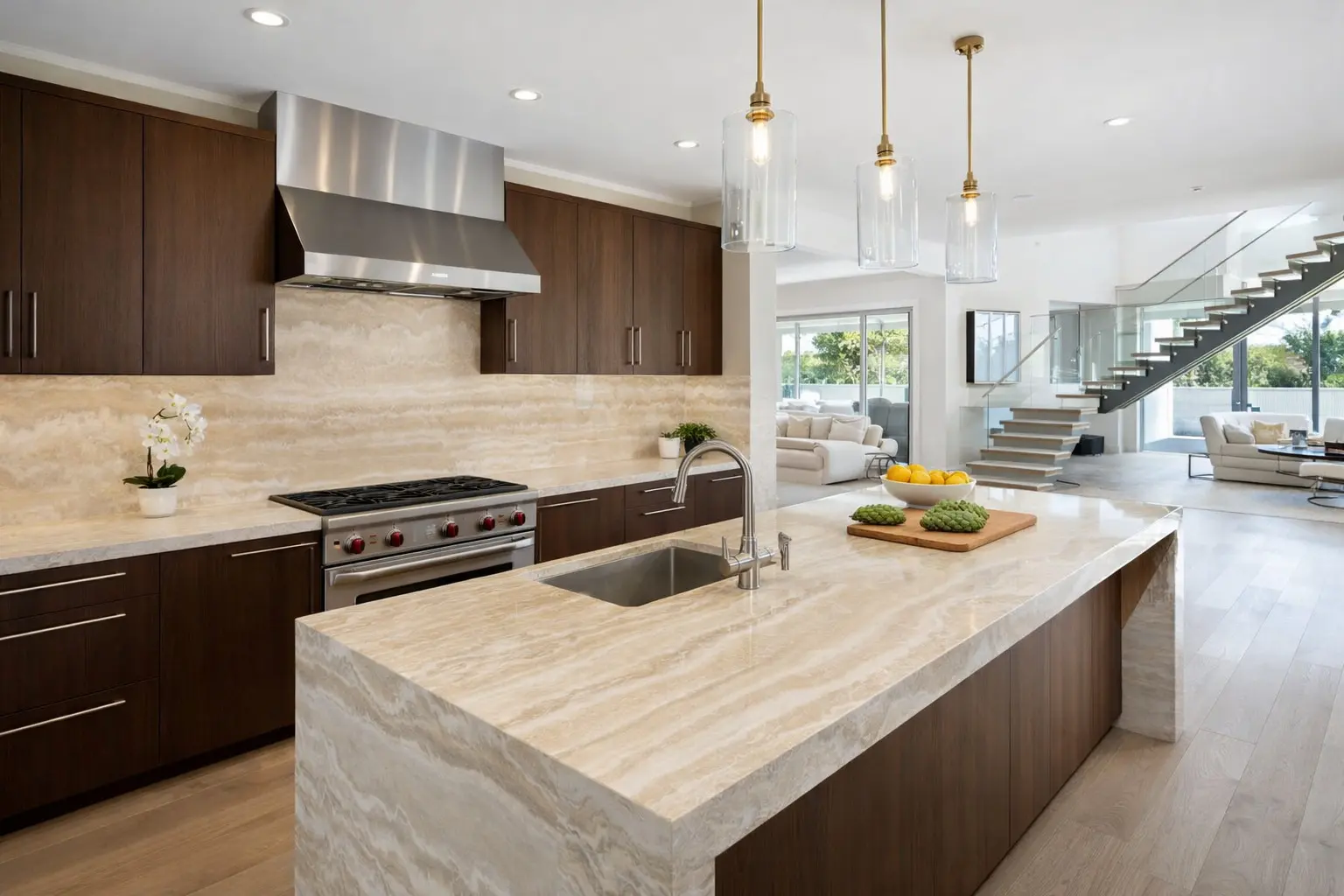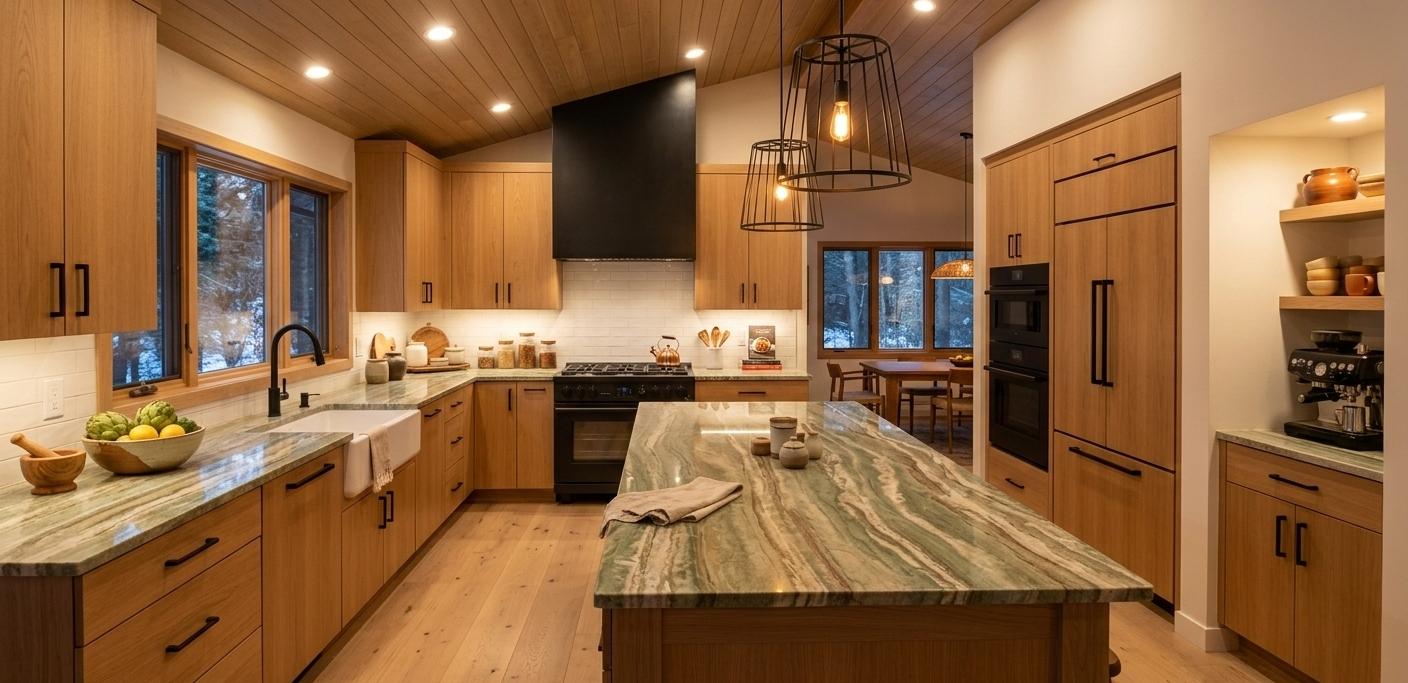
Green travertine countertop is a natural stone slab formed from mineral-rich limestone deposits, prized for its distinctive earthy green tones and organic pitting that gives every surface its own identity. Available in polished, honed, and leathered finishes, it transitions beautifully from kitchen islands and countertops to bathroom vanities. If you want a surface that carries genuine character, travertine delivers something engineered stone cannot: one-of-a-kind patterning that deepens and improves over time.
Travertine Natural Stone - Quick Facts Sheet
What Is Travertine?
Travertine is a form of limestone deposited by mineral springs, particularly hot springs. It forms through the rapid precipitation of calcium carbonate, giving it a distinctive layered, porous appearance that has been prized in architecture for thousands of years.
ORIGIN
Turkey, Italy, Mexico, Peru, Iran
COMPOSITION
Calcium carbonate(CaCO3)
HARDNESS (MOHS)
4 - 5
STONE TYPE
Sedimentary
(limestone family)
SEALING
Recommended
(porous stone)
PATTERN
Unique Veining & Movement
Countertops
Flooring
Backsplashes
Shower Walls
Fireplace Surrounds
Exterior Cladding
Can Green Travertine Countertop Be Used For Bathroom Vanities?
Travertine forms when calcium carbonate minerals precipitate through geothermal springs, and the green variation gets its color from trace minerals including chlorite and serpentine embedded within the stone. Each slab carries a slightly different pattern, which means no two kitchens or vanities will ever look exactly the same. In terms of format, a full travertine slab runs edge to edge across your surface, which is a very different experience from standard 3x6 subway tile layouts that introduce grout lines and visual breaks every few inches. The polished finish amplifies green tones with a reflective sheen; honed gives a matte, softer contemporary look; and the leathered option adds subtle tactile depth suited to high-use kitchen countertops.
Practical Advantages Worth Knowing Before You Buy
- Stain resistance with the right finish: Polished surfaces are denser and easier to seal, making them the most practical choice for busy modern kitchen countertops.
- Unique patterning per slab: No production run can replicate the natural variation in color and veining, so your countertop is entirely your own.
- Thermal mass: Natural stone holds a cool temperature, making it ideal for kitchen prep and baking tasks.
- Finish flexibility: Polished, honed, and leathered options give you direct control over how much texture, slip resistance, and maintenance you want to manage.
From Kitchen Islands to Vanities: Design Possibilities in Every Direction
Slab format countertops bring an uninterrupted visual flow that tile-based surfaces simply cannot match. The green travertine's natural movement reads well both horizontally across wide kitchen islands and vertically on bathroom vanity surrounds. It pairs naturally with warm wood cabinetry, matte black hardware, and concrete-look flooring. For a cohesive color story throughout the room, coordinating your countertop with other tile format on the backsplash adds intentional continuity without looking overdone. The leathered finish is particularly well-suited for bathroom vanities where texture and warmth matter as much as aesthetics.
Why Green Travertine Is a Long-Term Investment in Your Home
Natural travertine has been used in premium interiors for centuries, and its appeal is not attached to any single design cycle. Green variations in particular are increasingly requested in luxurious kitchen countertop and bathroom vanity renovations, giving this material strong long-term resale appeal. With proper sealing and routine care, a travertine slab can perform well in everyday countertop use, but acidic spills should be cleaned quickly to help prevent etching.
If you are still comparing natural stone options, the blog post Choosing Natural Stone For Your Home: A Complete Guide walks through every performance and aesthetic factor worth weighing. To carry the green palette further into the room 2x6 green subway tiles on adjacent walls extend the stone's natural tones without repeating the same material.
Frequently Asked Questions
It is a natural stone slab cut from travertine limestone that contains trace mineral deposits giving it an earthy green coloring. Each slab is genuinely unique due to the organic veining and porous texture produced during the stone's natural formation process.
Yes. When properly sealed, travertine is dense and heat-resistant enough for everyday kitchen use. Polished finishes provide the best protection against staining, while leathered finishes effectively conceal minor wear from daily activity.
Green travertine is available in three finishes: polished for a reflective, color-rich surface; honed for a smooth matte appearance suited to modern kitchens; and leathered for a textured, tactile quality ideal for bathroom vanities and transitional interiors.
Seal the surface annually with a penetrating stone sealer to prevent moisture and staining. Clean with a pH-neutral cleaner and avoid acidic substances like lemon juice or vinegar, which can etch the stone surface over time.
Absolutely. The leathered and honed finishes are especially popular for bathroom vanity applications because they add visual warmth and a spa-like texture while remaining practical and easy to maintain in lower-traffic wet environments.