Skip to Content

Green Quartzite

Green quartzite is a natural metamorphic stone prized for its rare green coloration and exceptional hardness as a surface material. It forms when quartz-rich sandstone is subjected to extreme heat and tectonic pressure within the Earth's crust, producing a dense crystalline rock composed of at least 90% silicon dioxide that rates around 7 on the Mohs hardness scale.

Beyond its structural properties, the stone's green hues develop entirely from chlorite and other mineral inclusions locked into its structure during metamorphism, with no dyes or treatments involved. Shades range from soft sage and mint to deep forest green and emerald, and because natural variation means each slab carries its own distinct combination of color, veining, and patterning, no two pieces read exactly alike. Its rarity as a color expression stems from a specific mineral combination that many quartzite deposits do not contain.

What Makes Green Quartzite Distinct From Other Natural Stones

Quartzite is frequently compared to marble because both share dramatic veining, but the two differ significantly in composition and performance. Marble is a metamorphosed limestone and remains calcite-based, which can make it reactive to acids and prone to etching. Green quartzite, by contrast, is a silica-based metamorphic rock that is generally more resistant to acid exposure and rates around 7 on the Mohs hardness scale, at the upper end of, or above, granite's typical 6 to 7 range, which can contribute to a scratch-resistant surface well suited to high-traffic applications.

Visually, the stone's green tones set it apart from the more common white, gray, and beige quartzite varieties widely seen in showrooms. Chlorite, a green sheet-silicate mineral, is the primary source of those hues. Muscovite and biotite mica can introduce flecks or streaks of white, silver, and black throughout the natural stone slab, while trace iron oxides occasionally add warm golden accents to the veining. The result is a quartzite with a depth of color that many engineered surfaces struggle to replicate.

Explore Our Stone Collection

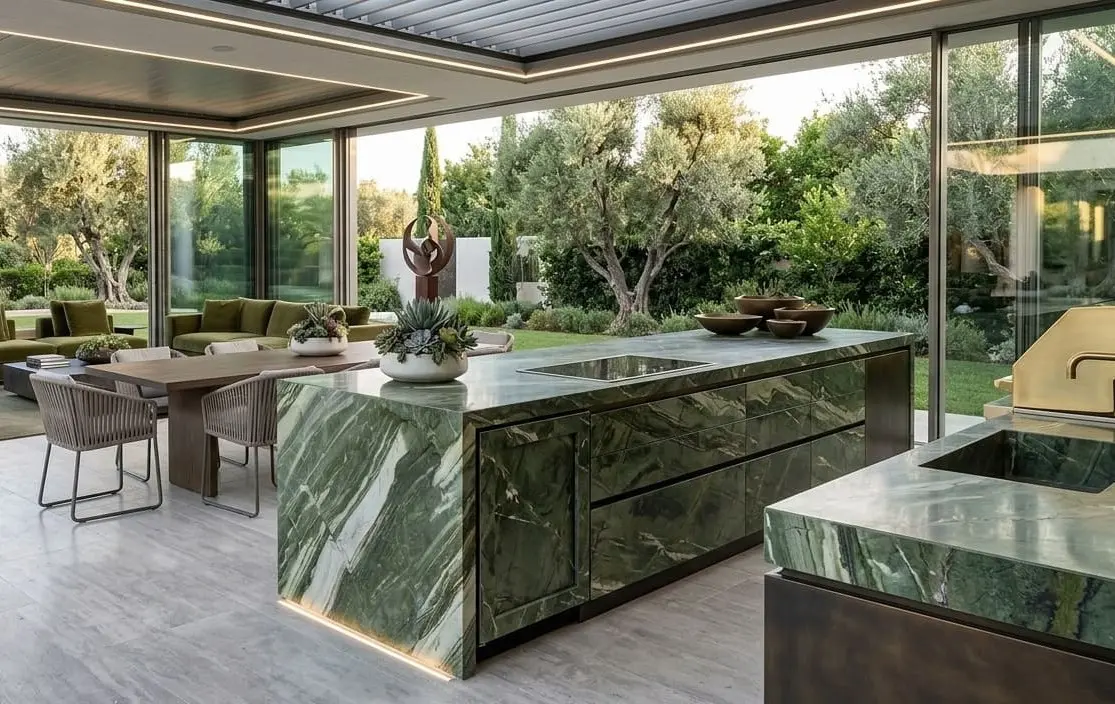
Modern kitchen with green quartzite features

Color Range and Varieties


No single shade defines this stone. The tonal range varies depending on the concentration and distribution of mineral inclusions in each slab. Lighter slabs lean toward sage, mint, and olive, which can work well in spaces where a subtle, nature-inspired quality is the design goal. Richer slabs lean toward deep forest green, emerald, and jewel-toned greens and may show more dramatic contrast in the veining. Some varieties, such as gold quartzite, incorporate warm amber and honey-colored veining from iron oxide minerals, which pairs naturally with the green base.

Most commercially available green quartzite originates from Brazil, with the Bahia region producing several of the most sought-after varieties. Amazonic Green quartzite features vibrant greens offset by golden and black veining. Verde Fondu quartzite showcases a deep forest-green base with pronounced contrasting patterning. Avocatus quartzite carries warm, tropical green tones interwoven with white and black accents. Each variety has a distinct character, which is why viewing individual slabs in person before making a selection is essential, as screen representations may not fully capture the mineral depth or movement visible under natural light.

Surface Finish Options


Beyond color, the finish selected for a green quartzite slab plays an equally important role in how the stone reads in a space. Four finish types are available: polished, honed, leathered, and specialty.

  • Polished finish tends to produce a high-gloss, reflective surface that can amplify the depth of the green tones and enhance the richness of the veining. It is the most popular choice for kitchen countertops and bathroom surfaces, where visual impact is the priority.
  • Honed finish removes the gloss and leaves a smooth, matte surface with a softer, more understated quality. It tends to show less fingerprinting than a polished finish and suits bathrooms and understated interior design schemes. 
  • Leathered finish uses diamond-tipped brushes to texture the surface, compressing the stone's surface pores in the process. This can produce a tactile, slightly matte result that helps conceal smudges and is a natural fit for kitchen islands and feature walls. 
  • Specialty finishes, which can include sandblasted, brushed, or water-jet treatments, add further textural variety for specific architectural applications.
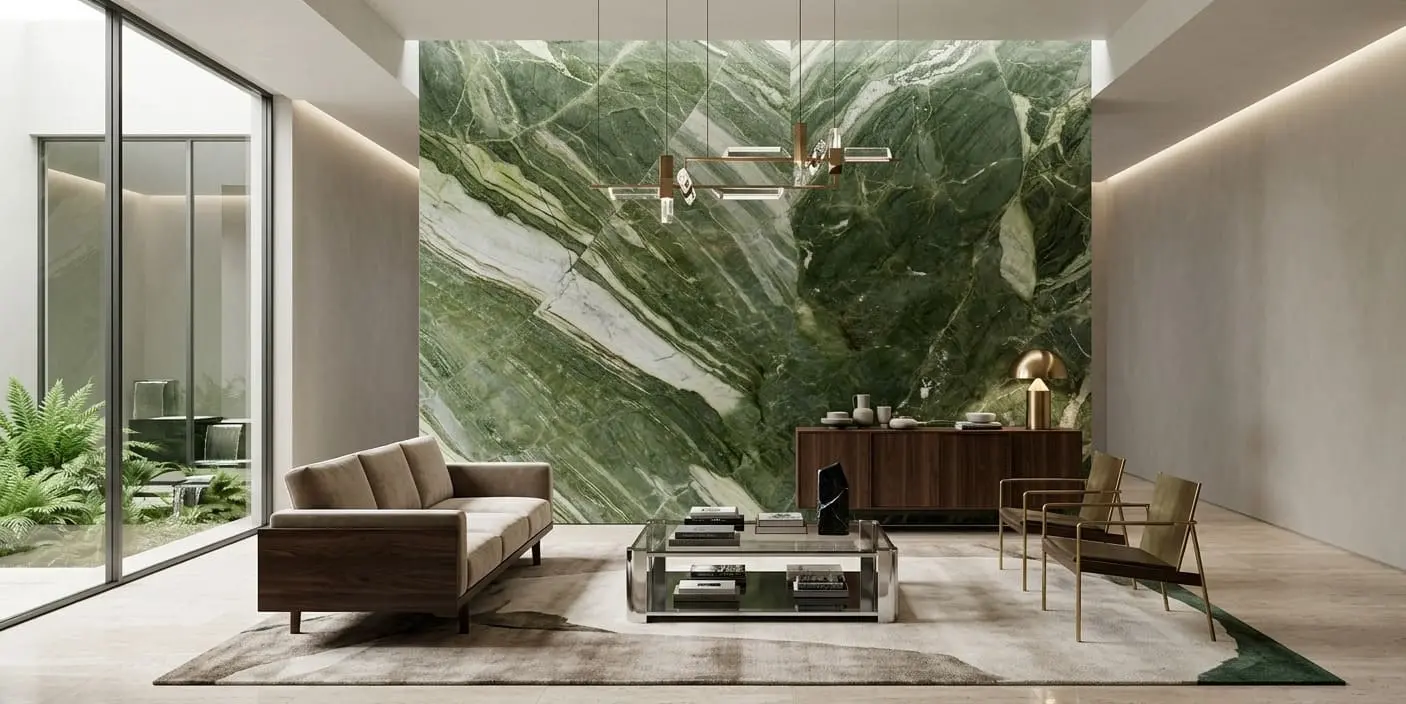
Luxury living room featuring a seamless green quartzite accent wall

Applications and Durability of Quartzite Stone Slabs

The choice of finish connects directly to quartzite's performance and long-term durability across its many applications. Kitchen countertops are one of the most common uses, where the stone's scratch resistance and heat resistance can make it a practical option for demanding surfaces. Backsplash installations, wall cladding, and fireplace surrounds are placements where quartzite's color and movement can serve as a room's visual anchor. 

Flooring installations can benefit from quartzite's resistance to wear in high-traffic areas, and outdoor applications including pool surrounds, patio surfaces, and exterior cladding are well within its performance range.

Because quartzite is porous regardless of application, a penetrating sealer should be applied before first use and reapplied periodically. Penetrating sealers can help protect against staining from liquids and oils but are not designed to prevent etching from prolonged acid exposure, worth noting when selecting a sealer.

Request a Slab Quote

Frequently Asked Questions

Green quartzite rates around 7 on the Mohs hardness scale, which places it at the upper end of, or above, granite's typical range of 6 to 7. This makes it highly resistant to surface scratching and it is generally considered comparable to or more durable than granite in most everyday applications.

The green hues develop naturally from chlorite, a green sheet-silicate mineral incorporated into the stone's crystalline structure during metamorphism. In genuine green quartzite, the color develops through natural mineral processes with no dyes or treatments. The concentration and distribution of chlorite influence whether a slab reads as soft sage or deep emerald.

Yes. Green quartzite is a porous natural stone and should be sealed before first use. A penetrating sealer can help protect against staining from liquids and oils but is not designed to prevent etching. Most installations benefit from reapplication every one to three years, though actual frequency depends on the slab's porosity and level of use.

Green quartzite is silica-based and formed from metamorphosed sandstone. Green marble is calcite-based and formed from metamorphosed limestone. Because marble is calcite-based, it reacts to acids and etches when exposed to substances like citrus juice or vinegar. True quartzite is silica-based and highly resistant to etching from everyday kitchen acids, making it the more practical choice for kitchen surfaces.

Yes. Green quartzite's dense, hard composition makes it well suited to outdoor applications including pool surrounds, patio surfaces, exterior cladding, and walkways. It is known for strong resistance to weathering and wear, making it a practical option for exterior use.

Transform Your Space

​If you are considering green quartzite countertop slabs, feature wall material, or flooring for your next project, viewing the stone in person is the most important step in the selection process. Each slab varies in color, veining, and finish, and these qualities read differently under real lighting than on a screen. Nova Tile and Stone carries green quartzite slab inventory across four showroom locations in Reno, Sacramento, Minden, and Fernley. Each location provides access to full-size slabs so you can evaluate your options in person.

Trusted Selection from Nova Tile and Stone