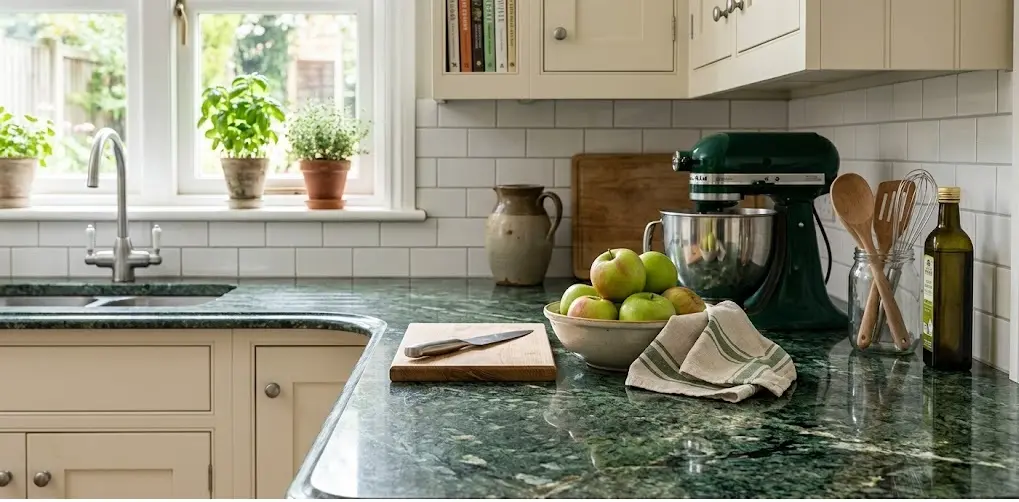
Green slabs commonly used for countertops have become a popular choice for kitchens and bathrooms. The color reads differently depending on the stone material, the lighting in a room, and the surrounding cabinetry, which is part of what makes this category worth exploring before committing to a specific slab.
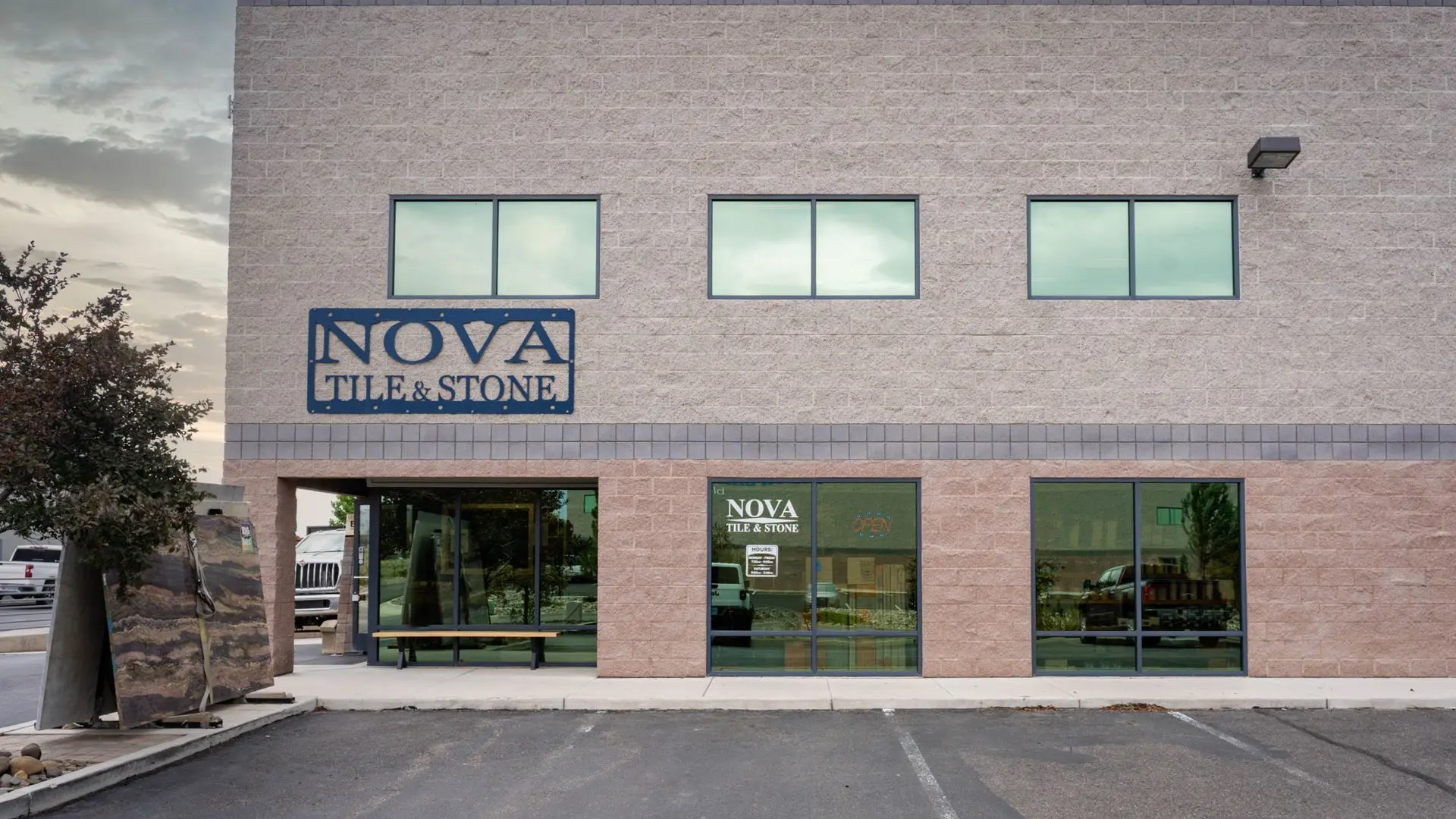
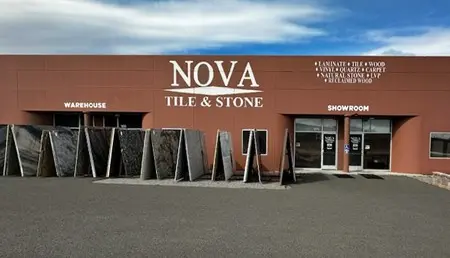
Nova Tile and Stone
We carry natural stone slabs and have been direct stone importers since 2005. Our design team works with homeowners, contractors, and trade professionals across Northern Nevada and Northern California, and we see a consistent amount of interest in green-toned stone, particularly quartzite and marble. Our direct import relationships give us access to a rotating selection of green-toned slabs that aren't typically available through standard distributors.
What Makes a Countertop Look Green
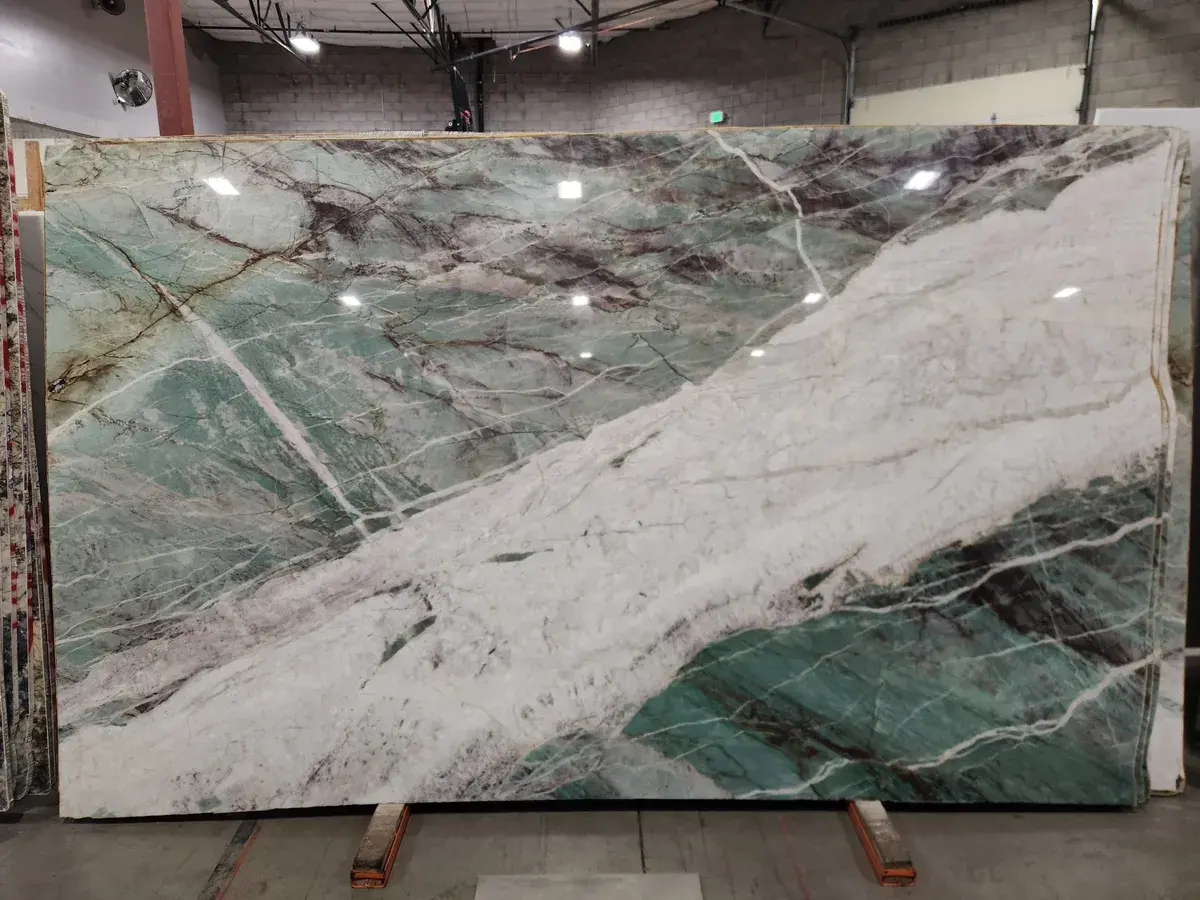
Green in natural stone is almost always a function of mineral content. In quartzite, green tones typically come from chlorite or fuchsite, a chromium-bearing mica that produces colors ranging from pale sage to deep forest. In marble, green veining and background tones often trace back to serpentine minerals or chlorite inclusions. Granite can also carry green hues, typically through feldspar and hornblende content.
Because the color in natural stone is mineral-driven, no two slabs will carry exactly the same distribution of tone or pattern. What you see in a product photo is representative, not definitive. Viewing slabs in person, under the lighting conditions closest to your space, is the most reliable way to assess color before making a purchase decision.
Natural Stone Materials That Produce Green Countertops
Green-toned slabs show up across several stone categories, and the material type shapes everything from surface hardness to how the color behaves under different lighting conditions.
Quartzite forms when quartz-rich sandstone undergoes metamorphic transformation, producing a stone that is hard and relatively resistant to moisture absorption. When fuchsite or chlorite is present during that process, the result is a slab with green tones woven into its structure rather than sitting on the surface. The color in green quartzite can range from muted sage to deeper, more saturated greens, often distributed unevenly across the slab in a way that varies from piece to piece.
Marble reaches green tones through a different mechanism. Serpentine minerals and chlorite inclusions introduce green into an otherwise calcite-dominant stone, sometimes producing pronounced veining and sometimes contributing a more diffuse background tone. Marble is softer and more porous than quartzite, which affects where it makes the most sense as a countertop material. It performs well in lower-traffic applications and spaces where contact with acidic substances is infrequent.
Granite in green tones tends toward a more granular, speckled appearance. Minerals like epidote, hornblende, and certain feldspars contribute green character to the grain structure of the stone. Because granite is hard and dense, it holds up well in active kitchen environments and is generally less demanding in terms of sealing frequency compared to marble.
Finish Options and How They Affect Appearance
The finish applied to a slab changes both the visual character and the practical behavior of the surface.
A polished finish produces a reflective surface that deepens color and makes veining more pronounced. It is the most common finish for kitchen countertops and is generally easier to clean.
A honed finish produces a flat, matte surface. Green tones often read as softer and more muted under a honed finish. This finish is popular for bathrooms and for homeowners who prefer a less reflective surface, though it can show etching more readily on calcite-based stones such as marble.
A leathered finish adds texture to the surface and falls between polished and honed in terms of light reflection. It is less common but works well for certain aesthetic directions.
Specialty finishes, such as brushed, antiqued, and flamed surfaces, are available for select stone materials. These finishes introduce additional texture and can alter how light interacts with the slab, often creating a more natural or weathered appearance. Availability varies by stone type, and each specialty finish comes with its own maintenance and performance considerations.
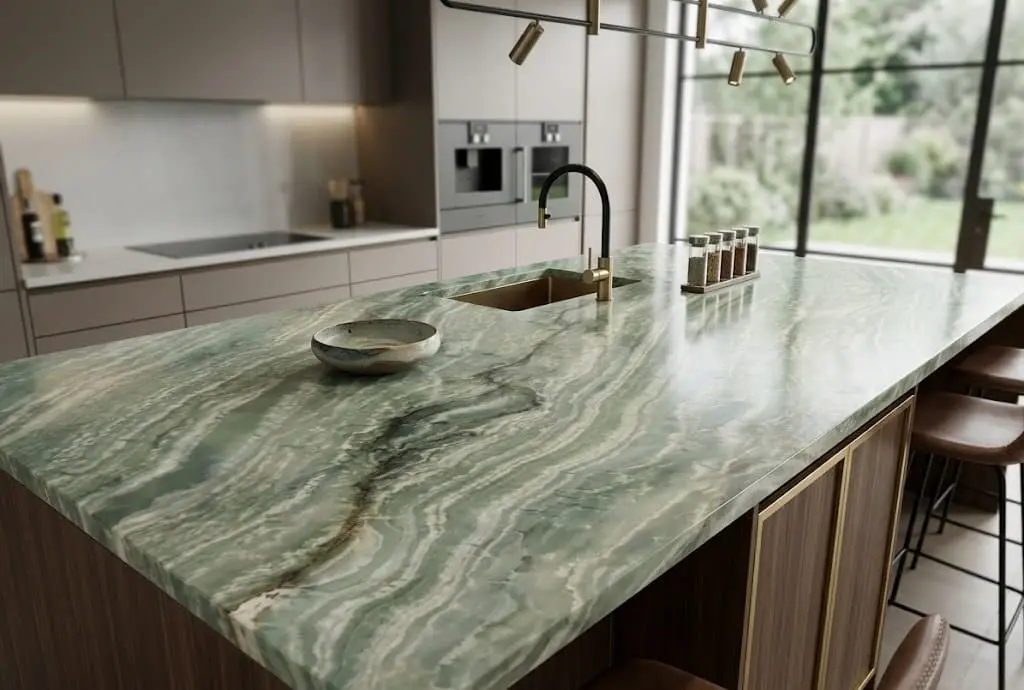 Conceptual rendering
Care and Maintenance
Natural stone countertops generally benefit from sealing, though the appropriate frequency and product type depends on the specific material. Quartzite and granite are denser and less porous than marble, so they typically require less frequent sealing. Marble and serpentine-based stones are more susceptible to etching from acids, and citrus, vinegar, and some cleaning products can dull the surface over time.
For day-to-day cleaning, pH-neutral stone cleaners are the standard recommendation. Avoid abrasive scrubbers on polished surfaces, and use cutting boards to protect the slab from scratching. If you have questions about care requirements for a specific material, our team at any of our four showroom locations can help point you in the right direction.
Frequently Asked Questions
Green tones appear most often in quartzite, marble, and granite. In quartzite, the color typically comes from minerals like fuchsite or chlorite. In marble, green hues often trace to serpentine mineral content. Granite can also carry green tones through feldspar and hornblende. Each material has different hardness and porosity characteristics that are worth considering alongside appearance.
Quartzite is one of the harder natural stone options and generally performs well in kitchen environments. It is denser and less porous than marble, making it more resistant to staining and etching. As with any natural stone, sealing is recommended, and the specific slab should be assessed for its mineral composition and finish before installation.
Finish has a significant impact on color perception. A polished finish deepens and saturates green tones and makes veining more defined. A honed finish produces a matte surface where greens read softer and less saturated. A leathered finish adds texture and sits between the two in terms of reflectivity. Viewing the same slab in multiple finishes, when possible, helps clarify which direction suits the space.
Yes. We carry natural stone slabs at all four of our Home Design Centers in Reno, Sacramento, Minden, and Fernley. Viewing slabs in person is the most reliable way to assess color and pattern, since photographs can shift how stone reads under different lighting. Our team offers free design consultations at each location.
Marble is a calcite-based stone and is more susceptible to etching from acidic substances than quartzite or granite. For a kitchen countertop, this means more careful management of spills from citrus, wine, and acidic cleaners. Many homeowners use green marble in bathrooms or lower-traffic applications where its appearance can be featured without the same exposure to acids. If you are considering it for a kitchen, our design team can walk you through what to expect in terms of ongoing care.
Looking for immediate assistance?
Give us a call!
775-374-668
(Available Mon-Fri 7:30am - 4:00pm PST)
Unlike most customer service lines, ours connects you with real people.
When you call, just press 1 for online shopping support, or 2 for local shopping support!