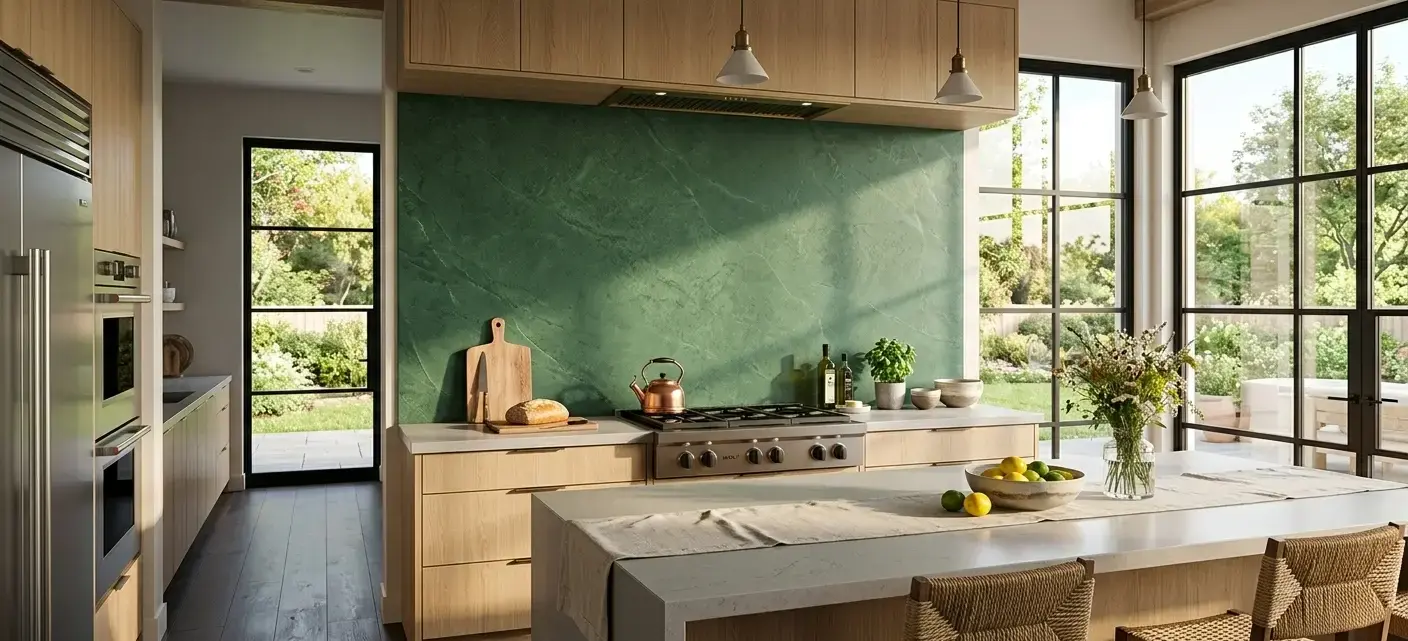
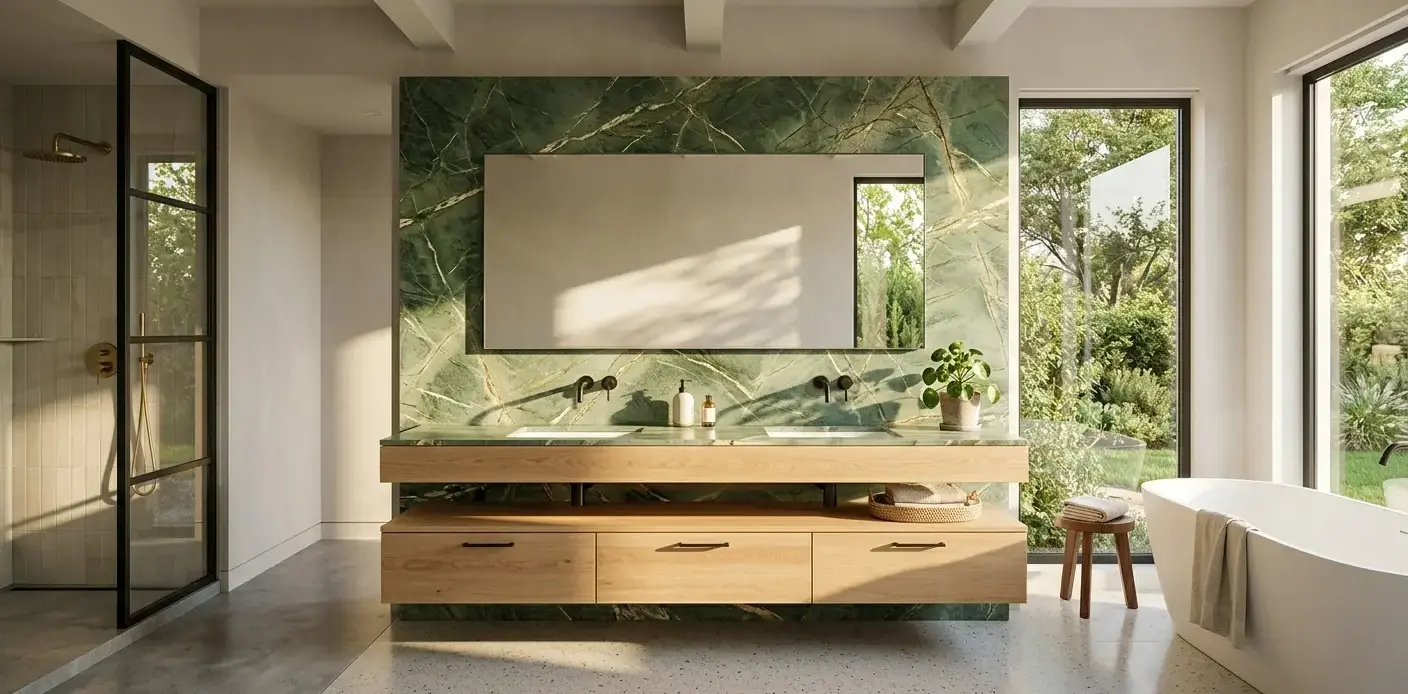
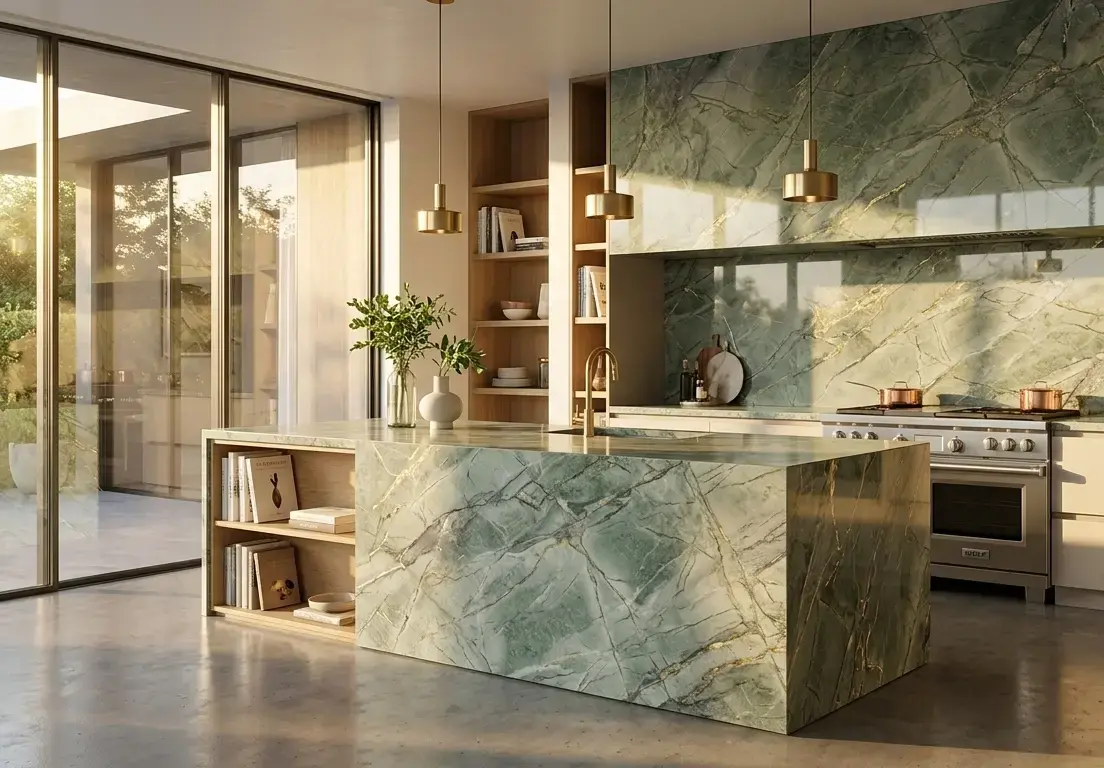
Green slab for backsplash is one of the most impactful ways to bring organic color and depth to a bathroom or kitchen wall. Available in natural stone varieties such as quartzite, marble, and granite, as well as large-format Italian porcelain, green slabs used for backsplash pair rich primary greens with gray, silver, and gold accents across linear, cross-cut, and artistic vein patterns.
Each slab format delivers a large, continuous surface with minimal interruption, making it well-suited for seamless wall applications in both residential and design-forward spaces. Whether the setting calls for a serene retreat or a refined culinary environment, a green backsplash slab provides a material presence that smaller tile formats cannot replicate.
Hardness, Thickness, and Material Specs
Green slabs span a broad material spectrum, each option carrying its own hardness rating, absorption behavior, and compatible finish range. Quartzite registers around 7 on the Mohs scale, making it one of the more resilient natural stone choices for backsplash wall applications. Marble and dolomite fall between 3.5 and 4 on the same scale, lending a softer, vein-forward aesthetic common in refined bathroom settings. Granite, rated 6 to 7 on the Mohs scale, offers a denser surface pattern and proven performance in kitchen environments where durability is a priority.
Natural stone slabs require periodic sealing, with cadence varying by material type; dolomite and marble typically every 6 to 12 months, quartzite and granite potentially less often. Porcelain is non-porous and requires no sealing under standard conditions, though consistent cleaning still supports long-term surface appearance. Browse the complete slab inventory to compare material specifications across every available option.
Note: Some images on this page may be conceptual renderings created to illustrate design possibilities and may not depict actual installations.
Application Versatility: Surface Layouts and Room Compatibility
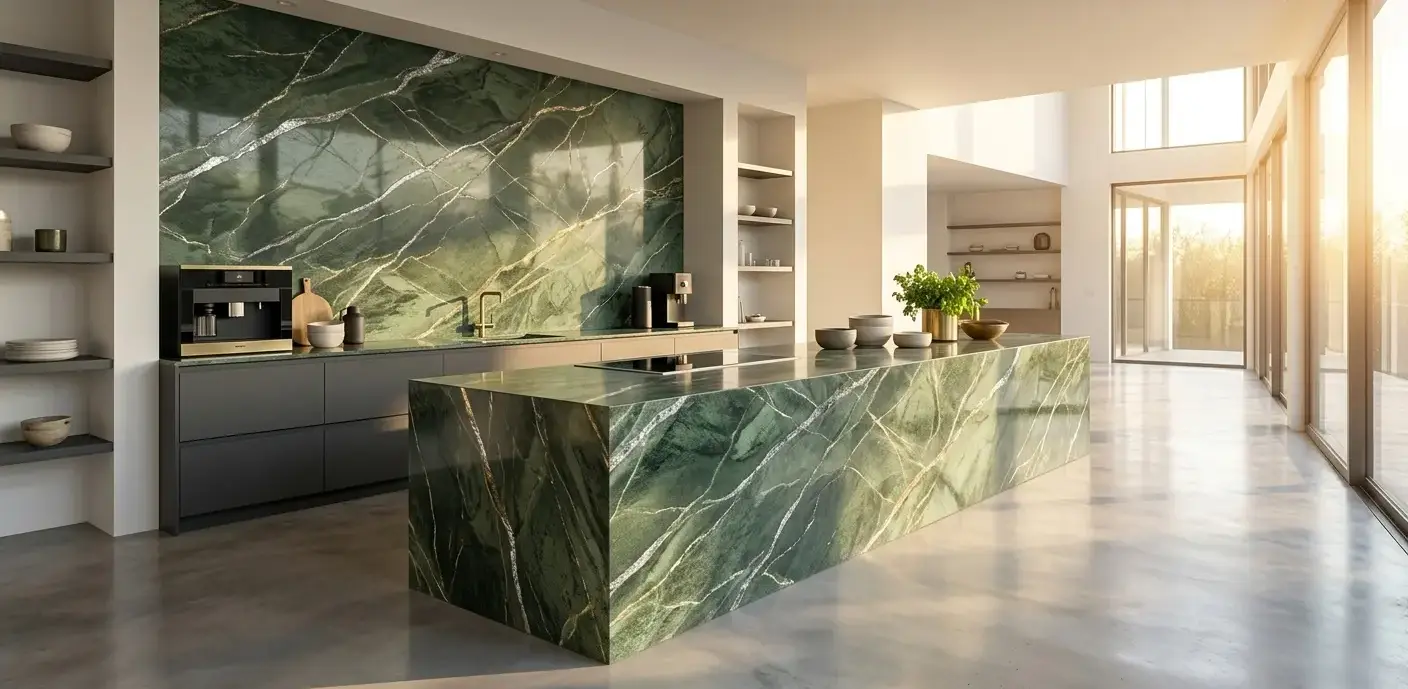
Large-format green slabs for backsplash accommodate layout strategies that smaller tile formats cannot match in terms of visual continuity. A single slab can span an entire kitchen backsplash run or shower wall, eliminating most grout lines and producing an unbroken visual field. Cross-cut patterns emphasize horizontal movement and work well in wide bathroom alcoves, while artistic and hybrid veins create flowing, irregular compositions that suit statement accent walls. Linear veining guides the eye along the length of a room, making it a practical choice for narrower kitchen layouts or elongated shower niches.
Finish selection adds another layer of control to the overall design. Polished surfaces amplify green tones through light reflection and bring out silver and gold accent veins with greater clarity. Honed and brushed finishes deliver a softer, matte result that suits relaxed, organic aesthetics without reducing depth in the green palette. Designers and architects seeking to stay current with evolving surface applications can reference the International Surface Event for material trends and specification insights relevant to walls and backsplashes.
Material Benefits: Green Slab for Backsplash Applications
- Heat resistance: Stone and porcelain slabs tolerate everyday heat exposure in kitchen and bathroom settings, though trivets near direct heat sources are still advisable for surface preservation over time.
- Moisture performance: Natural stone slabs that are properly sealed, and non-porous porcelain slabs, both perform well in wet environments like showers and kitchen backsplash walls, provided maintenance stays consistent.
- Minimal grout: Large slab formats significantly reduce grout line frequency, limiting the surface area where moisture, residue, and staining agents can accumulate.
- Finish range: Polished, honed, leathered, and brushed options are available across most natural stone and porcelain material categories, giving each project the flexibility to match surface texture to functional priorities.
- Scratch resilience: Harder stone varieties like quartzite resist everyday surface abrasion under normal use, though cutting boards remain recommended wherever food preparation occurs nearby.
- Natural variation: Every natural stone green slab carries unique veining, movement, and tonal shifts, no two slabs are exactly alike, which adds inherent character to any application.
- Accent color integration: Gray, silver, and gold secondary tones woven through the slab surface allow compatibility with both warm and cool interior palettes without requiring significant surrounding adjustments.
Long-Term Value: Durability and Design That Holds
A well-maintained green slab for backsplash can preserve its visual character for many years, though longevity depends on material type, the finish selected, and the care routine applied consistently over time. Natural stone surfaces develop a patina as they age, which many designers and homeowners regard as an added quality that deepens the material's character rather than diminishing it. Porcelain slabs, engineered with UV, stain, and scratch resistance built into the body, tend to retain their original surface appearance longer under comparable conditions, though no surface is fully immune to wear.
The green, gray, silver, and gold palette common across these slabs carries precedent in both classical and contemporary interior traditions, making it a lower-risk long-term investment compared to highly trend-specific color choices. Viewing slabs in person before finalizing a selection gives the most accurate read of how scale and light interact with the material, which no screen can fully replicate. Find a showroom in Reno, Minden, Sacramento, or Fernley to view live slab inventory and speak with a U.S.-based design expert at no cost.
Newest Articles and Guides
Frequently Asked Questions
Green slabs are available in natural stone categories including quartzite, marble, granite, and dolomite, as well as large-format porcelain manufactured in Italy. Each material offers a different balance of hardness, veining character, and maintenance requirements.
Most natural stone slabs require periodic sealing, with frequency depending on the specific material. Marble and dolomite typically need sealing every 6 to 12 months, while quartzite and granite may require less frequent attention. Porcelain slabs are non-porous and do not require sealing under normal conditions.
Yes, both natural stone and porcelain slabs are suitable for shower wall applications. Natural stone requires proper sealing and maintenance. For wet areas, a honed or matte finish is generally preferred over polished surfaces, which can become slippery when wet.
Green backsplash slabs are available with linear, cross-cut, artistic, and hybrid vein patterns. Linear veining creates a structured, directional look. Artistic and hybrid veins introduce more organic movement across the surface.
Yes. Green slabs work well as kitchen wall surfaces. Porcelain options offer stain and heat resistance suited to cooking environments, while natural stone options perform comparably with appropriate sealing and consistent care.