Mont Blanc Quartzite Backsplash
Few kitchen surfaces stop a room the way a well-chosen backsplash does. It frames the cooking space, ties together countertops and cabinetry, and gets noticed every time someone walks into the room. Mont Blanc quartzite earns that attention with a bright white base, soft gray veining, and a natural depth that no manufactured material can fully replicate. What makes it especially well suited to this application is that it backs up its good looks with serious hardness, rating 7 to 7.5 on the Mohs scale. This guide covers everything you need to know before choosing a Mont Blanc quartzite backsplash for your home.
Bright white Brazilian natural stone with soft gray veining and exceptional durability.
How It Holds Up in a Working Kitchen
A backsplash is exposed to cooking splatter, steam, cleaning products, and heat on a daily basis. Quartzite handles that environment well. Its hardness makes it resistant to scratching, and unlike marble, it does not etch easily when it comes into contact with acidic substances like tomato sauce, lemon juice, or vinegar.
A Mont Blanc quartzite backsplash also pairs naturally with a wide range of countertop materials and cabinet finishes. Its neutral white and gray palette works alongside warm wood tones, white cabinetry, dark navy or charcoal shakers, and natural wood island bases. Whether your kitchen leans traditional, transitional, or contemporary, Mont Blanc quartzite fits without forcing the design.
The Stone Behind the Name
Mont Blanc quartzite is a metamorphic rock that begins as quartz-rich sandstone. Over millions of years, intense heat and pressure fuse the quartz grains together into a dense, hard surface. It rates 7 to 7.5 on the Mohs hardness scale, making it harder than granite and significantly tougher than marble, which sits between 3 and 4 on the same scale.
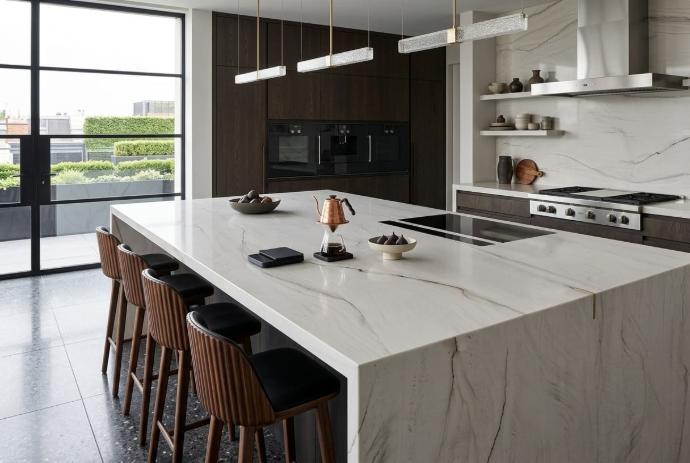
Visually, Mont Blanc quartzite features a clean white to off-white base with delicate gray veining. It draws frequent comparisons to Carrara marble for its light, refined appearance, but it outperforms marble in nearly every practical category. For homeowners who love the look of white stone but want a surface built for a working kitchen, browsing our natural stone slab inventory is a great place to start.
Polished, Honed, or Leathered: Picking the Right Finish
The finish you choose affects both how the stone looks and how it performs day to day.
A polished finish brings out the stone's natural brightness and makes veining more vivid. It is the easiest to wipe clean, which is a practical advantage in a kitchen setting. A honed finish produces a matte, flat surface that reads as softer and more understated. A leathered finish sits between the two, with subtle texture and a low sheen that gives the stone a more natural, tactile quality.
Keeping It Looking Its Best
Quartzite is lower maintenance than marble but still benefits from consistent care. It should be sealed to protect against moisture and staining, with resealing recommended every 12 to 18 months for a backsplash application. For everyday cleaning, a pH-neutral stone cleaner and a soft cloth are all you need. Avoid harsh chemical cleaners, acidic products, or abrasive scrubbers, as these can wear down the sealant over time. Wipe up spills promptly, particularly anything oily or highly pigmented.
Because a backsplash sees less direct contact than a countertop, quartzite tends to maintain its appearance well in this application with relatively straightforward upkeep.
Come See It in Person and Browse Slab Inventory
Natural stone slabs are unique by nature. No two slabs are identical, and the appearance of Mont Blanc quartzite slabs can vary meaningfully from one piece to the next in terms of veining intensity, background tone, and overall movement. Seeing slabs in person is the best way to find the right piece for your space.
We have our showroom locations in Reno, Sacramento, Minden, and Fernley. Our commission-free design consultants are available to help you evaluate options, compare finishes, and think through how Mont Blanc quartzite will work alongside your countertops, cabinetry, and flooring. We offer free design consultations, so you can take your time making the right decision without any pressure.
Frequently Asked Questions
Yes. Mont Blanc quartzite is an excellent backsplash material. It rates 7 to 7.5 on the Mohs hardness scale, which makes it resistant to scratching and etching. Unlike marble, it holds up well against acidic substances common in kitchens, and its white and gray palette suits a wide range of design styles.
Mont Blanc quartzite offers a similar aesthetic to white marble but with significantly greater durability. Marble rates 3 to 4 on the Mohs scale and is more prone to etching from acidic foods and liquids. Quartzite resists etching and requires sealing less frequently, making it a lower-maintenance option for a kitchen backsplash.
Yes. Although quartzite is denser and less porous than marble, it is still a natural stone and benefits from sealing. For a backsplash application, sealing every 12 to 18 months is generally recommended to protect the surface from moisture and staining.
Mont Blanc quartzite is available in polished, honed, and leathered finishes. Polished is the most reflective and easiest to clean. Honed provides a softer matte appearance. Leathered offers subtle texture with a low sheen. The right finish depends on your kitchen's style and your maintenance preferences.
Yes. We encourage customers to view natural stone slabs in person before making a decision. Every slab is unique, and seeing the stone in a showroom setting gives you a much better sense of its veining, tone, and scale. We have showrooms in Reno, Sacramento, Minden, and Fernley, and our team offers free design consultations to help guide your selection.