Gray Quartzite Countertop
Gray quartzite countertop is a natural stone surface made from quartzite, a metamorphic rock formed when sandstone is transformed by heat and pressure deep within the earth. It rates between 7 and 8 on the Mohs hardness scale, making it harder than granite and more durable than marble. Its cool, neutral tone and natural veining make it a refined option that works equally well in traditional and contemporary interiors.
Unlike engineered quartz, which is manufactured from ground quartz crystals combined with polymer resins, quartzite is 100% natural stone quarried directly from the earth. The distinction matters: no two slabs are identical, which means every gray quartzite countertop carries its own distinct character that no manufactured surface can replicate.
At Nova Tile and Stone, with showrooms in Reno, Sacramento, Minden, and Fernley, we help homeowners and designers find the right slab for their space.
What Makes Gray Quartzite Countertops a Smart Choice
- Exceptional Hardness Quartzite ranks between 7 and 8 on the Mohs hardness scale, placing it among the hardest natural stones used in residential and commercial applications. Granite typically registers between 6 and 6.5 by comparison. This hardness makes the surface highly resistant to scratching during cutting, prep work, and daily use.
- A Naturally Sophisticated Aesthetic Gray quartzite tones range from soft, pale silvers to deep charcoal, often with veining in white, cream, or subtle gold. This variation produces a look that is both refined and organic, with flowing patterns that no manufactured surface can replicate consistently across slabs.
- Heat Resistance Quartzite is formed through geological metamorphism at temperatures ranging from 400°F to 1,500°F, giving it a natural heat tolerance well beyond typical kitchen conditions. Because it contains no polymer resins or binders, it does not share the heat threshold limitations of engineered surfaces, engineered quartz, for instance, begins to risk discoloration and resin damage at around 300°F. Using trivets and hot pads is still recommended to guard against thermal shock, a rapid temperature change that can cause cracking near edges or cutouts in any natural stone.
- Long-Term Value A gray quartzite countertop adds resale value to a home and holds its visual relevance across changing design trends.
Featured Quartzite Slab
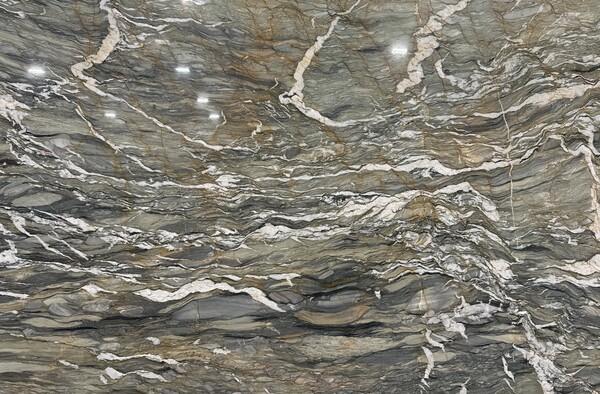
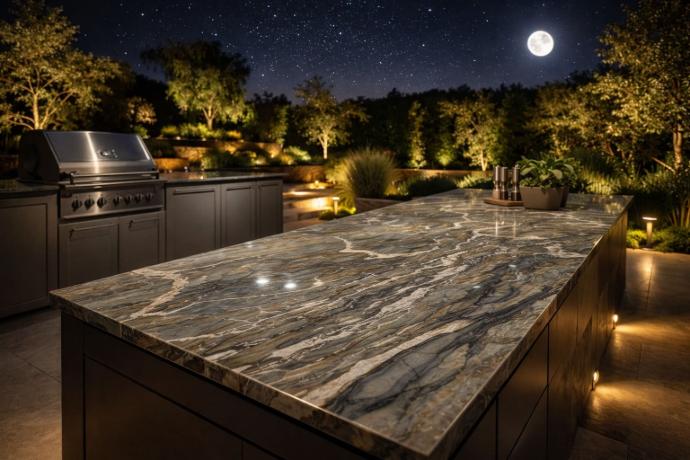
Fusion
(QUARTZITE)
Fusion Quartzite is a striking natural stone originating from Brazil, distinguished by its dramatic blend of deep bluish-gray, cream, brown, and rust tones that flow through each slab in bold, sweeping patterns. As a highly durable quartzite, it performs exceptionally well in high-use applications including kitchen countertops, bathroom vanities, flooring, and accent walls in both residential and commercial settings.
Its complex, movement-rich patterning makes every slab one of a kind, bringing a natural, artistic quality to any interior or exterior design project.
Gray Quartzite vs. Other Stone Options
Gray Quartzite vs. Gray Granite Both are natural stones, but quartzite is generally harder. Granite registers between 6 and 6.5 on the Mohs scale and may require more frequent sealing depending on the variety. Aesthetically, granite tends toward a speckled, granular pattern, whereas this stone displays flowing veins more reminiscent of marble, giving it a more distinctive visual presence on countertops.
Gray Quartzite vs. Gray Marble Marble typically rates between 3 and 4 on the Mohs scale, making it considerably more susceptible to scratching and etching from acidic substances. A gray quartzite countertop delivers a similar veined aesthetic with significantly greater durability, making it the more practical choice for kitchens and bathrooms that see regular use.
Gray Quartzite vs. Gray Quartz (Engineered) A gray quartz countertop requires no sealing and offers consistent color and pattern across every slab. However, its polymer resin content limits heat tolerance to around 300°F, and its uniform patterning lacks the depth of a naturally quarried material. For those who want the beauty of natural stone without compromising on heat resistance, gray quartzite is the stronger long-term investment.
Care and Maintenance
Sealing As a porous natural stone, it should be sealed upon installation. Resealing at least once a year is the standard recommendation for kitchen countertops, though the interval depends on porosity, usage, and sealer quality, high-quality penetrating sealers may extend protection up to two years. A water bead test is a reliable way to gauge when resealing is due: if water absorbs into the surface rather than beading up, it is time to reseal.
Daily
Cleaning Use mild
dish soap diluted in warm water with a soft cloth for routine cleaning. Avoid
harsh chemical cleaners, bleach-based products, and abrasive scrubbing pads, as
these degrade the sealant and dull the surface over time.
Spill Management Promptly wipe up acidic liquids such as citrus juice, wine, or vinegar. Prolonged exposure to acidic substances can cause etching if the sealant has worn thin.
Avoiding Impact Damage Despite its hardness, the material can chip at
edges and corners from sharp, direct impacts. Standard kitchen care, avoiding
dropping heavy objects onto corners, applies as it would with any stone
surface. With consistent upkeep across all four areas, a gray quartzite
countertop will maintain its appearance and performance for decades.
Explore Our Latest Slab Blogs
Frequently Asked Questions
Yes. Its heat tolerance, rooted in its resin-free, natural composition, makes it well-suited for cooking areas, and its non-reactive stone surface holds up reliably against the demands of daily kitchen activity. With proper sealing and routine care, it performs exceptionally well in high-use environments.
At least once a year is the standard recommendation for kitchen countertops. High-quality penetrating sealers may extend that interval to two years, depending on porosity and usage. A water bead test is the most reliable indicator, if water absorbs into the stone rather than beading on the surface, resealing is needed.
No. Its rating of 7 to 8 on the Mohs hardness scale makes it one of the hardest natural stones used for countertops. Everyday kitchen use is unlikely to cause visible scratching, though using a cutting board remains good practice to protect both the sealant and your knives.
Gray quartzite is 100% natural metamorphic stone, while quartz countertops are engineered from ground quartz crystals and polymer resins. The resin content in engineered quartz limits its heat tolerance to around 300°F and gives every slab a uniform, manufactured appearance. The natural stone requires periodic sealing but offers superior heat resistance and unique character that cannot be replicated.
Nova Tile and Stone specializes in natural stone surfaces and carries an extensive selection of gray quartzite slabs across a range of tones, veining patterns, and finishes. With four showrooms in Reno, Sacramento, Minden, and Fernley, our team guides you through every stage, from slab selection and edge profiles to care advice.