Skip to Content
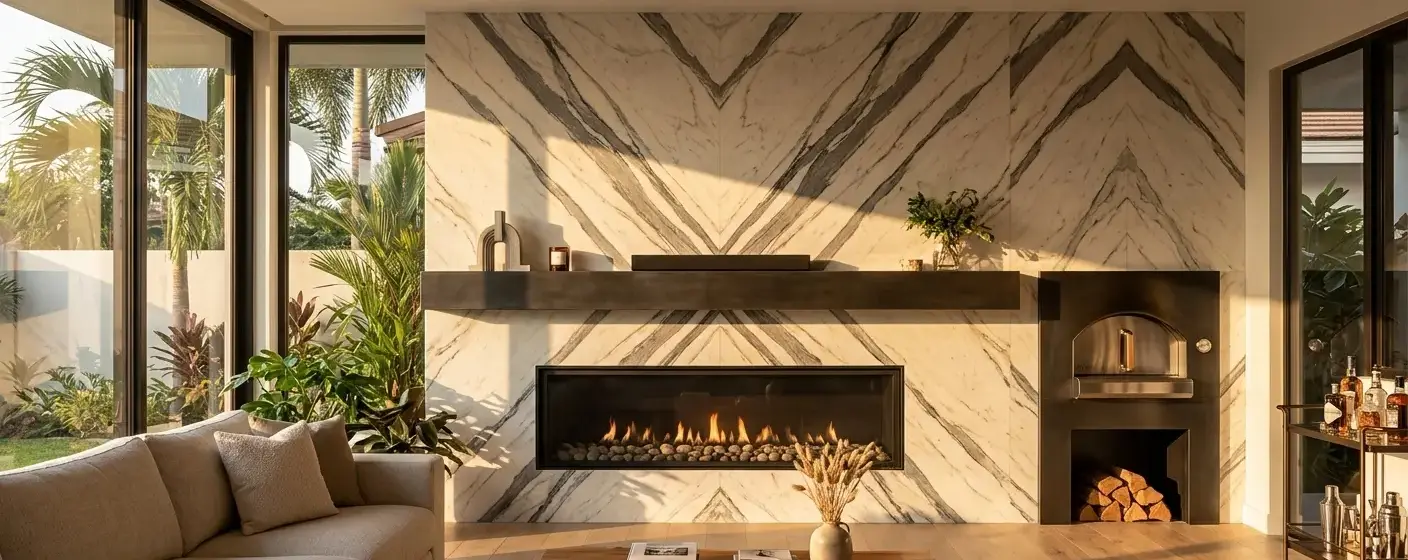
Conceptual rendering of a Calacatta marble fireplace backsplash with bold diagonal veining in a modern living room Conceptual rendering

Fireplace Backsplash

A fireplace backsplash made from a natural stone slab defines the living room's most prominent architectural feature. Marble, quartzite, and granite bring depth and warmth with a level of authenticity that engineered materials cannot fully replicate. Whether the vision calls for a bookmatched Calacatta marble statement or a subtly veined quartzite field, the right fireplace backsplash transforms the area surrounding the firebox into the room's defining focal point.

Browse our slab inventory across showroom locations in Reno, Minden, Sacramento, and Fernley to view full-size slab selections in person.

Marble, Quartzite, and Granite: Core Materials for a Fireplace Backsplash


Marble remains the most requested material for fireplace backsplash applications, particularly warm-white and gray-veined varieties such as Calacatta and Statuario. These marbles are quarried primarily from the Apuan Alps region of Carrara, Italy, and from select quarries in Greece and Turkey, producing slabs with fine crystalline grain and distinctive directional veining.

Quartzite is the preferred choice when heat exposure and durability are the primary concerns. Varieties such as White Macaubas and Taj Mahal quartzite, sourced from quarries in Brazil, deliver dense, low-porosity surfaces with dramatic veining that closely resembles marble at a significantly higher hardness rating

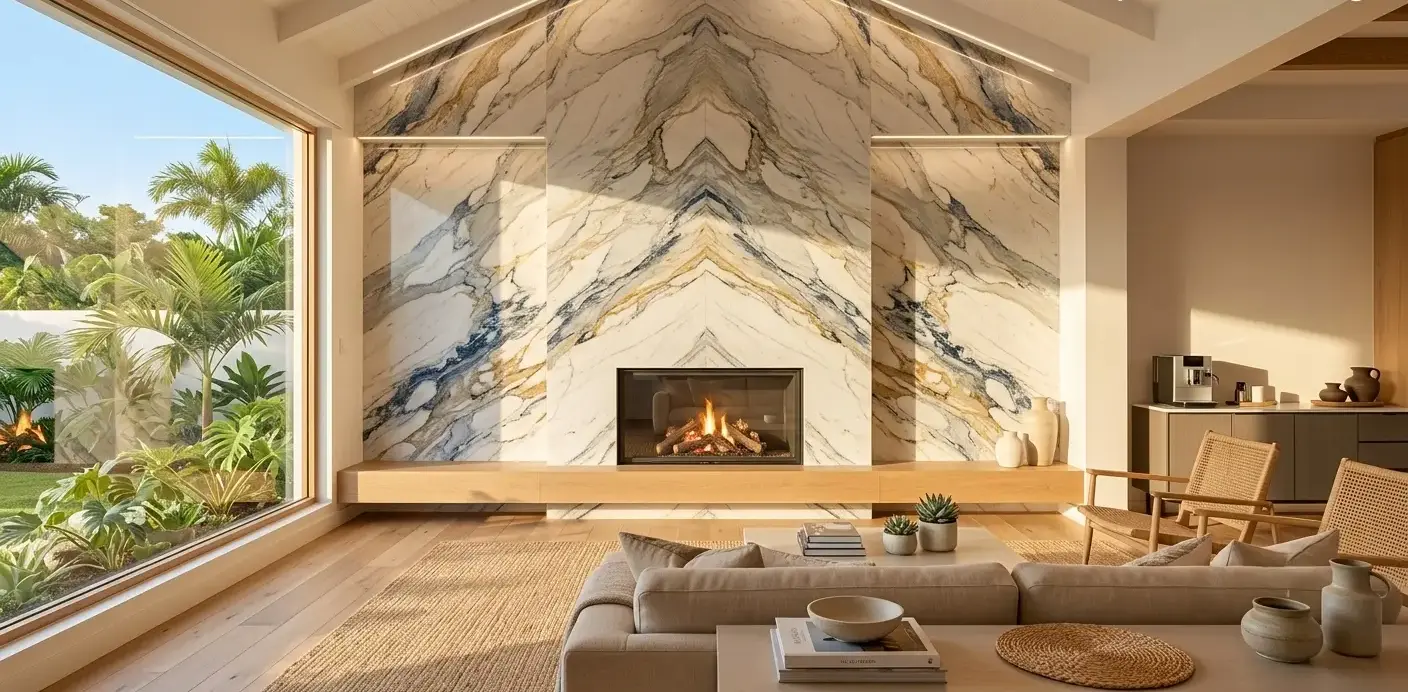
Conceptual rendering of a bookmatched quartzite fireplace backsplash with symmetrical veining on a full-height slab Conceptual rendering

Property

Marble

Quartzite

Granite

Mohs Hardness

3 to 4

7+

6 to 7 

Standard Thickness

3/4 in (2 cm)

3/4 to 1.25 in (2 to 3 cm)

3/4 to 1.25 in (2 to 3 cm)

Water Absorption

0.1 to 0.8%

Less than 0.1%

Less than 0.4% ​

ASTM Standard ​

C503

C97

C615/ C97

Finish Options

Polished, Honed, Leathered, Specialty

Polished, Honed, Leathered, Specialty

Polished, Honed, Leathered, Specialty

Granite adds a third option suited to fireplaces where visual weight and robustness matter equally. Dark-toned granites with fine black, charcoal, and silver mineral patterns provide strong contrast against lighter wall finishes. The fireplace surround slab guide from Nova Tile and Stone covers heat tolerance and finish behavior across all three stone types in detail.

Fireplace Backsplash Designs: Layouts, Veining, and Finish Selection


A full-height slab application extending from the firebox surround to the mantel line is the standard approach for contemporary fireplace backsplash designs. Where the stone field continues to the ceiling, bookmatching two adjacent cuts of the same block creates a mirrored veining effect that maximizes visual symmetry. This approach suits dramatic marble varieties with bold diagonal veining, where each half reflects the other across the seam.

For narrower fireplace walls or transitional-style living rooms, a single-slab vertical layout with softly patterned stone delivers a refined look without requiring matched veining alignment. Honed finishes perform particularly well on fireplace backsplash surfaces because they reduce glare from ambient and fire light and are less prone to showing surface marks from heat proximity. Leathered finishes introduce subtle texture suited to living rooms with organic or rustic design themes.

For adjacent walls in the same space, reviewing available natural stone backsplash options supports a coordinated material selection across the full living room.

Practical Advantages of a Stone Used as a Fireplace Backsplash


  • Heat-tolerant stone surfaces remain dimensionally stable under radiant heat from the firebox, provided the stone is properly set with appropriate substrate and bonding materials.
  • Unique natural patterning ensures every fireplace backsplash is visually distinct, as no two natural stone slabs carry identical veining or mineral distribution.
  • Low-porosity quartzite and granite resist smoke residue and surface discoloration when sealed consistently, while marble requires more frequent sealing to maintain adequate protection.
  • Honed and leathered finishes minimize glare and surface smudging in fireplace settings, making them a more practical choice than polished surfaces for high-use living rooms.
  • Slab-format coverage eliminates grout lines across the backsplash field, reducing maintenance surfaces and producing a cleaner, more architecturally considered result.

Large-format slabs applied to vertical fireplace walls depend on professional-grade bonding systems. Advances in surface bonding technology continue to improve long-term adhesion performance for stone surfaces in high-heat vertical environments.
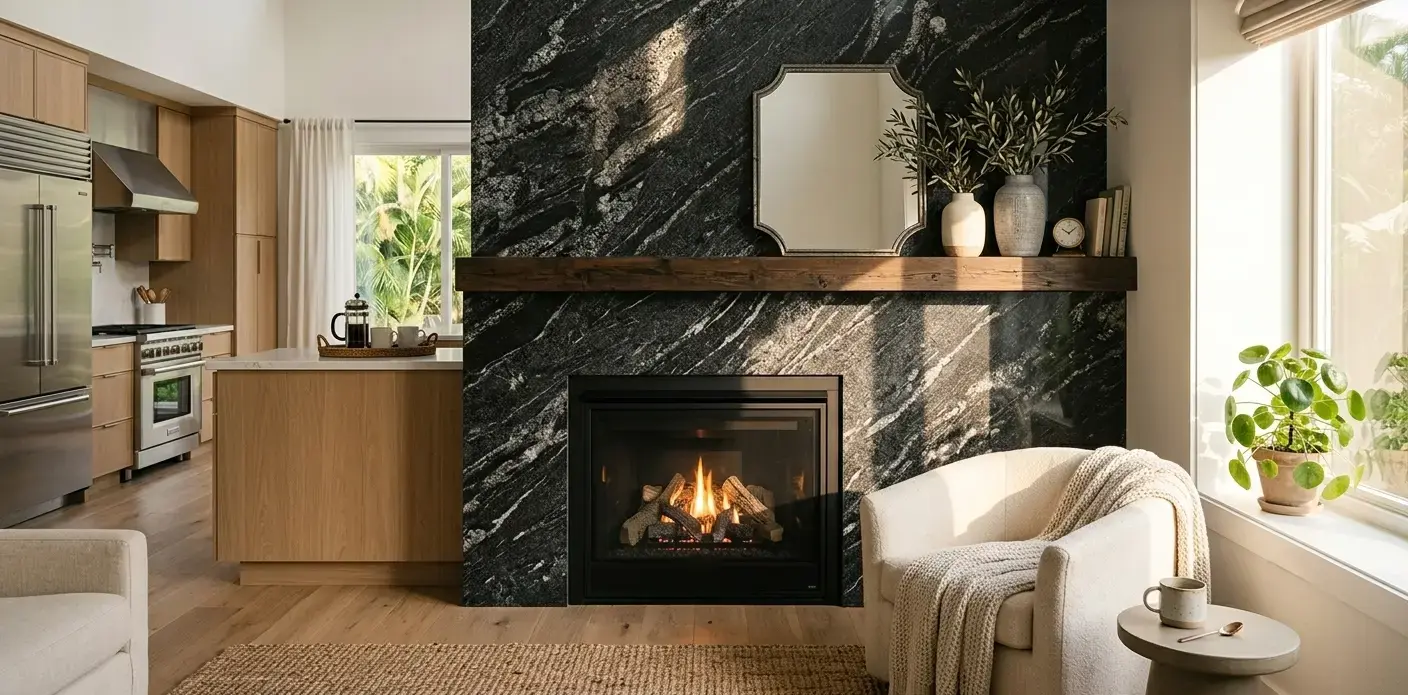
Conceptual rendering of a dark granite stone fireplace backsplash with charcoal and silver mineral patterning Conceptual rendering

Stone Surfaces That Retain Long-Term Value


Natural stone fireplace backsplash slabs hold their visual relevance across design cycles in a way that painted drywall or prefabricated surrounds typically do not. Marble, quartzite, and granite each carry a physical permanence that contributes lasting value to the living room.

Granite products are commonly evaluated according to ASTM C615, the standard specification for granite dimension stone, and ASTM C97, which measures water absorption and bulk specific gravity. Marble products are commonly evaluated according to ASTM C503, the standard specification for marble dimension stone. Together, these ASTM standards provide consistent benchmarks for material quality and help guide stone selection and long-term performance expectations.

Properly sealed granite or quartzite slabs used as a fireplace backsplash can maintain their appearance for decades with routine care. To confirm current slab availability and receive project-specific guidance, submit a slab quote request to our team before finalizing material selection.

Frequently Asked Questions


Granite and quartzite are the most durable choices for this application because of their high Mohs hardness rating, low absorption rate, and heat tolerance. Marble is a popular visual choice but requires more frequent sealing and careful maintenance near heat sources.

Marble can be used for a fireplace backsplash in interior living room settings, but it performs best when positioned away from direct flame contact. It should be sealed consistently and cleaned with pH-neutral products to prevent acid etching and surface dulling over time.

Honed, leathered, and specialty finishes are generally recommended over polished for fireplace backsplash surfaces. They reduce glare from fire and ambient light and are less likely to show surface marks or smudging in a living room setting.

A fireplace backsplash refers specifically to the vertical stone surface behind and immediately surrounding the firebox opening. A fireplace surround is a broader term that typically includes the mantel structure, leg columns, and decorative frame extending outward from the opening.

Most natural stone slabs used near a firebox benefit from periodic sealing, though frequency varies by material. Granite and quartzite require less frequent sealing than marble due to their lower absorption rates. A qualified stone supplier can recommend the appropriate sealer for the specific material selected.

Got Something Else on Your Mind?


Browse Our Newest Innovations Today

Your Dynamic Snippet will be displayed here... This message is displayed because you did not provided both a filter and a template to use.

View Available Slabs at Nova Tile and Stone

The right stone for fireplace backsplash sets the tone for the entire living room. Visit a Nova Tile and Stone showroom in Reno, Minden, Sacramento, or Fernley to view full slab inventory, compare finishes side by side, and speak with a slab specialist about the material best suited to the project.