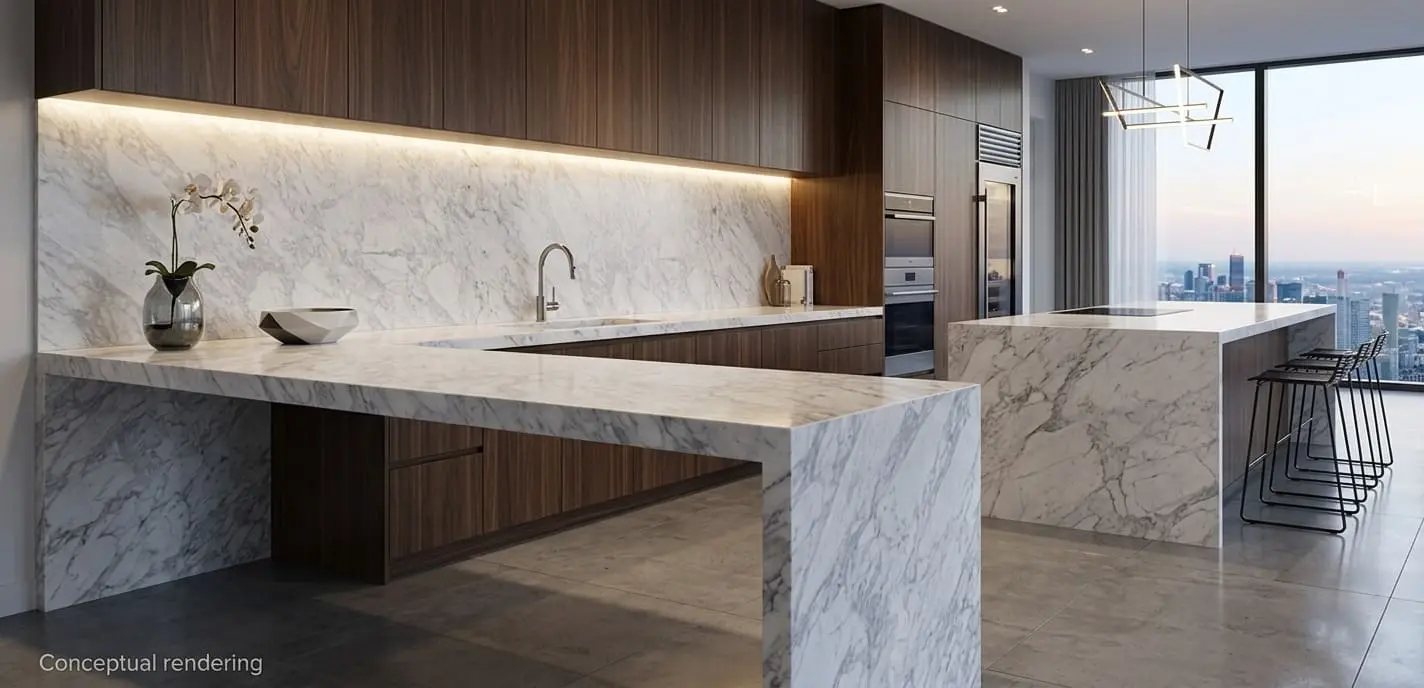
Why Carrara Marble Slabs are a Top Choice for Countertops
Carrara marble slabs for countertops are a natural stone surface quarried from the Apuan Alps in Tuscany, Italy. This Italian marble is a trusted indoor countertop material for kitchens, bathroom vanity tops, wet bar surfaces, and laundry rooms, and is not recommended for outdoor use due to the stone's lack of UV resistance. Composed of approximately 98% calcium carbonate with a Mohs hardness of 3 to 4 and a density of approximately 2,711 kg/m³, Carrara marble slabs are available in four finishes: polished, honed, leathered, and specialty. A penetrating sealer is required before first use. Because calcium carbonate is reactive to acids, consistent stone care and informed finish selection are the two most critical factors in the long-term performance of Carrara marble slabs for countertops.
Where Carrara Marble Slabs for Countertops are Installed
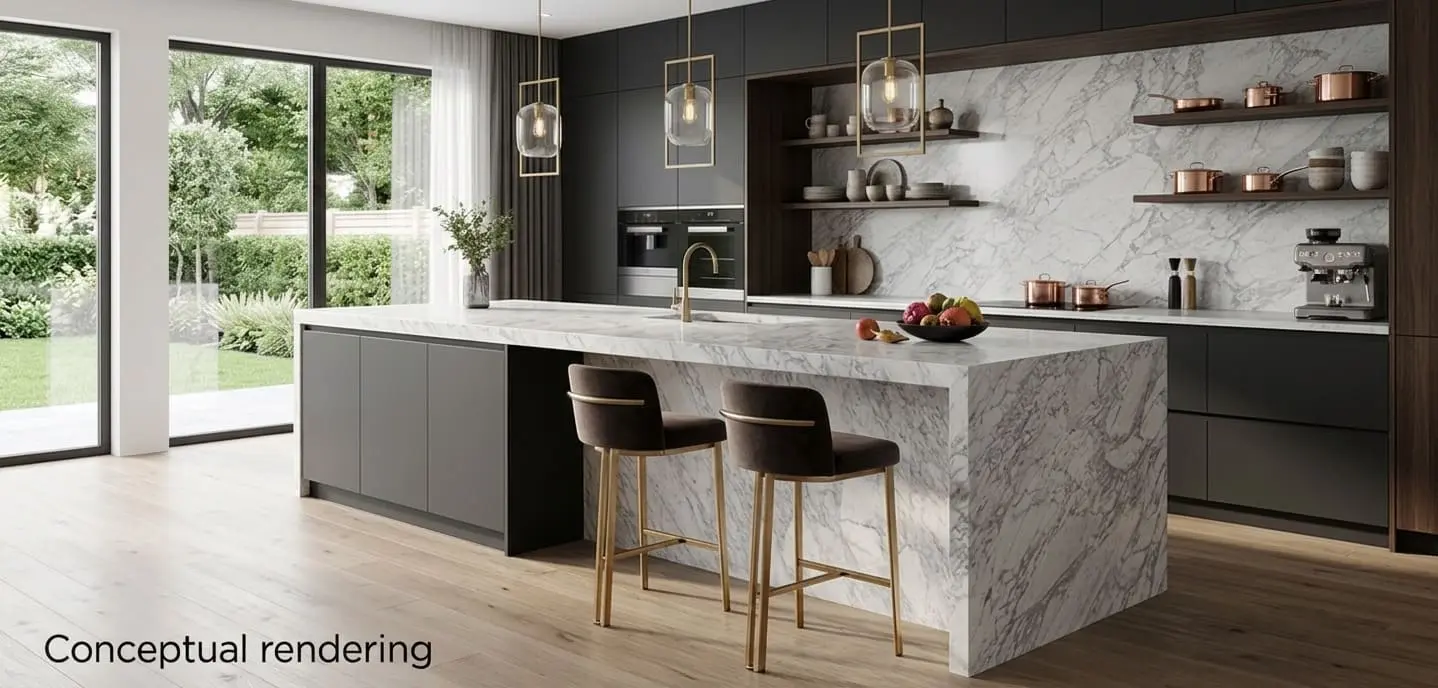
Carrara marble slabs rank among the most widely specified natural stone surfaces in residential renovation and interior design. The stone's white to blue-grey background with natural veining suits a wide range of cabinetry colors, including white, timber, navy, and matte black, making it a versatile Italian marble countertop choice for kitchen and bathroom renovation projects.
In the kitchen, Carrara marble slabs for countertops are valued for their naturally cool surface temperature, well suited to baking and food preparation. The stone is a popular choice for both custom-built and prefab kitchen island tops, where its natural veining tends to serve as a strong visual focal point. In the bathroom, Carrara marble is most commonly specified as a vanity countertop on single and double vanity tops, powder room surfaces, and master bathroom installations. One important consideration for any kitchen or bathroom renovation is the stone's UV sensitivity.
Carrara marble has no UV resistance. Prolonged sun exposure can cause discoloration that is difficult to reverse, and outdoor moisture and temperature fluctuations can accelerate deterioration. Carrara marble slabs for countertops should always be installed indoors.
Performance Specifications for Carrara Marble Slabs
Carrara marble slabs for countertops rate 3 to 4 on the Mohs hardness scale, below granite at 6 to 7 and quartzite at 7. The surface is susceptible to scratching from sharp utensils and is prone to etching when acidic liquids such as lemon juice, vinegar, or wine contact the stone. Etching is a chemical reaction between acid and the calcium carbonate in the marble and is not prevented by sealing. Sealing helps reduce staining by slowing liquid absorption, but it does not stop etching. Both scratching and etching tend to be less noticeable on honed and leathered surfaces than on polished ones.
A 3 cm slab is the industry standard for kitchen countertop installations, including prefab kitchen island tops, as it is typically self-supporting and able to accommodate overhangs without additional reinforcement. A 2 cm slab is lighter and less expensive but typically requires a plywood substrate in kitchen applications and is the more common choice for bathroom vanity tops. Finish selection directly affects the performance, appearance, and stone care needs of Carrara marble slabs, and each of the four options has distinct characteristics.
Polished finish
A polished Carrara marble slab has a smooth, high-gloss surface that highlights the stone's natural veining. It is among the less porous and more stain-resistant finish options, but etch marks and scratches tend to be more noticeable on a reflective surface. Polished is generally better suited to bathroom vanity tops than high-use kitchen countertops.
Leathered finish
A leathered Carrara marble slab, produced by running diamond-tipped brushes across a honed surface, delivers a low-sheen, textured result unique to this Italian marble finish. Porosity sits between polished and honed. The texture can help conceal fingerprints and water marks, though the grooves benefit from daily wiping as part of routine stone care.
Honed finish
A honed Carrara marble slab has a smooth, flat, matte surface. It is more porous than polished and requires more frequent sealing, but etch marks and scratches are far less visible, making honed the most widely recommended finish for Carrara marble slabs used as kitchen countertops.
Specialty finish
Specialty finishes such as brushed, sandblasted, or hand-chiseled produce custom textures beyond the three standard options. Because each method alters surface porosity differently, the sealing and stone care approach should be confirmed with a specialist before installation.
Caring for Carrara Marble Slabs for Countertops
Once the right slab and finish have been selected, consistent stone care determines how well the countertop performs over time. Wipe the surface after each use with a soft cloth or pH-neutral stone cleaner. When spills occur, blot rather than wipe, as wiping spreads liquid across the stone. Acidic substances such as lemon juice, wine, vinegar, and coffee are known to etch calcium carbonate on contact, so removing them promptly is strongly recommended. Using a cutting board and placing a trivet under hot cookware can also help protect the slab.
Because Carrara is a light-colored, porous Italian marble, it requires more frequent sealing than denser natural stone countertop materials. Honed kitchen surfaces are generally re-sealed every three to six months; polished surfaces may go up to twelve months. Bathroom vanity tops typically require re-sealing once a year. Apply a few drops of water to the stone. If it absorbs within minutes rather than beading, re-sealing with a penetrating sealer formulated for natural marble is advisable. For stubborn stains, a stone poultice left for 24 to 48 hours is the recommended stone care approach. Deep damage may require professional re-honing or re-polishing. If you are unsure which slab, finish, or stone care routine suits your renovation project, speaking with a natural stone specialist is the most reliable first step.
DON'T
- Cut directly on the stone
- Leave acidic liquids on the surface
- Use bleach, ammonia, or vinegar cleaners
- Place hot pans directly on the slab
- Install outdoors or in direct sunlight
- Use abrasive scrubbing pads or tools
DO
- Use a cutting board on the stone
- Blot spills as quickly as possible
- Use pH-neutral stone cleaners only
- Place trivets under hot cookware
- Re-seal on schedule for your finish
- Install indoors only
Note: Some images on this page may be conceptual renderings created to illustrate design possibilities and may not depict actual installations.
The Surface Worth Having
Frequently Asked Questions
Carrara marble slabs are not recommended for outdoor installation. The stone has no UV resistance, and sun exposure can cause discoloration that is difficult to reverse. Outdoor moisture and temperature changes also increase the risk of cracking. This Italian marble should always be installed indoors.
Honed is widely recommended because its matte surface makes etching and scratches far less visible. Leathered is also practical, as the texture helps conceal fingerprints. Polished is generally better suited to bathroom vanity tops where acid exposure from food preparation is less of a concern.
No. Sealing reduces staining by slowing liquid absorption, but etching is a chemical reaction between acid and calcium carbonate that occurs at the surface regardless of the seal. Prompt removal of acidic substances is the most effective stone care practice to limit etching risk.
Honed kitchen surfaces are generally re-sealed every three to six months; polished surfaces may go up to twelve months. Bathroom vanity tops typically need re-sealing once a year. Use the water test to confirm: if drops absorb within a few minutes rather than beading, it is time to re-seal.
Engineered quartz is non-porous, needs no sealing, and does not etch. It is generally more resistant to staining and scratching. Carrara marble slabs for countertops, however, offer the natural veining, cool surface temperature, and character of genuine Italian marble that quartz cannot replicate. The choice comes down to how much stone care a homeowner is prepared to commit to.
Find the Right Carrara Marble Slab for your Countertop
Visit our showroom to view our full range of Carrara marble slabs for countertops in person. Our natural stone specialists can guide you on finish, thickness, and stone care for your renovation project.