Calacatta Marble Kitchen Countertops
Calacatta marble kitchen countertops are one of the most sought-after natural stone surfaces in high-end home design. Quarried from the Apuan Alps near Carrara, in the Tuscany region of northern Italy, Calacatta marble is a metamorphic rock composed primarily of calcite, recognized for its bright white background and bold, dramatic veining in shades of gray, gold, and warm brown.
On the Mohs hardness scale, it rates between 3 and 5, making it softer than granite but well suited to kitchen use with proper sealing and maintenance. Because no two slabs share the same veining pattern, each installation is a genuinely unique surface that holds its value over time.
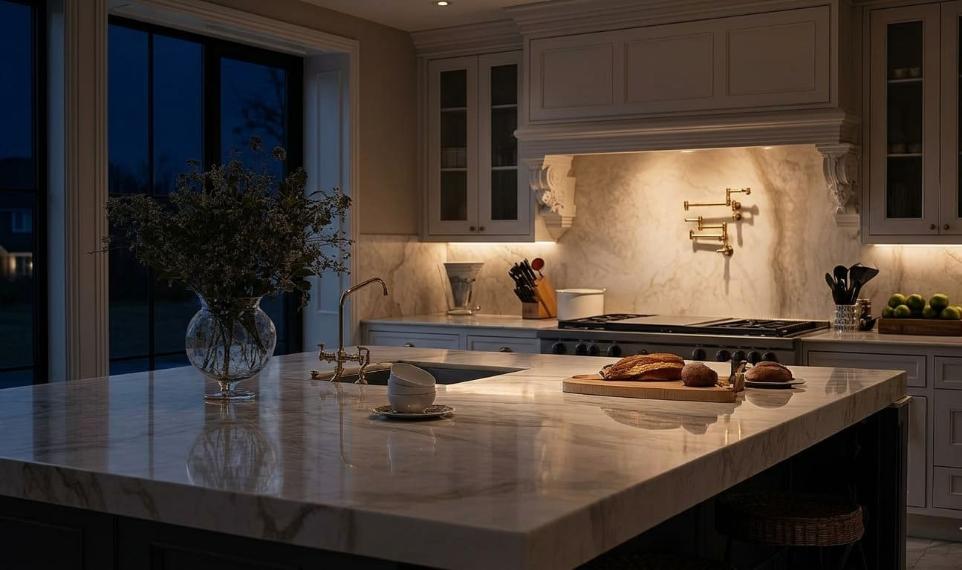
Bold veining. Timeless kitchens. One natural stone.
Calacatta marble: the countertop that outlasts trends.
What Makes Calacatta Marble Kitchen Countertops a Timeless Choice
Calacatta marble forms when limestone is subjected to intense heat and pressure deep within the earth, causing its carbonate minerals to recrystallize into a dense, interlocking structure. During metamorphism, mineral-rich fluids deposit trace minerals into fractures within the rock. Iron oxides produce the gold and warm brown veining, while graphite is responsible for the gray tones. Those veins contrast sharply against the bright white background, giving each slab a character that no engineered material can replicate, a quality that makes Calacatta marble kitchen countertops a lasting investment in any home.
Because it is calcite-based, Calacatta marble reacts chemically to acidic substances such as vinegar, lemon juice, and wine, which can etch the surface. A consistent cleaning routine using pH-neutral products, along with prompt attention to spills, preserves the stone's polish and appearance. How well it holds up in a kitchen also depends on the finish selected and how the stone is integrated into the overall design.
Finish Options and Design Flexibility
Choosing a finish changes the way Calacatta marble kitchen countertops look, feel, and perform in daily use.
Polished
Achieved by buffing the stone with progressively finer abrasives until the surface reaches a high-gloss, mirror-like shine. This process closes the stone's pores more completely, making it slightly more resistant to staining than other finishes. The reflective surface amplifies the contrast between the white background and the veining, though etch marks from acidic contact are more visible on it.
Leathered
Produced by brushing the honed surface with diamond-tipped tools, adding subtle texture and depth. It offers a tactile, organic quality that pairs well with warmer cabinet tones and mixed-material kitchens.
Honed
Stops before the final buffing stage, leaving a smooth, matte surface. Because the pores are not closed to the same degree as polished marble, honed marble is more susceptible to staining and requires more frequent sealing. It does, however, hide etch marks and light scratches more effectively, since the matte surface does not amplify surface irregularities the way a high-gloss finish does.
Specialty
Specifically a brushed or antique finish, is achieved by brushing the marble surface with abrasive pads, creating a slightly textured surface with a weathered, aged appearance. It retains some of the stone's natural luster while softening the overall look, hides minor scratches and imperfections effectively, and suits traditional and rustic kitchen designs particularly well. Like honed marble, it requires regular sealing to protect against staining.
Each finish is available for both countertop slabs and kitchen islands, and the right choice shapes not only how the stone performs but also how it reads within a given design style.
Pairing Calacatta Marble with Kitchen Design Styles
Calacatta marble's bold veining and bright white background make it adaptable across a wide range of kitchen aesthetics.
In a traditional kitchen, white shaker cabinets, brass hardware, and apron-front sinks complement the stone's warm veining naturally. In a modern kitchen, Calacatta marble paired with flat-panel cabinetry in dark charcoal or matte black fixtures introduces contrast and warmth, preventing the space from feeling cold. In a transitional kitchen, it works alongside wood accents, brushed nickel hardware, and open shelving without visual conflict. Across all three styles, using Calacatta on a kitchen island while keeping the perimeter more restrained is a reliable way to create a focal point without overwhelming the overall design.
Transform Your Space
Nova Tile and Stone carries a curated selection of Calacatta marble slabs for countertops, kitchen islands, and beyond. Seeing slabs in person is the best way to select natural stone. Variation in veining, tone, and size can differ significantly from one slab to the next, and the right choice becomes clear when viewed under real light alongside cabinet samples and flooring selections.
Our team is available to guide you through finish options and key slab selection considerations. Visit any of our four showroom locations in Reno, Sacramento, Minden, and Fernley to explore our current inventory and speak with a design specialist.
You can also explore more of our collection directly on our website before your visit.
Frequently Asked Questions
Yes, with proper care. Calacatta marble rates between 3 and 5 on the Mohs hardness scale, making it softer than granite but entirely suitable for kitchen use. It performs best when sealed correctly, cleaned with pH-neutral products, and kept away from direct contact with acidic substances.
Sealing frequency depends on the finish type, level of use, and the specific products applied. Rather than following a fixed schedule, consult a professional stone fabricator or supplier to determine the right maintenance plan for your installation. A simple water absorption test, where water beads on the surface, indicates whether the sealer is still performing effectively.
Yes. Large slabs allow the full veining pattern to be displayed as a single, continuous surface, making Calacatta a popular choice for kitchen islands. Some homeowners use it on the island as a statement piece and pair it with a more durable material on the perimeter, while others use matching marble throughout for a cohesive result.
This stone can be etched by acidic substances such as lemon juice, vinegar, and wine. Etching is a chemical reaction that dulls the surface and is distinct from staining. Sealing protects against staining but does not prevent etching. A professional stone restorer can re-hone or re-polish an etched surface, and wiping spills immediately significantly reduces the risk.
Both are quarried in the Apuan Alps in northern Italy and share a calcite-based composition, rating 3–5 on the Mohs hardness scale. Carrara has a light gray background with soft, feathery veining, while Calacatta features a brighter white base with bolder, thicker veins in gray, gold, and warm brown. Calacatta is extracted from fewer quarries in more limited quantities, which contributes to its higher price.
Our Showroom Locations
Reno, NV
Sacramento, CA
Fernley, NV
Minden, NV
Looking for immediate assistance?
Give us a call!
(Available Mon-Fri 7:30am - 4:00pm PST)
Unlike most customer service lines, ours connects you with real people.
When
you call, just press 1 for online shopping support, or 2 for local shopping support!