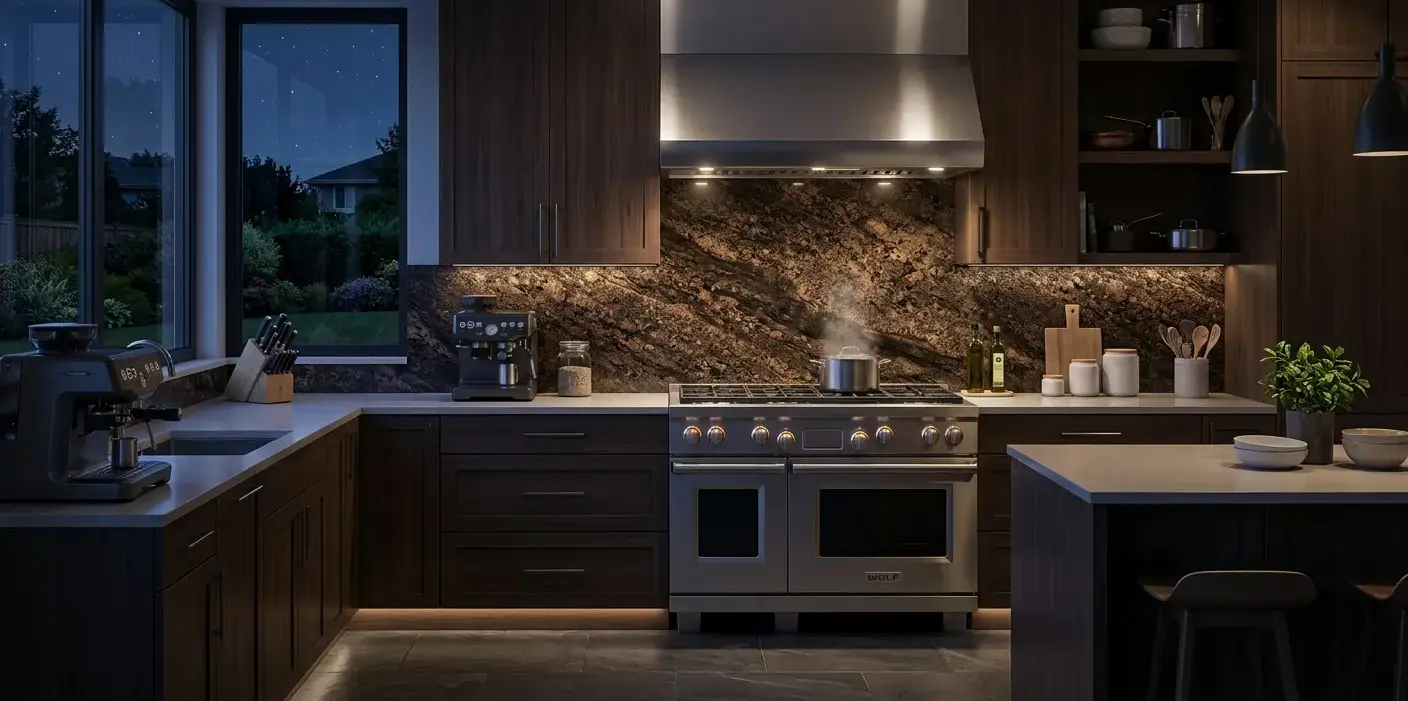
Brown slabs for backsplash are full-format natural and engineered stone panels used behind kitchen cooktops, ranges, and bathroom vanities. Available in granite, quartzite, marble, travertine, dolomite, and quartz, these slabs deliver seamless wall coverage with warm earth tones, dramatic veining, and a surface profile that elevates any design scheme. Finishes include polished, honed, leathered, and specialty options, each affecting both aesthetics and practical performance in wet or high-use spaces.
Brown Stone Slab Details: Composition, Surface Options, Durability
Brown granite and quartzite rank among the most requested materials for a brown backsplash application. Granite registers between 6 and 7 on the Mohs hardness scale; quartzite typically reaches 7 to 7.5, making both among the harder options in natural stone. Standard slab thickness runs 3/4 inch (20 mm) or 1 1/4 inch (30 mm), depending on span and application requirements.
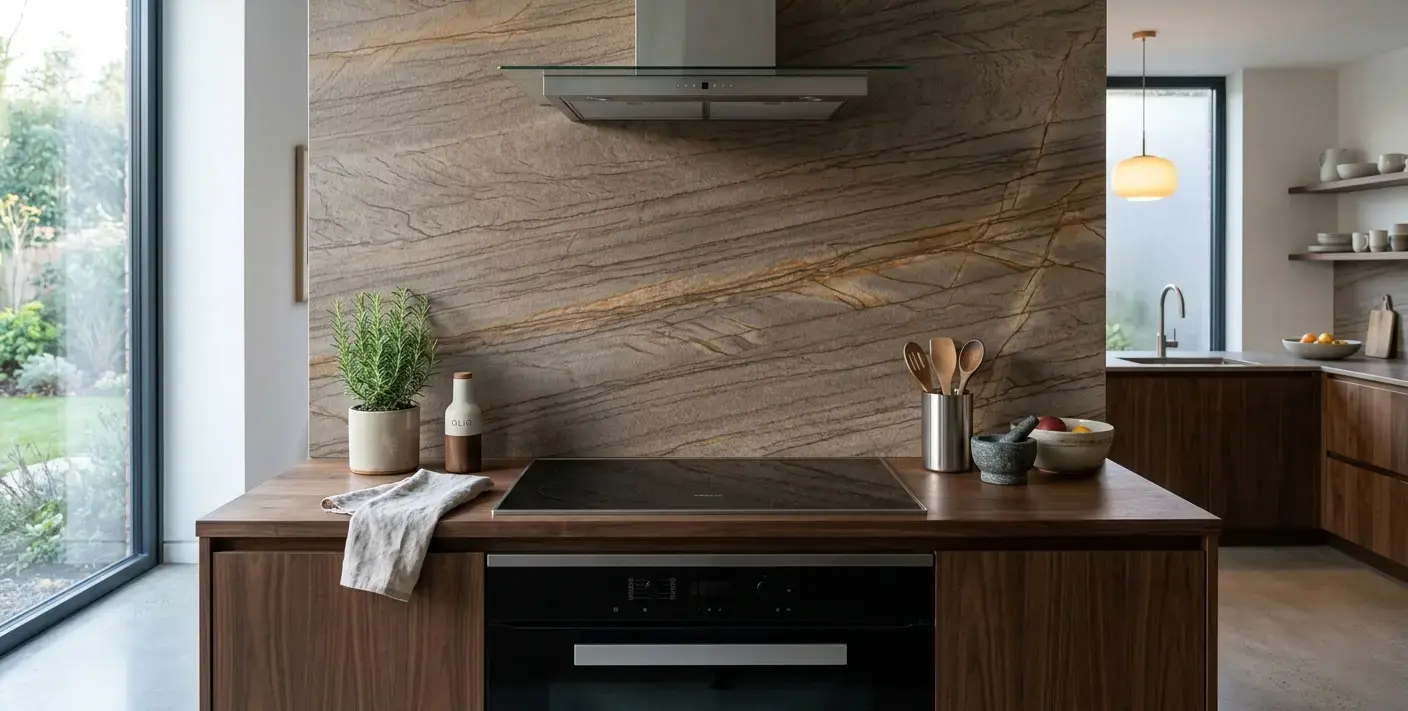
Primary color tones in brown granite include warm tawny gold and deep espresso, while quartzite commonly presents in sandy taupe with ivory or rust undertones. Secondary tones often include amber, cream, or pewter-gray mineral flecks that emerge clearly under a polished finish. Veining in quartzite tends toward linear, flowing patterns; granite features more granular, speckled movement rather than dramatic streaks.
 Conceptual rendering
For engineered options, quartz slabs in brown tones combine crushed stone with resins for a non-porous surface that resists staining without periodic sealing. Quartz rates approximately 7 on Mohs and is suited to indoor floor and wall applications only. Compared to natural stone, quartz offers greater color consistency across the slab face. Nova Tile and Stone's live slab inventory includes current stock across these material categories, updated as new slabs arrive.
Granite and quartzite quarry from multiple global regions, including Brazil, India, and Norway, with regional geology producing distinct color concentrations. Absorption rates for dense granite average below 0.4%, a characteristic that supports routine kitchen and bath use with appropriate sealing. Quartzite absorption is comparably low but varies by specimen; periodic resealing extends performance over time.
Brown marble and travertine slabs offer softer earth tones and more pronounced veining than granite. Marble registers 3 to 4 on Mohs, making it more susceptible to scratching and etching from acids found in kitchen environments. Travertine's characteristic open-pore structure requires filling and sealing before backsplash use to prevent moisture intrusion. Both materials suit shaded or indoor applications and should not be specified in direct-UV outdoor settings.
Backsplash Design Ideas: Layout, Pattern, and Visual Impact for Brown Slabs
A brown slab for backsplash performs differently depending on how it is cut and oriented. Vertical slab placement elongates wall height, a useful effect in kitchens with standard 8-foot ceilings. Horizontal orientation emphasizes width and draws the eye across a long countertop run. Matching slab sections cut from the same block and mirrored in a book-match layout produce a dramatic symmetrical pattern that suits open-plan kitchens with unobstructed sight lines.
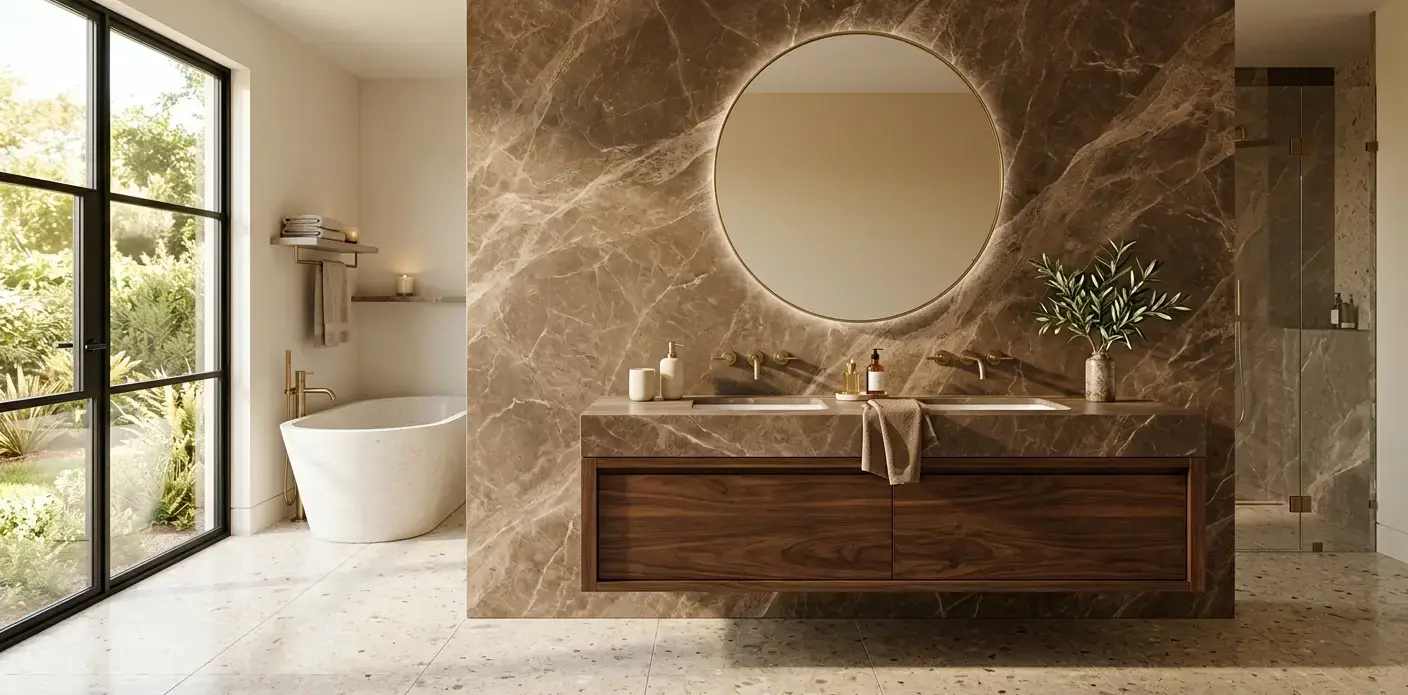
Waterfall configurations extend the backsplash material continuously down a kitchen island or vanity side panel, creating a unified stone envelope. This approach highlights the movement in quartzite or the tonal depth in a leathered granite finish. For bathrooms, a single full-height slab behind a freestanding tub or floating vanity eliminates grout lines entirely and simplifies cleaning. Brown tones belong to a family of classic earth palettes that design authorities consistently identify as timeless against both light and dark cabinetry. Nova Tile and Stone's full slab selection supports matching backsplash and countertop slabs from the same lot for a continuous visual result.
Why a Brown Stone Slab Backsplash Delivers Practical Advantages Worth Noting
- Fewer grout lines. Full slab coverage across a backsplash zone eliminates the grout joints that accumulate grease and moisture over time, subject to regular surface cleaning with non-abrasive products.
- Finish variety expands functional range. A honed or leathered finish reduces surface reflectivity and better conceals fingerprints and water marks in high-traffic kitchens; polished finishes amplify depth in low-moisture bathroom feature walls.
- Heat resistance with limits. Natural stone tolerates ambient kitchen heat well, but thermal shock from sustained direct heat can cause micro-fractures; trivets and hot-pad use protect the slab surface.
- Scratch resistance varies by material. Quartzite and granite offer meaningful scratch resistance under daily use; marble and travertine require cutting boards and prompt cleanup to preserve surface appearance.
- Non-porous quartz option. Quartz brown slabs need no resealing, maintaining stain resistance in kitchen and bathroom wall applications without added maintenance steps.
- Consistent slab sizing for large formats. Standard jumbo slab dimensions (typically 55 x 120 inches and larger) allow a single piece to cover most residential backsplash zones without seams.
 Conceptual rendering
Trade professionals working on residential or commercial projects can explore account benefits through Nova's trade account program, which is structured for designers, contractors, and builders.
Note: Some images on this page may be conceptual renderings created to illustrate design possibilities and may not depict actual installations.
 Conceptual rendering
Brown Slabs: Long-Term Design Investment in Any Kitchen or Bathroom
Natural and engineered stone slabs outlast many other backsplash materials when properly maintained. The depth of color in a brown quartzite or granite slab does not fade under interior lighting conditions the way printed or painted surfaces can over years of use, though sealing schedules and cleaning practices directly affect long-term appearance. Stone slabs with movement and veining also carry a visual complexity that single-color or flat-surface alternatives cannot replicate.
The timeless character of earth-tone stone means brown backsplash slabs remain relevant across shifting interior trends. They pair with shaker cabinetry, flat-front modern kitchens, and transitional bathroom designs without requiring replacement as adjacent finishes evolve. A well-specified slab, matched in material and finish to the application demands of the space, represents a surface investment built to last through multiple renovation cycles. The Nova Tile and Stone team carries an inventory of slab material suited to both residential and commercial projects, with options spanning the full range of brown material families.
Latest Stone Slab Articles
See What’s New With Us!
Frequently Asked Questions
Brown backsplash slabs are available in granite, quartzite, marble, travertine, dolomite, and quartz. Each material differs in hardness, porosity, finish options, and maintenance requirements, so the right choice depends on the specific kitchen or bathroom conditions where the slab will be used.
Honed or leathered finishes are generally better suited to active cooking areas because they are less slippery when wet and conceal minor marks more effectively than polished surfaces. Polished finishes amplify veining and color depth but may show fingerprints and water splatter more readily in a kitchen environment.
Yes. Natural stone backsplash slabs, including granite and quartzite, benefit from periodic sealing to maintain stain and moisture resistance. Sealing frequency depends on the specific stone's absorption rate and the intensity of use. Quartz is non-porous and does not require sealing.
Brown marble can be used as a kitchen backsplash, but it requires more careful maintenance than granite or quartzite. Marble registers lower on the Mohs hardness scale and is susceptible to etching from acidic substances like citrus juice, vinegar, and certain cleaners. Prompt spill cleanup and use of pH-neutral products help preserve its appearance.
Most residential backsplash slabs are supplied at 3/4 inch (20 mm). A 1 1/4 inch (30 mm) thickness is also available and is more common for countertop or structural applications. For wall-mounted backsplash use, 3/4 inch is the standard specification and the more common choice across material types.
Explore Brown Slabs Available in Current Inventory
View the full range of brown stone slabs, confirm available finishes, and connect with a design specialist to identify the right material for your kitchen or bathroom project.
Visit Our Showrooms Near You