AT A GLANCE
- Travertine is a porous limestone graded under ASTM C1527.
- Light tones stay more comfortable in full sun than dark blends.
- Honed, leathered, and textured finishes generally grip better than polished when wet.
- Travertine absorbs more water than granite or porcelain.
- French pattern and large-format pavers are common layouts.
- Our travertine comes in polished, honed, leathered, and specialty finishes for indoor and outdoor floors.
IN THIS POST
- Is Travertine Good for Pool Decks?
- Do Travertine Pavers Get Hot in the Sun?
- Are Travertine Pavers Slippery When Wet?
- Filled vs. Unfilled Travertine: Which is Better for a Pool Deck?
- Travertine vs. Porcelain and Granite for Pool Decks
- Do Travertine Pavers Hold Up in Freezing Climates?
- Is Travertine Good for Saltwater Pools?
- What Patterns and Coping Styles Suit a Travertine Pool Deck?
- How Do You Seal and Clean Travertine Pool Pavers?
- What Should You Ask Before Buying?
- See Travertine Pavers in Person
- Frequently Asked Questions
Travertine pavers can work well for pool decks when the stone has a lighter color, a honed, leathered, or textured finish, and enough density for the local climate. They also perform best with a penetrating sealer and regular cleaning with non-acidic products. Travertine is a form of limestone made of calcium carbonate. It forms when mineral-rich spring water releases carbon dioxide and deposits calcium carbonate layer by layer, which leaves much of the stone naturally porous with small voids. According to the ASTM C1527 standard specification for travertine dimension stone, travertine is evaluated for absorption, density, strength, and abrasion resistance, and those properties largely determine how it holds up beside a pool.
Is Travertine Good for Pool Decks?
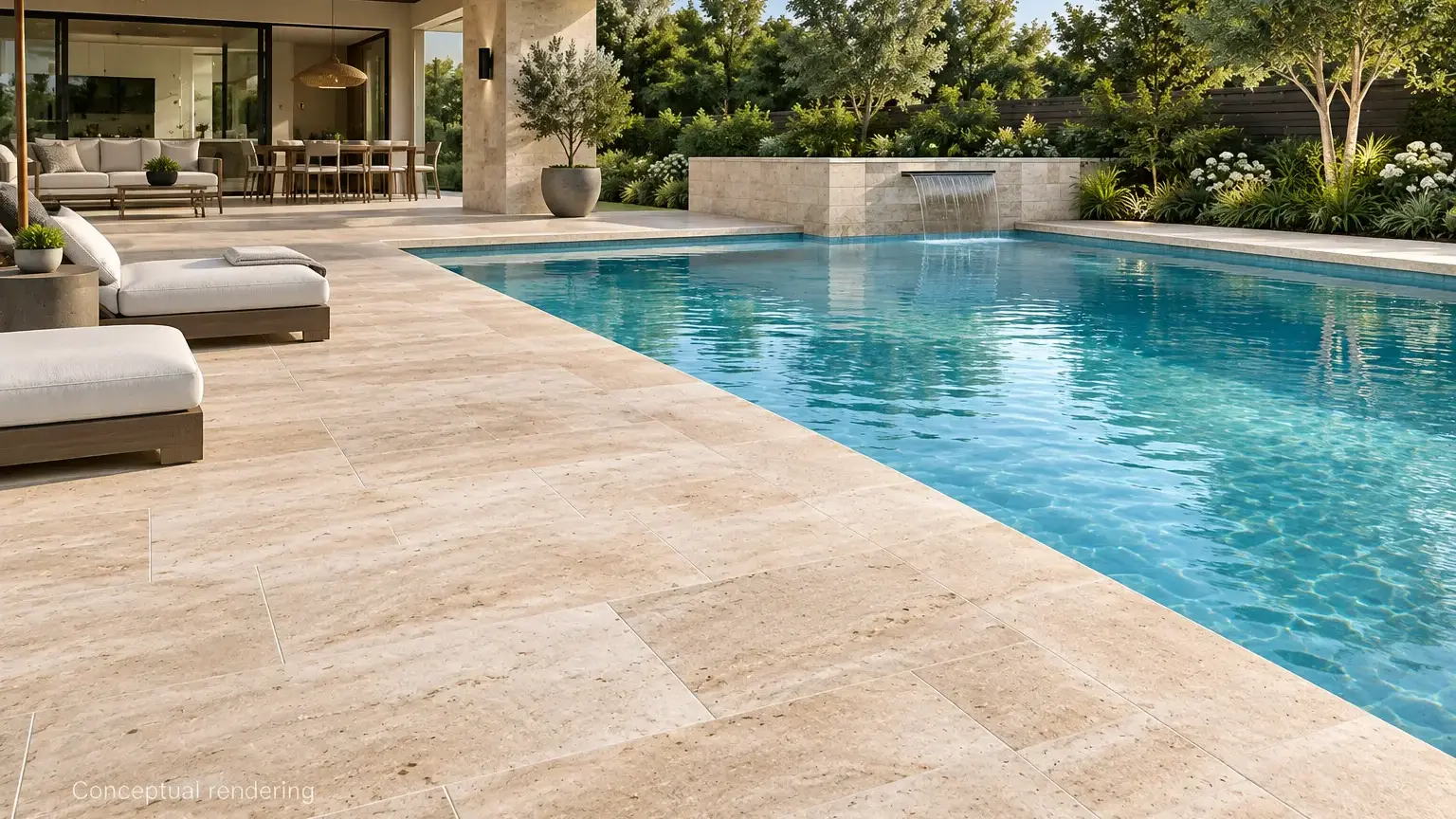
Yes. Travertine pavers are a common pool deck choice when the color, finish, and density suit the site, and when the deck is sealed and cleaned with non-acidic products.
The main trade-off is absorption. The same open structure that gives travertine its texture lets it take in more water than granite or porcelain, which makes climate and care more important. The sections below follow the decision in order: comfort, grip, surface type, comparisons, climate, design, and care.
Do Travertine Pavers Get Hot in the Sun?
Travertine pavers do warm up in direct sun, but light-colored travertine generally stays more comfortable underfoot than dark stone or dark pavement. Color does most of the work here. Dark pavements absorb 80 to 95 percent of sunlight, which is why they get so hot. In one infrared comparison of a road with light and dark sections, the lighter section measured about 30°F cooler than the darker one. The same research notes that a surface’s reflectance can change over time as it weathers and collects stains.
For a pool deck, that means:
- Ivory, cream, light beige, and pale silver travertine will generally stay more comfortable in full sun than walnut or other dark blends.
- Light-colored stone still warms up in strong sunlight. It is more comfortable than darker surfaces, but it is not cool to the touch in every condition.
- Keeping the surface clean helps it keep its original color and reflectance.
- Shade from trees, umbrellas, or a pergola often makes a bigger difference to comfort than the paving material alone.
At Nova Tile and Stone, we carry pavers and exterior stone, including travertine suited to outdoor floors, so you can see the tones in person and judge how light or dark a stone will look on a sunny deck before you choose a color.
Are Travertine Pavers Slippery When Wet?
Polished travertine can be slippery when wet, while honed, leathered, and textured finishes generally offer more grip around a pool. The surface finish makes much of the difference. In laboratory slip tests on limestone, granite, and marble, polished surfaces showed far lower slip resistance when wet than unpolished surfaces of the same stones. Travertine was not part of that study, but it is a close relative of limestone, and the pattern is a useful guide: the smoother and glossier the face, the less grip it tends to offer once water is present.
Here is how common finishes compare for a pool surround:
- Polished: glossy and reflective. Better reserved for walls, fireplace surrounds, and other areas that stay dry.
- Honed: smooth and matte with no shine. It offers a clean, contemporary look with more grip than polished stone.
- Leathered: a softly textured surface that adds tactile grip while keeping a natural appearance.
- Specialty textured finishes: these vary by product, so ask what surface texture a specific specialty finish has.
Grip can also change with use. A technical review of stone selection for a busy urban plaza notes that with heavy foot traffic, travertine’s surface can wear smoother over time, which reduces slip resistance. That makes the starting finish especially important in busy areas like pool entries and walkways. Two travertines with the same finish name can still perform differently.
For contractors, designers, and installers choosing finishes for a client’s pool deck, our trade account program connects you with our team, who can help compare finish options from one project to the next.
Filled vs. Unfilled Travertine: Which Is Better for a Pool Deck?
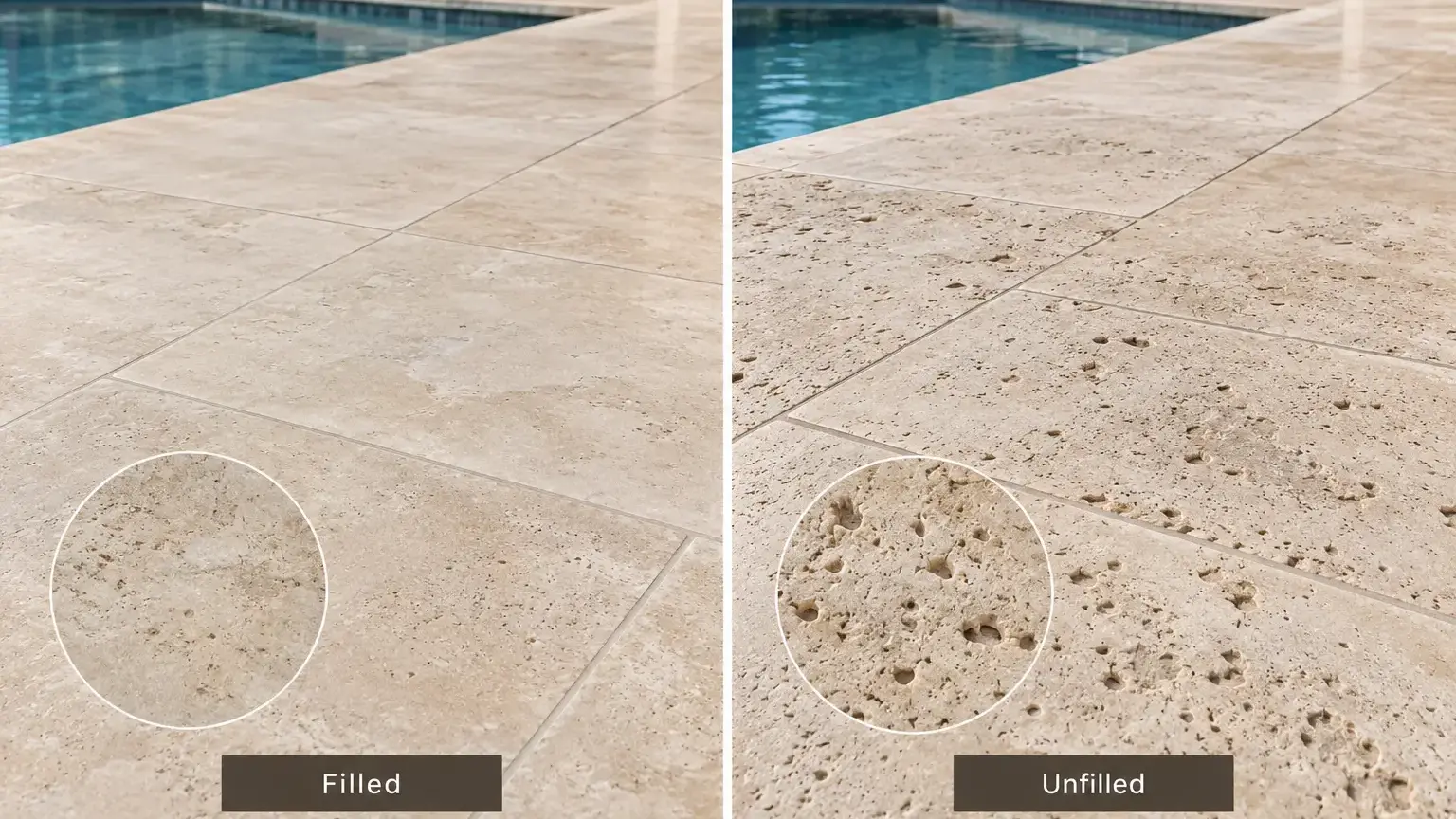
For pool decks in freezing climates, unfilled travertine avoids filler that can loosen when water freezes in it. In mild climates, filled travertine gives a smoother surface that is easier to sweep. Because of its natural voids, travertine is often sold filled or unfilled. In filled stone, the surface holes are packed with cement or synthetic materials so the face looks smoother and more uniform. Unfilled stone leaves the holes open.
The plaza review above notes that fillers can fail when water intrusion and freeze-thaw cycles combine, so the choice is partly a climate question. Filled surfaces sweep easily and look more refined. Unfilled surfaces show more texture but can hold onto dirt, leaves, and sunscreen residue.
Travertine vs. Porcelain and Granite for Pool Decks
Travertine offers natural variation and warm, light tones, while porcelain and granite absorb far less water, which can make them more forgiving in harsh winters. The best fit depends on your climate, how much upkeep you want, and the look you prefer.
- Granite: In the plaza review, travertine’s ASTM C1527 maximum absorption of 2.5 percent by weight was compared with 0.27 percent for the granite proposed. That lower absorption can make granite more forgiving where winters are harsh or de-icing salts are used. Its appearance is usually more speckled or uniform. Our granite comes in polished, leathered, and specialty finishes and is suited to indoor and outdoor floors.
- Porcelain pavers: These are defined by industry standards as having water absorption of 0.5 percent or less. They offer consistent sizing and color, though some people prefer the variation of real stone. Our porcelain comes in polished, honed, and specialty finishes and is suited to indoor and outdoor floors.
- Travertine: offers natural variation and a wide range of light, warm tones. The trade-off is higher absorption, which means more attention to climate, sealing, and cleaning.
Differences in color, texture, and surface feel are easier to judge in person than in photos. You can compare granite, porcelain, and travertine side by side at our showrooms in Reno, Minden, Fernley, and Sacramento.
Do Travertine Pavers Hold Up in Freezing Climates?
Some travertine pavers hold up in freezing climates, but not all. According to the ASTM C1527 standard, some travertines may not be suitable for exterior use where freeze-thaw cycles are frequent. Density, absorption, and drainage matter more where hard freezes are common.
The plaza review notes that greater absorption can be an indication of more freeze-thaw distress, since water that collects in the pores and freezes pushes outward on the stone from inside. That review was written for a high-traffic city plaza in a cold climate where de-icing salts are used. It also cites the Marble Institute of America’s recommendation against using travertine in exterior locations where those salts are applied. A backyard pool deck in a warm climate faces far milder conditions.
In practice, warm and mild climates are generally the most forgiving for travertine around pools. Two situations call for closer attention to the stone’s density and the deck’s drainage:
- regions with regular hard freezes
- decks near driveways and walkways where de-icing salt can be tracked onto the stone
Is Travertine a Good Choice for Saltwater Pools?
Travertine can work around a saltwater pool, but softer, porous stone has eroded in splash zones, so a penetrating sealer, fresh-water rinsing, and balanced water chemistry matter. Trade reporting describes how, as salt-chlorinated pools grew popular in the mid-2000s, reports of stone coping deterioration began to surface. Softer, more porous stones were eroding on copings and deck areas with consistent splash-out.
The experts interviewed did not fully agree on the cause. Some pointed to salt crystals left behind as splashed water evaporates. Others noted that any pool water carries dissolved minerals that remain on the deck when it dries, and that poor water balance and maintenance play a role. The exact mechanism has not been definitively identified, but the practical advice was fairly consistent:
- Favor penetrating sealers that repel water over film-forming surface coatings, which can wear off or delaminate.
- Rinse the deck and coping with fresh water. Salt system manufacturers recommend doing this after each use.
- Keep pool chemistry balanced.
- Watch splash zones closely, since that is where problems tended to appear first.
What Patterns and Coping Styles Suit a Travertine Pool Deck?
French pattern layouts suit a classic look, large-format pavers suit a modern one, and the coping choice decides how the deck meets the water.
- French pattern layouts mix squares and rectangles of several sizes for a classic look that blends natural color variation.
- Large-format pavers in a straight grid or running bond feel cleaner and more modern.
- Matching coping from the same selection creates a seamless edge where the deck meets the water, while a contrasting color frames the pool as a feature.
How Do You Seal and Clean Travertine Pool Pavers?
Clean travertine pool pavers with a pH-neutral stone cleaner, avoid acidic products, and reseal with a penetrating sealer as needed. Travertine is a calcareous stone. Because calcium carbonate is sensitive to acidic solutions, mild, non-acidic cleaners are recommended for routine cleaning, and products containing lemon, vinegar, or other acids can dull or etch the surface. The same guidance notes that sealing makes stone more stain resistant rather than stain-proof, which gives you more time to clean up spills before they soak in. For outdoor pool and patio areas, it suggests flushing with clear water and using a mild bleach solution to remove algae or moss.
A practical care routine:
- Sweep or blow off sand and grit regularly. Abrasive particles wear the surface.
- Wash with a pH-neutral cleaner made for natural stone.
- Rinse away spills promptly, especially pool chemicals and acidic drinks.
- Treat algae or moss carefully. Test any diluted bleach solution on a hidden area first, and rinse thoroughly afterward.
- Reseal as needed, following the sealer manufacturer’s instructions.
What Should You Ask Before Buying Travertine Pool Pavers?
Ask for the stone’s absorption and density values, whether it is filled, its finish and slip-resistance data, and which sealer suits a pool environment. A short list of questions for the showroom and your installer can pull all of these factors together:
- What are the absorption and density values for this specific stone?
- Is it filled or unfilled, and if filled, with what material?
- What is the surface finish, and is there slip-resistance test data for it?
- What sealer do you recommend for a pool environment, especially for a salt pool?
- How should drainage be handled so water does not sit on the deck?
It also helps to look at several pieces of the same stone together, since natural variation across a whole deck is usually greater than a single sample suggests.
See Travertine Pavers in Person
Travertine’s appeal around pools comes from the same trait that calls for care. Its porous, naturally varied structure gives the stone its texture and soft color range, and it is also what makes climate, finish, and maintenance so important. Where conditions are mild and the stone is chosen and cared for with those factors in mind, travertine can make a comfortable, attractive pool surround. Where salt, de-icing chemicals, or frequent freezes are part of the picture, it calls for more careful selection and upkeep.
If you are weighing travertine against other paving options, seeing them in person makes the comparison much easier. Our travertine comes in polished, honed, leathered, and specialty finishes and is suited to indoor and outdoor floors, walls, and fireplaces, so a pool deck can connect visually with other spaces around your home. We offer free design consultations where you can compare colors, finishes, and formats and work through the questions above before talking with your installer. You can visit our showrooms in Reno, Minden, Fernley, or Sacramento.
Frequently Asked Questions
Lighter shades such as ivory, cream, light beige, and pale silver are usually the most practical choice because they absorb less sunlight and stay more comfortable for bare feet. Darker blends can still work in shaded areas or as accents.
It depends on your priorities. Porcelain absorbs very little water and offers uniform sizing, which suits colder climates and low-maintenance goals. Travertine offers the look and variation of natural stone, but it needs sealing and more attention to climate.
Filled travertine gives a smoother, more uniform surface that is easy to sweep, but the filler can wear or loosen where water and freezing combine. Unfilled travertine has a more rustic texture and avoids filler failure, though its open pores can collect debris.
A mild, diluted bleach solution is a recognized way to remove algae or moss from outdoor stone. Test it on a hidden spot first, avoid strong concentrations, and rinse thoroughly. Acidic cleaners such as vinegar or lemon should be avoided.
There is no fixed schedule, since it depends on the sealer, sun exposure, foot traffic, and pool chemistry. A simple check is to sprinkle water on the stone. If it beads, the sealer is still working. If it soaks in and darkens the surface, it is time to reseal.
Sources
- ASTM C1527/C1527M, Standard Specification for Travertine Dimension Stone | https://store.astm.org/c1527_c1527m-23.html
- ANSI Blog: Porcelain Tile Definition (ANSI A137.1 and ASTM C373) | https://blog.ansi.org/ansi/porcelain-ceramic-tile-ansi-a137-1-astm-definition/
- Natural Stone Institute: Care and Cleaning of Natural Stone | https://www.naturalstoneinstitute.org/consumers/care/
- Lawrence Berkeley National Laboratory, Heat Island Group: Cool Pavements | https://heatisland.lbl.gov/coolscience/cool-pavements
- MDPI Materials Proceedings: Investigation of the Freezing-Thawing Effect on the Slip Resistance of Natural Stones | https://www.mdpi.com/2673-4605/5/1/32
- NYC Landmarks Preservation Commission: 140 Broadway Technical Review of Stone Selection | https://www.nyc.gov/assets/lpc/downloads/pdf/presentation-materials/20190205/140-Broadway.pdf
- Concrete Decor: Compatibility Issues Between Stained Concrete and Salt Chlorinated Swimming Pools | https://www.concretedecor.net/departments/staining-coloring/the-pool-water-problem-are-there-compatibility-issues-between-decorative-concrete-and-salt-chlorinated-swimming-pools/
Note: Some images on this page may be conceptual renderings created to illustrate design possibilities and may not depict actual installations.