Granite and quartzite are the best-suited stacked stone choices for a wood-burning fire pit and for any wall that salt water reaches. Travertine, usually sealed, fits gas fire tables and pool walls set back from the water's edge. Whatever the stone, the flame belongs inside a steel or firebrick liner, with the stacked stone as the outer face.
Stacked stone is natural stone cut into thin, layered pieces and set as the finished face of a fire pit, seat wall, or water feature wall. Below, we cover heat, smoke, metal, salt water, winter weather, sealing, and slip resistance.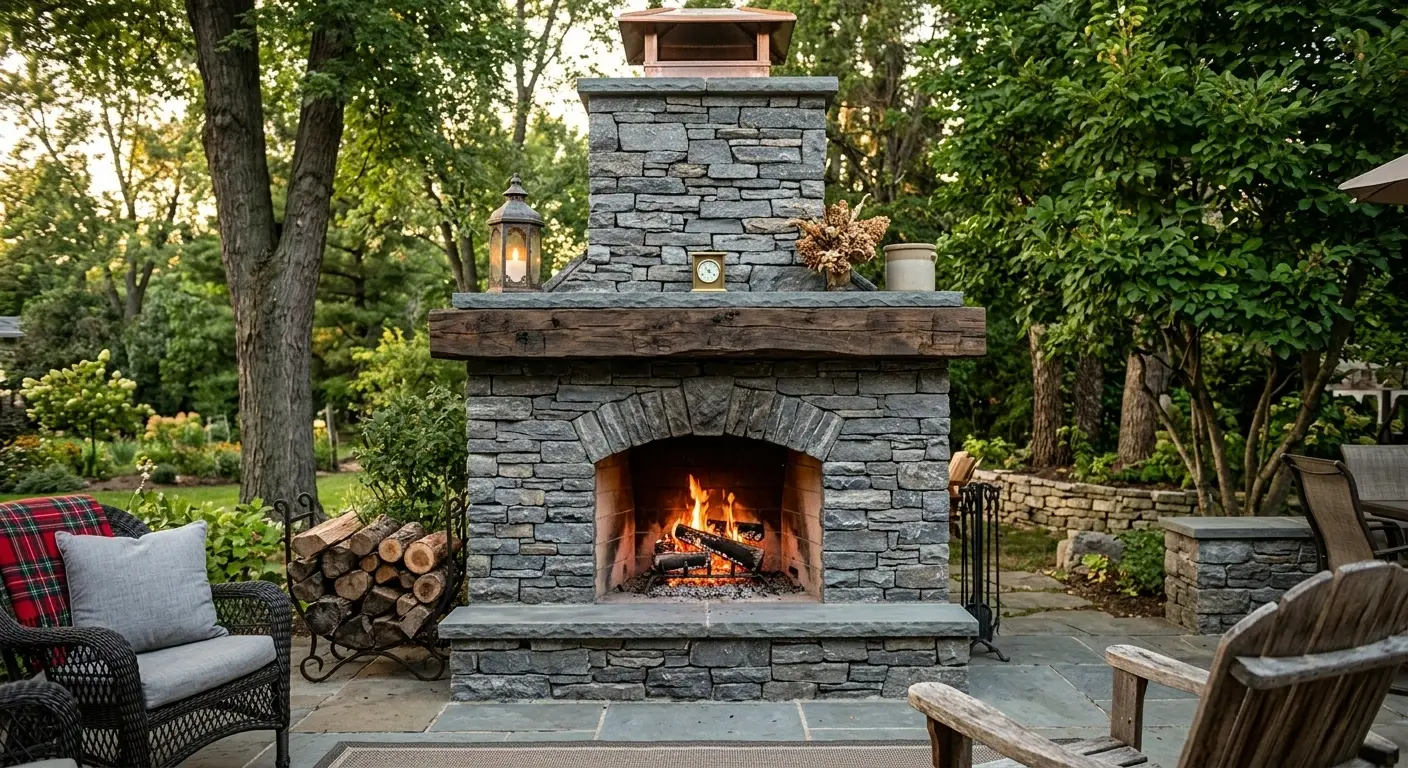
Is Stacked Stone Heat Resistant?
Natural stone handles the heat that reaches the outside of a fire pit, but the flame itself should sit inside a liner made for direct fire. A steel fire ring or a firebrick lining takes the flame, and the stacked stone forms the finished wall around it.
Granite, quartzite, and travertine are all a good fit for fireplace applications. The liner keeps direct flame off the stone, which is what lets each of them work as the finished face.
Wood Smoke Calls for Denser Stone Than Gas
Wood smoke carries acids that can etch stone, so a wood-burning fire pit calls for a denser stone than a gas one. The Natural Stone Institute's care guidance notes that smoke-stained fireplaces can show some etching once the residue is cleaned off, because smoke carries carbonic and other acids.
Travertine is mostly calcium carbonate, which reacts with acids. Granite is made mostly of quartz and feldspar, and true quartzite is almost entirely quartz, so both hold up to most everyday acids far better.
One caveat: some stones sold as quartzite are actually marble or dolomite, which etch much like travertine. Confirm a slab is true quartzite before choosing it for a wood-burning fire pit.
Gas burns with much less smoke, so a gas fire table is where a warm travertine becomes a fair choice for the surround. For a wood-burning pit that gets lit every weekend, our pick is granite or quartzite.
Metal Parts Can Leave Stains That Will Not Wipe Off
Bare steel and copper sitting on or near stone can leave stains that a quick cleaning will not remove. Fire pits bring fire rings, grates, and burner pans, and HGTV's outdoor stacked stone fireplace project notes that most chimney caps are made of metal too.
NSI explains that rust stains show up orange to brown and follow the shape of the object, while copper and bronze leave green or muddy-brown marks. These need a poultice to remove, and deep-seated rust may leave the stone permanently stained.
Our advice is simple: ask what every metal part touching the stone is made of before the stone is chosen. A bare steel grate resting on a stacked stone ledge is the setup most likely to leave a mark you see every evening.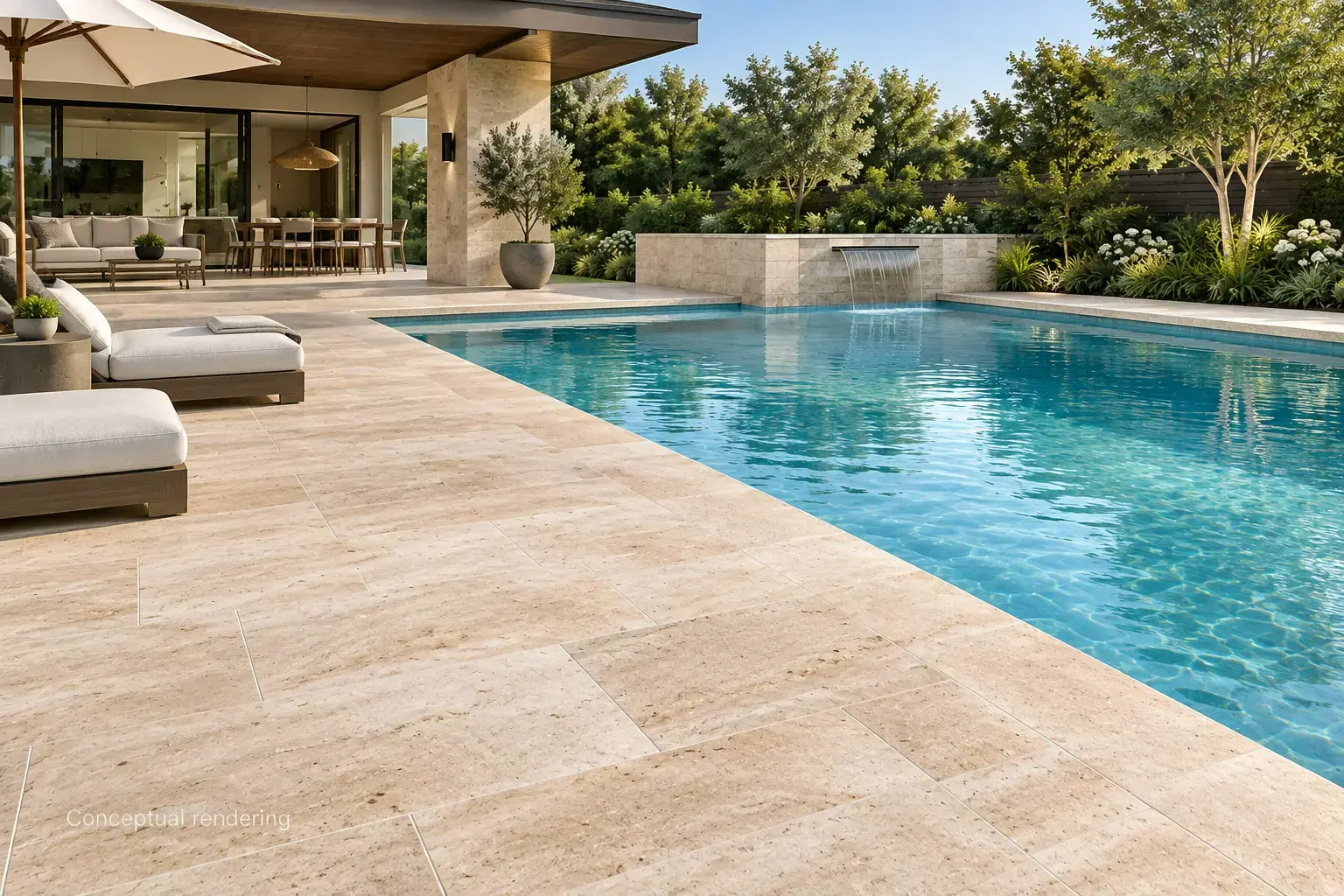
Does Salt Water Damage Travertine?
It can, over time. In a saltwater pool, salt water soaks into the pores of porous stone, and as it evaporates, salt crystals form inside the stone, which can lead to pitting or flaking at the surface. Salt crystallization is one of the best-documented causes of wear in porous stone, travertine included.
Travertine is naturally porous, so it is more exposed to this than dense granite or quartzite. Sealing helps reduce how much water the stone absorbs, but our recommendation is to keep travertine back from the water's edge on a saltwater pool and use granite or quartzite on walls and ledges the splash reaches.
Water That Drains Is Fine, Water That Sits Is Not
A water feature wall works when the water runs off and drains away freely. The trouble comes from water that pools against the stone or gets trapped behind it with nowhere to drain, since prolonged saturation can affect the material over time.
Moving water can still leave a mark. Water that travels through a wall can carry mineral salts to the surface, leaving a white powder NSI calls efflorescence, and NSI advises dusting or vacuuming it rather than rinsing it, since water only hides it for a while.
White powder shows up more against dark stone than light. On a water feature wall, that is a fair reason to lean toward a lighter granite or quartzite.
Can Stacked Stone Handle Freezing Winters in Reno?
Dense stones like granite and quartzite absorb very little water and generally hold up through freeze-thaw cycles. More porous stone is more likely to crack when water gets in and freezes repeatedly, and sealing does not make an unsuitable stone frost resistant.
Freeze-thaw matters most in Reno, Minden, and Fernley, where winter nights below freezing are routine. A water feature that keeps a wall wet into late fall is one of the riskiest spots in the yard, so in those areas we would use granite or quartzite. Sacramento sees hard freezes far less often, which leaves more room for travertine.
Should Outdoor Stacked Stone Be Sealed?
Travertine usually benefits from sealing outdoors, and your stone supplier can recommend a sealer and schedule for your specific stone and exposure. Granite and quartzite absorb little moisture and often need less, but beside a saltwater pool it is worth asking about sealing for any stone.
NSI explains that stone sealers work as repellents: they make stone more stain resistant, not stain proof. NSI also notes that many stones do not require sealing at all, which is why the specific stone should drive the decision rather than one rule for every wall.
What Stone Finish Is Least Slippery Around a Pool?
For any ledge, cap, or coping that gets wet, choose a honed or textured finish over a polished one. Honed and textured surfaces tend to offer more grip in wet conditions, though caution still matters on any wet surface.
Pool coping and stacked stone both sit under Pavers and Exterior Stone in our full product range, so the pool edge and the wall behind it can be chosen together. For a flat ledge on top of a fire pit or seat wall, browse our live slab inventory for a granite or quartzite that pairs with the wall, then request a slab quote on the slabs you want.
Plan the Fire Pit and Pool as One Outdoor Room
Choose the fire pit stone, the pool wall stone, and the coping at the same time, so the yard reads as one design. Our page on granite, quartzite, and travertine for exterior use shows conceptual renderings of this approach, including a granite outdoor kitchen and fire pit, and a travertine pool deck with a water feature wall.
Our overview of where exterior stone is used around a home also lists outdoor kitchen and fireplace structures, chimneys, and garden walls among its accent applications. For homeowners who also compare what goes into each material, Use Natural Stone's guide to environmental and health product labels explains the ingredient disclosures available for natural stone.
Conclusion
Before choosing a stone, note four things: whether the fire burns wood or gas, whether the pool is saltwater, what every metal part near the stone is made of, and whether any wall stays wet into winter. Those answers settle most of the stone decisions above.
Bring that list when you visit one of our showrooms in Reno, Sacramento, Minden, or Fernley to see exterior stone in person. If you would rather plan with a designer from the start, book a free design consultation and our team at Nova Tile and Stone will help you match the stone to each feature.
Note: Some images on this page may be conceptual renderings created to illustrate design possibilities and may not depict actual installations.
Frequently Asked Questions
Granite, quartzite, and travertine are all suited to fireplace applications and handle the heat on a fire pit's outer wall. The flame itself should sit inside a steel fire ring or firebrick liner, since direct flame contact on the stone should be avoided.
It can over time. Salt water soaks into travertine's natural pores, and salt crystals that form as it dries can cause pitting or flaking. Sealing reduces absorption, and keeping travertine back from the water's edge on a saltwater pool lowers the risk further.
Travertine usually benefits from sealing outdoors, and your stone supplier can recommend a sealer and schedule for your specific stone and exposure. Granite and quartzite absorb little moisture and often need less, though sealing is worth asking about beside a saltwater pool. Sealing improves stain resistance but does not make stone stain proof.
Dense stones like granite and quartzite absorb very little water and generally hold up through freeze-thaw cycles. Porous stone is more likely to crack when water gets in and freezes repeatedly, so walls that stay wet into winter are best built with a dense stone.
It is usually efflorescence, a white powder left when water carries mineral salts to the surface and evaporates. The Natural Stone Institute recommends dusting or vacuuming it rather than rinsing it, and checking the moisture source if it keeps returning.