The most important pool paver rule is to choose the stone and its finish together. Pair an outdoor-rated material, either a natural stone such as granite, quartzite, or travertine or a porcelain paver, with a honed or leathered finish that holds its grip when wet. Under the ANSI A326.3 slip standard, an outdoor pool deck is generally accepted to need a wet dynamic coefficient of friction (DCOF) of at least 0.55.
The key dos are to check each paver’s Exterior, Wet rating, judge grip wet instead of dry, choose lighter pavers for barefoot areas, and match sealing needs and climate to the stone you love. The key don’ts are polished finishes near the water, dark pavers where people walk barefoot, and marble or dolomite on the pool deck.
This guide covers each of those decisions for homeowners planning a new pool deck or replacing a worn one, ideally while comparing options in our pavers and exterior stone selection, which includes pool coping and small to large format pavers.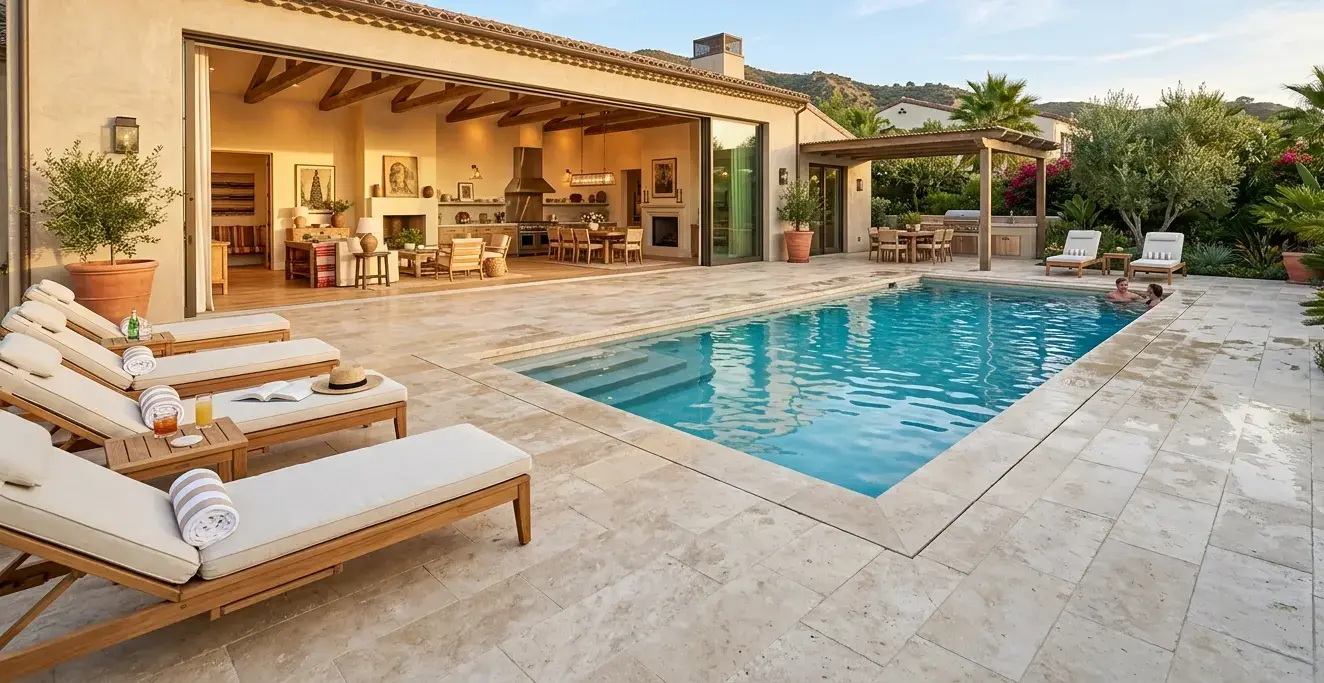
What Slip Rating Does a Pool Deck Need?
ANSI A326.3 sorts hard flooring into five use categories, and outdoor pool decks, patios, and walkways fall under Exterior, Wet. Indoor pool decks sit in a separate Interior, Wet Plus category, which shows how seriously the industry treats an open-air deck.
For the exterior category, the ANSI A326.3 standard published by the Tile Council of North America notes that flooring is generally accepted to need a wet DCOF of at least 0.55, with other factors weighed alongside the test result. That is a higher bar than the 0.42 minimum the standard sets for level indoor floors walked on when wet.
Manufacturers declare the Exterior, Wet category themselves, and the industry’s aim is for that classification to be shown on product data sheets and display boards. Look for it on any porcelain paver you shortlist, ask for it if you don’t see it, and keep looking if Exterior, Wet is missing. When a natural stone option carries no declared category, pairing it with a honed or leathered finish becomes an important safety signal.
For its wet categories, the standard also lists drainage, surface structure, and the number of grout joints among the factors to weigh beside DCOF. In our view, that makes paver size a safety choice too. A large-format paver gives a sleek look with fewer joints, so the finish on that paver has to carry more of the grip on its own.
Don’t Trust a Dry Touch to Predict Wet Grip
A paver that feels grippy in a dry showroom tells you little about a soaked deck at 4 p.m. The UK Health and Safety Executive’s guidance on assessing floor slip resistance reports that most slip accidents happen when floors are wet or otherwise contaminated, which is why a dry test tells you so little.
The ANSI standard also states that it provides no fixed DCOF limits for pool decks or for flooring where little or no footwear is used, and the HSE uses a separate, softer test rubber for barefoot areas. Put plainly, a passing number is a filter, not a promise, and bare feet deserve their own place in your decision.
Our advice is to judge each stone and finish by how it will perform wet, not by how it feels on a dry display. When visiting one of our showrooms, compare a honed and a polished finish on the same stone side by side, and ask our team which options suit wet outdoor use.
Check glare at the same time. In direct sun, a polished face throws back noticeably more light than a honed one, which matters on a deck where you keep an eye on swimmers all day.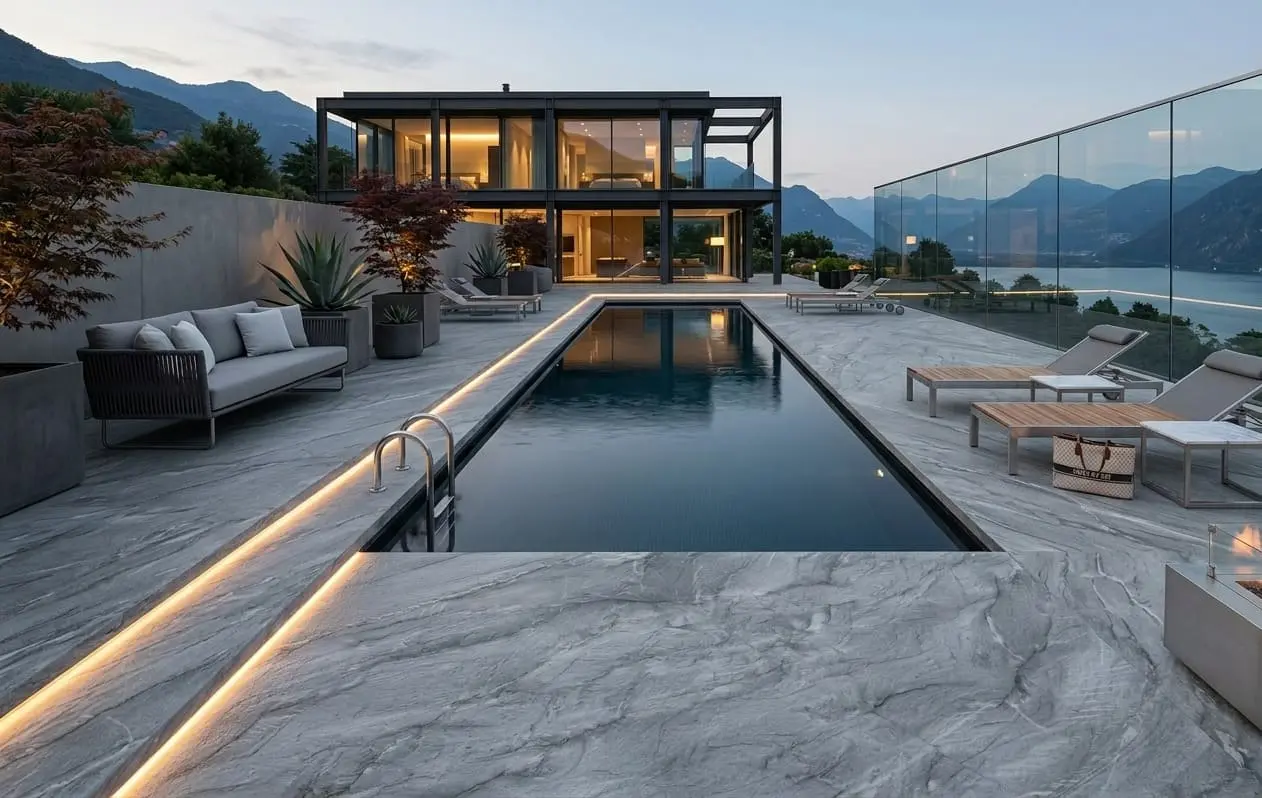
Do Pair Each Stone With a Finish Made for Its Zone
A pool surround has three zones with different safety needs. Coping takes constant splash and doubles as a bench, the main deck carries wet foot traffic, and the far edge of the patio often stays dry most of the day.
For coping and the splash zone, pair an outdoor-rated natural stone or porcelain with a honed or leathered finish. Granite, quartzite, and travertine are all good fits for exterior stone applications, as our guide to natural stone for exteriors explains, and porcelain is a good fit outdoors as well. That guide also notes that honed and textured surfaces tend to offer more grip in wet conditions than a highly polished one.
Pool steps and the edge of a sun shelf deserve the most texture of all. That is where feet move straight from water onto stone, often mid-stride and carrying a towel or a toddler.
The dry far end of the patio is where you can relax the rules. A smoother honed face or a bolder stone color works there, as long as it sits well back from the splash line.
Save polished finishes for indoor projects. The ANSI standard names polished surfaces as an example of flooring that can measure below 0.42 when wet, and says flooring in that range should only be installed where it will be kept dry. A pool deck is the opposite of that.
Grip also changes with age. The ANSI standard notes that DCOF can shift over time with wear and surface contaminants, and the same HSE guidance warns that slip resistance can change significantly after short periods of use. That is a strong argument for choosing more texture than you think you need.
We don’t recommend marble or dolomite for pool decks or other outdoor projects. Both are beautiful choices for interiors, and the outdoor-rated materials above are the better match for wet, sunny pool areas.
Don’t Put a Dark Stone Where Bare Feet Land
On a pool deck, surface heat is part of safety because people cross it barefoot, whether on a July afternoon in Sacramento or Reno. In an Arizona pilot study cited by the U.S. EPA’s cool pavements guidance, conventional asphalt reached surface temperatures up to 152°F at midday, while reflective cool pavements stayed 10 to 16°F cooler.
The Lawrence Berkeley National Laboratory Heat Island Group explains why: dark pavements absorb 80 to 95 percent of sunlight, while solar-reflective surfaces stay cooler in the sun. In one thermal image on that page, the light section of a road measured about 30°F cooler than the dark section beside it.
That research covers paving in general rather than any single paver, but the lesson for barefoot areas is clear. Choose lighter pavers and coping for the deck, paired with a honed or leathered finish for grip, since that edge is where people sit in swimsuits between swims.
Dark stone still has a place in a pool area. It suits exterior stone accents like a garden wall or an outdoor fireplace near the pool, where nobody stands barefoot in the afternoon sun.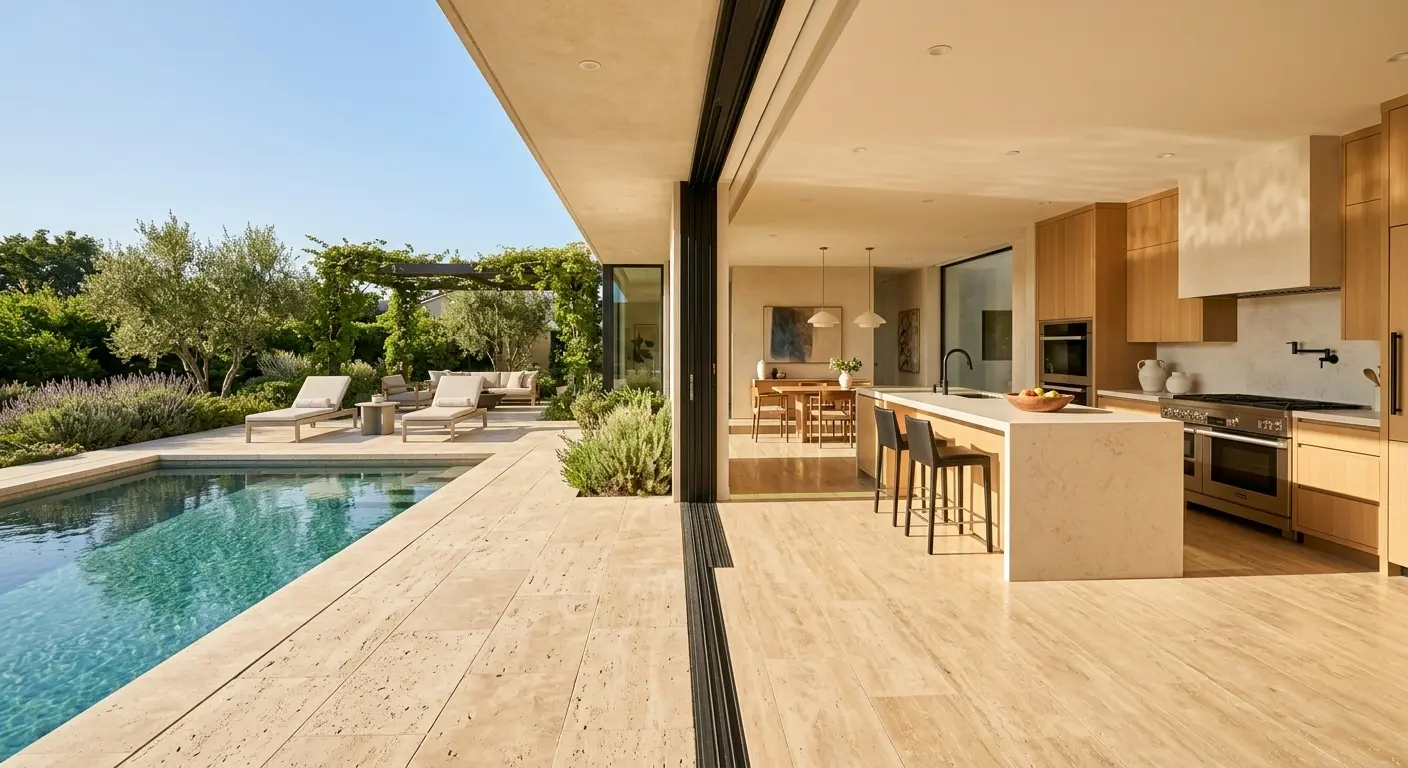
Do Choose a Material That Stays Safe Through Every Season
A deck is only as safe as its surface stays, so think about how each stone holds up over the years. Travertine has natural pores and benefits from sealing, with periodic resealing to keep that protection in place. Granite and quartzite are denser and have low absorption when properly selected, sealed, and maintained.
Freeze-thaw winters raise the stakes. Dense stones such as granite and quartzite generally hold up well through freeze-thaw cycles because they absorb very little moisture, while porous stones can be more susceptible to cracking if water gets in and freezes repeatedly. Sealing helps, but it does not make an unsuitable stone frost resistant.
That makes travertine the stone in this guide that needs the most thought in places like Reno, Minden, and Fernley, where winter nights regularly drop below freezing. If you love travertine there, choose a dense piece and keep it sealed, or lean toward granite, quartzite, or a porcelain paver tested frost resistant to ASTM C1026, the industry’s freeze-thaw test for ceramic tile. An Exterior, Wet rating will not tell you this, since the slip standard notes that label refers to slip resistance, not frost resistance.
Porcelain sits at the low end of the absorption scale. Under the industry definition, a tile qualifies as porcelain only with water absorption of 0.5% or less. It is moisture resistant, but standing water should not be left for long periods, and grout joints still need routine attention.
Clean surfaces are safer surfaces. Moss, mildew, or algae in shaded, damp corners of the deck should be addressed promptly, and the Natural Stone Institute’s care and cleaning video demonstrates routine care and stain removal. Our design team can also talk through upkeep for a specific stone and finish when you book a free design consultation.
Conclusion
Narrow your shortlist to three light, outdoor-rated options, each paired with a textured finish, then compare them side by side in person. A honed granite, a leathered quartzite, and a honed porcelain make a useful first trio to ask about, and our team can tell you which pavers and pool coping we currently carry in each finish. Rank them on grip when wet, comfort under bare feet, and how they look beside the water.
Our slab selection also includes granite, quartzite, and travertine options for exterior natural stone projects. Browse our live slab inventory and note the name and bundle number of any slab you like for the pool area. With those details in hand, you can request a slab quote from Nova Tile and Stone and keep the deck, coping, and any outdoor kitchen or fire feature in one coordinated palette.
Note: Some images on this page may be conceptual renderings created to illustrate design possibilities and may not depict actual installations.
Frequently Asked Questions
A honed or leathered finish on an outdoor-rated natural stone such as granite, quartzite, or travertine, or on porcelain, is a strong choice around water. Polished finishes are best kept away from the pool, since a smooth, reflective face offers less grip once it is wet.
Natural stones such as granite, quartzite, and travertine, along with porcelain, are all good fits for outdoor applications, including pool surrounds. Pair any of them with a honed or leathered finish, and plan for sealing on travertine, which benefits from periodic resealing.
In freeze-thaw areas like Reno, Minden, and Fernley, choose a dense travertine and keep it sealed, or lean toward granite, quartzite, or a frost-resistant porcelain paver. Porous stone can crack if water gets in and freezes repeatedly, and sealing does not make an unsuitable stone frost resistant.
Research on paving shows that surfaces reflecting more sunlight stay cooler than darker ones. A lighter paver is the better pick for bare feet, though any surface in direct summer sun still warms up.
We don’t recommend marble or dolomite for pool decks or other outdoor projects. Granite, quartzite, travertine, and porcelain are better matches for wet, sunny pool areas.