The slip resistance rating to look for on a pool deck is Exterior Wet, one of five product use classifications in ANSI A326.3, the American standard for measuring the dynamic coefficient of friction (DCOF) of hard surface flooring. Exterior Wet is declared by the manufacturer, so a high DCOF number on its own does not confirm that a surface suits an open pool deck.
A paver can test at a wet DCOF of 0.62 and still carry only an Interior Wet rating, the category the standard ties to a minimum wet DCOF of 0.42. Around a pool, the classification printed on the spec sheet tells you more than the friction score does.
This guide covers how the five categories work, where natural stone and porcelain fit, and what a rating leaves out, from drainage to sealers. It’s written for homeowners planning a pool deck, and it doubles as a checklist to share with whoever is helping you choose materials.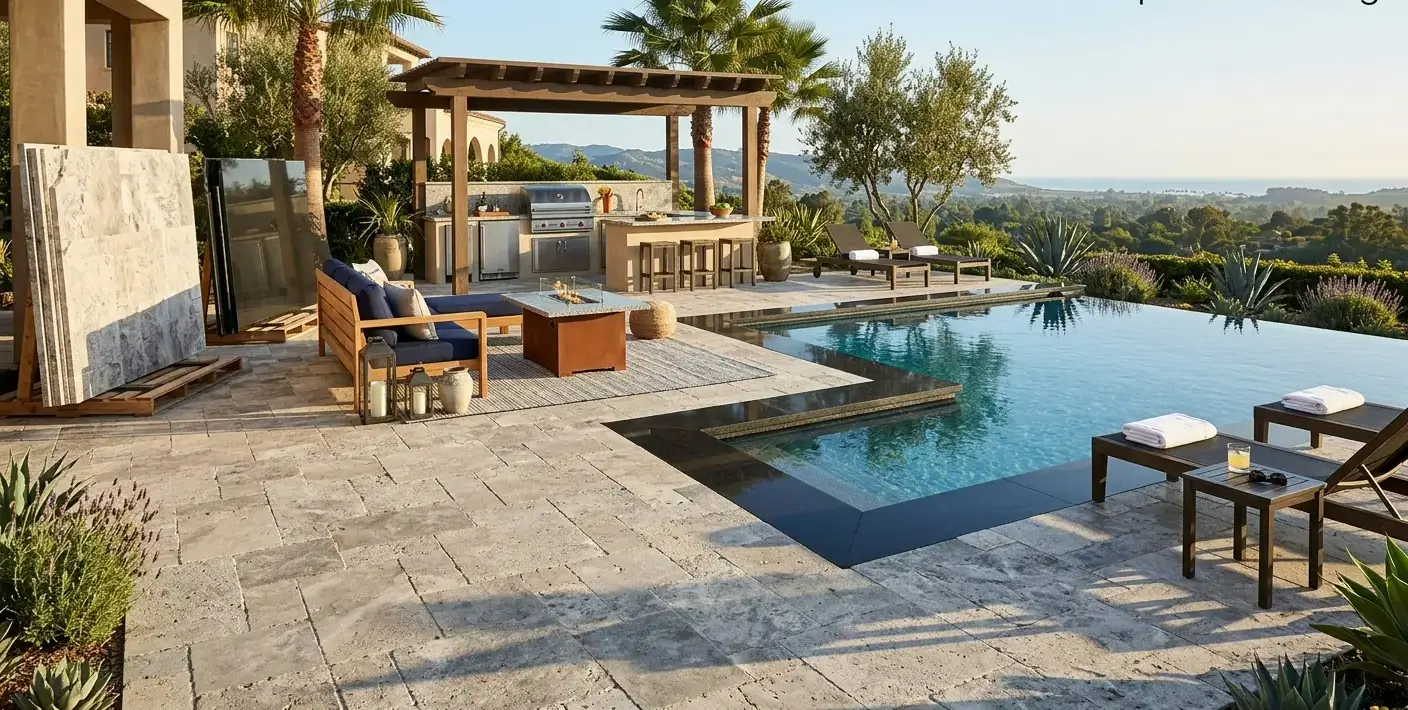
Why a 0.62 Friction Score Can Still Miss the Mark
DCOF stands for dynamic coefficient of friction, a measure of how much force it takes to keep something sliding across a surface once it is already moving. The Tile Council of North America (TCNA) is direct about its limits: DCOF is not the same thing as slip resistance, and it does not predict whether a person will slip.
TCNA lists the variables a lab number cannot capture, including shoe soles, water and other contaminants, stride length, upkeep, and how liquids drain. On a pool deck, water and drainage are in play every time someone steps out of the pool.
Here is how that plays out on paper. Picture two porcelain paver spec sheets side by side: the first shows a wet DCOF of 0.62 and a classification of Interior Wet, while the second shows 0.56 and a classification of Exterior Wet.
The second one is the pool deck product, even with the lower number. Both numbers clear 0.55, the wet DCOF that a note in the standard says is generally expected for Exterior Wet surfaces, but only the second has been declared fit for an open, sunlit, splash-soaked deck.
You can check this yourself, since TCNA offers the full ANSI A326.3 standard as a free download. Table 1 ties only two of the five categories to a DCOF figure. For Exterior Wet, the standard offers an informative note rather than a pass or fail limit, and it states that no single DCOF limit is set for pool decks.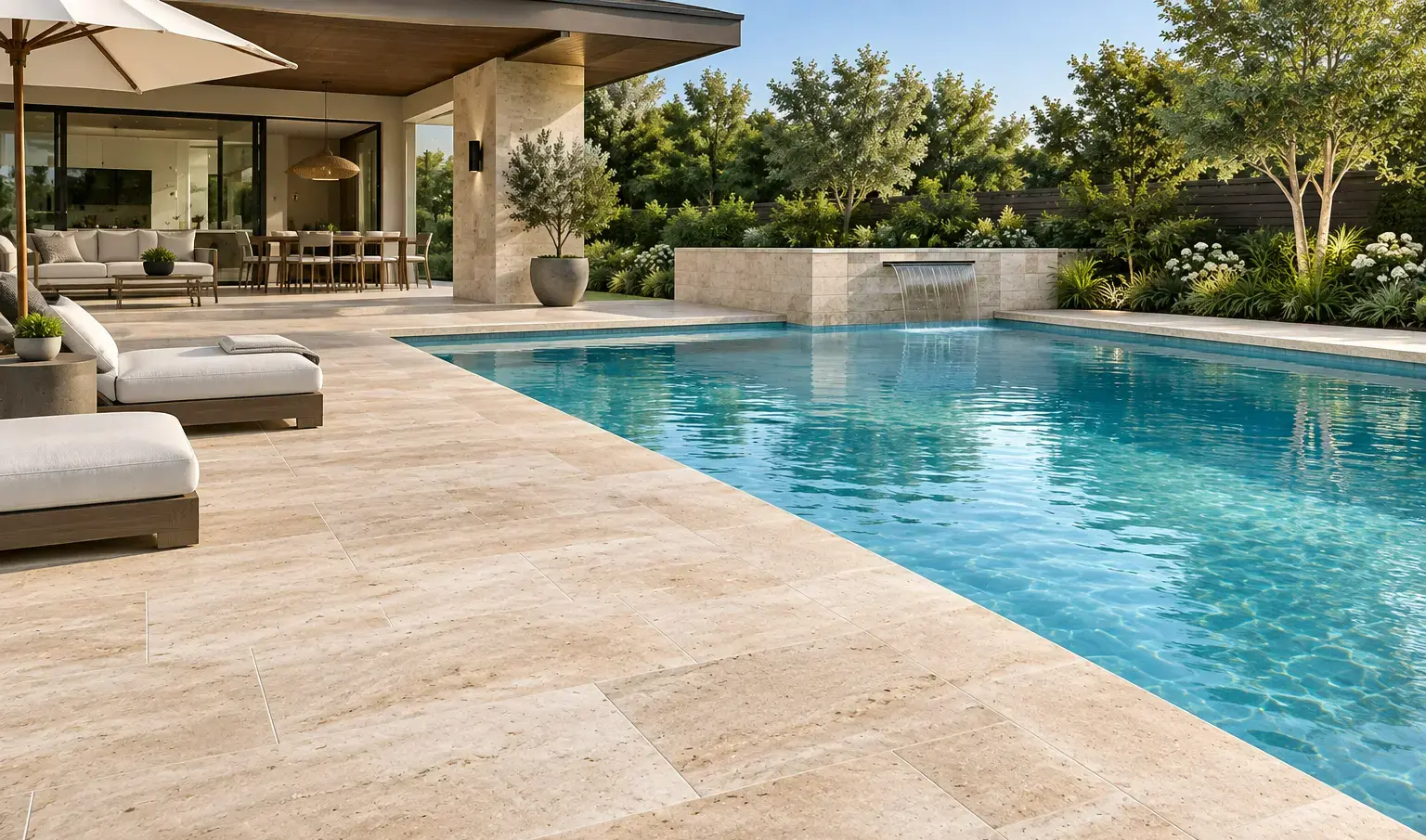
Where Exterior Wet Sits Among the Five Categories
ANSI A326.3 sorts hard surface flooring into five product use categories: Interior Dry, Interior Wet, Interior Wet Plus, Exterior Wet, and Oils/Greases. TCNA’s consumer site lists pool decks, walkways, patios, and sidewalks as typical Exterior Wet areas, which makes it the one label to look for on any open deck.
The category next to it is easy to confuse with it. Interior Wet Plus covers interior pool decks and covered exterior areas, so a surface rated for a shaded lanai is not automatically rated for the uncovered deck ten feet away.
Exterior Wet is also manufacturer-declared. The maker assigns it based on manufacturing parameters, internal quality control, and experience with similar surfaces, rather than a single lab score.
That is a reason to ask for the declaration, not a reason to distrust it. When you browse our full material selection for an outdoor project, ask which classification each candidate carries before the shortlist gets any shorter.
If a contractor or designer is helping you choose materials, ask one simple question about each product: is it rated Exterior Wet? Get the answer in writing on the quote or the product sheet, not just a friction number.
That small step protects you if a different product gets swapped in later. A replacement with an impressive number but the wrong rating is easy to spot on paper, and much harder to fix once your deck is finished.
Natural Stone and the Rating Question
Natural stone has its own history with friction testing. After the ASTM C1028 friction test was withdrawn in 2014, the stone industry had no established way to measure walking surface friction, so the Natural Stone Institute ran a study of 51 stone types, each tested in six finishes, to evaluate A326.3 for stone.
TCNA confirms that A326.3 is a hard surface flooring standard, not a ceramic-only one, so a natural stone product can carry a product use classification too. When a stone product shows a friction figure but no classification, ask for the classification before treating that figure as a pool deck approval.
Finish matters too. Our guide to natural stone for outdoor surfaces notes that honed and textured finishes tend to grip better in wet conditions than a highly polished one. In the Natural Stone Institute study, polished finishes fell short of the 0.42 wet benchmark on average in every stone type tested.
We would rule out polished stone for an open pool deck entirely, however striking it looks on a sample board. A polished finish belongs on a wall or a countertop, where nobody walks across it with wet feet.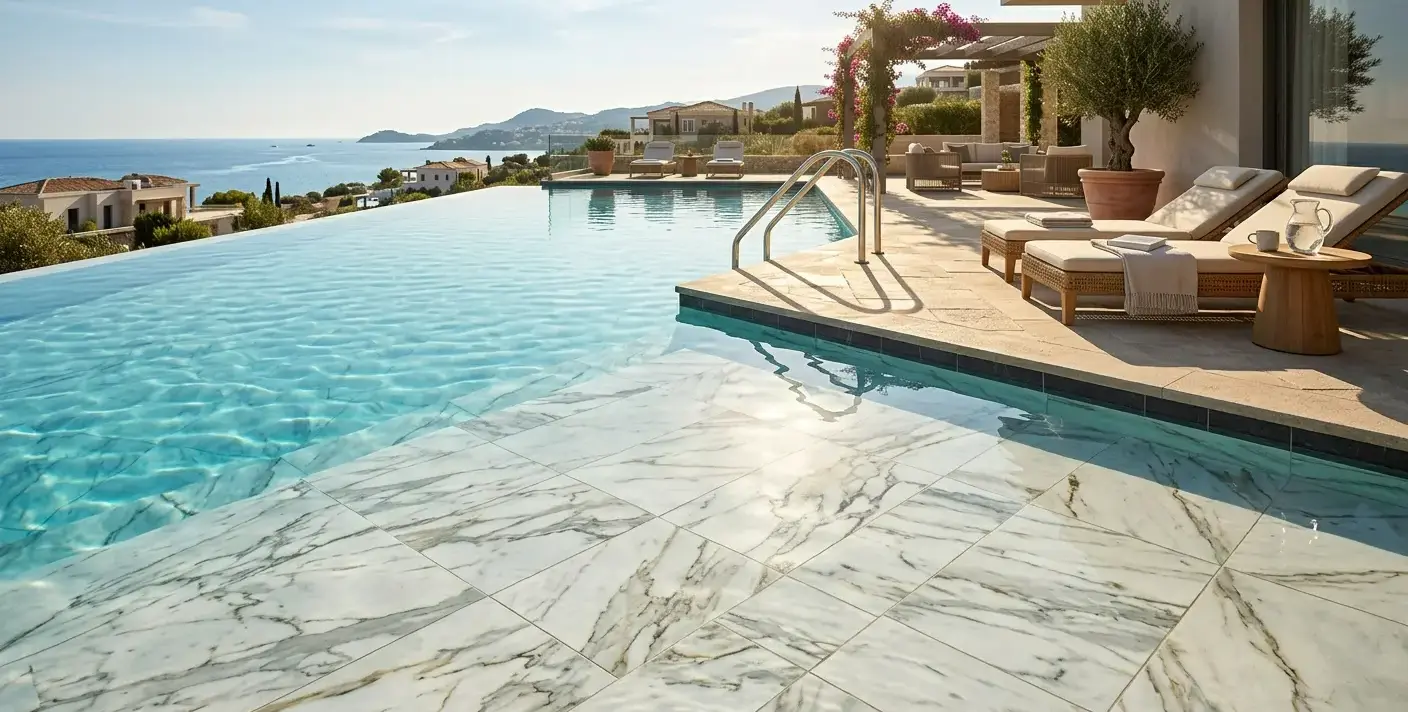
Matching Our Materials to a Wet, Sunny Deck
Granite, quartzite, travertine, and porcelain are all good fits for outdoor floors, and each is available in honed finishes as well as polished. For a pool deck, start the search at honed or textured finishes and leave polished for indoor walls.
Marble, dolomite, and quartz are not on our list for outdoor floors. Quartz is an indoor surface, and for a pool deck we point shoppers toward the four materials above rather than marble or dolomite.
Porcelain follows the same rule as stone. A porcelain paver with a travertine look or limestone look still needs its own declared classification, because the pattern on its face says nothing about the texture underfoot.
If an outdoor kitchen is part of the plan, granite is the stone to start with. It suits outdoor use and food preparation alike, though a cutting board is always recommended.
Browse our slab inventory to see the granite bundles on our floor, then request a quote on the slabs you shortlist when you are ready to compare options.
Three Things a Rating Does Not Cover
Even a correctly rated product has blind spots. The five categories are written for level surfaces, and TCNA confirms none of them addresses ramps or inclines, so pool steps and sloped transitions need their own review.
Drainage is the second gap. The International Swimming Pool and Spa Code, in use or adopted in 33 states plus Washington, D.C. and Puerto Rico, defines how deck drainage carries water away from the pool to prevent slip hazards.
That tells you the code treats standing water as a risk of its own, separate from the surface rating. The 2024 edition of the code also requires walking surfaces for decks, ramps, and coping to be slip resistant to the standards it indicates.
That edition references the 2017 version of A326.3, which predates the five categories. Ask your local building department which edition applies where you live and what it accepts.
The third gap is the sealer, which matters most for travertine, since our exterior stone overview groups it with the porous stones that call for periodic sealing outdoors. Under A326.3, flooring with a permanent surface coating, whether applied at the factory or after installation, should only be used in areas that can be kept dry unless the coating’s manufacturer declares otherwise. If your deck will get a sealer that forms a coating on the surface, ask whether that product is declared for wet exterior use.
Write down all three gaps and bring them to your showroom visit or design consultation, so each one gets an answer before anything is ordered.
Conclusion
A classification tells you what the manufacturer stands behind, and your own hand tells you the rest. Wet a honed sample and a polished one of the same stone, then compare the two by hand.
At Nova Tile and Stone, our showrooms in Reno, Sacramento, Minden, and Fernley carry pavers and exterior stone, including pool coping, so you can compare finishes side by side. Visit one of our four showrooms with your spec sheet questions written down, and ask to see each product’s declared classification.
If you would rather plan it with a specialist, book a free design consultation and bring your deck measurements and photos. You can take tile samples home and wet them on your own patio before a single order is placed.
Bring the three details that change the answer: whether the deck is covered, how much of it sits in the splash zone, and whether steps or slopes are part of the layout. Those facts decide whether you are shopping for Exterior Wet, Interior Wet Plus, or a separate review of the inclined areas.
Note: Some images on this page may be conceptual renderings created to illustrate design possibilities and may not depict actual installations.
Frequently Asked Questions
There is no pass or fail number for pool decks in ANSI A326.3, but a note in the standard says Exterior Wet surfaces are generally expected to reach at least 0.55 wet DCOF. The manufacturer’s Exterior Wet declaration is still what confirms a product for an open deck.
Not for an uncovered deck. Interior Wet Plus covers interior pool decks and covered exterior areas, while Exterior Wet is the category intended for open pool decks, patios, and walkways.
Yes. A326.3 is a hard surface flooring standard rather than a ceramic-only one, so natural stone products can carry a product use classification. If a stone product does not list one, ask for it before choosing it for a pool deck.
It can. Under A326.3, flooring with a permanent surface coating should only be used in areas that can be kept dry unless the coating’s manufacturer declares otherwise, so if a sealer forms a coating on the surface, confirm that product is declared for wet exterior use.
Honed and textured finishes tend to give more grip when wet than a highly polished surface. Granite, quartzite, travertine, and porcelain are good fits for outdoor floors, but each product’s declared classification should still be confirmed.