A strong patio design with pavers comes down to three decisions: the stone, the layout pattern, and how far that stone carries beyond the ground. Our recommendation is to build around one natural stone, such as quartzite or travertine pavers, and repeat it on walls, coping, and even the outdoor counter instead of mixing several materials.
For Northern Nevada and Sacramento yards, climate narrows the choice fast. Quartzite absorbs very little moisture, which makes it the stronger fit for uncovered patios that see freeze-thaw cycles, while travertine suits covered areas and milder climates like Sacramento's.
From there, the layout adds movement: French pattern for travertine pool decks, running bond for large-format quartzite, and herringbone as an accent zone. A quartzite or granite slab then finishes the outdoor kitchen, so a quartzite patio can carry straight onto the counter.
Why One Stone Beats a Mixed Palette Outdoors
Popular idea roundups, like this list of paver patio layout ideas, push mixed colors and textures for drama. We think that advice works better indoors, where lighting is controlled. A backyard in Reno or Sacramento gets hard midday sun that flattens contrast, so three competing tones often blur into one muddy field by noon.
One stone used in several formats gives you variety without that noise. Picture large-format quartzite pavers on the main terrace, the same quartzite cladding a seat wall and topping the outdoor counter, and coping in a matching stone along the water. The eye reads one material at different scales, which makes even a small yard feel planned.
There is a practical payoff too. When a single stone covers the patio, walls, and edges, you learn one care routine and one sealing schedule instead of juggling several.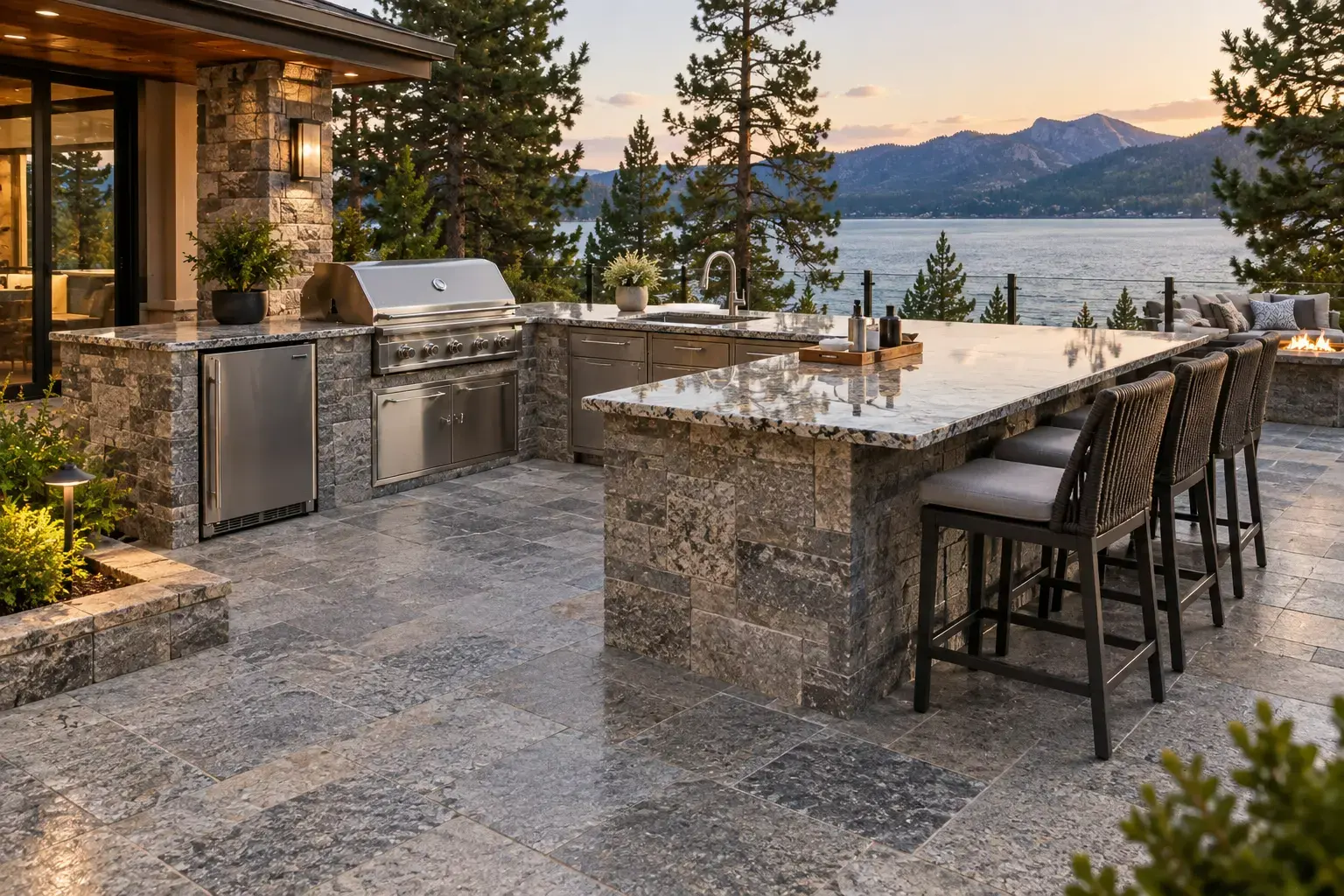
Quartzite, Travertine, or Granite: Picking Your Stone
This guide focuses on three of our outdoor natural stones, and each plays a different role. Quartzite works underfoot and on the counter, travertine stays underfoot, and granite earns its place on walls and counters. Our overview of natural stone for exterior design explains how each one forms.
Quartzite suits a bright, contemporary yard. Formed from sandstone under heat and pressure, it is a good fit for exterior applications from pavers to wall cladding. It also comes in full slabs, which is what lets one stone run from the terrace to the countertop.
Travertine is our choice for a relaxed, resort-style pool deck in a milder climate like Sacramento's. It also works well for walkways, pool surrounds, and column wraps. Its natural pores take in more water than quartzite does, so plan on periodic sealing.
Granite is the low-maintenance pick for the vertical layer and the counter. Its dense, crystalline structure suits garden walls, entry surrounds, and outdoor kitchens. Granite holds its color well in strong sun, though that varies by color and finish, so look at the actual stone in full sun before committing.
Match the Stone to Your Climate First
Freeze-thaw cycles decide more patio outcomes than color does. In Reno, Minden, and Fernley, winter nights drop below freezing while afternoons warm up, so any water held inside a paver expands and contracts again and again.
Dense stones like quartzite and granite absorb very little moisture, which is why we steer high-desert homeowners toward quartzite for open, uncovered patios and pool decks. Travertine is a better match for a covered patio or a milder Sacramento yard, since sealing does not make an unsuitable stone frost resistant.
Finish matters as much as material. A honed or textured surface gives more grip around a pool or a sprinkler-soaked path than a polished one. Outdoors, we recommend keeping polished finishes to vertical surfaces and counters, not the walking surface.
Layouts That Make a Single Stone Look Designed
One stone only feels intentional when the layout does real work. Pattern is where you add the movement a mixed palette would otherwise supply.
French pattern combines three or four rectangle and square sizes in a repeating module. It is our first suggestion for travertine pool decks, since the varied sizes disguise the natural tone shifts from paver to paver.
Running bond sets same-size rectangles in offset rows, like brickwork. It suits large-format quartzite on a modern terrace, where fewer joints keep the surface calm and the long lines point the eye toward the view.
Herringbone sets rectangles in a zigzag, and it works best as a marker rather than a whole field. Use it for a fire pit circle or an entry landing inside a running bond terrace. Ashlar, a random mix of rectangles with offset joints, gives quartzite or travertine a quieter, old-world look along garden paths.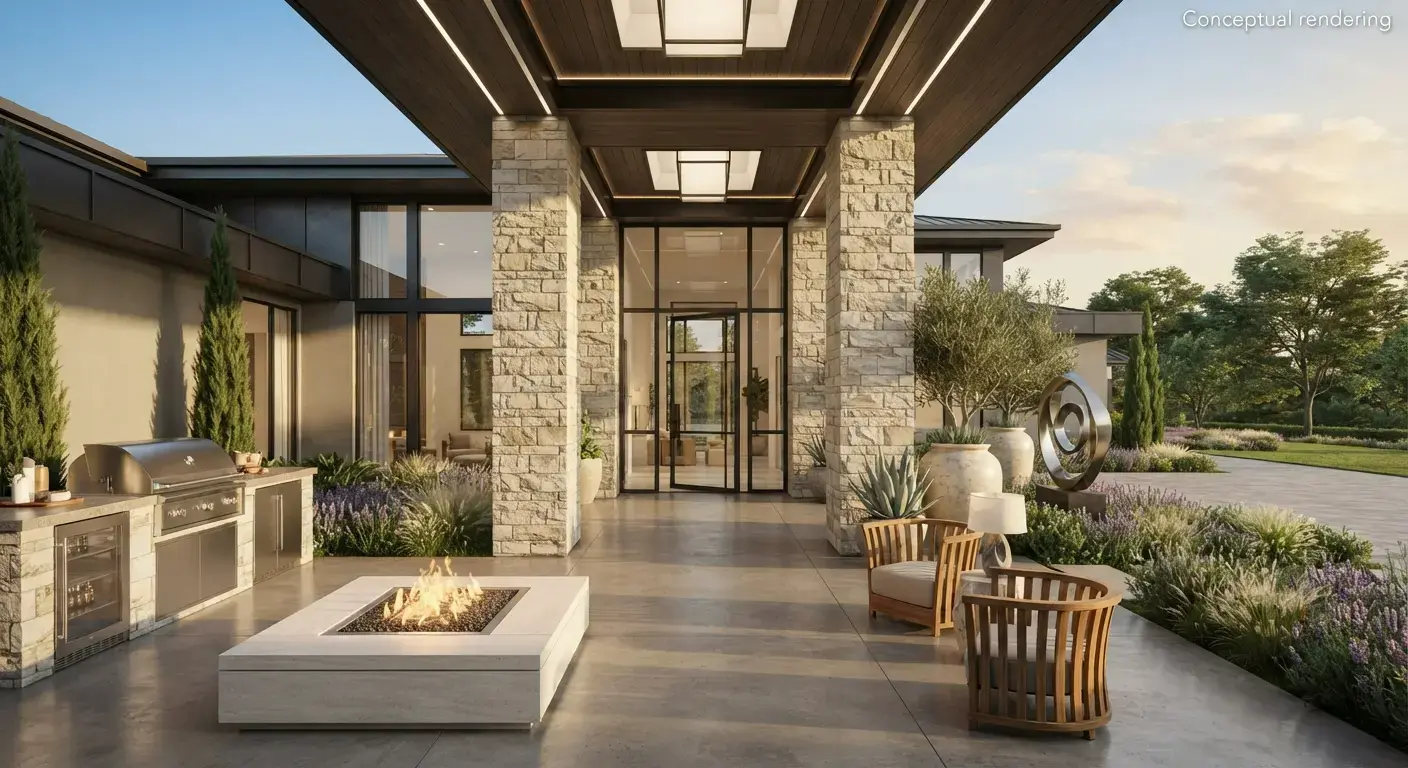
Carry the Stone Up: Walls, Coping, and Entrances
The ground plane is only half the patio. Stacked stone on a seat wall, a planter, or an outdoor fireplace creates the vertical layer, and when it coordinates with the pavers, the yard reads as one outdoor room.
Thin stone veneer, cut to roughly three-quarters of an inch to an inch and a half, is a common choice for these walls. It adds real stone to an existing structure and generally skips the added footings or reinforcement that full-depth cladding requires. Our guide to exterior stone for walls and entrances compares the two formats side by side.
Pool coping is the detail most homeowners leave until last, and it shows. Ask for coping in the same stone as the deck and select both together. Edges chip more easily than flat surfaces, so give the coping profile as much thought as the color.
Where a Matching Slab Finishes the Space
An outdoor kitchen or bar turns a patio into the room people actually use. Granite and quartzite both make strong outdoor counters. Travertine is better kept underfoot, since its pores and sensitivity to acids make it a poor match for food prep.
That choice keeps the one-stone idea intact: a quartzite patio can carry straight onto a quartzite counter. With travertine pavers, pick a granite or quartzite slab whose tone echoes the ground. Either way, use a cutting board for prep and set hot grill tools on a trivet rather than directly on the stone.
Natural stone varies from bundle to bundle, so choosing from photos of the actual slab matters. Our live slab inventory shows every bundle on our floors, photographed and updated weekly.
When you spot a bundle that pairs with your pavers, request a slab quote and note the bundle number. Reserved slabs are held for three days while you bring your fabricator in to see them.
The Carbon Numbers Behind Stone Underfoot
If sustainability shapes your decision, natural stone has third-party figures behind it. Industry-wide environmental product declarations for natural stone put natural stone flooring and paving at 22 kg of CO2e per square meter, against 82.2 kg for terrazzo, a common manufactured flooring.
The gap is wide on vertical surfaces too: natural stone cladding comes in at 21.4 kg per square meter, compared with 62.3 kg for precast concrete cladding. The comparison gives you a fair yardstick when a designer on your project tracks embodied carbon.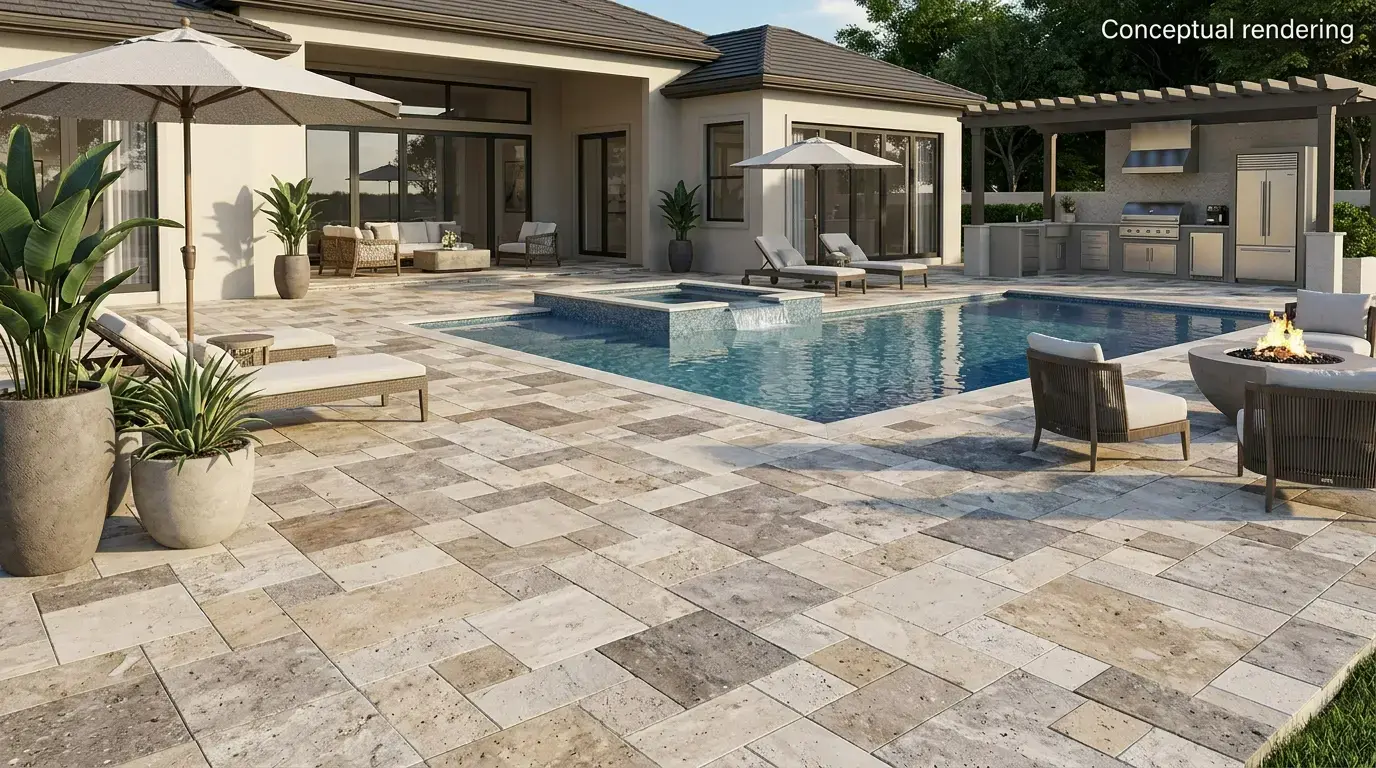
Keeping One Stone Looking Like One Stone
A single-stone patio stays cohesive only if every surface ages at the same pace, so plan care for pavers, walls, coping, and counters together. Rinse the whole area periodically, clean with a mild pH-neutral product, and skip acidic cleaners, which can dull calcareous stone like travertine. The Natural Stone Institute's care guidance explains which products suit siliceous stones such as granite and quartzite and which suit calcareous ones.
Reseal travertine on a schedule set by your exposure, and give quartzite and granite a quick water-bead check each spring. Stone that skips a season of care shows it, and a patio sealed in patches will weather unevenly.
Conclusion
Stone color shifts noticeably between direct sun and shade, so seeing the material at full scale beats any screen. Visit one of our four showrooms in Reno, Sacramento, Minden, or Fernley to see quartzite, travertine, and granite finishes and colors in person.
Bring yard photos and rough measurements, then book a free design consultation so a commission-free specialist can match pavers, walls, and slab surfaces before you commit. Nova Tile and Stone has helped homeowners plan with natural stone since 2005, and you can browse the full range of surfaces we carry before your visit.
Note: Some images on this page may be conceptual renderings created to illustrate design possibilities and may not depict actual installations.
Frequently Asked Questions
Quartzite is the strongest fit for uncovered patios that see freeze-thaw cycles, because it absorbs very little moisture. Travertine is a better match for covered or milder settings, since sealing does not make an unsuitable stone frost resistant.
Yes, and matching the two is one of the simplest ways to make a pool area look planned. Ask for coping in the same stone as the deck, and give the edge profile as much thought as the color, since edges chip more easily than flat surfaces.
French pattern suits travertine pool decks because its mixed sizes disguise natural tone variation, while running bond suits large-format quartzite on modern terraces. Herringbone works best as an accent zone inside a larger field.
Yes. Both make strong outdoor counters, so a quartzite patio can carry straight onto a quartzite counter. Use a cutting board for prep and set hot grill tools on a trivet rather than directly on the stone.
It depends on the stone. Porous travertine benefits from periodic sealing, while dense quartzite and granite need little more than routine cleaning with a mild, pH-neutral product, though a yearly water-bead check is still a good habit.