To style hardscape so it matches your home’s exterior, take its color, tone, and finish from the house itself. Match the paving’s undertone to the roof and siding, echo or contrast any stone already on the walls, and choose a honed or textured finish that suits the texture of the facade.
Under a gray roof, gray granite or a cool-toned quartzite usually fits best, while warm travertine suits a brown or terracotta roof. Our exterior stone guide notes that a partial facade, with stone across the lower third of the walls, is one of the most requested applications we see, so many homes already carry stone the patio has to answer to.
Granite, quartzite, travertine, and porcelain pavers made for exterior use all suit outdoor paving, so durability is the easy part. Matching color and finish to the house is what makes a patio or walkway read as part of the home instead of an add-on.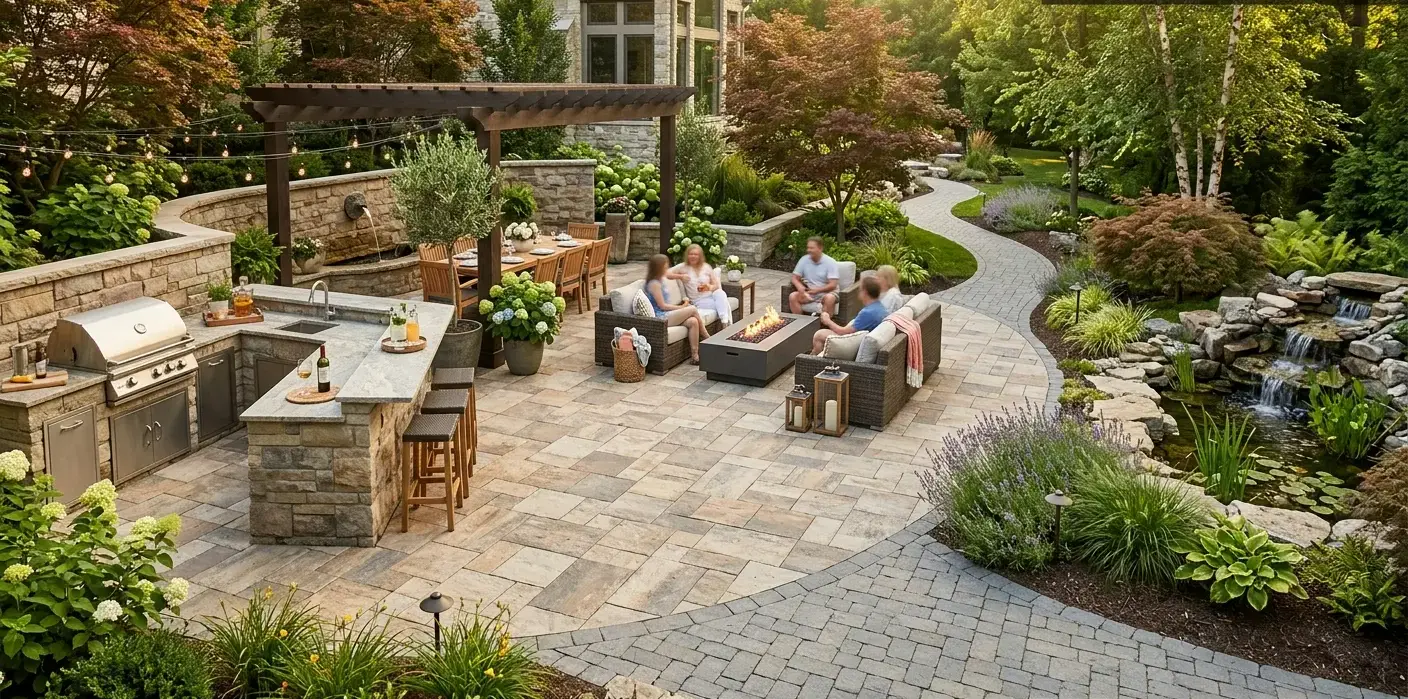
Let the Roof Set Your Hardscape Palette
The roof is the first surface to read. It is one of the largest blocks of color you see from the street, so it sets the starting point for every other color choice, including the paving. Name the roof’s undertone before you look at a single paver, because everything below it should agree with that lean.
Exterior design firm brick&batten puts it plainly in its guide to exterior grays: a cool, blue-leaning gray beside a red or brown roof makes a house look disjointed, and a warmer gray works better. The same logic runs the other way, so a gray or charcoal roof calls for cooler neutrals. Sort your roof into one of those two camps, then set aside every stone that leans the other way.
When you browse our live slab inventory, keep a photo of your roof open on your phone. A stone that fights the roof will keep fighting it, because the roof isn’t the part that’s changing.
Read the Undertone in Your Siding or Stucco
Beige stucco and gray siding are rarely as neutral as they look. Sherwin-Williams’ guide to paint undertones sorts it simply: warm colors carry orange, yellow, or red undertones, while cool colors carry blue, green, or purple. Hold any neutral next to a pure white and that hidden lean shows up fast.
The paving should share the siding’s undertone even when it doesn’t share its color. Stucco with a pink or golden cast suits travertine, whose natural tones run from white to tan and cream. Blue-gray or charcoal siding suits gray granite or a cool quartzite instead.
Crossing the two is the mistake to avoid: a cool gray paver laid against warm tan stucco reads slightly dirty next to the wall, even when both colors look fine on their own. Our natural stone exterior guide explains how granite, quartzite, and travertine differ beyond color, which helps once the undertone narrows the list.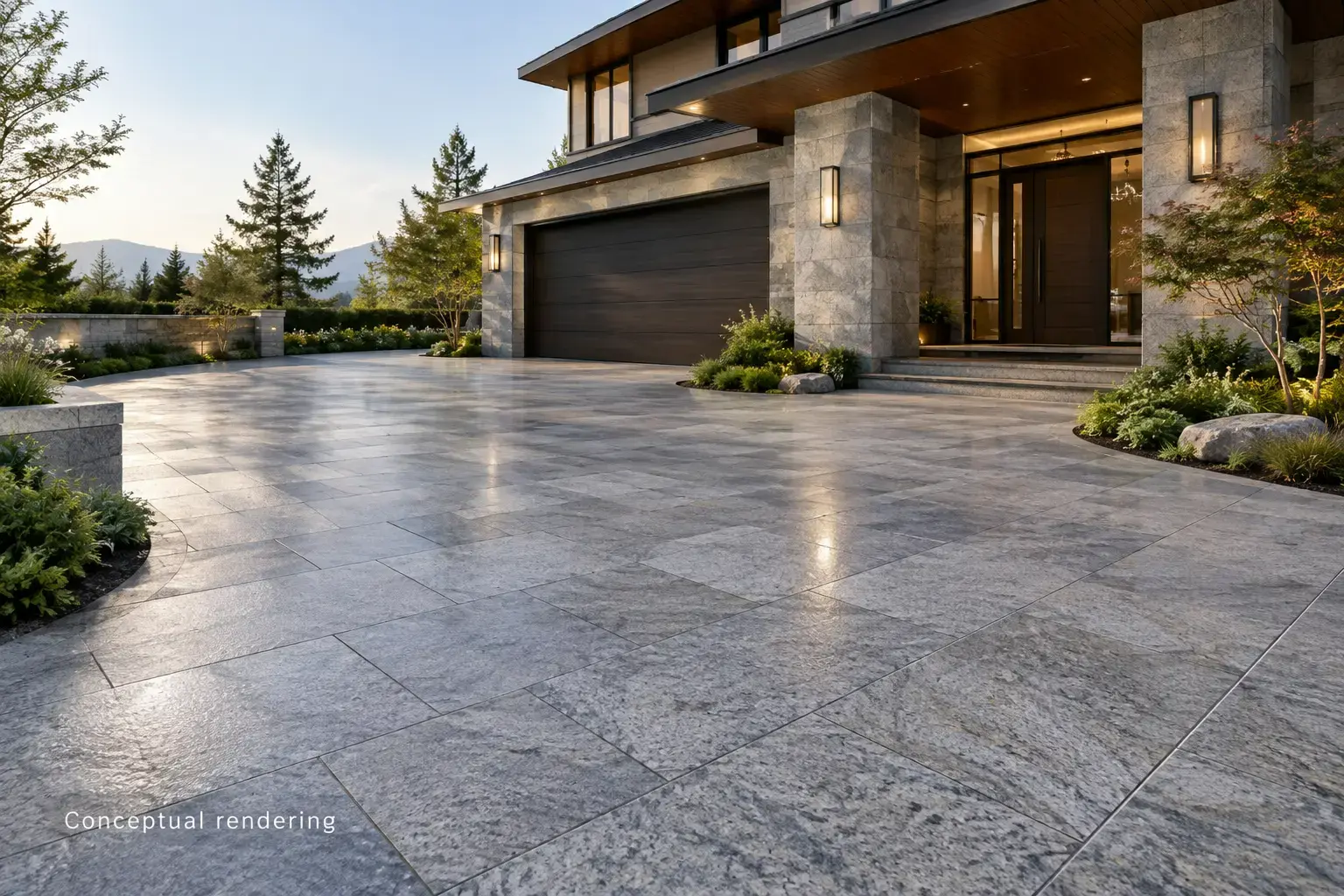
When the House Already Has Stone on It
If your home already wears stone on a wainscot, a column, or an entry wall, that stone outranks everything at ground level. Paint EZ’s guide to coordinating with brick and stone points out that a single stone facade can mix cream, gray, gold, brown, charcoal, and even muted green, so pick out the two or three colors that repeat most before choosing any paving.
From there, choose echo or contrast and commit to it. An echo is a warm travertine patio below a gold-cast wall stone; a contrast is a dark granite walkway beneath pale quartzite. A near-match sits in between and looks like a failed attempt at the real thing.
The same guide notes that when stone covers a large part of the facade, a quieter color beside it keeps the exterior balanced. At ground level, a rough, multi-tone stacked stone wall pairs better with calm, even-toned paving than with a heavily veined slab. Our natural stone selection is easier to narrow once you know which of the two roles your paving plays.
Let the Facade’s Texture Pick the Finish
Polished stone belongs on vertical accents, not underfoot. In a Natural Stone Institute friction testing study, polished finishes did not meet the 0.42 wet traction benchmark for level interior floors as an average in any stone type, and the same report notes that exterior paving is nearly always supplied in textured finishes.
That leaves honed or textured, and the wall decides between them. Smooth stucco, painted lap siding, and clean modern lines call for honed, which reads quiet and flat. Rough wall stone, board-and-batten, or heavy timber details suit a textured surface, such as leathered granite or quartzite, or brushed or tumbled travertine, which repeats what the facade is already doing.
Granite, quartzite, travertine, and exterior-rated porcelain pavers are all a good fit for hardscape paving, but each one should be evaluated for its spot. Seeing the finishes in person during a free design consultation makes the choice easier than any photo.
Travertine needs the most care in Reno, Minden, and Fernley, where winters bring repeated freeze-thaw cycles, while Sacramento’s milder winters are far more forgiving. Porous stone can crack when water gets in and freezes, and our natural stone exterior guide notes that sealing limits absorption but does not make an unsuitable stone frost resistant. Choose a dense travertine made for exterior paving, plan for good drainage, and keep up with sealing and mild, pH-neutral cleaners.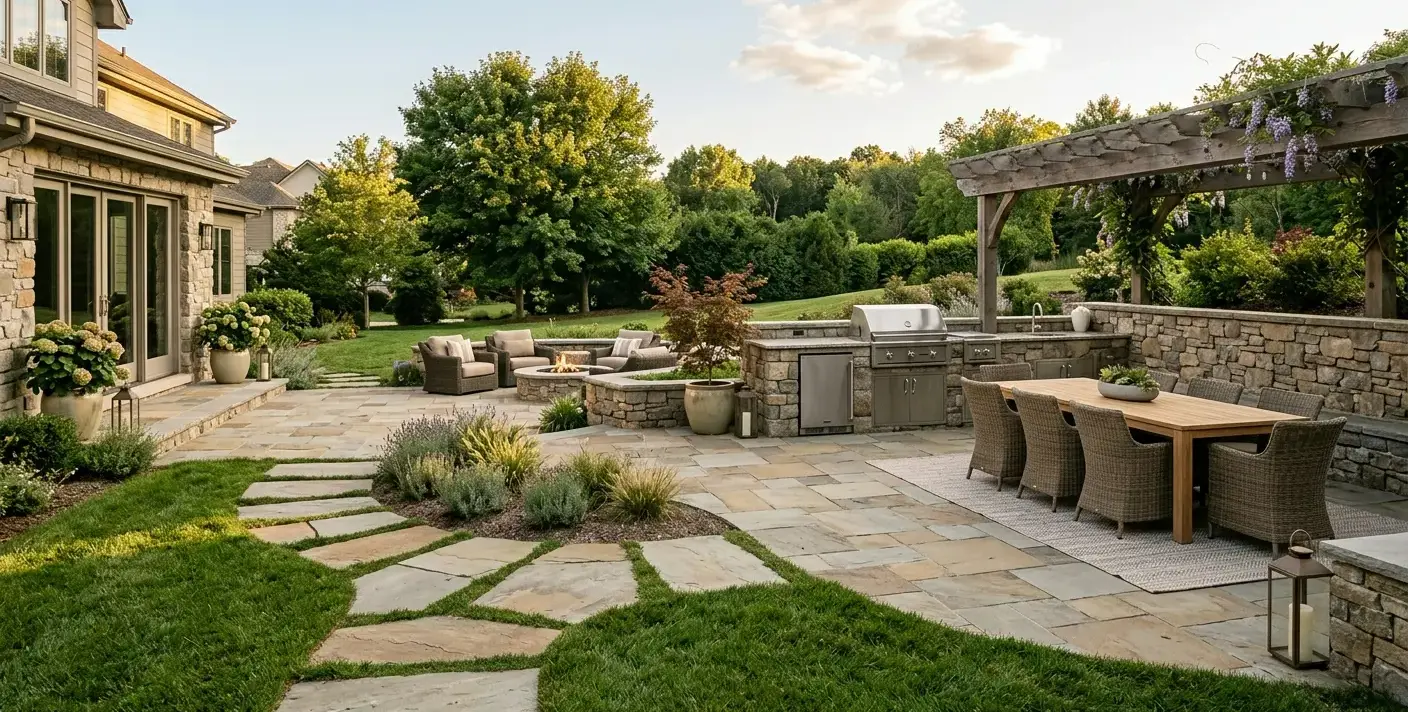
Use One Stone Family From Wall to Walkway
The most cohesive exteriors treat the facade and the ground as a single material decision. At the Archangel Estate, a 6,300-square-foot home in Brookline, Massachusetts, native Puddingstone and fieldstone were used for both the facade and the hardscape, with Deer Isle granite as the cap stone.
The project’s design team insisted on mock-ups of every exterior section before work began, and they named mortar color as one of the details that mattered most. On a patio, the joints between pavers play that role: light joints look crisp beside white trim, while darker joints sit better under a charcoal roof.
Most homes won’t repeat a single stone everywhere, and they don’t need to. Keep the front walk and the back patio in the same stone family, and see the stone in person before committing. Granite Gold’s article on why to see natural stone before buying notes that every slab differs in color, pattern, and graining, and one color can dominate in photos while another shows in natural light.
Exterior-rated porcelain pavers make this easier when one natural stone can’t cover every area. Their travertine, limestone, and concrete looks let a porcelain side-yard path stay in the same color family as a travertine entry.
Conclusion
A stone that looks right under showroom lights can shift once it sits beside your walls. The direction of the light changes how a color reads, so a patio on the north side of a home can look cooler than the same stone at a sunny front entry. Check the stone wet as well as dry, too, since a quick rinse shows how the color deepens after rain or sprinklers.
Test the match where the hardscape will actually go. Walk the slab bundles at one of our four showrooms with photos of your roof, trim, and siding on your phone, and compare each stone against them side by side. Then picture that stone in your own light: a bundle that already leans cool in the showroom will lean cooler still on a shaded north-side patio.
Once a bundle fits, you can reserve slabs from our live inventory, and Nova Tile and Stone will hold them for 3 days. When you’re ready, request a quote and note the bundle number you liked so the stone you approved is the stone you bring home.
Note: Some images on this page may be conceptual renderings created to illustrate design possibilities and may not depict actual installations.
Frequently Asked Questions
A gray roof generally pairs best with cool neutrals, so gray granite, a cool-toned quartzite, or a gray porcelain paver made for exterior use tends to sit comfortably beneath it. Check the roof’s undertone first, since some grays lean blue and others lean brown. If the roof leans warm, cream or tan paving can still work as long as it shares that lean.
No. An exact match is nearly impossible with natural stone, and a near-match tends to look like a mistake rather than a choice. Either echo the wall stone’s color cast with a related tone, or pick a clear contrast in lightness. When the wall stone is busy, keep the paving calmer and more even in tone.
Polished stone is better kept for vertical accents than for walking surfaces. Natural Stone Institute testing found that polished finishes, on average, fell short of the wet traction benchmark used for level indoor floors in every stone type tested. Honed and textured finishes are the more practical outdoor choices, though caution is still worthwhile on any wet surface.
Yes, travertine is a good fit for exterior paving, but installation must match the application. It has natural pores, so sealing and periodic resealing help limit moisture absorption, and mild, non-acidic cleaners are recommended. In freeze-thaw areas like Reno, Minden, and Fernley, choose a dense travertine made for exterior use and plan for good drainage.
Bring photos of your roof, trim, and siding to a showroom and compare them against the actual slab bundles in person. Then think about your own light, since the same stone reads cooler in shade and warmer in direct sun. If a bundle fits, you can reserve slabs from our live inventory, and we hold them for 3 days.