At a Glance
- Granite, quartzite, travertine, and porcelain belong outside.
- Keep marble, dolomite, and engineered quartz indoors.
- Acid rain wears down marble and dolomite, and sun can yellow quartz.
- Covered patios and outdoor fireplaces still count as outside.
- For an outdoor kitchen that matches the inside, match the color, not the material.
- Granite is the top pick for outdoor kitchen counters.
- Travertine needs sealing, good drainage, and a textured finish outdoors.
- Before choosing, check the outdoor rating, water absorption, sun exposure, and food prep use.
In This Post
- Why the Outdoors Is Harder on Stone Than Any Kitchen
- Marble and Dolomite: Beautiful Indoors, Vulnerable to Rain
- Quartz Belongs Inside, Even When the Outdoor Kitchen Matches
- Covered Patios and Outdoor Fireplaces Still Count as Outside
- The Stones That Do Belong Outside
- Four Questions to Ask Before Any Stone Goes Outside
- Bring the Location, Not Just the Look
- Conclusion
- Frequently Asked Questions
To choose exterior stone, start with four checks: whether the stone is rated for outdoor use, how much water it absorbs, how much sun it will get, and whether food will be prepared on it. Granite, quartzite, travertine, and porcelain are suited to outdoor use, while marble, dolomite, and engineered quartz are best kept indoors.
The choice matters because outdoor stone faces rain, freezing nights, and strong high-desert sun for years. A stone that looks perfect in a kitchen can wear badly outside, especially when an indoor favorite like a quartz island or a marble entry is carried out to an outdoor kitchen or covered patio.
At Nova Tile and Stone, we’d rather catch that at the planning stage than after the first summer. This guide explains why each indoor stone struggles outdoors, which stones to choose instead, and how to check any stone before it goes outside.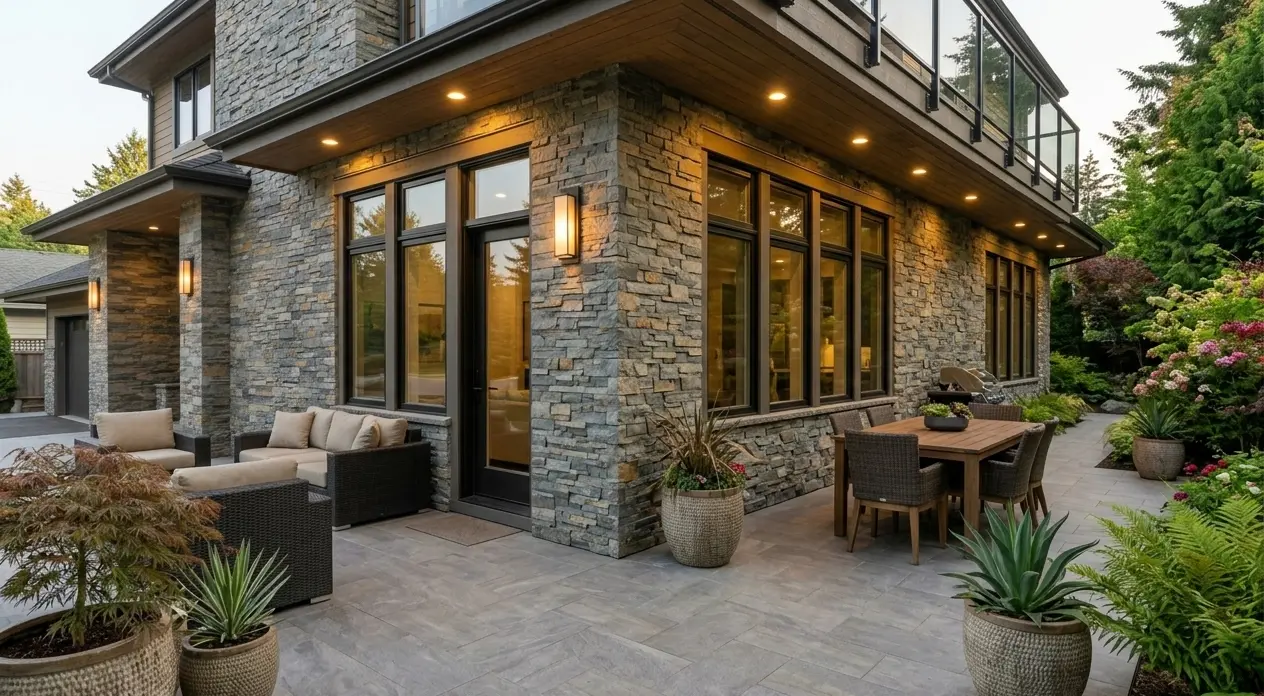
Why the Outdoors Is Harder on Stone Than Any Kitchen
An indoor countertop deals with spills and hot pans. An outdoor surface deals with rain, freezing nights, and direct sun for years, and each of those finds a different weak point.
Start with water. A Construction Canada article on selecting exterior stone explains that the lower a stone’s water absorption, the better its frost resistance, stain resistance, and strength, and that stone absorbing 3 percent or less is generally considered frost resistant.
Sun matters more at elevation. The World Health Organization’s guide to ultraviolet radiation notes that UV levels rise about 10 percent for every 1,000 meters of altitude. Reno sits roughly 1,400 meters up, so an outdoor kitchen in Reno gets about 14 percent more UV than the same kitchen at sea level.
Then there is chemistry, which few buyers think about. Rain picks up acids from air pollution, and some stones react with them.
Marble and Dolomite: Beautiful Indoors, Vulnerable to Rain
Marble’s problem outdoors is its chemistry. The U.S. Geological Survey explains that acids in polluted rain dissolve the calcite in marble and limestone, leaving roughened surfaces and worn carving details on exposed stone.
Dolomite is also a carbonate stone, and it sits in the same indoor group on our material list. Both are a good fit for indoor floors, walls, and fireplaces, where their polished and honed surfaces stay out of the weather.
Quartz Belongs Inside, Even When the Outdoor Kitchen Matches
Engineered quartz is one of the most practical indoor countertops, which is exactly why homeowners want it outside too. The weak point is the resin that binds the stone. In an interview with Hunker on quartz versus marble countertops, designer Lauren Lerner notes that UV rays can yellow or fade a quartz surface over time.
Most indoor counters get little direct sun, so the change is slow or never shows. An uncovered outdoor kitchen in the high desert puts the same surface in full sun for months every year.
So when the plan calls for an outdoor kitchen that matches the island inside, we match the color, not the material. Choose a granite in a similar tone for the counters, and keep the quartz indoors. Porcelain can carry the look onto the outdoor kitchen’s floor or back wall.
Covered Patios and Outdoor Fireplaces Still Count as Outside
The most common gray zone is a space with a roof: a covered patio, a loggia, or an outdoor fireplace under a pergola. A roof keeps rain off, so it feels safe to bring an indoor stone out.
A roof helps less than people expect. The same USGS page notes that sheltered areas of marble buildings develop blackened gypsum crusts that can peel away from the stone beneath, and a covered space still sees the same freezing nights as the open yard.
Sun reaches under a roof too. The WHO guide notes that fresh snow can reflect as much as 80 percent of UV radiation, so in a Reno or Minden winter, UV can bounce off a snowy yard into covered spaces that never get direct sun.
Fireplaces are where this catches people most often. Marble and dolomite are a good fit for an indoor fireplace surround, but an outdoor fireplace is an outdoor surface first. For one under a pergola, choose granite, quartzite, travertine, or porcelain.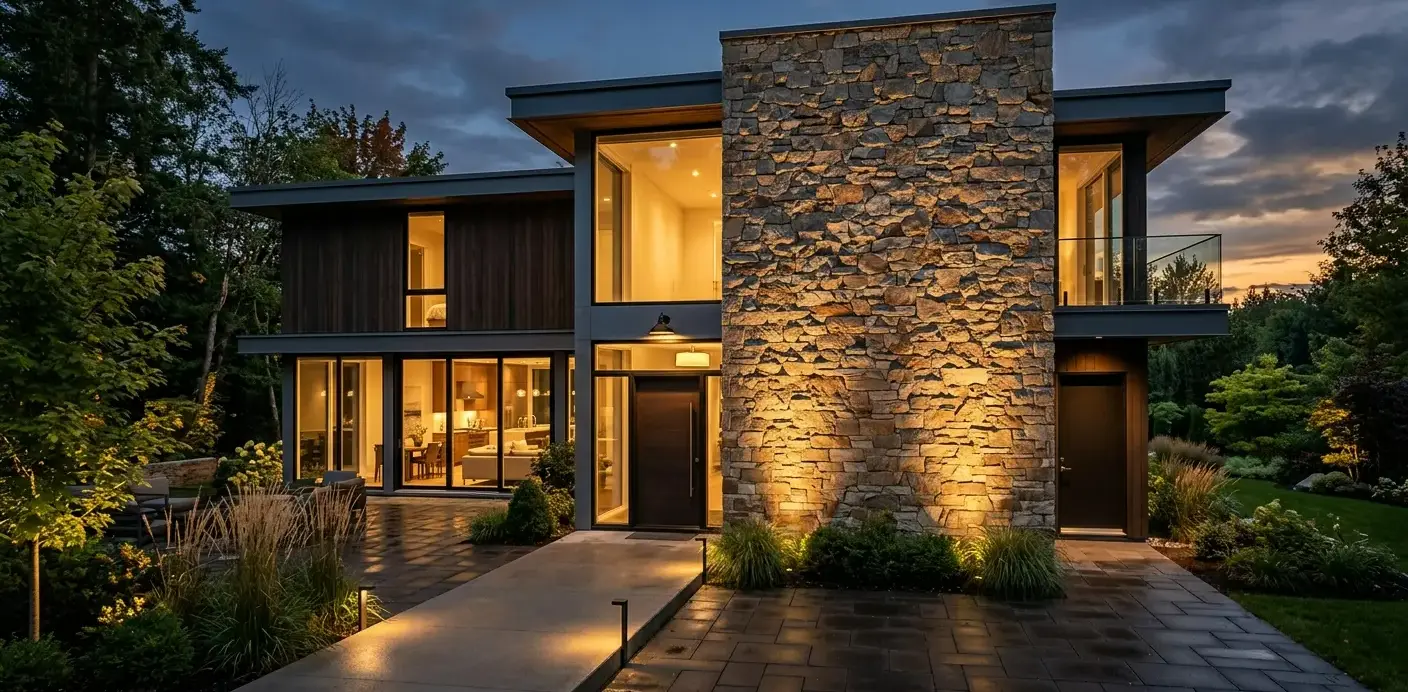
The Stones That Do Belong Outside
Granite is the most complete outdoor stone we carry. It is a good fit for outdoor walls, floors, and fireplaces, and of the stones on our outdoor list, it is the one we recommend for food prep surfaces. It handles food prep well, though a cutting board is still the better habit.
That makes granite our first suggestion for outdoor kitchen counters. It resists UV fading, though how well depends on the color and finish, so look at the exact slab you plan to use in daylight. Construction Canada notes that granite for exterior walls should absorb no more than 0.40 percent of water under ASTM standards.
Quartzite is a strong match for walls and cladding. Our page on quartzite wall cladding covers how it performs on facades, columns, and entry walls.
Travertine works outside with more care. It is a carbonate stone like marble, so acid can etch it too, but it is usually chosen outdoors in honed, brushed, or tumbled finishes, where light etching tends to show less than on polished marble.
Its natural pores are the bigger concern. Outside, travertine needs a sealer, good drainage, and a textured finish on any surface people walk on, as our guide to natural stone for exteriors explains.
Porcelain has a water limit built into its definition. Under ANSI A137.1, a tile counts as porcelain only if it absorbs 0.5 percent of water or less, as the American National Standards Institute explains in its guide to porcelain tile standards. That low absorption makes it a good fit for outdoor floors and walls where winters freeze.
Four Questions to Ask Before Any Stone Goes Outside
Before choosing an exterior stone, run it through four questions. Each one rules out a mistake that is expensive to undo.
First, is the stone on the outdoor list at all? Marble, dolomite, and quartz are not, however good the slab looks.
Second, how much water does it absorb? Lower absorption generally means better frost resistance, which matters wherever winter nights drop below freezing.
Third, will it sit in full sun? Sun rules out resin-bound materials and makes color and finish worth checking on the actual slab.
Fourth, will food touch it? If yes, the counter needs a stone suited to food prep, and on our outdoor list, granite is the one we recommend.
Our exterior stone guide covers climate, color, and upkeep in more depth once those four questions are answered.
Bring the Location, Not Just the Look
Photos of finished projects help with the look, but the more useful thing to bring to a stone appointment is a short description of where the stone will live. Note which direction it faces, whether it is covered, how cold the winters get, and whether food will be prepared on it.
With that in hand, a free design consultation goes straight to the stones that will hold up. You can browse our live slab inventory beforehand to shortlist colors, then request a slab quote once the pieces are measured.
Conclusion
The look of a stone is easy to judge in a showroom. How it handles rain, frost, and high-desert sun is harder to see, and it decides how the surface looks years from now.
If you are planning an outdoor kitchen, an entry wall, or a covered patio, start by ruling out the indoor stones, then choose from the ones built for the job. Our team at Nova Tile and Stone can help you compare them at any of our four showrooms in Reno, Minden, Sacramento, and Fernley.
Note: Some images on this page may be conceptual renderings created to illustrate design possibilities and may not depict actual installations.
Frequently Asked Questions
Of the stones we carry, granite, quartzite, travertine, and porcelain are suited to outdoor use. Marble, dolomite, and engineered quartz are best kept indoors, because rain, freezing temperatures, and direct sun are hard on them.
Marble is best kept indoors. The U.S. Geological Survey notes that acids in rain dissolve the calcite in marble, and even sheltered marble can develop crusts that peel away. Granite, quartzite, or porcelain are better choices outside.
Engineered quartz is an indoor material. Its resin binder can yellow or fade with sun exposure, so the counters of a matching outdoor kitchen are better made from granite in a similar color.
Granite is our first recommendation, because it suits outdoor use and handles food prep. It is UV resistant, but performance may vary by color and finish, and a cutting board is always recommended.
Yes. Porcelain absorbs 0.5 percent of water or less by definition, and lower absorption generally means better frost resistance. It suits outdoor floors and walls, though it is not a surface we recommend for food prep.