At a Glance
- Put stone on the lower third of the front wall and around the entry first.
- Granite is the top pick for exterior walls, with true quartzite a close second.
- Keep marble and dolomite indoors, since they etch in acidic rain.
- True quartzite scratches glass and doesn’t react to acid.
- In freezing winters, choose granite, quartzite, or frost-resistant porcelain.
- Use one stone in one finish, and match its undertone to the roof.
- Clean gently with a soft brush and a pH-neutral cleaner, and keep water off the base of the wall.
In This Post
- Where should stone go on the front of a house?
- Why does stone make a house look more expensive?
- What is the best natural stone for exterior walls?
- Which exterior stone holds up in Northern Nevada winters?
- How do you match exterior stone to your home’s style?
- How do you keep exterior stone looking new?
- Conclusion
- Frequently Asked Questions
Exterior stone makes a home look newer and more expensive when it goes where people look first: a band across the lower third of the front wall and a surround at the entry. Choose granite or true quartzite for walls that take the most weather, and judge the color in daylight before you commit. Our showrooms in Reno, Sacramento, Minden, and Fernley carry granite, quartzite, travertine, and porcelain for exterior projects.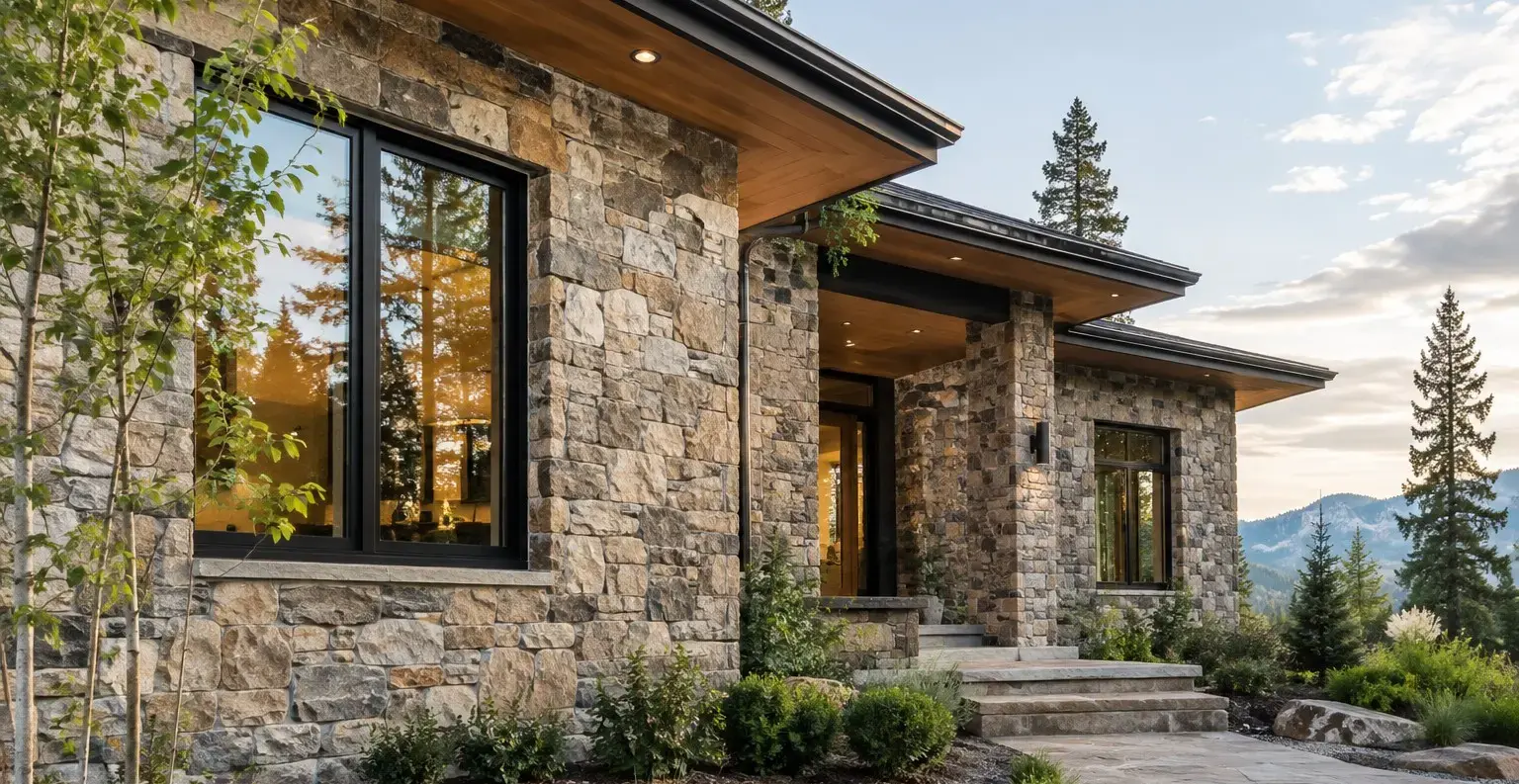
Where should stone go on the front of a house?
Our exterior stone guide lists a partial façade or wainscot on the lower third, below siding or stucco, as one of the most requested applications we see. That band puts stone at eye level from the street while the upper wall keeps its existing finish.
The entry is the second place to put stone. A surround framing the front door, or stone wrapped around porch columns, marks the spot every visitor walks toward, and we see doorway surrounds, porch posts, and column wraps among the most common exterior uses.
Smaller accents finish the street side. Chimneys, window surrounds, garden walls, and mailbox posts can repeat the same stone in small amounts, which ties the elevation together without covering the whole house. Granite at the band and the same granite on a mailbox post read as one plan rather than separate projects.
A full façade is the biggest commitment. Many homeowners we work with start with a smaller accent to test a stone’s color and texture before covering a larger area, and that order also keeps the look deliberate rather than heavy.
Begin with the band, add the entry surround or porch columns second, and stop there unless the architecture calls for more. That sequence puts stone where people actually look and keeps the house from reading as a stone box.
Why does stone make a house look more expensive?
Three signals make stone read as expensive from the sidewalk: shadow, variation, and reputation.
Shadow is the first signal. Paint and siding are flat, while every joint and corner in a stone wall casts a small shadow, and that texture is what separates a stone front from a painted one.
Thickness and edge detail decide how much of that shadow you get. Where a band wraps a corner or frames the entry, look at how the stone’s edge will read from the street before you choose.
Variation is the second signal. Each piece of quarried natural stone has its own tone, veining, and movement, so a natural stone wall shifts in color and pattern along its length.
Reputation is the third signal, and granite carries the most of it. Geology.com notes that granite is often chosen as a prestige material for an impression of elegance, durability, and lasting quality, and it lists building veneer among granite’s common uses.
What is the best natural stone for exterior walls?
Granite is our first choice for a street-facing wall, and true quartzite is a close second. Travertine suits homeowners who accept periodic sealing, porcelain is the engineered route, and we recommend keeping marble and dolomite indoors.
Stone | Best exterior uses | Freeze-thaw | Sealing |
Granite | Full façades, wall bands, high-exposure walls | Handles it well | Often little or none |
Quartzite (true) | Contemporary façades, slab entry walls | Handles it well | Varies by stone, ask |
Travertine | Traditional and Mediterranean homes, column wraps | Needs a freeze-thaw rated grade | Periodic sealing |
Porcelain | Granite, limestone, and slate looks | Choose a frost-resistant rating | Follow the manufacturer |
Marble and dolomite | Interiors only | Not recommended outside | Sealer won’t stop etching |
“New” is a material decision. A wall that stains, pits, or dulls after three winters stops looking expensive, however good it looked on day one. That’s why we keep marble and dolomite indoors: both etch in acidic rain, and a sealer won’t prevent it.
How do you know a quartzite is real quartzite?
Some stones sold as quartzite are actually marble or dolomite, which etch and wear like marble. True quartzite scratches glass and doesn’t react to acid. Before you commit to a quartzite for an exterior wall, ask our team whether it passes both checks.
Why consider a slab for the entry wall?
Slabs deserve a place on the shortlist for an entry wall. A large granite or quartzite slab covers more wall with fewer joints than smaller pieces, and fewer joints read as modern and custom. Check what is on hand in our live slab inventory before settling on a color.
Which exterior stone holds up in Northern Nevada winters?
In Reno, Minden, and Fernley, choose dense stone for exterior walls. Winter nights there often drop below freezing and afternoons thaw, so any water inside a stone freezes and expands over and over. Granite, true quartzite, and frost-resistant porcelain absorb little water and handle those cycles well.
Travertine can still work in Northern Nevada if you choose a grade rated for exterior and freeze-thaw use, keep it sealed, and make sure sprinklers and downspouts aren’t soaking the base of the wall. Sacramento’s milder winters leave more room for travertine, though sun and irrigation still matter there.
Talk with your installer about how the wall will shed water. How water drains off a stone band matters as much in winter as the stone itself.
How do you match exterior stone to your home’s style?
A stone band that fights the house looks like a retrofit, and a retrofit never reads as expensive. Clean-lined modern homes suit quartzite or granite in one consistent color, while traditional and Mediterranean homes suit warmer tones such as travertine, or a warm granite where winters are hard.
Follow that pairing and resist mixing. One stone in one finish, repeated at the band, the entry, and the columns, looks deliberate. Three different stones on one elevation look like leftovers.
Match the undertone to the roof, not the paint. Paint is easy to change later and a roof is not, so a warm stone under a cool gray roof will still look wrong after the trim has been repainted.
Finish matters as much as color. On a wall in full sun, choose a honed or leathered face over a polished one, since a polished face reflects more light and shows less of the texture you chose the stone for.
Color also shifts noticeably between direct sun and shade, so judge it in daylight, at the hour your façade gets its light. See candidates in person at one of our four showrooms, and compare them side by side before you decide.
How do you keep exterior stone looking new?
How a stone wall is cleaned matters as much as which stone you chose. The National Park Service’s Preservation Brief 1 names inappropriate cleaning and coating treatments as a major cause of damage to masonry, and states that its guidance applies to all masonry buildings, not only historic ones.
So the care routine is deliberately mild: a periodic rinse for dust and pollen, a soft brush, and a pH neutral cleaner. Keep any pressure washer on low pressure and well back from the surface. Avoid acidic or harsh cleaners.
Sealing is the other half for porous stone. The Natural Stone Institute is blunt that a sealer makes stone more stain resistant, not stain proof, and that many stones do not require one at all. Ask which group your stone falls in before you choose, because that answer sets your maintenance routine.
Water is the last enemy. Aim sprinklers and downspouts away from the base of the wall. Shaded, damp stretches are also where moss and algae tend to start, so deal with any growth promptly.
Conclusion
Stand across the street, take one photo, and mark the lower third and the entry. That marked area is your starting project.
Plan the stone once for the whole street side, even if the band, the entry, and the columns go in over different seasons. Each piece of natural stone has its own tone and movement, so a second order picked later to match the first can read as a different stone on the wall.
Along with the photo, note the roof color, the main siding or stucco color, and which way the front wall faces. Those details narrow granite, quartzite, travertine, and porcelain options to a short list quickly.
Book a Free Design Consultation at any of our four showrooms, and we can help you select options that suit the architecture. If a slab-clad entry wall or outdoor kitchen surround is part of the plan, Request a Slab Quote with the names of the slabs you like. To see the wider range first, browse our full material selection.
Nova supplies the stone; your contractor or mason handles the installation.
Note: Some images on this page may be conceptual renderings created to illustrate design possibilities and may not depict actual installations.
Frequently Asked Questions
Yes, when it goes where the street looks first. A natural stone band across the lower third of the front wall plus a surround at the entry adds the depth and shadow that flat siding lacks, and it uses far less material than a full stone façade.
Granite and true quartzite are the strongest choices for exterior walls because both are dense, hard, and absorb little water. Travertine works if you accept periodic sealing, and frost-resistant porcelain offers granite, limestone, and slate looks.
We don’t recommend it for exterior walls. Marble and dolomite are carbonate stones that etch in acidic rain, and thin marble panels can bow permanently over years of heat and moisture. A sealer slows staining but does not prevent etching.
It can be, with the right grade and detailing. Travertine absorbs more water than granite, and water that freezes in its pores can damage the surface. In Reno, Minden, and Fernley, choose a grade rated for exterior and freeze-thaw use, keep it sealed, and keep water off the base of the wall.
It depends on the stone. Porous stone such as travertine needs periodic sealing outdoors, while dense granite and true quartzite often need little beyond gentle cleaning. A sealer makes stone more stain resistant, not stain proof.