The best exterior stone for your house depends on which wall it covers. Dense granite and quartzite are the strongest choices for exposed walls that face freeze-thaw cycles and strong sun, while travertine works best in covered spots like porch columns and recessed entries, where its natural pores are easier to keep sealed.
This guide walks around a typical Northern Nevada home, from the shaded north wall to the side yard, using three of the natural stones our team works with for exterior stone applications like facades, entrances, and column wraps. Here's the short version before the details.
Wall | Conditions | Best stone | Finish or care tip |
North wall | Holds snow, dries slowly, faces freeze-thaw | Granite or quartzite | Check shaded spots for moss or algae |
West wall | Longest stretch of afternoon sun | Granite or quartzite | Ask how your finish holds up in sun |
Front entry | Meets steps and walkways that get wet | Granite or quartzite, or travertine if covered | Honed or leathered, not polished |
Covered porch | Sheltered from direct weather | Travertine | Plan for periodic resealing |
Downspout corner | Splash zone that stays wet | Granite or quartzite | Note where water runs first |
Side yard | Rarely seen or checked | Granite or quartzite | Little upkeep beyond an occasional rinse |
Absorption Comes Before Color
One of the biggest factors in exterior upkeep is absorption, meaning how much water a stone takes in. Granite and quartzite are dense with low absorption, while travertine has natural pores and voids that need sealing and periodic resealing.
Our page on granite, quartzite, and travertine for exterior walls lays out how each one forms and where it fits. That density difference comes up on every wall below.
What Stone Works Best on a North-Facing Wall?
Granite or quartzite, every time. In Reno, Minden, and Fernley, the north side of a house often holds snow longest and dries last after a storm, and repeated freezing and thawing is hardest on stone that holds water.
Dense stones like these generally hold up well through freeze-thaw because they absorb very little moisture, but good drainage and correct installation still matter. Sealing won't make an unsuitable stone frost resistant, so if a porous stone is the wrong match for this wall, no product applied later fixes that.
Shade brings a second issue. Moss, mildew, and algae tend to show up on damp, shaded stone, so check shaded sections, like the stretch behind shrubs, and deal with any growth promptly.
The West Wall: Afternoon Sun and Surface Changes
The west elevation takes the longest, hottest stretch of afternoon sun. Granite and quartzite are both UV resistant.
Over many years, sun combined with repeated temperature swings can cause gradual surface changes, and how much depends on the stone and its finish. Quartzite reads bright and contemporary with a subtle sparkle, while granite's speckled pattern and density make it a strong fit for high-exposure walls.
Our live slab inventory shows more than 500 photographed slab bundles across four showrooms, so you can compare colors and patterns before picking one for a sunlit wall. No two pieces of granite or quartzite are alike, and one of the best parts of our work is seeing a slab in the showroom and later getting photos of how it was cut to run along a homeowner's walls. That variation is why it pays to judge the actual bundle, not a color name.
The Front Entry: Where Finish Beats Color
The entry is the wall people touch, walk past, and photograph, and it usually meets steps and a walkway. Honed and textured surfaces tend to offer more grip in wet conditions than polished ones, though care is still needed on any wet exterior surface.
For stone that runs from the entry wall down to the steps, we'd choose honed or leathered over polished without hesitation. If the stone you love is shown polished, ask whether a honed or leathered version is available.
The entry is also the smartest place to start if you're unsure about a stone. A partial facade on the lower third of the exterior, below siding or stucco, is one of the most requested exterior stone applications our team sees, and starting there shows how a stone weathers before you commit to the full elevation.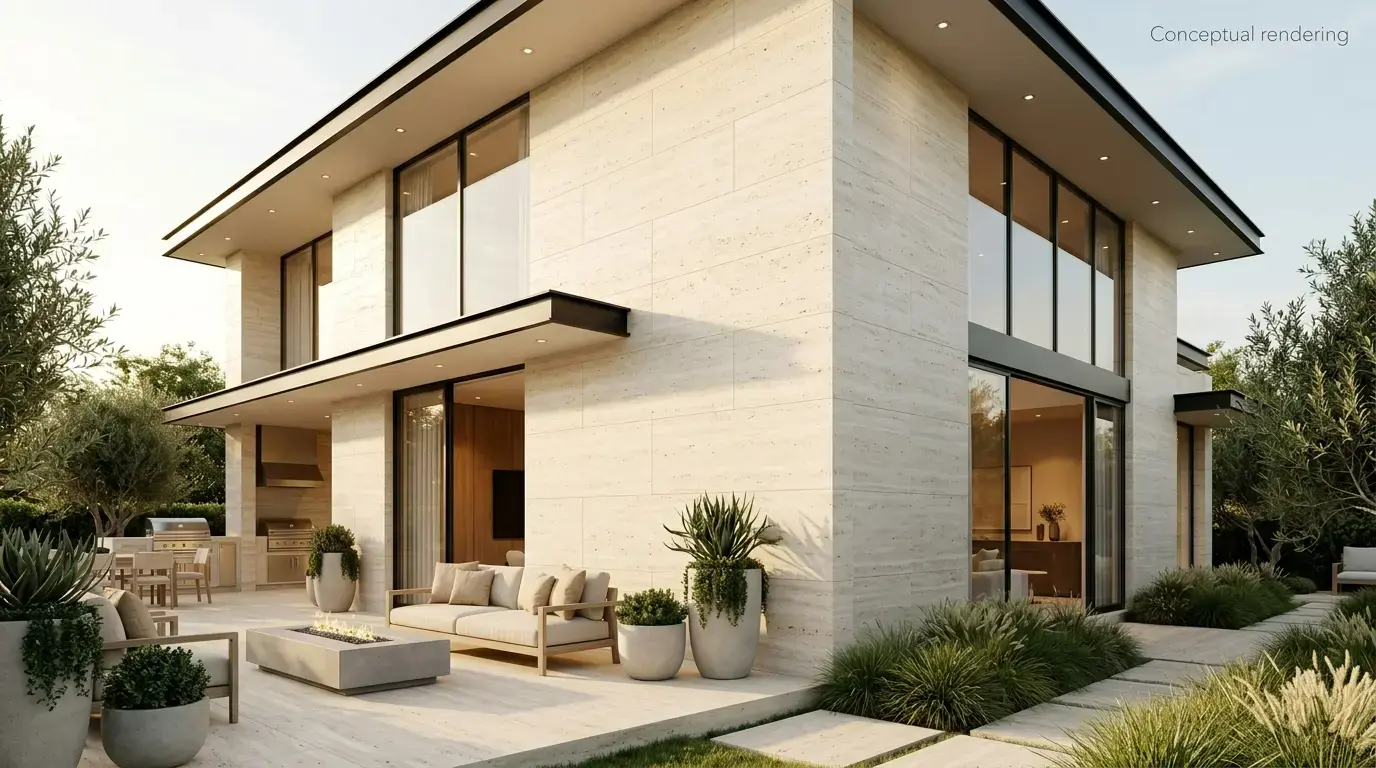
Is Travertine Good for Exterior Walls?
Yes, in the right spot. Travertine is suitable for outdoor use when the installation matches the application, and it makes the most sense in covered areas like porch columns and recessed entry surrounds, which see far less direct weather than an open wall.
That shelter keeps its sealing schedule manageable, and column wraps are one of the applications it's suited for. How often it needs resealing depends on porosity and climate, and the Natural Stone Institute's consumer resources collect care, cleaning, and stain removal guidance worth bookmarking.
If you want travertine across an entire open facade, go in expecting more upkeep. Otherwise, keep it under the roofline and use a denser stone on the exposed walls.
Downspout Corners and Splash Zones
Most houses have at least one spot where a downspout releases water near the base of a wall. That corner can stay wetter than the rest of the wall, and standing water shouldn't be left against any stone for long periods.
Note where water runs before you finalize a material, and treat that corner like the north wall: the same dense stone you'd use there. A stone that's fine on a dry wall has a much tougher job in a splash zone.
The Side Yard: The Wall Nobody Looks At
Narrow side yards are easy to forget. A wall you walk past twice a year can hide moss, debris piled against its base, or an overflowing gutter for months before anyone notices.
This stone gets the least attention, so give it the most forgiving choice: the same dense stone as the north wall, which needs little upkeep beyond an occasional rinse.
If you're deciding how far stone should wrap the house, the side yard is often the place to stop. Keeping coverage on the walls people actually see, like the entry and front elevation, puts the stone where it does the most work.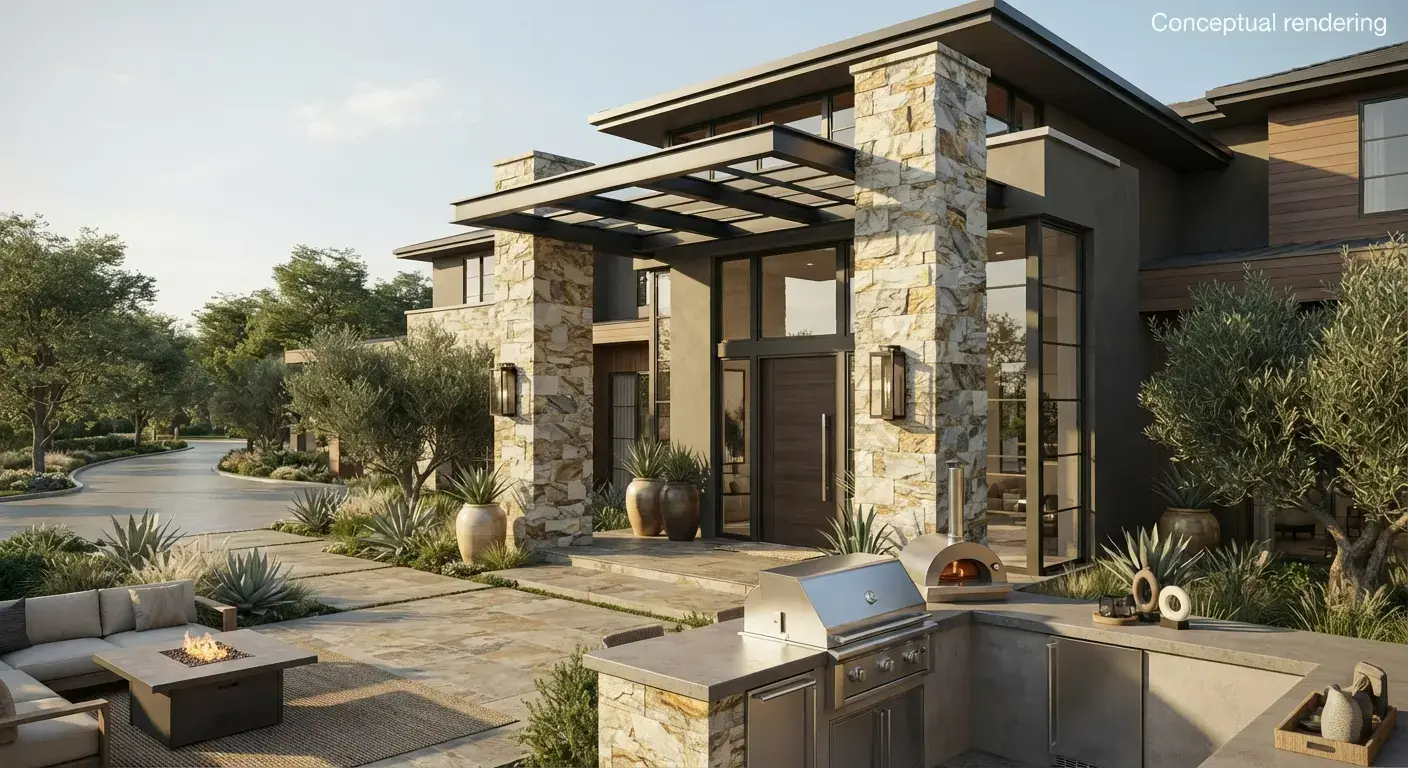
What the Whole House Needs Once It's Done
Choose well wall by wall, and routine care stays light. A periodic rinse and a mild, pH neutral cleaner with a soft brush cover most of it, while abrasive cleaners and harsh chemicals can wear down a finish over time, and close-range pressure washing can affect certain finishes.
For building owners and contractors who want the formal reference, ASTM C1515, the standard guide for cleaning exterior dimension stone, covers cleaning materials and the conditions for using them. The same guide notes that cleaning can't always return discolored stone to its original appearance, which is the strongest argument for getting each wall right at the start.
Natural stone cladding also has a smaller carbon footprint than precast concrete. The Natural Stone Institute's embodied carbon comparison puts it at roughly a third of precast concrete cladding per square meter.
If the project continues indoors, granite and quartzite carry over well to floors and walls. Our full range of tile, slabs, countertops, and flooring covers the next step.
Conclusion
Choosing exterior stone comes down to one rule: match the stone to the conditions each wall faces. Dense granite or quartzite belongs on north walls, sun-exposed elevations, downspout corners, and anywhere that's hard to keep up with, while travertine fits covered areas, and honed or textured finishes make sense wherever a facade meets steps.
The most useful thing to bring to a conversation with Nova Tile and Stone is a note on which walls face north, which take afternoon sun, and which sit under a roof. With that list in hand, you can book a free design consultation and match a stone to each elevation with our team.
Prefer to look first? Find the showroom closest to you in Reno, Minden, Fernley, or Sacramento. Once a slab stands out, request a slab quote with its name or bundle number, and we'll hold reserved slabs for three days while you finalize plans.
Note: Some images on this page may be conceptual renderings created to illustrate design possibilities and may not depict actual installations.
Frequently Asked Questions
Not necessarily. North walls, walls in full afternoon sun, and walls under a roof face very different conditions, so many homes are best served by dense granite or quartzite on exposed walls and a more porous stone like travertine in covered areas.
In freeze-thaw climates, it's usually a shaded north wall that holds snow and dries slowly, along with any corner where a downspout releases water. Dense stones such as granite and quartzite are the stronger choice for those spots.
Polished stone tends to offer less grip in wet conditions than honed or textured surfaces. Where a facade meets steps or walkways, a honed or textured finish is the more practical choice.
Travertine works best in covered areas such as porch columns and recessed entry surrounds, where it sees less direct weather. Its natural pores mean sealing and periodic resealing are part of owning it.
Not always. The ASTM standard guide for cleaning exterior dimension stone notes that cleaning can't always return discolored stone to its original appearance, which is why choosing the right stone and finish for each wall matters from the start.