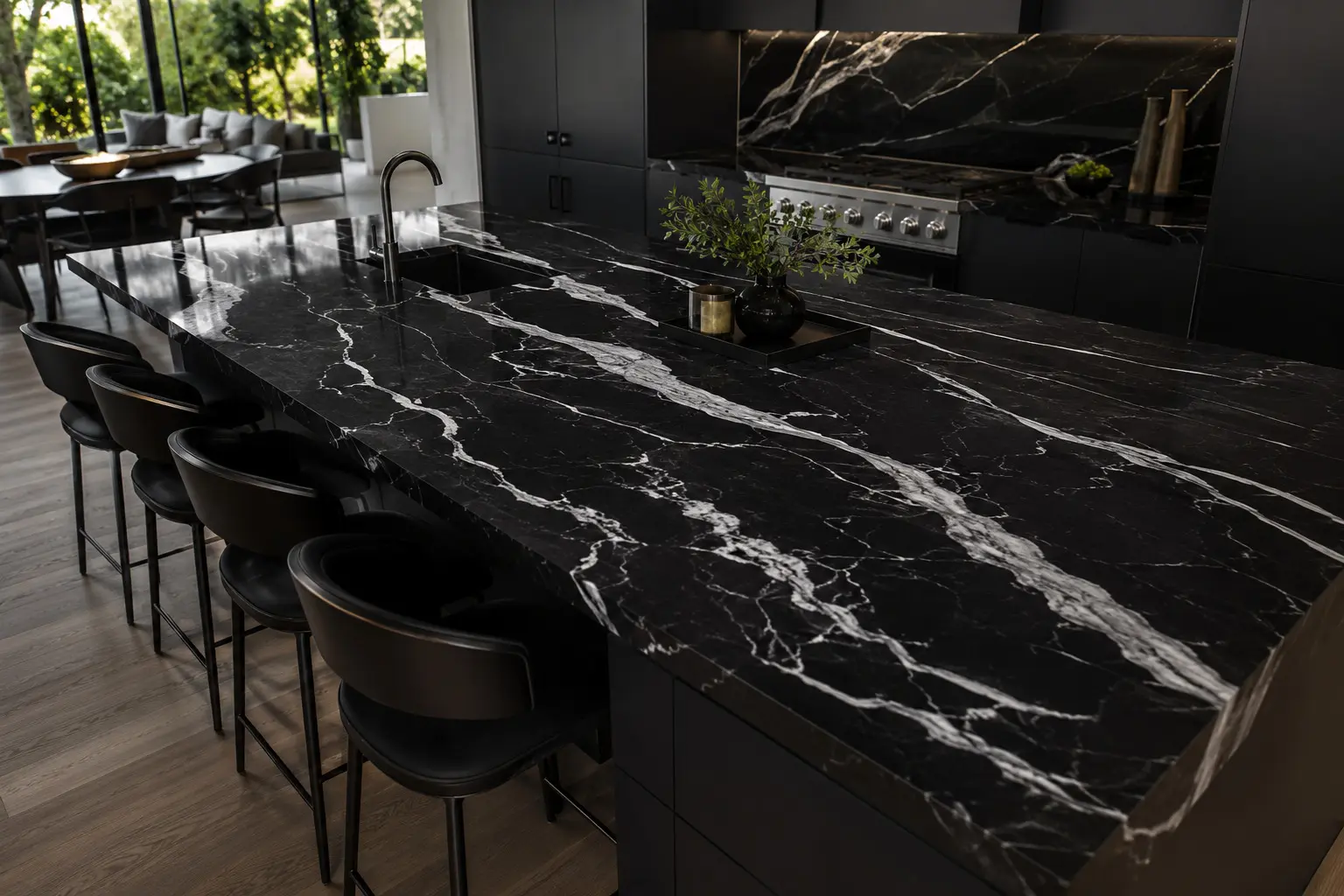
Natural stone that displays a contrasting range of dark and light tones is a considered choice for countertop applications. Depending on the material, that contrast may come from the distribution of minerals within the stone, from veining across a lighter field, or from the layered structure formed during the stone's natural development. Granite, quartzite, marble, and dolomite are among the materials that can carry this kind of tonal range, and each brings a different surface character, maintenance profile, and set of available finishes. The right material depends on where the countertop will be installed, how much daily contact it will receive, and how much ongoing care is practical for the household or project.
Granite tends to display a crystalline mineral structure with flecks of black, white, and gray distributed across the face of the slab. Quartzite may appear more layered, with linear movement running through the stone. Marble and dolomite often show defined veining across a lighter field, which can give a countertop a more graphic, high-contrast appearance. Available finishes typically include polished, honed, leathered, and specialty and each one changes how the tonal variation reads and how the stone responds to daily use.
Natural Stone Slabs in Black and White for Countertops
Polished
Brings out the deepest contrast in the stone with a smooth, reflective surface that highlights natural mineral variation and veining.
Specialty
Refers to less common surface treatments such as brushed or sandblasted finishes that offer a distinct look beyond standard options.
Our showrooms carry a rotating inventory of stone slabs that fall within this tonal range, and our team is available to help identify the right material and finish for the application. For those also considering related color directions, our pages on gray countertops and black countertops cover additional options in similar color families.
How Dark and Light Tones Vary Across Natural Stone Materials
The way dark and light tones appear in stone depends on the material itself. Granite carries its tonal contrast through a crystalline mineral composition, with individual mineral grains of varying color distributed across the slab. Quartzite develops its character through layered compression over time, which can produce linear movement and tonal shifts across the face of the stone.
Marble and dolomite tend to display their contrast through veining, where darker mineral lines run across a lighter base. Because each slab forms through its own geological process, the distribution of tone, the scale of any veining, and the overall appearance can vary considerably between individual pieces. Viewing slabs in person before selecting is worthwhile, as photographs may not fully capture the depth and character of the stone. For guidance on how the finish affects the final result on a countertop, this resource on selecting the ideal stone finish is a useful reference.
How Natural Stone Holds Up When Used as a Countertop
Stone used for countertop applications can perform well over time, but how it holds up depends on the material selected, the finish applied, and how consistently the surface is maintained. Granite is generally known for good hardness among natural stone materials and can handle regular contact well when properly cared for, but cutting directly on the stone is not recommended regardless of material, and a cutting board should be used. Quartzite can also perform well in countertop settings, but long-term results depend on appropriate sealing and consistent upkeep. Marble and dolomite tend to be more sensitive to acidic substances than harder stone types, so spills are best cleaned promptly to reduce the chance of etching.
For heat exposure, trivets or heat pads are recommended under hot cookware across all these materials, as direct contact with very hot items may pose a risk of thermal shock. The Natural Stone Institute offers educational resources and events covering performance, care, and installation across a range of stone types. Outcomes can vary based on the slab selected, the finish applied, the sealing schedule followed, and how the countertop is used day to day.
Find more helpful guides on our blog:
Keeping a Natural Stone for Countertop in Good Condition Over Time
Preserving the appearance of a stone for countertop comes down to consistent, gentle care. The finish plays a role in how maintenance should be approached, since polished, honed, leathered, and specialty surfaces respond differently to cleaning products and daily contact. The Natural Stone Institute care guidelines are a practical starting point for understanding what each material tends to need.
- Wipe spills promptly, particularly anything acidic such as citrus, vinegar, or coffee, to help reduce the chance of staining or etching.
- Use a pH-neutral stone cleaner or mild dish soap diluted in warm water for routine cleaning. Abrasive cleaners and harsh chemicals should be avoided.
- Follow a sealing schedule suited to the specific material and finish. Some stone types may benefit from more frequent resealing than others.
- Use trivets or heat pads under hot cookware. Placing very hot items directly on stone is not recommended, as it may pose a risk of thermal shock.
- A cutting board is recommended for all materials and finishes. Cutting directly on stone is not advised.
- Avoid leaving standing water near edges or seams, as prolonged moisture in those areas may affect the installation over time.
- For polished stone, use cleaning products formulated for that finish. For honed or leathered surfaces, confirming compatible products with our team before use is a good idea.
Frequently Asked Questions
Granite, quartzite, marble, and dolomite can all display tonal contrast in the black and white range. Granite carries that contrast through its mineral composition, quartzite through layered movement in the stone, and marble and dolomite through veining across a lighter base. Each slab forms through its own geological process, so the appearance can vary between individual pieces. Our team can help identify which options are currently available in this tonal range.
Granite is generally known for good hardness among natural stone materials and can handle regular use well when properly maintained. Spills should be cleaned promptly, abrasive cleaners should be avoided, and a cutting board should be used rather than cutting directly on the stone. Resealing on a consistent schedule also helps protect the surface over time. Long-term results will depend on the specific slab, the finish selected, and the maintenance routine followed.
Yes, the finish affects both the visual result and the upkeep required. A polished finish brings out depth and contrast in the stone, but polished surfaces may show fingerprints and watermarks more readily. A honed finish gives a softer, matte appearance and tends to be more forgiving in high-contact areas, though it may require more frequent sealing depending on the material. A leathered finish adds a subtle texture and sheen. The best choice depends on where the countertop will be used, the look being pursued, and the level of maintenance that is practical for the space.
Yes, store pickup is available at all four showroom locations. A properly rated truck and A-frame are required to safely transport natural stone slabs. Our team will assist with loading at the time of pickup. Scheduling an appointment in advance is recommended to ensure the slabs are ready upon arrival.
Yes, slab delivery is available to any of the 48 contiguous U.S. states. Natural stone slabs require special handling and are securely strapped to an A-frame and loaded onto a dedicated truck for transport. Delivery is made directly to a fabricator's address, and the receiving facility must have a forklift and slab boom or clamp available for unloading. Contact the team directly for a custom freight quote based on delivery location.