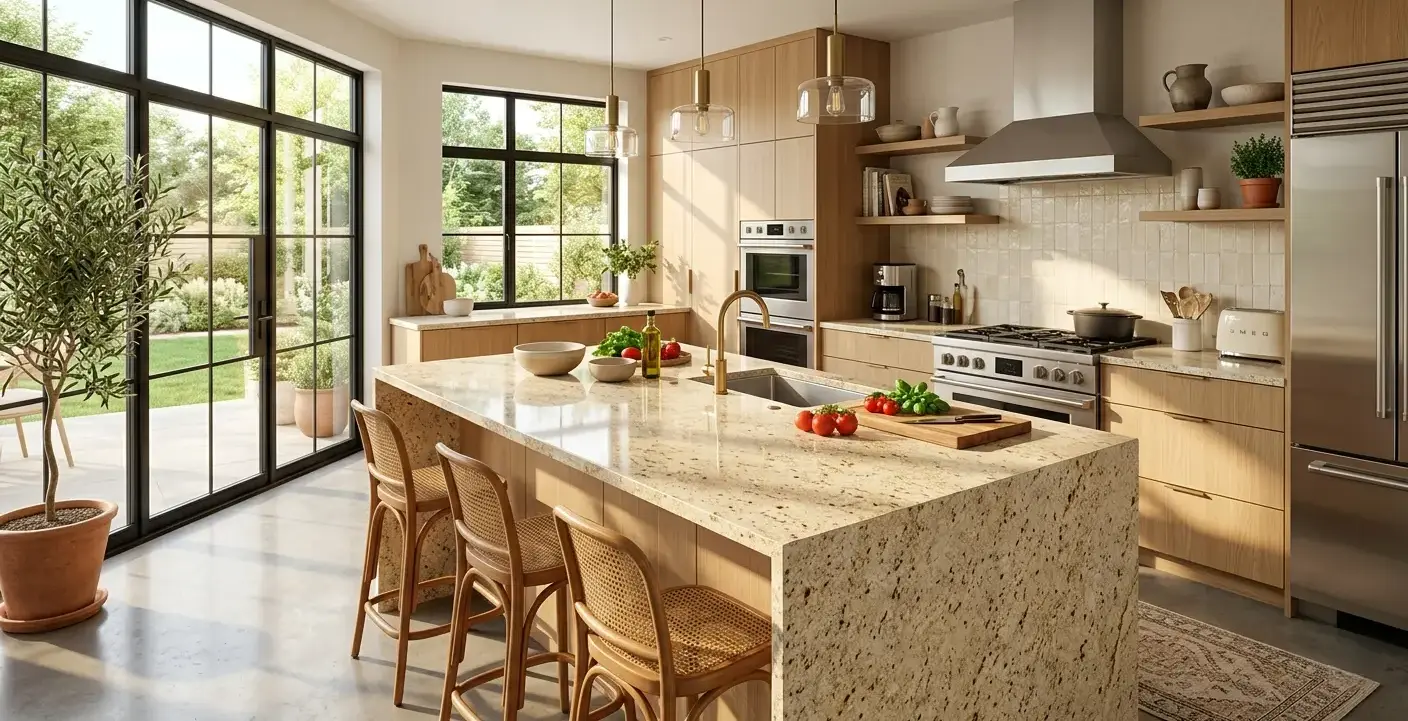
A beige slab used as a countertop brings warmth and lasting versatility to kitchens, bathrooms, and bar surfaces. Nova Tile and Stone carries beige-toned in natural and engineered stone slabs, with Taj Mahal quartzite and classic travertine leading the range for this palette. Both materials deliver the creamy, earth-toned character that defines a true beige countertop. Soft enough to pair with almost any cabinet finish, each is distinctive enough to anchor a room on its own.
Material Profile: What Makes a Beige Slab for Countertop Worth Choosing
 Conceptual rendering
Quarry Origin: Taj Mahal quartzite originates primarily from Minas Gerais, Brazil, a region known for producing slabs with consistent warm toning and the fine-grained density that distinguishes premium quartzite from lesser grades. Travertine for countertop use is most commonly quarried in Turkey and central Italy, where sedimentary banding produces the signature linear patterning prized in kitchen and bath design.
Taj Mahal quartzite is the lead material for this page. Its ivory-to-cream base color with soft golden and taupe undertones reads as a refined, sophisticated beige under most lighting conditions. The secondary material, travertine in a polished finish, offers a slightly warmer, more porous character with a distinctive linear vein structure that suits bathroom vanities and bar surfaces where visual texture is a priority.
For homeowners and designers who prefer an engineered option, a cream or warm-white quartz in a honed finish provides consistent color and lower porosity, extending the beige countertop palette into higher-traffic kitchen applications where natural stone sealing schedules may be a concern.
Property |
Taj Mahal Quartzite
|
Travertine
|
Cream Quartz
|
Mohs Hardness | 7 | 3–4 | 6–7 |
Standard Thickness | 3/4 in (2 cm) / 1-1/4 in (3 cm) | 3/4 in (2 cm) / 1-1/4 in (3 cm) | 3/4 in (2 cm) / 1-1/4 in (3 cm) |
Absorption Rate | <0.1% | 0.5–2.5% | <0.1% (engineered) |
Typical Finish | Polished, Honed, Leathered, Specialty | Polished, Honed, Leathered, Specialty | Polished, Honed |
Sealing Required | Yes, periodically | Yes, more frequently | No |
A polished finish on Taj Mahal quartzite enhances the natural depth of its golden veining and suits kitchen islands where visual impact matters. A honed finish on the same material delivers a softer matte character, practical for bathroom vanity surfaces and bar tops where a subtler tone is preferred. Travertine in a polished finish works well for vanity countertops and low-traffic bars, though trivets are advised near heat sources, as polished stone can be susceptible to thermal shock under prolonged direct heat.
Design Directions: How Beige Stone Surfaces Shape a Space
 Conceptual rendering
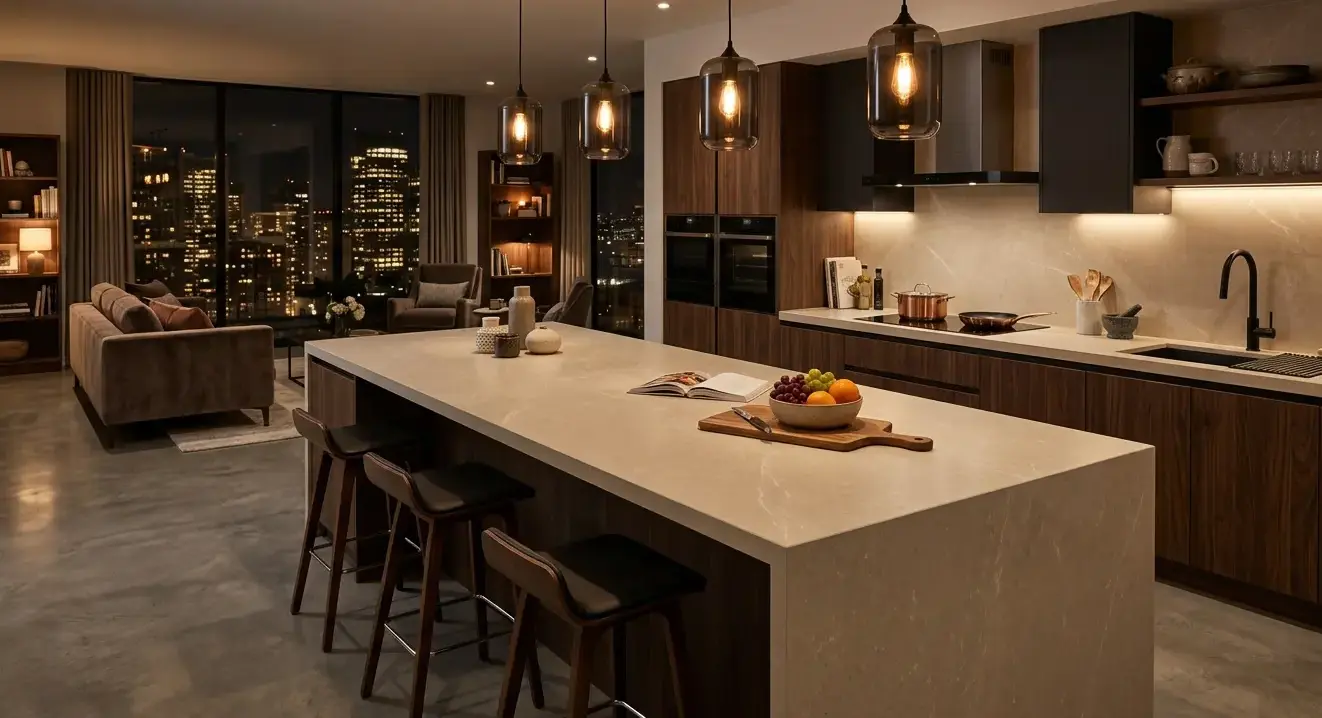
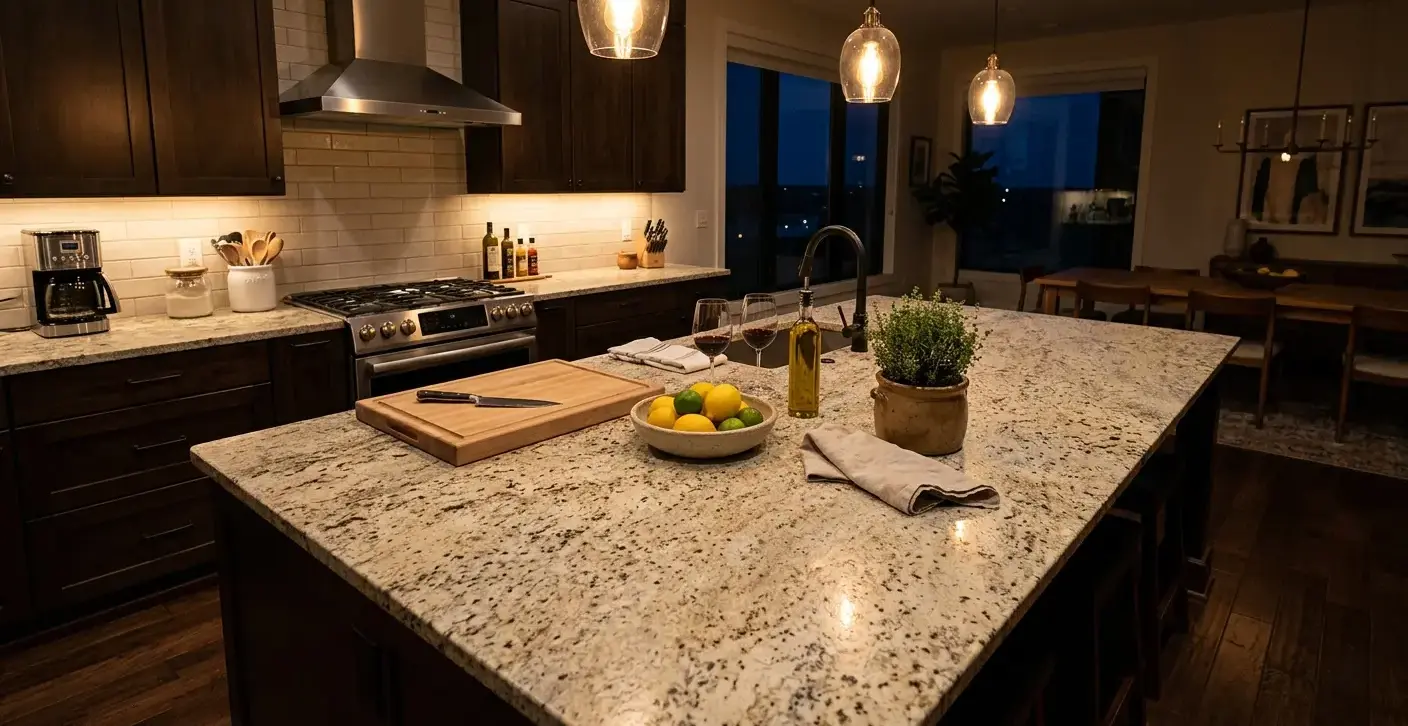
The beige countertop performs across a wide range of kitchen and bathroom design styles because its undertones shift depending on the materials around it. Paired with white oak or warm-stained cabinetry, Taj Mahal quartzite reads golden and organic. Against painted gray or navy cabinets, the same slab cools into a crisp, neutral anchor. This adaptability is one reason warm neutrals, including beige stone surfaces, are among the leading countertop design directions for 2026 according to interior design trend reporting.
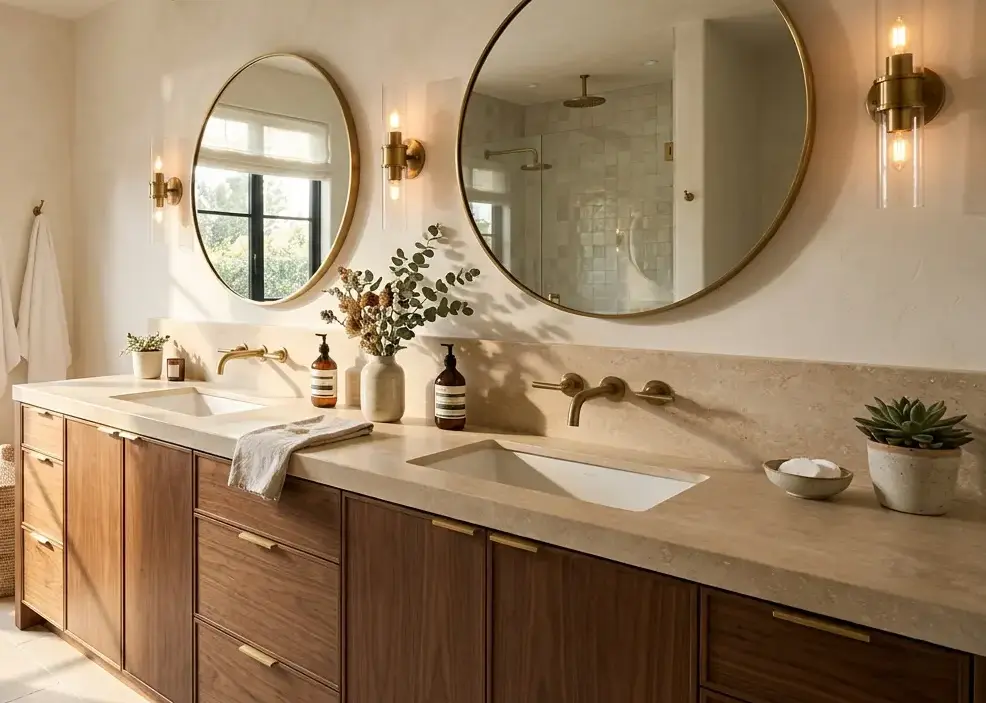
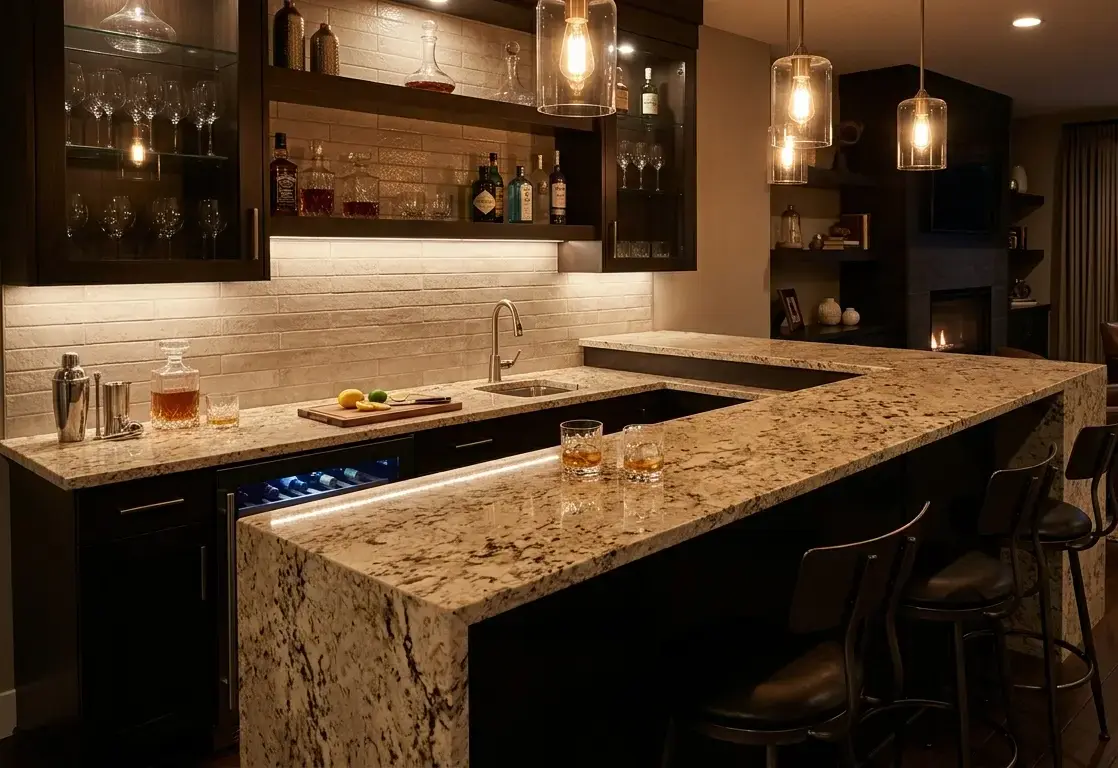
For kitchen countertops, a straight horizontal layout along the perimeter paired with a waterfall edge detail on the island creates clean, contemporary geometry while showcasing the full veining run of the slab. In bathrooms, beige countertop stone placed vertically behind the vanity as a small backsplash panel ties the countertop slab into the wall plane. Bar surfaces benefit from a thicker 1-1/4-inch profile, which adds visual weight and a refined, substantial feel.
Bookmatching polished travertine slabs horizontally across a larger vanity installation creates a symmetrical, mirror-image pattern that reads as a designed feature. Cream quartz in a honed finish suits bar tops in commercial or high-traffic residential settings where a consistent, low-maintenance surface is the priority.
 Conceptual rendering
Note: Some images on this page may be conceptual renderings created to illustrate design possibilities and may not depict actual installations.
 Conceptual rendering
Why Beige Stone for Countertops Delivers Practical Performance
- Broad application range: Taj Mahal quartzite is rated for indoor and outdoor use, floor and wall surfaces, and fireplace surrounds, making it one of the most versatile natural stones available in the beige palette.
- Surface hardness: At Mohs 7, Taj Mahal quartzite resists everyday scratching better than marble or travertine, though cutting boards are still recommended to preserve the finish long-term.
- Thermal resistance: Both quartzite and travertine handle ambient kitchen heat well; trivets protect the surface finish from direct cookware contact and guard against thermal shock.
- Non-slip option: A honed or leathered finish on quartzite reduces surface slipperiness compared to a high-polish finish, making it a sound choice for bathroom vanity countertops where water contact is frequent.
- Sealing schedule: Quartzite and travertine require periodic sealing to maintain stain resistance. Cream quartz requires no sealing and suits high-use bar and kitchen environments where maintenance simplicity is a priority.
- Compatibility with most cleaners: pH-neutral stone cleaners preserve the surface and the seal. Abrasive cleaners and acidic products such as vinegar should be avoided on all three materials, as they can degrade the surface finish over time.
Long-Term Value: Why a Beige Slab Holds Its Place
Beige is not a trend color for stone; it is the baseline of natural stone's visual vocabulary, which is why it continues to appear in kitchen, bathroom, and hospitality design decade after decade. Taj Mahal quartzite, in particular, commands consistent demand in the North American slab market, which supports resale recognition compared to highly seasonal color selections.
While travertine is generally stable under normal sunlight exposure, prolonged outdoor UV and weather exposure can gradually alter its appearance and finish. As a result, it is often used in shaded outdoor settings or interior applications where long-term sun exposure is limited.
The design team at Nova Tile and Stone's slab showrooms can help match the right beige stone slab to a specific countertop project, with in-person slab viewing available across locations.
Fresh Updates from Our Team
Stay Informed on Our New Initiatives!
Frequently Asked Questions
Taj Mahal quartzite, one of the most popular materials for a beige countertop, rates Mohs 7 in hardness, which makes it resistant to everyday surface wear from kitchen activity. Sealing on schedule and using cutting boards helps preserve the finish over time in high-use environments.
A polished finish produces a smooth, reflective surface that deepens the color and highlights veining. A honed finish creates a matte, slightly softer surface that shows fewer water marks and fingerprints, a practical consideration for bathroom vanity countertops and bar tops.
Quartzite is UV-stable and rated for outdoor use, making it suitable for outdoor kitchen countertop surfaces. Travertine is best reserved for shaded outdoor areas rather than direct-sun applications, as extended UV exposure can affect its polished finish.
Natural stone requires periodic sealing and prompt spill cleanup to maintain appearance. Engineered cream quartz requires no sealing. Regardless of material, avoiding abrasive cleaners and acidic substances protects the surface and the seal.
For kitchen countertops and bathroom vanities, 3/4-inch (2 cm) slabs are common, while 1-1/4-inch (3 cm) slabs are preferred for kitchen islands and bar tops where visual weight and edge profile options matter more.