Skip to Content

Polished Travertine

Natural Stone for Interior Surfaces and Architectural Applications


View Our In-Stock Slab Collection

Polished travertine slab is a natural stone surface material commonly used for kitchen countertops, bathroom vanity tops, feature walls, and commercial cladding. It is a sedimentary limestone formed when groundwater carrying dissolved calcium carbonate rises to the surface, releases carbon dioxide, and causes mineral deposits to accumulate and solidify over time. This process gives travertine its characteristic layered structure, natural voids, and tonal variation across each slab.

The polishing process grinds and buffs the stone surface to a high-gloss finish, drawing out the stone's natural colors, typically creams, ivories, warm beiges, and walnut browns, and creating a smooth, reflective surface suited to interior use. Because polishing compacts the surface layer, polished travertine is generally less absorbent than honed or brushed finishes of the same stone, though it remains a calcium carbonate-based material that reacts to acidic substances and requires appropriate care.

Polished travertine slabs at Nova Tile and Stone are filled, meaning the natural pits and voids formed during the stone's creation are filled with a compatible material before polishing, producing a consistent, workable surface. Slabs are available in large-format sizes suited to single-piece countertop and vanity top applications.

Material Properties and Finish Characteristics

Travertine is primarily composed of calcium carbonate, the same mineral found in marble and limestone. It rates 3 to 4 on the Mohs hardness scale, softer than granite at 6 to 7 and comparable to marble. For interior surface applications, this hardness is generally adequate, though the stone can be susceptible to scratching from abrasive contact and to etching from prolonged exposure to acidic substances such as citrus juice, vinegar, and certain household cleaners.

Polished slab has a high-gloss, reflective appearance that accentuates color depth and natural veining. Honed slab has a smooth matte finish that is less reflective and less likely to show surface marks in daily use. Leathered finish adds subtle texture to the surface while retaining some of the stone's natural depth, and is a practical choice for surfaces where a less formal look is preferred. Specialty finishes cover a range of custom treatments that can alter the surface character further depending on the design intent. Each finish carries distinct performance and maintenance characteristics, and the appropriate choice depends on the application and the look required.  

Where Polished Travertine Slabs Are Most Commonly Used

The stone performs well across a range of interior applications where an uninterrupted surface with minimal seams is both functional and visually appropriate.

Kitchen Countertops and Island Benchtops

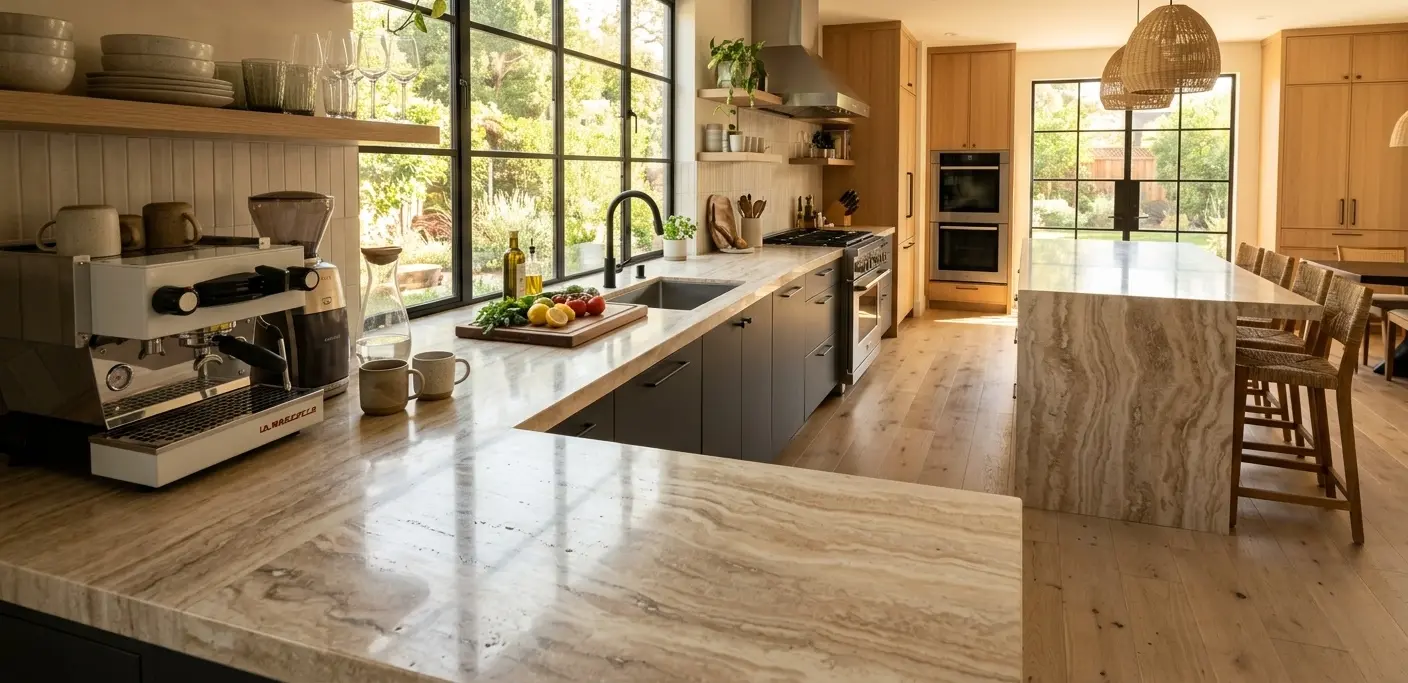
It is a popular choice for kitchen countertops and island benchtops, where its warm tones complement both timber and painted cabinetry. Because travertine reacts to acidic substances, prompt clean-up of spills and applying a penetrating stone sealer before installation are both recommended for kitchen surfaces.

Feature Walls and Wall Cladding

Large-format slabs are used as interior feature walls, whether behind a fireplace, along a living room accent wall, or in an entry. The polished finish reflects light, and fewer joints compared to tile formats give cladding a cleaner, more continuous appearance.

Bathroom Vanity Tops

The stone works well for bathroom vanity tops, where its warm neutral tones suit natural light and complement a range of cabinetry finishes. A full slab paired with an undermount or integrated basin showcases the stone's natural patterning without interruption.

Commercial Interiors

In commercial settings such as hotel reception desks, restaurant feature walls, and bar tops, the slabs are valued for their natural character and long-term performance when maintained appropriately.

Kitchen featuring high-end cabinets and expansive polished travertine countertops

The Stone That Elevates Every Surface in Your Space

How to Select the Right Slab for Your Project


Each slab is an individual piece of natural stone with its own tonal character, veining distribution, and color range. These qualities are best assessed by viewing the full slab in natural light before making a purchase decision, as a small sample gives a limited impression of how the stone will read across a full surface.

Natural variation in travertine means two slabs from the same quarry batch can have noticeably different tonal qualities. For projects requiring multiple slabs, sequencing from the same bundle helps maintain tonal continuity across the installation.

Thickness is determined by the intended application. A 20mm slab is commonly used for vanity tops and wall cladding, while a 30mm slab is typically chosen for kitchen countertops and island benchtops where a more substantial edge profile is required. Nova Tile and Stone's team can advise on the right specification for your project and fabricator requirements.

Care and Maintenance


  • Sealing Polished travertine is less porous than honed or brushed travertine due to the compaction effect of polishing. For countertop surfaces, particularly in kitchens, applying a penetrating stone sealer before installation is a widely recommended precaution. A water absorption test, placing a small amount of water on the slab and observing whether it soaks in within a few minutes, can help confirm whether sealing is needed. For kitchen countertops, resealing every one to two years is a reasonable guideline. Vanity tops and wall cladding in lower-traffic areas typically require less frequent attention.
  • Daily Cleaning Clean the surface with a pH-neutral stone cleaner or plain warm water and a soft cloth. Avoid products containing acids, alkalis, ammonia, or vinegar, as these can etch the surface and break down any applied sealant. Soap-based cleaners are best avoided as well, as they can leave a residue over time that gradually dulls the finish.
  • Spill Management Blot spills promptly, particularly acidic liquids such as citrus juice, wine, and coffee, rather than wiping them across the surface. Even with a sealer applied, acidic substances can etch the stone's finish if left to sit, so prompt attention matters most on countertop surfaces.
  • Long-Term Upkeep Use cutting boards, trivets, and coasters on countertop surfaces to reduce direct contact with abrasive and acidic materials. Over time, light etching or surface dulling in high-use areas can be addressed by a professional stone polishing service, which can restore the original finish without requiring full slab replacement. This is one practical advantage of natural stone over many manufactured surface materials.

Transform Your Space

Natural stone brings a quality to interior surfaces that is difficult to achieve with manufactured alternatives. Polished travertine, with its warm neutral palette and smooth reflective finish, suits a range of interior styles, from traditional and Mediterranean-influenced designs to contemporary and minimalist spaces.

At Nova Tile and Stone, we carry polished travertine slabs in a curated range of colors and formats, selected for consistency in surface quality and finish. Our team works with homeowners, interior designers, builders, and architects, and can assist with slab selection, and thickness recommendations. Whether the project is a single vanity top or a full commercial fitout, we can help you find the right slab and confirm the specification before fabrication begins.

Visit the Nova Tile and Stone showroom to view current slab stock in person. Seeing a full slab in natural light is the most reliable way to assess color, veining, and how the stone will read across your specific surface before committing to a purchase.

Nova Tile and Stone Product Range Schedule an Appointment


Come in. View the slabs. Choose with confidence.


All slabs are available at Nova Tile and Stone. Contact our team for current stock, slab dimensions, and project pricing.

Frequently Asked Questions

Yes, polished travertine is used in kitchen countertops and performs well with the right care routine. The key considerations are avoiding prolonged contact with acidic substances and applying a penetrating stone sealer before installation. With consistent maintenance, the countertop surface can hold its appearance well over time.

Polished slab is ground and buffed to a high gloss, bringing out full color depth and creating a reflective surface. Honed slab has a smooth matte finish that is less reflective and more forgiving in daily use, as surface marks and etching are less visible. The choice comes down to the preferred aesthetic and the maintenance routine the owner is comfortable managing.

It depends on the application. Because the polishing process compacts the surface, the stone is less absorbent than honed or brushed finishes, and wall cladding may not require sealing. For kitchen countertops, a penetrating stone sealer before installation is a widely recommended precaution. Nova Tile and Stone's team can advise based on your specific application.

These slabs are commonly available in large-format sizes sufficient to cover a standard kitchen island or vanity top in a single piece. Standard thicknesses are 20mm for vanity tops and wall cladding, and 30mm for kitchen countertops and island benchtops. Contact our team or visit the showroom for current stock and dimensions.

Both are calcium carbonate-based stones, reactive to acidic substances, and rate 3 to 4 on the Mohs hardness scale. Marble tends to feature bolder veining and a wider color range, while travertine offers warmer, more muted tones and is generally available across a wider range of price points. The right choice depends on the design intent and the look required for the space.

Discover Our Showrooms