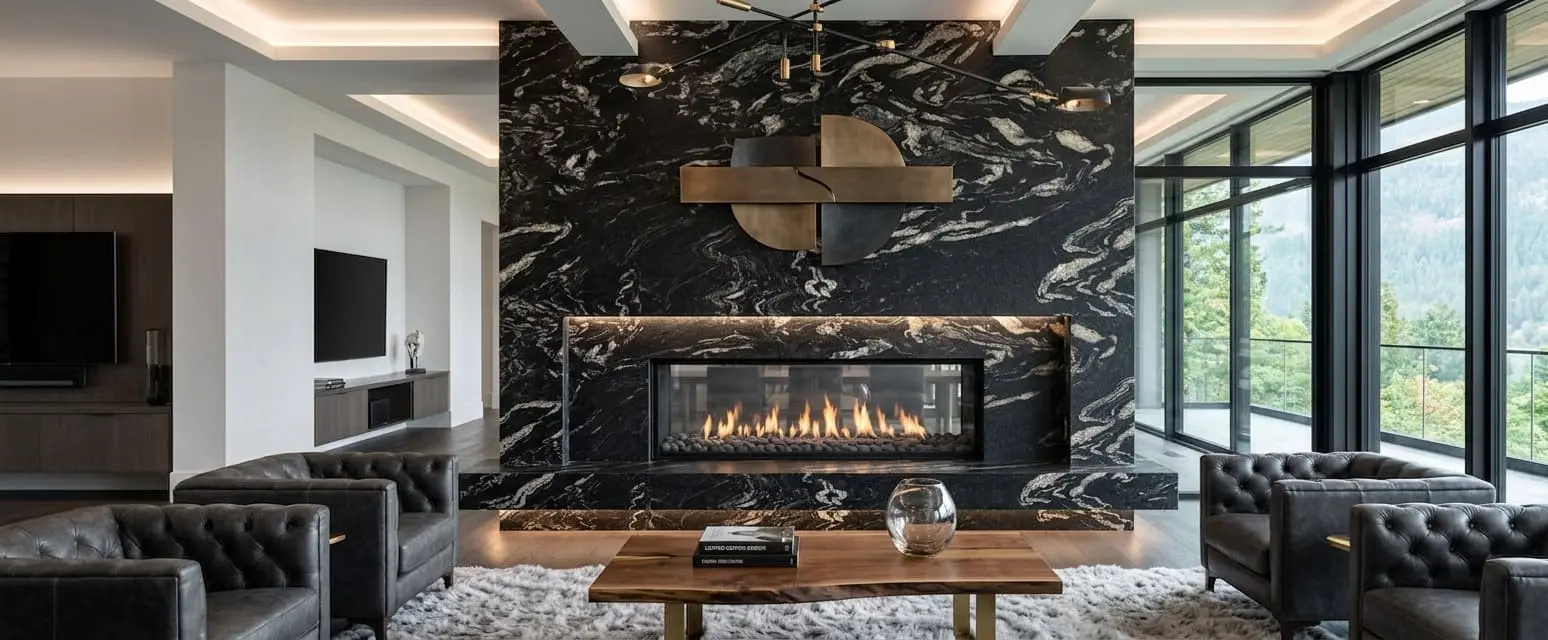
Why Titanium Granite Is a Strong Choice for a Fireplace Surround
Titanium granite's physical properties align closely with what a natural stone fireplace surround demands. As an igneous rock, titanium granite forms through the cooling and crystallization of magma, a process that gives it exceptional thermal stability, keeping it from warping, discoloring, or cracking under radiant heat.
Granite ranks between 6 and 7 on the Mohs hardness scale, well above marble's 3 to 4, making it highly resistant to scratching from fireplace tools and debris. Its low absorption rate means soot, moisture, and ash are unlikely to penetrate the surface and cause staining. When properly sealed, a titanium granite fireplace surround requires minimal ongoing maintenance.
Finish Options for a Granite Fireplace Surround
Beyond its physical performance, the finish applied to titanium granite slab shapes how the stone reads on the fireplace surround. Four categories are available, polished, honed, leathered, and specialty, each suited to a different design direction.
- Polished finish amplifies contrast, bringing the dark base and metallic veining into sharp relief against a smooth, reflective surface. The gloss catches light from the fire and the surrounding room, making it well suited to contemporary and transitional interiors where visual impact is the priority.
- Honed finish is matte and smooth without the reflectivity of polish. It preserves the stone's natural color and veining while producing a quieter, more restrained result, the right choice for farmhouse, rustic, or understated modern interiors where a high-gloss surface would feel out of place around the hearth.
- Leathered finish introduces subtle surface texture through a brushing process applied during fabrication. Its slightly matte, tactile surface conceals minor dust and fingerprints more effectively than a polished finish, while still showcasing titanium granite's natural veining, a practical advantage near an active fireplace surround.
- Specialty finish covers custom-processed surfaces such as
brushed or sandblasted, and is best suited to projects where a more distinctive
stone surround result is the goal. It offers the most flexibility for
installations that call for a surface treatment beyond the three standard
options.