Specialty Finish Titanium Granite
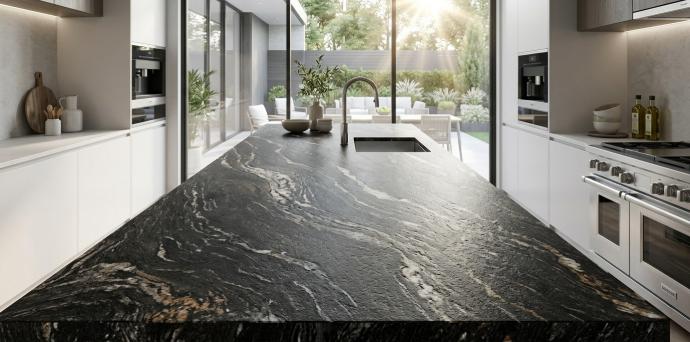
Quarried in Brazil, titanium granite is a natural igneous stone with a deep black base and swirling veins of silver, gold, gray, and cream. The term specialty finish refers to the surface treatment applied to the slab: polished, honed, or leathered. Each finish produces a different visual and tactile result, and the choice between them affects how the stone performs and how it reads in a space. Common applications include kitchen countertops, bathroom vanities, fireplace surrounds, and accent walls.
The Stone Behind the Name
Granite is an igneous rock formed from slowly cooled magma deep within the Earth's crust. That geological process produces a stone composed primarily of quartz, feldspar, and mica, which together give granite its characteristic hardness and density. Titanium granite rates 6 to 6.5 on the Mohs hardness scale, making it resistant to scratches and everyday surface damage. Its tight crystalline structure also gives it heat resistance, which is relevant for kitchen applications.
What sets titanium granite apart within the granite family is the intensity of its movement. The metallic veining that runs through the stone, in tones ranging from soft gold and ivory to bold silver and charcoal, creates a dynamic visual that interacts with light differently throughout the day. No two slabs are identical, which makes it a common choice for projects where a one-of-a-kind surface is the goal.
A Closer Look at Each Finish
The finish applied to a granite slab plays a significant role in its final appearance, texture, and surface behavior. For titanium granite specifically, three specialty finishes are most commonly used, and each produces a distinctly different result.
A polished finish brings the stone's metallic veining forward with a high-gloss, light-reflective surface. It is the most traditional choice and works well in spaces where shine and visual contrast are part of the design intent. The smooth, sealed surface is also straightforward to clean, which suits kitchen environments.
A honed finish removes the gloss while preserving the stone's color depth. The result is a smooth, matte surface with a more subdued character. Honed titanium granite is a fitting choice for bathrooms and spaces where a quieter aesthetic is preferred.
A leathered finish is achieved by running diamond-tipped brushes across a honed surface, creating a subtle texture that is reminiscent of natural leather. This finish retains the stone's color depth while adding a tactile quality that polished and honed finishes do not have. It also conceals fingerprints and minor smudges more effectively, which makes it a practical option for high-use countertops. Because the leathering process can slightly open the stone's pores, sealing after the finish is applied is important.
Common Applications
The versatility of titanium granite, combined with the range of available finishes, makes it suitable for a variety of applications across residential and commercial spaces.
Kitchen countertops are the most common use. You can view available titanium granite slabs to see the range of veining and movement across current inventory. The stone's dark base creates contrast against lighter cabinetry and walls, while its scratch and heat resistance make it appropriate for daily use. A polished or leathered finish is typically selected for kitchen surfaces.
Bathroom vanities and shower surrounds are another natural fit. Titanium granite holds up well in moisture-prone environments, and a honed or leathered finish tends to suit the tone of bathroom spaces.
Fireplace surrounds, accent walls, and outdoor kitchen surfaces are additional applications where the stone is regularly used. Its density and heat resistance make it a viable option beyond interior countertops, and its specialty finishes perform well in spaces that experience significant temperature variation.
Fresh Insights from Our Blog
Frequently Asked Questions
A polished finish is achieved by buffing the stone to a high gloss, which makes colors appear deeper and more reflective. A honed finish stops the polishing process before the final buffing stage, resulting in a smooth, matte surface with no shine. A leathered finish starts from a honed surface and uses diamond-tipped brushes to add subtle texture across the stone, producing a matte appearance with a tactile quality that neither polished nor honed finishes replicate.
Leathered granite has a textured surface that can collect crumbs and fine debris in its small peaks and valleys, which requires slightly more attention than wiping down a smooth polished surface. That said, the texture also hides fingerprints, smudges, and water spots more effectively than polished granite. For routine cleaning, a soft brush or microfiber cloth with mild soap and warm water is sufficient for all three finishes.
Yes. Granite is a porous natural stone and benefits from periodic sealing regardless of finish. Annual sealing is the standard recommendation for polished surfaces. Honed finishes are more porous than polished and may require sealing more frequently, as often as every six months depending on use. Leathered finishes, where the process can slightly open the stone's pores, also benefit from regular sealing to protect the surface from staining.
The right finish depends on how the kitchen is used and the look being pursued. Polished granite is the most common choice for kitchens because its smooth, sealed surface resists staining and is straightforward to clean. Leathered granite is a practical alternative for high-use kitchens because its texture hides everyday marks more effectively than a polished surface. Honed granite suits kitchens where a matte, understated look is the priority, though it requires more frequent sealing than the other two options.
Yes. Because natural stone varies considerably from slab to slab, viewing the material in person is the most reliable way to evaluate it. Seeing a polished finish alongside a leathered or honed finish also makes the differences between them immediately clear in a way that photographs do not capture. Nova Tile and Stone carries natural stone slabs across all four showrooms in Reno, Sacramento, Minden, and Fernley, and our commission-free design consultants offer free design consultations to help you compare options for your specific project.
Viewing Slabs at Nova Tile and Stone
Because titanium granite varies from slab to slab, viewing it in person before making a selection is the most reliable approach. The way the stone's metallic veining responds to natural light is difficult to assess from photographs, and comparing finishes side by side makes the differences between them immediately apparent.
At Nova Tile and Stone, our commission-free design consultants are available at all four showrooms in Reno, Sacramento, Minden, and Fernley to help you explore available natural stone slabs and identify which finish and material fits your project. We offer free design consultations, and our team can guide you through what to consider when evaluating slabs for countertops, vanities, or other surface applications.