Mont Blanc Quartzite Pool Surround

Why Mont Blanc Quartzite Is the Ideal Choice for a Pool Surround

Mont Blanc quartzite is a natural metamorphic stone rated 7 to 8 on the Mohs hardness scale, quarried in Brazil, and widely used as a pool surround material for its UV resistance, low porosity, freeze-thaw stability, and slip-manageable finish options.

Where natural stone meets poolside luxury Turn your pool surround into a statement The natural stone that outlasts the elements

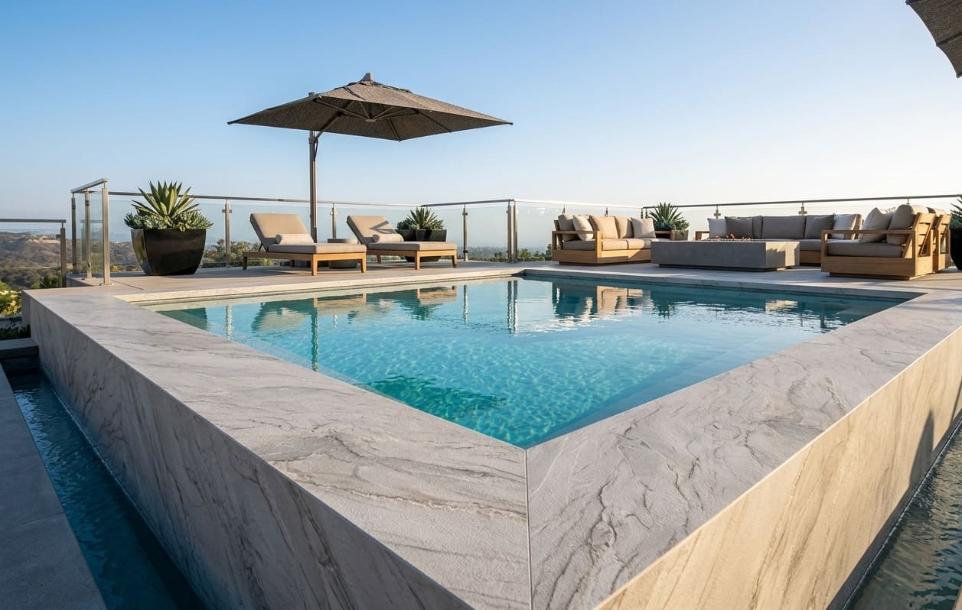
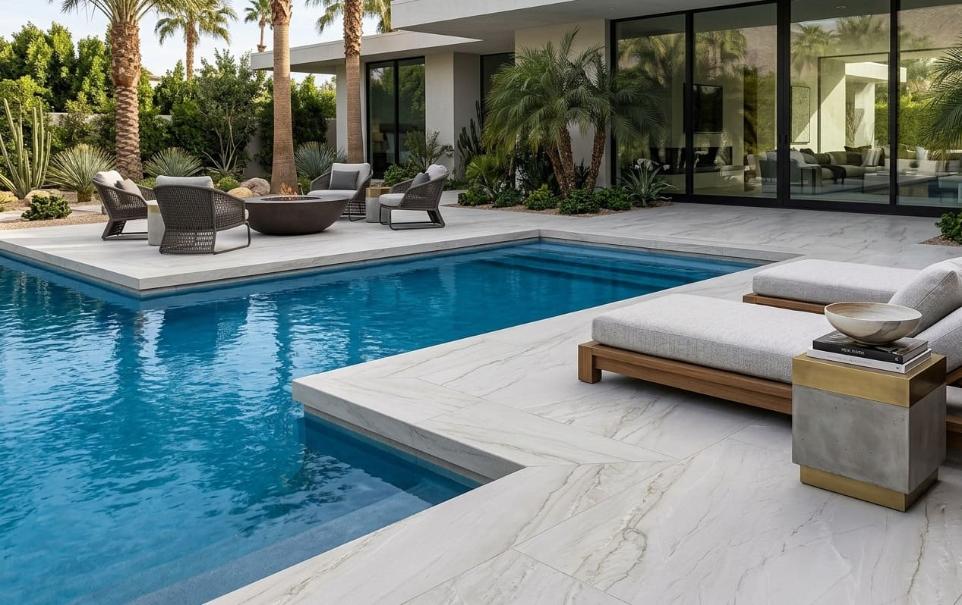
Its creamy white to light taupe surface, marked by flowing veins of gray and beige, closely resembles marble in appearance but offers significantly greater durability outdoors. Unlike marble, it resists etching from pool chemicals, does not fade under prolonged sun exposure, and tolerates the moisture and temperature fluctuations inherent to outdoor water environments.


Physical Properties That Make Mont Blanc Quartzite a Pool Surround Material

Not every natural stone performs equally in an outdoor, water-adjacent setting. A pool surround must endure chlorine exposure, standing water, temperature swings, and constant foot traffic, often simultaneously.

Its low porosity limits water absorption and reduces the risk of surface staining from pool chemicals or mineral deposits. UV resistance is built into the stone's natural quartz composition, so the pale background does not fade or yellow with prolonged sun exposure. Freeze-thaw stability is equally significant in climates where temperatures drop in winter. Because Mont Blanc does not readily absorb water, it is far less susceptible to the internal expansion and cracking that affects more porous stones when temperatures fluctuate.

For a pool deck that sees constant foot traffic, outdoor furniture, and coping loads, structural resilience matters. This quartzite is a dense, hard stone that withstands the sustained pressure of poolside use without fracturing, chipping, or cracking at the edges. Exact compressive strength values vary by block and quarry batch, and a fabricator or stone professional can provide specific technical data for a given slab.

Aesthetic Qualities: Designing Around Mont Blanc Quartzite Pool Surround

Its structural performance is matched by an equally strong aesthetic case. The stone's neutral palette, ranging from soft ivory to warm taupe with linear veins of gray, creates a seamless visual connection between the pool and its surroundings. In bright sunlight, its milky surface reflects light without producing harsh glare, contributing to the calm, resort-like atmosphere that many homeowners seek.

Because each slab is formed by geological processes, no two pieces are identical. Some display subtle, understated veining; others carry more dramatic gray striations with visible movement. When slabs are book-matched, cut and oriented to mirror each other, the effect around a pool coping edge or step detail can be particularly striking.

As Mont Blanc quartzite pool deck material, it complements a range of surrounding finishes, including pale concrete, natural coping stone, and wood-look composite decking, without competing with the water feature itself.

Finish Options for Pool Surround

How that appearance reads in a finished installation depends largely on finish selection. Four finishes are available for pool applications: polished, honed, leathered, and specialty.

  • A polished finish enhances the stone's natural luster and brings out the full depth of its veining. It offers the most visually dramatic result but can become slippery when wet, making it better suited to vertical coping edges, raised feature walls, or dry seating areas rather than horizontal walking surfaces adjacent to water.
  • A honed finish produces a smooth, matte surface with a subdued sheen, reducing slip risk while presenting a clean, refined appearance. 
  • A leathered finish adds subtle texture through a brushing process that raises the stone's natural grain, improving grip underfoot and concealing water marks more effectively than polished or honed finishes.
  • Specialty finishes, such as sandblasted, bush-hammered, or water jet, create pronounced texture and maximum slip resistance. These suit high-traffic zones, steps, or entry points where additional traction is needed, and are often used selectively in specific zones rather than across the entire surround. 

A stone professional can advise on which finish, or combination of finishes, best suits the safety requirements and design goals of a given pool layout.

Transform Your Space

Mont Blanc is a long-term investment in both the appearance and the function of an outdoor pool space. As a natural stone, quartzite does not require the periodic refinishing or full replacement that synthetic pool deck materials often demand, and its visual relevance does not diminish with changing design trends the way manufactured surfaces can.

For homeowners in the Reno, Sacramento, Minden, and Fernley areas, Nova Tile and Stone carries Mont Blanc quartzite slabs available for in-person viewing across all four showroom locations. Lighting conditions, slab variation, and veining character are details that photographs cannot fully convey, making an in-person visit the most reliable way to select the right slab. The team at Nova Tile and Stone can also assist with slab selection.

Nova Tile and Stone's Offerings Visit Our Showroom

Maintaining Quartzite Pool Surround

Once installed, keeping Mont Blanc quartzite pool surround in good condition requires consistent but straightforward care. Because quartzite has a more open internal structure than some other stones, it benefits from a penetrating impregnating sealer applied in multiple coats at installation, with reapplication intervals determined by exposure conditions and use. A water-bead test, performed by dropping water on the surface and observing whether it beads up or absorbs into the stone, helps gauge when resealing is warranted. A stone professional can advise on sealer products and schedules suited to outdoor, pool-adjacent conditions.

For routine cleaning, warm water and a mild, pH-neutral stone cleaner are sufficient. Avoid harsh acidic or abrasive products, which can compromise the sealer and dull the finish. Periodic rinsing to remove chlorine residue and mineral deposits helps preserve the stone's appearance, and promptly addressing pooling water in low-lying areas reduces long-term saturation risk.

Frequently Asked Questions

Yes. It is a suitable natural stone for pool surround applications. Quartzite's hardness, low water absorption, and resistance to pool chemicals make it one of the more reliable options for outdoor water environments. For horizontal walking surfaces, a honed or leathered finish is recommended over polished to reduce slip risk when wet. Consulting with a stone professional and a licensed installer ensures the finish and installation method are appropriate for the specific pool layout and climate.

Sealing is strongly recommended for outdoor applications subject to pool water, moisture, and direct sunlight. A high-quality penetrating impregnating sealer protects against staining and water infiltration. Initial installation typically calls for several coats; ongoing reapplication intervals depend on the stone's finish, elemental exposure, and local climate. A stone care professional can provide product and schedule recommendations.

It offers a similar aesthetic to white marble but with greater durability in outdoor use. Marble rates 3 to 4 on the Mohs hardness scale, making it significantly softer than quartzite at 7 to 8, and more porous and susceptible to etching from acidic substances, including pool chemicals and rainfall. Quartzite's higher density and chemical resistance make it the more practical choice where the stone will be regularly exposed to moisture and fluctuating water chemistry.

Slabs are most commonly available in 2 cm (approximately ¾ inch) and 3 cm (approximately 1¼ inch) thicknesses. For pool coping and surround applications, 3 cm is generally preferred for its greater strength, more substantial visual presence at the pool edge, and better resistance to chipping under load. Specific thickness recommendations should be confirmed with a qualified fabricator based on the installation design and support conditions.

No. It is naturally UV-resistant, so the color does not fade or yellow with prolonged sun exposure. The stone's creamy white tones remain consistent over time.